How to Find Authentic Restaurants in Italy (Not Tourist Traps)
Finding yourself seated at a crowded table in the shadow of the Pantheon, only to be served a lukewarm, overpriced plate of frozen lasagna, is a rite of passage many visitors to Italy unfortunately endure. This frustrating experience often leaves travelers feeling exploited and disconnected from the legendary culinary heritage they expected to find. This guide is designed to hand you the keys to the kingdom, providing the exact visual cues, cultural signals, and practical strategies I have used over the last decade to bypass these "trappole per turisti" and secure a seat at the tables where Italians actually eat.
Disclosure: This post may contain affiliate links. We may earn a commission at no extra cost to you if you make a purchase through these links. Read full disclosure.
Spotting the Red Flags: How to Identify a Tourist Trap Instantly
The first step in finding the soul of Italian cooking is learning to recognize the camouflage of the tourist trap. These establishments are expertly designed to catch the eye of a hungry traveler who is tired from a day of sightseeing and looking for the path of least resistance. However, the most rewarding meals in Italy are almost always found by those willing to look past the neon signs and the multi-language banners.
The Visual Cues: Menus with Pictures and Multi-Language Signage
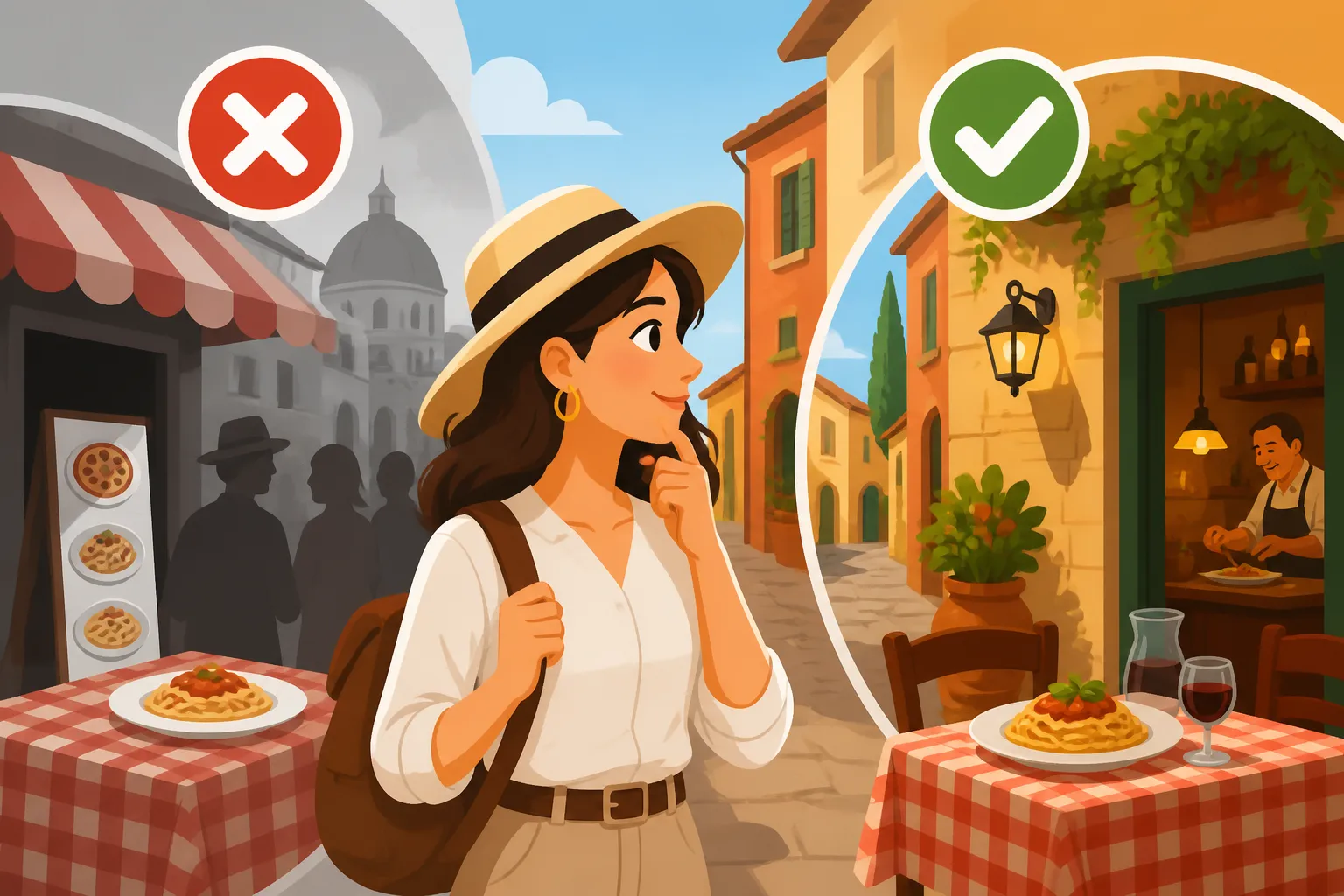
In my early days in Rome, I made the mistake of thinking a menu with photos of the pasta was helpful. In reality, it is a glaring warning sign. Authentic Italian kitchens take immense pride in the freshness of their ingredients, and their menus are often printed daily on simple sheets of paper or handwritten on a chalkboard. A permanent, laminated menu featuring faded photos of "Spaghetti Carbonara" or "Pizza Margherita" usually indicates that the food is standardized, likely pre-prepared, and aimed at people who do not know what the dish is supposed to look like.
Furthermore, keep an eye out for the "Menu Turistico" or "Tourist Menu." This is a fixed-price deal that usually includes a primo (first course), a secondo (second course), a side dish, and a drink for a seemingly low price. While it looks like a bargain, the quality is almost universally lower than what you would receive if you ordered a la carte. If you see a sign outside translated into five different languages—especially if the English is perfect but the Italian is sparse—it is a sign that the restaurant is not courting the locals.
Location and the Presence of the Buttafuori
There is a direct correlation between the proximity of a restaurant to a major monument and the likelihood that it is a trap. If you can see the Colosseum or the Duomo of Florence from your table, you are likely paying a "view tax" of at least 30% on your meal. While there are a few exceptions, most high-quality eateries are tucked away in the side streets, where the rent is lower and the chef has to rely on the quality of the food rather than foot traffic.
Perhaps the most aggressive red flag is the "buttafuori," or the tout standing outside the door. If a man in a waistcoat is holding a menu and trying to lure you inside with phrases like "best pasta in town" or "hey my friend, come in," keep walking. An authentic trattoria or osteria does not need to beg for customers. In fact, many of the best spots in the country barely have a sign at all, and they certainly do not have staff members accosting passersby.
Hours of Operation and the "Non-Stop" Kitchen
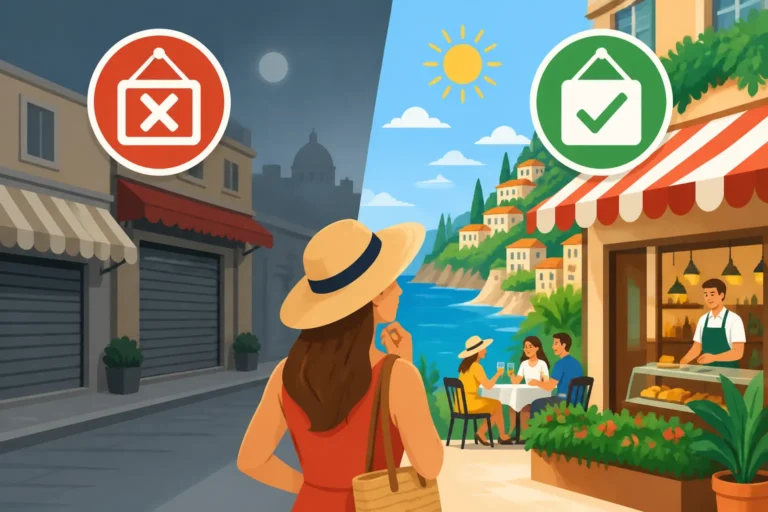
Italians are very protective of their dining hours. Lunch is typically served from 12:30 PM to 2:30 PM, and dinner rarely begins before 7:30 PM, with peak service at 8:30 PM or 9:00 PM. If you walk past a restaurant at 5:00 PM and people are sitting down to full meals, you have found a tourist trap. Authentic places often close their kitchens between 3:00 PM and 7:00 PM to prep for the evening service. A sign that says "No Stop" or "Open All Day" is a signal that the restaurant has prioritized convenience for tourists over the traditional rhythms of Italian Food Culture: Eating Well as a Visitor.
The Secret Language of Authentic Italian Eateries
Understanding the different types of dining establishments is crucial for managing your expectations. Not every place to eat is a "ristorante," and knowing the distinctions can help you find exactly the kind of atmosphere and price point you are looking for. When you are traveling between regions, perhaps using Omio to book your train tickets, you will notice that these definitions can shift slightly, but the core principles remain the same.
Trattoria vs. Osteria vs. Ristorante
A Ristorante is typically the most formal option. You can expect white tablecloths, a professional sommelier, and a more extensive, refined menu. While many are excellent, this is also the category where you are most likely to find "fine dining" traps that are long on presentation but short on traditional soul.
A Trattoria is traditionally a family-run establishment. The decor is simpler, the service is more casual, and the food is focused on regional classics. This is the sweet spot for authenticity. In a real trattoria, you might see the grandmother in the back making pasta by hand. These are the places where you should look for the Regional Trains in Italy: How to Use Them and Save tips to reach smaller towns where the trattoria culture is at its peak.
An Osteria was originally a place that served wine and simple snacks, often where locals could bring their own food. Today, they are essentially casual bistros. They usually have a short, focused menu that changes daily based on what the market had to offer that morning. If you want a glass of local wine and a plate of house-made ragù, the osteria is your best bet.
The Importance of the Menù del Giorno and Seasonality
Authentic Italian cooking is hyper-seasonal. If you see "Pasta with Zucchini Flowers" on a menu in December, it is a sign that the restaurant is using frozen or imported produce. Real local spots will have a "Menù del Giorno" (Menu of the Day), which reflects what is currently in season. In Rome, this means artichokes in the spring; in the north, it means truffles and mushrooms in the autumn.
Before you sit down, a quick glance at the Italian Regional Cuisine: How Food Changes Across Italy can help you understand what dishes should be on the menu in a specific area. If a restaurant in Venice is pushing "Bistecca alla Fiorentina" (a Florentine steak), they are catering to tourists who want a "best of Italy" experience rather than a real Venetian one. Authentic places stick to what they know best: their own backyard.
Identifying the Coperto and Local Wine Lists
In Italy, the "coperto" is a standard cover charge that ranges from 1 to 3 Euros per person. This is not a scam; it covers the bread, the tablecloth, and the service. It is a fundamental part of Italian Customs, Etiquette, and Social Life. If you see a restaurant that advertises "No Cover Charge" in big letters, it is often a ploy to attract tourists who have read online complaints about the fee.
Additionally, look at the wine list. An authentic local spot will prioritize the "Vino della Casa" (house wine) from the surrounding hills. If the only wine options are expensive branded bottles or if the wine list is dominated by international grapes like Chardonnay and Merlot, you are likely in a place that caters to global palates rather than local tradition.
| Feature | Tourist Trap | Authentic Local Gem |
|---|---|---|
| Menu Presentation | Laminated, photos of food, 5+ languages | Paper or chalkboard, Italian only (or simple English) |
| Dining Hours | Open all day ("No Stop") | 12:30–2:30 PM and 7:30–10:30 PM |
| Staff Presence | Touts (buttafuori) outside the door | Staff busy serving inside; no one outside |
| Location | Next to major sights/main piazzas | Side streets, residential neighborhoods |
| Seasonality | Same dishes year-round | Menu changes with the market seasons |
| Price Signal | "Fixed Price Tourist Menu" signs | Daily specials listed on a board |
Practical Strategies for Finding Local Favorites
Now that you know what to avoid, how do you actually find the hidden gems? It requires a bit of digital savvy and a willingness to explore the neighborhoods where people actually live. If you are staying in a central hotel booked through Booking.com, your instinct might be to eat nearby, but a ten-minute walk can make a world of difference.
Digital Tools and Cross-Referencing Reviews
While TripAdvisor and Google Reviews are helpful, they are often dominated by fellow tourists. To find where the locals eat, look for reviews written in Italian. You don't need to be fluent; just look for keywords like "casereccio" (home-style), "tradizione" (tradition), or "onesto" (honest/fair-priced). If a restaurant has 2,000 reviews and they are all in English, it is a tourist hub. If it has 300 reviews and 80% are in Italian, you have found a winner.
Another great strategy is to use GetYourGuide to book a local food tour early in your trip. A professional guide can point out the specific stalls and trattorias that they frequent themselves, giving you a list of vetted options for the rest of your stay. This is particularly useful for learning How to Eat Like a Local in Italy: Meal Structure and Timing, which can be confusing for first-timers.
The "Three-Block" Rule and Residential Scouting
The "Three-Block Rule" is a simple but effective technique: never eat within three blocks of a major tourist attraction. If you are at the Trevi Fountain, walk three blocks in any direction away from the water. The crowds will thin out, the noise will drop, and the prices will follow. Look for streets that have hardware stores, pharmacies, or local grocery shops. If people are doing their daily chores on that street, they probably eat there too.
Pay attention to the signage of other businesses. If you see a "Latteria" (dairy shop) or a "Panificio" (bakery) nearby, the restaurants in that area are likely serving the people who work in those shops. This is where you will find the most Authentic Italian Social Customs: Greetings, Gestures, and Personal Space, as the diners are often neighbors who have known each other for decades.
Following the Locals (and the Silence)
If you are unsure where to go at 1:00 PM or 8:30 PM, look for a group of Italians. Specifically, look for workers in blue-collar uniforms or office workers in suits. If you see a crowd of locals waiting outside a non-descript door, join them. Italians will not wait in line for bad food.
Another subtle cue is the sound level. Tourist traps are often loud with international pop music or "Italian-style" accordion music played by street performers. Authentic spots are filled with the sound of clinking silverware and the hum of Italian conversation. They don't need music to create an atmosphere; the food and the company provide all the "vibes" necessary. Once you find these spots, you can truly enjoy the Italian Wine, Coffee, and Aperitivo Culture without feeling like you are part of a theme park.
Regional Specifics: Where to Look in Major Cities
Every city has its own "safe zones" for food. In Rome, the neighborhood of Testaccio is the historic heart of Roman cuisine, far from the polished tourist center. In Florence, cross the Arno river to the Oltrarno district; as you move further from the Ponte Vecchio, the quality of the "osterie" rises significantly. In Venice, avoid the area around San Marco and the Rialto Bridge and head to Cannaregio or Castello, where you can find "cicchetti" (Venetian tapas) bars filled with locals.
When exploring these neighborhoods, don't be afraid to walk into a place that looks "too simple." Some of the best meals I’ve had in Italy were served on paper placemats in rooms with fluorescent lighting. In Italy, the focus is on the plate, not the wallpaper. If the place is full of Italians and the smell of garlic and olive oil is wafting from the kitchen, you are in the right place. Understanding How to Order Food and Drinks in Italian: A Practical Phrasebook will also give you the confidence to step into these less-touristy establishments where English might not be the primary language spoken.
Disclaimer
The information provided in this guide is based on personal experience and local cultural norms in Italy. While these strategies significantly increase your chances of finding authentic dining experiences, restaurant quality can change over time. This guide is for informational purposes only and does not guarantee a specific dining outcome. Always use your best judgment and be respectful of local customs when visiting independent establishments.