Rome to Perugia: Reaching Umbria by Rail and Coach
Oh, Italy! The land of ancient history, incredible food, and, let's be honest, sometimes a bit of a head-scratcher when it comes to getting from point A to point B. If you've spent any time in Rome, you know its chaotic charm, but sometimes you just need to escape the urban whirlwind. That's where Perugia, the stunning capital of Umbria, comes in. This guide is going to walk you through exactly how to make that journey by train and coach, making it as smooth as a fresh gelato.
Disclosure: This post may contain affiliate links. We may earn a commission at no extra cost to you if you make a purchase through these links. Read full disclosure.
Embracing the Green Heart: Why Perugia is Your Next Escape
After the dazzling, yet often overwhelming, experience of Rome, many expats and tourists yearn for a change of pace, a breath of fresh air, and perhaps a bit more… green. That's precisely what Perugia offers. Nestled in the rolling hills of Umbria, often lovingly called the "Green Heart of Italy," Perugia is a medieval jewel box, rich in history, art, and a vibrant local culture that feels distinct from its more famous Tuscan neighbors.
The Undeniable Appeal of Perugia
Perugia isn't just another pretty Italian town; it's a living, breathing university city with an ancient Etruscan core. Imagine strolling through narrow, winding alleyways, suddenly emerging into grand piazzas like Piazza IV Novembre, dominated by the magnificent Fontana Maggiore and the Gothic Palazzo dei Priori. The views are spectacular, the pace is slower, and the feeling is authentically Italian. For those who've been exploring cities like Rome for a while, it’s a refreshing change, offering quiet moments alongside lively student life. You'll find yourself wondering why you didn't venture here sooner. It's a fantastic hub for further exploration of Umbria, too, with places like Assisi and Orvieto just a short hop away.
What Awaits You in Umbria's Capital
Beyond its stunning aesthetics, Perugia is famous for its chocolate, hosting the annual Eurochocolate festival, and for its jazz festival, Umbria Jazz, which draws international crowds. It's a place where you can dive into history at the Rocca Paolina, an underground fortress, or explore the Galleria Nazionale dell'Umbria, home to masterpieces of Umbrian art. The food scene, while still distinctly Italian, leans into local specialties like wild boar and truffles, offering a delightful culinary journey. Moving to a new region also means understanding the nuances of local culture and public services, much like learning to navigate everyday life when you first moved to Italy, which can sometimes feel like a puzzle.
Navigating the Rails: Rome to Perugia by Train
Ah, Italian trains! They can be a source of endless fascination, occasional frustration, and ultimately, a fantastic way to see the country. Traveling by train from Rome to Perugia is a popular and generally reliable option, offering scenic views as you leave the busy capital behind and venture into the Umbrian countryside.
Choosing Your Train and Route
When you're heading from Rome to Perugia by train, you'll almost exclusively be relying on Trenitalia, Italy's national railway company. Unlike some other routes, the high-speed Frecce trains don't go directly to Perugia, as it's not on their main network. This means you'll typically be taking a regional train (Regionale) or an Intercity train.
Your journey will usually start from Rome's main station, Roma Termini. From there, you'll look for direct trains or those with a single change. Many direct trains from Termini will take you straight to Perugia Fontivegge, which is the main train station in Perugia, located in the lower part of the city. Sometimes, especially if direct options are limited, you might find a route that involves a change at places like Foligno or Terontola-Cortona. Don't worry, these connections are usually quite straightforward. The key is to check the route carefully when booking. This is where services like Omio really shine, as they show you all the available routes, including any changes, in a clear and concise way, letting you compare journey times and prices effortlessly.
The Journey and What to Expect
A direct train journey from Rome Termini to Perugia Fontivegge typically takes anywhere from 2 hours to 2 hours 45 minutes, depending on the number of stops the regional train makes. Intercity trains might be a little faster or have fewer stops, but the difference isn't usually dramatic for this route.
- Comfort: Regional trains are perfectly comfortable for this duration. They might not have all the bells and whistles of high-speed trains, but they're clean, have decent seating, and usually offer lovely views. You'll pass through quaint towns, tunnels, and lush agricultural land.
- Tickets: You can buy tickets at the station from ticket counters or self-service machines, or more conveniently, online. When booking on a platform like Omio, you get an e-ticket, so there's no need to print anything or worry about validating a physical ticket at the station (a common pitfall for foreigners using regional trains in Italy!). Just show your digital ticket on your phone.
- Arrival in Perugia: Perugia Fontivegge station is a hub, but it's not right in the historic center. From Fontivegge, you'll need to take a local bus (several lines, like E001 or E003, go uphill) or, for a truly unique experience, hop on the "Minimetrò." The Minimetrò is an automated people mover that whisks you from Fontivegge up to the historic center in minutes, offering several stops along the way. It's an efficient and fun way to reach the upper city, with the final stop, Pincetto, putting you right near the heart of the action. You'll need to purchase a separate ticket for the Minimetrò or local bus, usually from a tabaccheria or newsstand.
For those planning an extensive trip throughout Italy, understanding the nuances of different regional transport systems is crucial, similar to knowing how to navigate High-Speed Trains in Italy: Trenitalia, Italo, Routes, and Savings or even just Getting Around Italian Cities: Metro, Tram, and Buses in general.
Hitting the Road: Rome to Perugia by Coach
While trains offer a classic Italian travel experience, coaches (buses) are often a fantastic alternative, especially for routes like Rome to Perugia. They can sometimes be more direct, more frequent, or even more budget-friendly, depending on your travel date and time.
Popular Coach Services and Departure Points
The main coach companies operating between Rome and Perugia are Flixbus and Sulga. These services are generally modern, comfortable, and reliable.
- Flixbus: This is a major player in European coach travel. Flixbus coaches are identifiable by their bright green branding and typically offer Wi-Fi, power outlets, and comfortable seating. In Rome, Flixbus often departs from Tiburtina Bus Station (Stazione Tiburtina Autostazione), which is easily accessible by metro (B line) from Termini. Some services might also depart from other locations, so always double-check your ticket.
- Sulga: Sulga is an Italian company that has long served the Rome-Perugia route. Their coaches are also comfortable, though perhaps a bit less modern than Flixbus on some routes. Sulga also typically departs from Roma Tiburtina Bus Station.
Both companies will drop you off at key locations in Perugia. Flixbus often uses Perugia Piazzale Umbria Jazz or Piazza Partigiani, while Sulga usually arrives at Piazza Partigiani.
The Coach Journey Experience and Arrival
The coach journey from Rome to Perugia usually takes around 2 hours 30 minutes to 3 hours, which is quite comparable to the train, sometimes even a little faster depending on traffic.
- Comfort and Amenities: Modern coaches offer reclining seats, air conditioning, and usually a restroom on board. Flixbus, in particular, prides itself on offering free Wi-Fi and charging ports, which can be a lifesaver for staying connected or keeping your devices charged. It's a great option for relaxing, catching up on emails, or just enjoying the roadside scenery.
- Tickets: Booking your coach tickets in advance, especially for popular times, is highly recommended. Websites like Omio allow you to compare prices and schedules for both Flixbus and Sulga, alongside train options, all in one place. You can book directly, and your e-ticket will be sent to your phone, making the boarding process incredibly smooth. No need to worry about printing or looking for a specific ticket booth – just show your digital ticket to the driver.
- Arrival in Perugia:
- Piazza Partigiani (Autostazione): This is the main bus station in Perugia, conveniently located just outside the historic center, connected by escalators and the Minimetrò (via the Cupa station, which is a short walk). It's incredibly well-integrated for reaching the upper city.
- Piazzale Umbria Jazz: This stop is a bit further out from the city center, typically used by Flixbus. From here, you'll likely need to take a local bus or a taxi to reach the historic center or your accommodation. Always check your exact drop-off point when booking to plan your onward journey.
Just like with trains, knowing the ins and outs of coach travel can save you a lot of hassle. If you're used to Intercity Buses in Italy: FlixBus and Regional Networks, you'll find this route quite familiar.
Choosing Your Ride: Train vs. Coach for Perugia
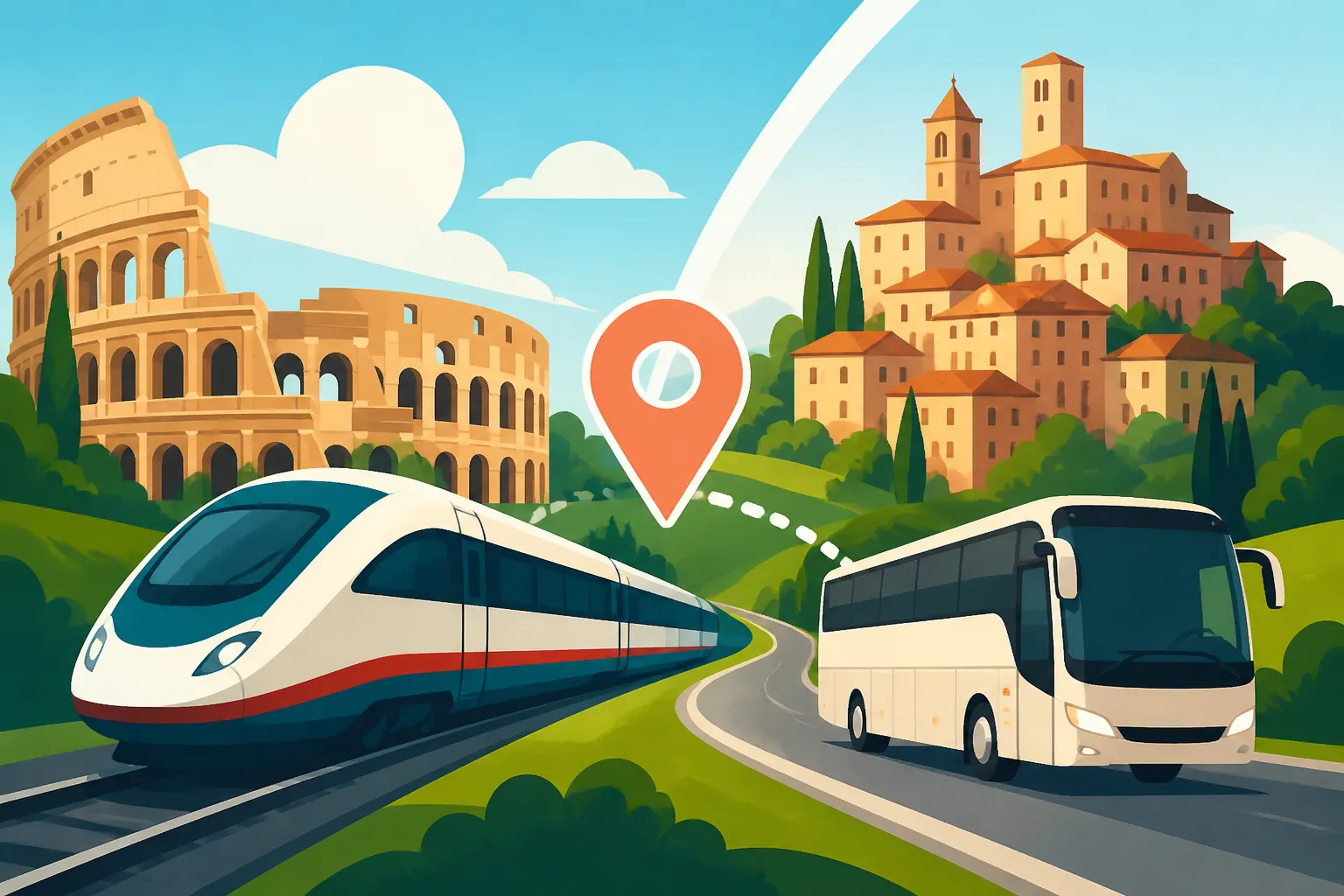
Deciding between taking the train or a coach from Rome to Perugia often comes down to personal preference, budget, and specific travel needs. Both offer unique advantages, and understanding these can help you pick the best option for your trip.
Head-to-Head Comparison: Train vs. Coach
Let's break down the key differences to help you make an informed decision:
| Feature | Train (Trenitalia) | Coach (Flixbus, Sulga) |
|---|---|---|
| Departure Point | Roma Termini (central) | Roma Tiburtina Autostazione (well-connected by metro) |
| Arrival Point | Perugia Fontivegge (connected to Minimetrò) | Perugia Piazza Partigiani (central) or Piazzale Umbria Jazz (outer) |
| Journey Time | ~2 hours – 2 hours 45 mins (direct) | ~2 hours 30 mins – 3 hours (traffic dependent) |
| Cost Range | Typically €15-€25 (Regional/Intercity) | Typically €9-€20 (can vary significantly with booking) |
| Comfort | Standard regional train seating, good legroom | Reclining seats, Wi-Fi, power outlets (especially Flixbus) |
| Scenery | Excellent, panoramic views of Umbrian countryside | Good, but can be limited by roadside views |
| Frequency | Decent, but less frequent than high-speed routes | Multiple departures daily, often a good range |
| Flexibility | Less sensitive to road traffic | Can be affected by traffic, especially leaving Rome |
Practical Considerations for Your Trip
- Budget: Coaches are generally the more budget-friendly option, especially if you book well in advance. You can often snag tickets for as low as €9-€12 on Flixbus if you're flexible with your travel times. Train tickets for this route are also reasonably priced, but less prone to extreme fluctuations.
- Convenience: The train departs from the very central Roma Termini, which can be a plus if you're staying near the historical center. However, Tiburtina, the main coach hub, is also very well-connected by Rome's metro system. In Perugia, both arrival points require a short onward journey to the historic center, but the Minimetrò from Fontivegge (train) or the escalators/Minimetrò from Piazza Partigiani (bus) make it easy.
- Experience: If you love the romance of rail travel and want to lean back and enjoy the views without worrying about traffic, the train is a great choice. If you prioritize amenities like Wi-Fi and charging ports, or are simply looking for the most economical option, the coach often wins out.
- Booking Ease: This is where platforms like Omio really prove their worth. Instead of visiting multiple websites or navigating potentially confusing Italian train station kiosks, you can simply input your origin (Rome) and destination (Perugia) on Omio. It will then display all available train and coach options, allowing you to filter by time, price, and even compare the total journey duration, including potential changes. This means you can swiftly compare a Trenitalia regional train against a Flixbus coach, see which one fits your schedule and budget best, and book your ticket in a matter of clicks. They handle all the currency conversions and provide clear e-tickets. It's truly a game-changer for international travelers in Italy. You can even use it to explore your options for Getting Around Italy: Trains, Buses, Flights, and Car Hire on a broader scale.
No matter your choice, ensure you have your essential travel documents ready. For peace of mind, it's also worth looking into Travel Insurance for Trips to and Within Italy if you haven't already.
Seamless Booking with Omio: Your Travel Companion
In the grand scheme of Italian travel, where bureaucracy can often feel like an intricate dance, having a straightforward way to book your transport is a blessing. This is precisely why Omio stands out as an invaluable tool for your Rome to Perugia journey, and indeed, for navigating travel across Italy and beyond.
Why Omio Makes a Difference
Think about it: you've just landed in Rome, you're probably jet-lagged or still buzzing from the Colosseum, and now you need to figure out the best way to get to Perugia. Do you go to Trenitalia's site? Flixbus's? What about comparing them side-by-side? That's a lot of tabs, a lot of language switching, and frankly, a lot of unnecessary stress.
Omio pulls all that information into one user-friendly interface. It's designed specifically for travelers who want to compare and book trains, buses, and even flights for European destinations. For your Rome to Perugia trip, it means:
- Comprehensive Search: Enter "Rome" to "Perugia," and Omio immediately shows you all the available train services from Trenitalia and coach options from Flixbus and Sulga. No need to visit multiple carrier websites.
- Clear Comparisons: See prices, journey times, and departure/arrival points for all options, side-by-side. This visual comparison makes it incredibly easy to pick the solution that best fits your budget and schedule. Need to be in Perugia by a certain time? Filter by arrival time. Want the cheapest ticket? Sort by price.
- Easy Booking: Once you've chosen your preferred option, you can book and pay directly through Omio in your preferred currency. The process is smooth and secure.
- Digital Tickets: Say goodbye to paper tickets and the fear of losing them. Your tickets are sent directly to your email and are accessible in the Omio app, ready to be shown on your phone when you board. This eliminates any confusion about validating tickets, which, as many expats know, can be a minor headache on regional Italian trains if you forget.
- Multi-Modal Planning: Beyond just this route, Omio helps you plan more complex itineraries, combining different modes of transport across Europe. This holistic approach simplifies travel planning immensely.
Essentially, Omio takes the guesswork and the heavy lifting out of booking your journey, giving you more time to savor that last Roman coffee or plan your first truffle-infused meal in Perugia. It's the digital assistant you didn't know you needed, but won't want to travel without. So, when you're ready to make the leap from the Eternal City to the Green Heart, remember that finding and booking your tickets is just a few clicks away with Omio.
Disclaimer
Please remember that travel information, schedules, and prices can change. While every effort has been made to provide accurate and up-to-date details, it is always recommended to double-check information with the respective transport providers or a reliable booking platform like Omio before making your travel arrangements. Local transport options in Perugia (Minimetrò, local buses) are separate services and require their own tickets.