Why do I need a permesso di soggiorno after a visa?
Discover why securing an Italian visa is only the first step in your relocation journey. This comprehensive guide explains the crucial difference between an entry visa and a residence permit, detailing the mandatory eight-day application rule and your residency rights.
Disclosure: This post may contain affiliate links. We may earn a commission at no extra cost to you if you make a purchase through these links. Read full disclosure.
Introduction
The confusion surrounding the Italian immigration system primarily stems from a misunderstanding of how international travel laws intersect with domestic security and residency laws. In many Western countries, a visa serves as both your permission to enter the country and your permission to reside there for the duration of your stay. Italy, alongside most of the European Union, separates these two functions into two distinct legal and administrative processes managed by completely different branches of the government.
Your entry visa was processed and issued by the Italian Ministry of Foreign Affairs through its network of embassies and consulates abroad. Its sole purpose was to verify that you met the initial criteria to travel to Italy. However, once you physically cross the border and step onto Italian soil, you fall under the jurisdiction of the Italian Ministry of the Interior, specifically the State Police and local municipal authorities. These domestic authorities need to know exactly who is living within their borders, where they are sleeping, and what they are doing.
The permesso di soggiorno, which translates directly to “permit of stay” or residence permit, is the physical manifestation of your legal right to inhabit the country. Without it, your initial visa quickly becomes meaningless. In this extensive guide, we will break down the fundamental differences between an entry visa and a residence permit, explore the rigid timeline you must follow upon arrival, and detail the severe legal and practical consequences of failing to secure this vital document. We will also examine the wealth of civic and social rights that the residence permit unlocks, transforming you from a temporary visitor into a fully integrated Italian resident.
The Legal Distinction Between an Entry Visa and a Residence Permit
To truly understand why both documents are necessary, it is helpful to look at the specific functions they serve and the different authorities that issue them.
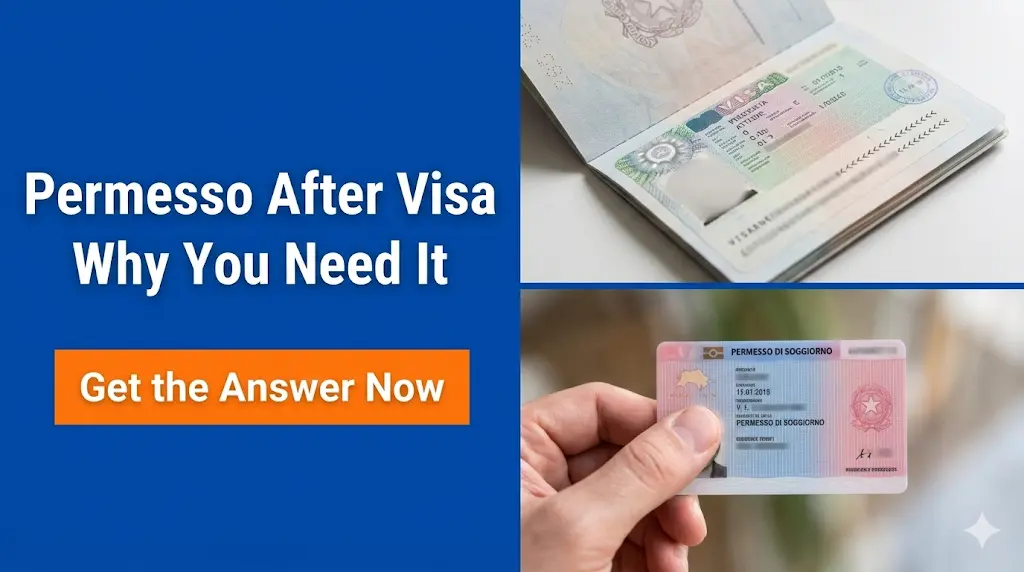
An Italian visa is a sticker affixed to a page in your passport. It is issued prior to your travel by an Italian diplomatic mission in your country of origin or legal residence. The visa evaluates your eligibility based on the specific purpose of your trip—be it for higher education, corporate employment, family reunification, or retirement. It specifies a “validity period,” which dictates the window of time during which you are allowed to enter Italy. Think of the entry visa as a movie ticket; it gets you past the ticket taker at the front door.
The permesso di soggiorno, on the other hand, is a physical, biometric plastic card that resembles a standard driver’s license or identification card. It contains an embedded microchip holding your digital fingerprints, a high-resolution photograph, and your specific personal data. This document is issued exclusively from within Italy by the Questura, which is the provincial headquarters of the Italian State Police.
If the visa is the movie ticket that gets you through the front door, the residence permit is the backstage pass that allows you to remain in the building, interact with the staff, and use the facilities. While your visa might be valid for 365 days, Italian law dictates that the visa itself does not authorize a continuous, unregulated stay. The residence permit supersedes the visa, acting as the ultimate domestic authority on your legal status, your right to access public funds, and your timeline for remaining in the country. If you want to understand the foundational document itself, you should read our comprehensive guide on the Italian Residence Permit (Permesso di Soggiorno) Explained.
Why Consulates Cannot Issue Residence Permits
A common follow-up question from frustrated expats is: “If the residence permit is so important, why couldn’t the consulate just issue it to me before I left my home country?”
The answer lies in national security, domestic resource allocation, and international law. An embassy or consulate operating on foreign soil does not have the administrative capacity or the legal authority to enroll individuals into domestic Italian databases. Furthermore, the issuance of a biometric residence permit requires physical fingerprinting and photographing that must be securely uploaded directly to the Ministry of the Interior’s central servers in Rome.
Additionally, the Italian government uses the residence permit process to verify that you actually followed through on the plans you stated in your visa application. For example, if you were issued a student visa, the police want to verify that you actually arrived in Italy and enrolled in the university you claimed you would attend. If you were issued a work visa, the police want to ensure you have formally signed your employment contract and secured safe, sanitary housing. The residence permit acts as a domestic compliance check, ensuring that foreign nationals are abiding by the specific terms of their immigration status.
The Strict Eight Day Rule for New Arrivals
The single most critical piece of information any new arrival to Italy must know is the “otto giorni” rule. Italian immigration law, specifically the Consolidated Act on Immigration, explicitly mandates that any non-European Union citizen entering Italy on a long-stay National Visa (Type D) must initiate their application for a permesso di soggiorno within exactly eight working days of crossing the border.
Calculating the Eight Days
The clock starts ticking the moment you enter the Schengen Area. The eight days are defined as “working days” (giorni lavorativi), which means you do not count Sundays or major national public holidays, but you generally must count Saturdays.
Proving Your Date of Entry
If you flew directly from a non-Schengen country (for example, a direct flight from New York to Rome), your passport will be stamped by Italian border police. This stamp serves as the official start of your eight-day countdown.
However, a major complication arises if you transit through another European country. If you fly from New York, layover in Paris, and then fly to Rome, your passport will be stamped in Paris by French border control. Because there are no routine passport checks on flights between France and Italy, you will not receive an Italian entry stamp. In this scenario, you must declare your presence in Italy within eight days. You can usually do this by submitting a formal Declaration of Presence (Dichiarazione di Presenza) to the local border police, or simply by submitting your residence permit application at the post office within eight days of the French stamp. Keeping your physical boarding passes as proof of your arrival date in Italy is highly recommended.
What Happens If You Do Not Apply for the Permit
Ignoring the eight-day rule or simply assuming your visa is sufficient is one of the most dangerous mistakes an expatriate can make. Failing to apply for a residence permit nullifies your legal status in the country, regardless of what the visa sticker in your passport says.
If the eight-day window passes and you have not submitted an application, you are technically considered an irregular migrant, or in Italian legal terms, a “clandestino.” The consequences of falling into this status are severe and immediate:
- Deportation and Bans: If you are stopped by law enforcement for a routine check and cannot produce either a valid residence permit or the postal receipt proving you applied for one, you can be issued a formal expulsion order (Foglio di Via). You will be forced to leave Italy and may face a multi-year ban from re-entering the entire Schengen Area.
- Inability to Renew: A visa cannot be renewed from within Italy. When your initial entry visa expires, the only way to legally remain in the country is by renewing your residence permit. If you never applied for the initial permit, you have nothing to renew, and you will be forced to return to your home country to start the arduous visa process entirely from scratch.
- Complete Administrative Paralysis: As we will explore in the next section, modern Italian society is built upon a foundation of linked databases. Without a residence permit, you will be entirely blocked from functioning in the local economy.
Core Rights Unlocked by the Residence Permit
The requirement to hold a permesso di soggiorno is not merely a punitive tracking measure; it is the master key that unlocks your civic, social, and economic rights within the Italian Republic. Your entry visa is virtually useless for domestic administrative tasks. Here is exactly why you need the permit to survive in Italy.
Establishing Official Residency and Identity
In Italy, there is a distinct legal difference between being physically present in the country and being an official “resident.” To become a legal resident, you must register your address with the local town hall (Comune) in a process known as Iscrizione Anagrafica. The municipal clerk will not allow you to register your residency using an entry visa. You must present a valid residence permit or the official receipt proving you have applied for one.
Once you are registered with the Comune, you can obtain a Carta di Identita (Italian Identity Card). This card is heavily relied upon for daily life, domestic flights, and signing legal contracts. Furthermore, establishing formal residency is the first step toward eventually qualifying for permanent residency or Italian citizenship. For a deeper dive into managing local municipal affairs, you should explore our guide on Navigating Italian Bureaucracy: Comune and Prefettura.
Accessing the National Healthcare System
Italy boasts a highly ranked public healthcare system, the Servizio Sanitario Nazionale (SSN). Access to this system provides you with a primary care physician, subsidized prescription medications, and free emergency hospital care. To enroll in the SSN and receive your Tessera Sanitaria (Health Card), the local health authority (ASL) requires proof of your legal immigration status. Your entry visa is entirely insufficient for this purpose. You must present your residence permit documentation to secure your health rights. If you need step-by-step instructions on securing your medical coverage, read How to Register for Italian Healthcare (SSN) as a Foreigner.
Employment, Taxation, and Banking
If you moved to Italy on a work visa, your employer cannot legally finalize your permanent payroll status or pay your social security contributions (INPS) without a copy of your residence permit. The permit proves to the Ministry of Labor that you are authorized to earn an income.
Similarly, due to strict European anti-money laundering regulations, Italian banks are legally prohibited from opening a standard resident checking account for a foreign national who cannot produce a residence permit. Without a bank account, you cannot easily pay utility bills, set up a local internet connection, or receive your monthly salary.
Visa vs Residence Permit Comparison
To clearly illustrate why the visa alone is insufficient, we have compiled a comparison table highlighting the distinct functions and limitations of both documents.
| Feature | Italian Entry Visa | Permesso di Soggiorno |
| Issuing Authority | Italian Embassy / Consulate (Abroad) | Questura / State Police (In Italy) |
| Primary Function | Permission to cross the border | Permission to live and reside |
| Format | Paper sticker in the passport | Biometric smart plastic card |
| Schengen Travel | Limited by the 90/180 day rule | Allows travel to other Schengen states |
| Renewability | Cannot be renewed from within Italy | Can be renewed at the local Questura |
| Civic Access | Cannot be used for healthcare or banking | Mandatory for healthcare, banking, IDs |
The Application Journey The Kit Giallo
Understanding why you need the permit is one thing; navigating the process to actually get it is another. The application process is a rite of passage for every expatriate in Italy.
For the vast majority of visa categories—including study, subordinate work, self-employment, and family reunification—the application process begins at the Italian Post Office (Poste Italiane). You must locate a post office equipped with a “Sportello Amico” counter and ask for a “Kit Giallo” (Yellow Kit).
This large yellow envelope contains extensive, complex forms written entirely in bureaucratic Italian. You must fill out the forms with a black pen, detailing your personal history, your housing situation, and the specifics of your visa. You must then compile a massive dossier of photocopies, including every page of your passport, your visa, your health insurance policy, and your financial statements.
You do not mail this envelope yourself. You must hand it, unsealed, to the postal worker at the Sportello Amico. The worker will verify your identity, process the application electronically, and charge you the associated government fees. These fees typically include a 16-euro Marca da Bollo (revenue stamp), a 30-euro postal service fee, and a card printing fee that ranges from 40 to 100 euros depending on the duration of your permit.
The Fingerprinting Appointment at the Questura
Submitting the Yellow Kit at the post office is only the first phase. The postal worker will hand you a printed letter featuring the date, time, and location of your mandatory appointment at the Immigration Office of the local Questura.
Depending on the city you live in, this appointment could be scheduled for a few weeks or up to six months in the future. On the day of your appointment, you must bring all the original documents that you submitted as photocopies in the Yellow Kit, along with four identical passport-sized photographs.
At the Questura, a police officer will scrutinize your documents, scan your digital fingerprints, and take your photograph. Once this appointment is successfully completed, your file is sent for final approval, and you enter the final waiting period for your plastic biometric card to be printed by the central mint in Rome.
The Power of the Postal Receipt or La Ricevuta
Because the Italian immigration system is heavily backlogged, it is incredibly common to wait anywhere from three to eight months to receive your physical plastic residence permit. This long wait time frequently causes panic among new expats who fear their entry visa will expire before the permit arrives.
Fortunately, the Italian government has a legal mechanism to protect you. When you submit your Yellow Kit at the post office, the postal worker hands you a receipt, known in Italian as “la ricevuta.” This flimsy, unassuming piece of paper—which features a hologram and a unique tracking barcode—is arguably the most important document you will possess during your first year in Italy.
The postal receipt acts as your temporary residence permit. By law, it guarantees your legal status in Italy even after your initial entry visa has completely expired.
What You Can Do With the Receipt
Holding the postal receipt allows you to legally remain in Italy without fear of deportation. It allows you to begin working if you entered on a work visa, and it allows you to enroll in the public healthcare system on a provisional basis. It is recognized by landlords for signing rental contracts and by municipal offices for beginning your residency registration.
The Travel Limitations of the Receipt
While the receipt protects you inside Italy, it has severe limitations regarding international travel. You cannot use the postal receipt to travel freely across the Schengen Area. If you want to fly home to the United States or the United Kingdom while waiting for your plastic card, you may only take direct flights. If you attempt to layover in another Schengen country—such as Germany or France—with an expired visa and only an Italian postal receipt, border guards in those countries may refuse you entry or detain you, as they are not obligated to recognize Italian administrative receipts.
Moving Toward Permanent Residency
The requirement to hold a permesso di soggiorno is an ongoing obligation. Most initial residence permits are valid for either one or two years, depending on your visa type. You must proactively apply to renew your permit at least sixty days before it expires.
However, this cycle of renewals is not eternal. The ultimate goal of the residence permit system is integration. Once you have legally and continuously resided in Italy for a period of five years, and assuming you meet specific income and language requirements, you become eligible to apply for the “Permesso di Soggiorno UE per Soggiornanti di Lungo Periodo.” This is the highly coveted permanent residence card. Once you secure permanent residency, you are no longer tied to the strict conditions of your original visa, you gain unrestricted access to the labor market, and you are exempt from the stressful biennial renewal process.
Conclusion
Understanding why you need a permesso di soggiorno after a visa is fundamental to a successful expatriate experience in Italy. Your visa was the necessary diplomatic tool that allowed you to leave your home country and legally cross the Italian border. The residence permit, however, is your domestic lifeline. It is the legal framework that protects your status, authorizes your presence, and integrates you into the civic infrastructure of the nation.
By respecting the strict eight-day application rule, carefully navigating the Post Office and Questura procedures, and guarding your postal receipt with your life, you can confidently transition from a temporary foreign visitor into a fully fledged, legally secure resident of Italy.
References
Primary sources official
- Ministero degli Affari Esteri e della Cooperazione Internazionale (Ministry of Foreign Affairs) – Visto per l’Italia Portal: https://vistoperitalia.esteri.it/home/en
- Polizia di Stato – Il rilascio del permesso di soggiorno: https://www.poliziadistato.it/articolo/il-rilascio-del-permesso-di-soggiorno
Other helpful sources
- Studio Legale Metta – Italian Residence Permit (Permesso di Soggiorno) Guidelines: https://www.studiolegalemetta.com/
- Expat Network Italy – Navigating the Kit Giallo and Questura Appointments: https://www.expatnetwork.com/italy/
Disclaimer
The information provided in this article is for educational and informational purposes only and does not constitute official legal or immigration advice. Italian immigration laws, visa regulations, and residence permit application procedures are subject to frequent changes by the Italian Ministry of the Interior and local Questura policies. Always consult the official website of the Italian State Police or a certified cross-border immigration attorney for the most current and personalized guidance regarding your specific immigration and residency status.