Digital Nomad vs Remote Work Permits in Italy
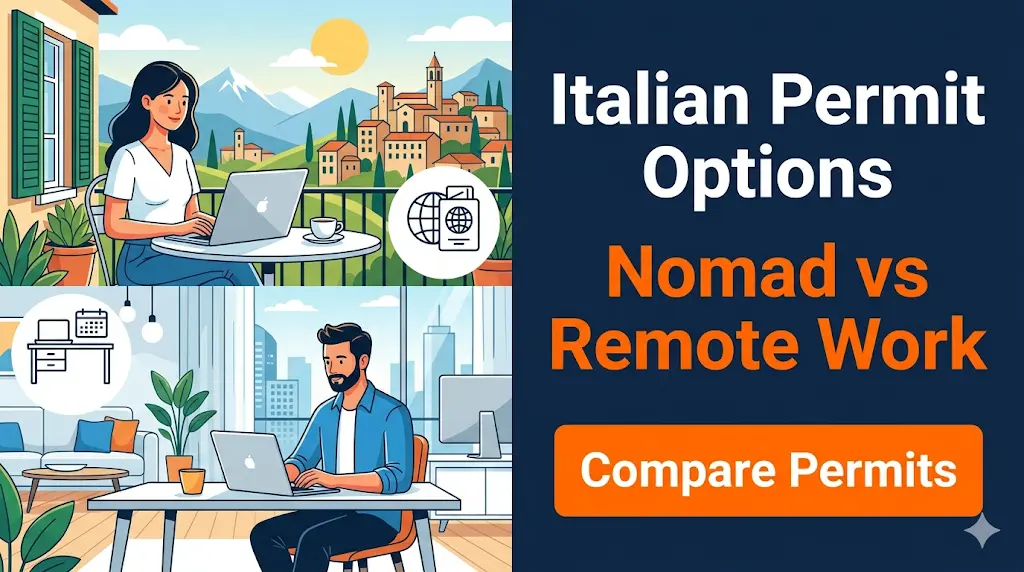
Trying to figure out if you can legally open your laptop in an Italian cafe without violating immigration law is a massive headache. I spent months drowning in contradictory forum posts before finally securing my own remote working setup in Rome. This guide breaks down the exact differences between Italy’s new digital nomad visa and traditional remote work permits.
Disclosure: This post may contain affiliate links. We may earn a commission at no extra cost to you if you make a purchase through these links. Read full disclosure.
The Long-Awaited Italian Digital Nomad Visa
For years, expats wanting to work remotely from Italy existed in a frustrating legal gray area. Many relied on tourist visas, making border runs every 90 days, or subjected themselves to the notoriously difficult self-employment visa process. Then, in 2022, the Italian government officially announced the creation of a dedicated Digital Nomad Visa. However, in true Italian bureaucratic fashion, the implementing decree detailing how to actually apply took two full years to materialize, finally becoming operational in early 2024. Understanding the nuances of this new pathway is critical for anyone looking to legally relocate.
What the New Law Actually Says
The absolute biggest advantage of the Digital Nomad Visa is that it is strictly outside the Decreto Flussi—Italy’s annual quota system that rigidly caps the number of foreign workers allowed into the country. If you meet the legal requirements, you can apply at your local consulate at any time of the year without furiously refreshing a government portal on a designated “Click Day”. Furthermore, unlike traditional work visas, it bypasses the Nulla Osta (security clearance) process, meaning you do not need an Italian entity to sponsor your application from within the country before you apply.
To qualify, you must be a non-EU citizen who is considered a “highly qualified” worker. Under Italian immigration law (specifically Article 27-quater of the Immigration Act), this generally means you possess an advanced university degree (a Master’s degree or equivalent) or have at least five years of demonstrated professional experience in your specific field. This is typically aimed at the tech sector, management consulting, or specialized digital marketing. You can either be a freelancer with clients outside of Italy, or a remote employee of a foreign company. Navigating these dense requirements can feel overwhelming, so reviewing our Checklist: All You Need Before Moving to Italy is highly recommended before you start booking consular appointments. If you are struggling to understand the complex legal jargon in the official government decree, utilizing the advanced reading comprehension modules on ItalianPod101 can be an absolute lifesaver. Deciphering official government Italian is an entirely different skill from ordering a pizza, and ItalianPod101 helps bridge that exact gap so you can read the laws for yourself.
Financial and Legal Requirements for Nomads
The financial bar for the Digital Nomad Visa is intentionally set high to ensure applicants will stimulate the local economy. You must prove an annual income that is roughly triple the minimum level required for exemption from national healthcare participation (currently sitting around €28,000 to €30,000 annually, depending on yearly inflation adjustments). You must also demonstrate that you have comprehensive health insurance valid for the entire duration of your stay. Later, you have the option to buy into the public Servizio Sanitario Nazionale (SSN), but for the initial visa, private coverage is mandatory.
Additionally, you need a signed lease agreement or property deed in Italy. A simple hotel reservation or an Airbnb booking for two weeks will not suffice; the consulate needs to see a registered, long-term housing contract. You will also need to provide a clean criminal record from your home country. One often overlooked requirement is that if you are a remote employee, your foreign company must sign a formal declaration confirming your remote status, outlining your daily duties, and proving their own legal standing. When calling the Italian consulate to verify which specific documents required an apostille, I realized my conversational skills were lacking. Practicing professional telephone dialogues with ItalianPod101 gave me the confidence to clarify exactly what the consulate needed without constantly asking the consular officer to switch to English. It is also worth keeping an eye on Italy’s new digital residency pilot for expats to see if future application processes might move partially online, streamlining these heavy paper requirements.
Traditional Remote Work as a Self-Employed Freelancer (Partita IVA)
If you do not meet the strict “highly qualified” threshold of the Digital Nomad Visa, you are not entirely out of luck. The traditional route for remote workers and freelancers has always been the Lavoro Autonomo (Self-Employment) visa. However, this path is significantly more treacherous and requires a high tolerance for bureaucratic pain.
Navigating the Decreto Flussi Quotas
Unlike the digital nomad route, the standard self-employment visa is heavily restricted by the Decreto Flussi. The Italian government usually allocates a shockingly small number of quotas (often just a few hundred nationwide) for self-employed individuals each year.
To even apply for this visa, you must secure various declarations from the local Italian Chamber of Commerce and the professional registry associated with your specific field. It is a classic “Catch-22”: you need the local business certifications to get the visa, but it is incredibly difficult to obtain those certifications without already being physically present in Italy. If you are trying to figure out how to demonstrate your financial solvency for this route, you must read our detailed breakdown of Acceptable financial proof for Italy self-employment visa. For younger travelers who want to work remotely but avoid this paperwork, exploring alternatives like Working Holiday Visas vs Digital Nomad Visas in Italy might bypass the bureaucratic nightmare entirely, provided your nationality qualifies. I spent weeks trying to understand the Chamber of Commerce regulations, and listening to the business culture podcasts on ItalianPod101 helped me grasp how local professional guilds operate, preventing me from applying for the wrong corporate classification.
The Reality of Opening an Italian Freelance Business
If you successfully secure the Lavoro Autonomo visa and move to Italy, you are legally required to open a Partita IVA (an Italian VAT number). Italy operates on a global taxation system, meaning if you reside in the country for more than 183 days a year, you are an Italian tax resident, regardless of where your clients are located or where your money is deposited.
The silver lining is that Italy offers a remarkably beneficial flat-tax regime for freelancers called the Regime Forfettario. Under this regime, if you earn under €85,000 a year, your income tax rate is reduced to a flat 15% (and sometimes just 5% for the first five years of a brand new business). However, the tax code is incredibly complex, and social security contributions (INPS) can eat up another 26% of your income. You absolutely cannot navigate this alone; you must hire a commercialista (tax accountant). I used the financial vocabulary lessons on ItalianPod101 to prepare for crucial meetings with my accountant. Being able to understand terms like “contributi previdenziali” and “fattura elettronica” (electronic invoice) thanks to ItalianPod101 prevented me from making costly financial mistakes during my first year of freelancing in Rome.
Choosing the Right Path for Your Remote Lifestyle
The choice between the Digital Nomad Visa and the traditional Self-Employment Visa largely comes down to your educational background, your professional timeline, and your income level. If you hold another European passport, you can skip both of these processes entirely; reviewing the Italian visa policy for dual nationals will clarify if your ancestry provides a loophole.
Comparing the Two Options
To help you visualize the core differences between these two distinct immigration pathways, refer to the comparison table below:
| Feature | Digital Nomad Visa | Self-Employment Visa (Lavoro Autonomo) |
| Quota System | Exempt (Apply anytime at the consulate) | Subject to strictly limited Decreto Flussi quotas |
| Qualification Needed | “Highly Qualified” (Master’s Degree or 5+ years experience) | General freelance status, plus Chamber of Commerce approval |
| Minimum Income Requirement | High (Approx. €28k – €30k annually) | Varies, usually €8,500 statutory minimum, but consulates prefer much higher |
| Clearance (Nulla Osta) | Not required | Required from Italian authorities prior to visa application |
| Target Audience | Tech workers, remote corporate employees, highly skilled digital freelancers | General freelancers, traditional trades, local business founders |
Navigating the Questura and Language Barriers
Regardless of which visa you successfully secure in your home country, the real battle begins when you land on Italian soil. A visa merely grants you the right to cross the border. Within exactly eight days of your arrival, you must go to a local Sportello Amico post office to submit a Kit Giallo (Yellow Kit) to apply for your Permesso di Soggiorno (Residence Permit). Understanding How long after entry to apply for a residence permit in Italy is non-negotiable if you want to avoid illegal status and potential deportation.
The instructions inside this postal kit are dense and intimidating. When I first arrived, I was terrified of checking the wrong box, but relying on ItalianPod101 to study the exact phrasing used in Italian postal and legal documents gave me the independence to fill it out myself without hiring an expensive local immigration consultant. After submitting the kit, you will wait for an appointment at the Questura (Police Headquarters) to be fingerprinted. The officers at the Questura are notoriously overworked, stressed, and rarely speak English. Utilizing the specific immigration role-play dialogues on ItalianPod101 will perfectly prepare you to answer their rapid-fire questions about your address, your employment status, and your legal intentions smoothly and politely.
Once your application is approved, knowing the Timelines for picking up your permesso di soggiorno in Italy will help you plan your international travel, as leaving the Schengen zone without the physical card in hand can be incredibly risky. If you happen to move to a new apartment or a different city while working remotely, you must legally update your registered residency; our step-by-step guide on How to change your address with the Questura in Italy walks you through that exact process. And whatever you do, keep your physical permit card safe, because the Consequences of losing your permesso di soggiorno card involve filing police reports and enduring months of bureaucratic limbo waiting for a duplicate.
Ultimately, being a remote worker in Italy is a deeply rewarding experience that offers an unmatched quality of life. However, it can become incredibly isolating if you only stay inside your English-speaking expat bubble. I highly recommend using ItalianPod101 to learn conversational icebreakers so you can make authentic local friends at your coworking space or neighborhood cafe. Going out for an aperitivo and genuinely connecting with local Italians, rather than just networking with other remote expats, is the true reward for surviving the exhausting visa process.
References
Primary sources (official)
- Ministero degli Affari Esteri e della Cooperazione Internazionale (Visa Information): https://vistoperitalia.esteri.it/
- Ministero dell’Interno (Immigration and Quotas): https://www.interno.gov.it/
Other helpful sources
- INPS (National Social Security Institute): https://www.inps.it/
Disclaimer
The information provided in this article is for general informational purposes only and does not constitute official legal, tax, or professional immigration advice. Italian immigration laws, visa quotas, Decreto Flussi announcements, and tax regulations are subject to frequent and unannounced changes by the Italian government. Always verify current requirements directly with the specific Italian consulate in your jurisdiction, a qualified commercialista (tax accountant), or a licensed immigration lawyer before making any financial commitments or submitting official relocation documentation.