Commercial vs Residential Rental Rules in Italy
You think signing a standard four-year apartment lease in Italy is intimidating? Wait until you try opening a business and find yourself staring down a legally binding twelve-year commercial contract. I almost signed away a decade of my life for a tiny Roman storefront before understanding the brutal exit clauses. This guide breaks down the massive legal differences between residential and commercial leasing so you do not accidentally trap your business or your life in a toxic contract.
Disclosure: This post may contain affiliate links. We may earn a commission at no extra cost to you if you make a purchase through these links. Read full disclosure.
The Fundamental Divide in Italian Property Law
Italian property law is heavily regulated, operating under a strict dichotomy that leaves very little room for creative interpretation. The state dictates exactly what you can do inside a specific building, and blending your personal and professional life under one roof is an administrative nightmare.
Cadastral Categories and Promiscuous Use
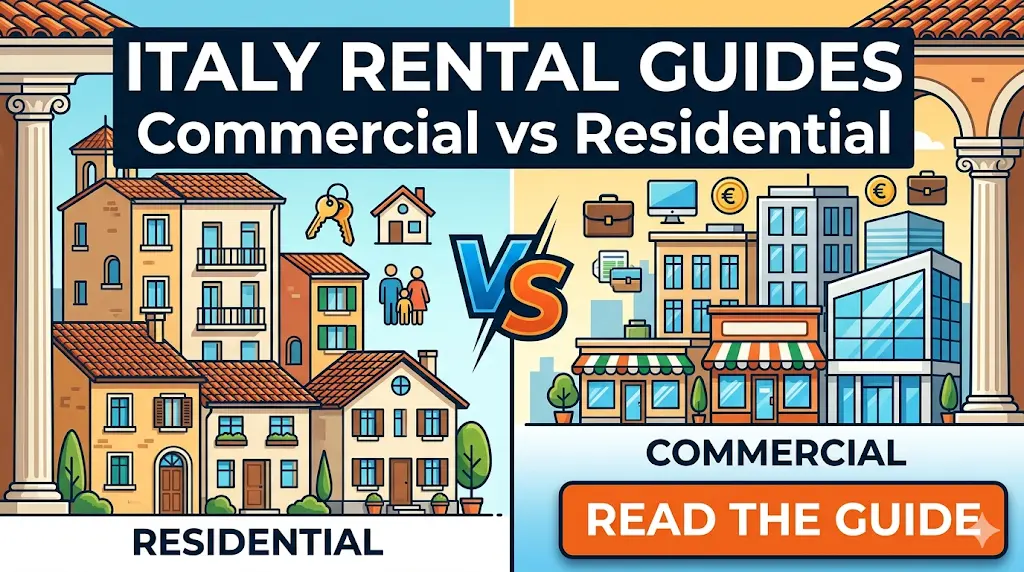
The Agenzia delle Entrate (Italian Revenue Agency) classifies every single property in the country using a rigid cadastral system known as categorie catastali. If a property is registered as category A/2 or A/3, it is residential. If it is registered as C/1 (for shops) or A/10 (for professional offices), it is strictly commercial. You cannot legally run a public-facing retail business out of a residential apartment, and you certainly cannot legally live and sleep in a commercial storefront.
Expats moving from the US or the UK often try to find a trendy “live/work” loft space. In Italy, this concept is legally defined as uso promiscuo (promiscuous use), and it is highly scrutinized. If you rent a residential apartment and use a dedicated room to see clients or operate your freelance business, you must formally declare this. While it allows you to deduct a specific percentage of your rent and utilities from your business taxes, it can complicate your lease if the landlord strictly forbade professional activities in the contract. When you are organizing your initial Checklist: All You Need Before Moving to Italy, you must decide immediately if you are merely working remotely from a laptop or actually receiving physical clients, as this dictates the exact type of cadastral category you must pursue.
The Registration Mandate and Taxes
Regardless of whether the lease is residential or commercial, it must be officially registered with the Agenzia delle Entrate within 30 days of signing. An unregistered contract, commonly referred to as renting in nero (on the black market), is completely illegal and entirely useless for your immigration paperwork.
The tax implications of this registration vary wildly. For residential leases, landlords often opt for the cedolare secca—a flat tax regime that absorbs the registration taxes and prevents the landlord from raising your rent with inflation. Commercial leases, however, are vastly different. Commercial rent is frequently subject to a 22 percent Value Added Tax (IVA) if you are renting from a real estate holding company, plus hefty registration stamp duties. As a business owner, you can offset this IVA, but it requires a significantly higher monthly cash flow than a residential lease.
Contract Durations and Eviction Realities
The Italian state views residential and commercial tenants through entirely different lenses. For residential contracts, the law prioritizes the tenant’s fundamental right to stable shelter. For commercial contracts, the law prioritizes the long-term stability of the business enterprise and the protection of the local economy.
Residential Standards and the Bridge Phase
The absolute standard for Italian housing is the 4+4 contract. It lasts for an initial four years and automatically renews for another four years. The landlord can only deny the first renewal under very specific, legally defined circumstances, such as needing to move their immediate family member into the apartment. There is also a 3+2 subsidized contract, which offers landlords tax breaks in exchange for capping the rent at municipal rates.
If you are a newly arrived expat, finding a traditional landlord willing to lock into a four-year contract with a foreigner who lacks a multi-year history of local Italian payslips is incredibly difficult. This is exactly why veteran expats use Spotahome to bridge the gap. Because Spotahome specializes in medium-term transitional housing, you can secure a vetted, legal roof over your head on a month-to-month basis without the immediate burden of a four-year commitment. By securing a flat through Spotahome, you buy yourself the necessary time to secure your tax code, open an Italian bank account, and properly hunt for long-term housing without the threat of imminent homelessness.
The Commercial Marathon
Commercial leases operate on an entirely different timeline governed by Law 392/1978. Because a business builds a customer base tied directly to its physical storefront, the law heavily restricts the landlord’s ability to arbitrarily evict a successful enterprise.
To provide this stability, commercial contracts are exceptionally long. A standard commercial lease for retail, artisan workshops, or industrial use has a mandatory minimum duration of 6 years, which automatically renews for another 6 years (the famous 6+6 contract). If you are opening a hotel, a bed and breakfast, or a theater, the law stretches even further to a 9+9 year structure. You cannot negotiate these minimums down. Any clause in a commercial lease stating the contract is only for two or three years is legally null and void, and a judge will automatically convert it to a 6+6 if challenged.
For an expat entrepreneur setting up shop under Italy’s new digital residency pilot for expats, understanding this timeline is terrifying. What if your business fails in year two? Fortunately, while the landlord is rigidly locked in for six years, the tenant usually has a legal escape hatch. You can terminate the commercial lease early for serious, documented reasons—such as business insolvency or a sudden severe drop in revenue—with a mandatory six-month formal notice sent via registered mail or certified email (PEC).
Maintenance, Deposits, and Goodwill Penalties
The upfront costs and hidden liabilities associated with signing an Italian lease are staggering. Assuming that the landlord will cover the costs of outfitting the space or fixing major appliances is a fast track to financial ruin.
Ordinary vs Extraordinary Maintenance
In both residential and commercial leases, the baseline legal rule is that ordinary maintenance falls to the tenant, while extraordinary maintenance falls to the landlord. If a lightbulb burns out, you fix it. If the building’s roof collapses, the landlord pays for it.
However, in commercial leases, landlords possess far more negotiating power and frequently attempt to insert specific clauses shifting all maintenance burdens, including major structural repairs and air conditioning overhauls, entirely onto the business owner. Furthermore, whether you sign a residential or commercial lease, you will likely receive a completely empty shell. Italian residential apartments often lack kitchens, and commercial storefronts almost always lack basic flooring or light fixtures. You will need to outfit the entire space yourself. Because running around a foreign industrial zone buying drywall and lightbulbs is exhausting without a car, utilizing Amazon Italy for your foundational supplies is a lifesaver. You can order heavy tools, basic shelving, and commercial-grade cleaning supplies via Amazon Italy and have them delivered directly to your empty storefront, allowing you to focus on managing your contractors rather than hauling heavy boxes on the metro.
Bank Guarantees and the Indennita di Avviamento
For standard residential leases, the maximum legal security deposit (deposito cauzionale) is strictly capped at three months of rent.
For commercial leases, the upfront financial burden is much heavier. Because evicting a commercial tenant can take years, landlords frequently demand a fideiussione bancaria (bank guarantee) covering six to twelve months of rent simply to hand over the keys. When negotiating a commercial lease without a history of local Italian tax returns, landlords will heavily scrutinize your foreign assets. The capital requirements you had to organize for the Acceptable financial proof for Italy self-employment visa will serve as your baseline here; you will likely need to show the landlord those same certified foreign bank statements to prove your business is solvent enough to survive a 6-year commitment.
Here is where the law finally protects the commercial expat. If you successfully reach the end of your first 6-year term and the landlord refuses to renew your lease because they want to sell the building or rent to someone else, they must pay you a massive penalty called the indennità di avviamento (loss of goodwill compensation). The landlord must pay you 18 months of your current rent in cash to legally force you out. For hospitality businesses, this jumps to 21 months. If the landlord subsequently rents the space to a direct competitor operating the exact same type of business within a year, that penalty instantly doubles to 36 or 42 months. This powerful legal quirk prevents greedy property owners from waiting for you to build a successful restaurant, kicking you out, and giving the turnkey location to a local friend.
| Feature | Residential Contract (Standard 4+4) | Commercial Contract (Standard Retail) |
| Minimum Duration | 4 Years (+ 4 Year Renewal) | 6 Years (+ 6 Year Renewal) |
| Notice to Terminate (Tenant) | 6 Months (for serious reasons) | 6 Months (for serious reasons) |
| Landlord Refusal to Renew | Allowed after first 4 years (strict conditions) | Allowed after first 6 years (triggers massive penalty) |
| Goodwill Compensation | None | 18 to 36 months of rent paid directly to tenant |
| Typical Security Required | 2 to 3 months deposit | 3 months deposit + 6 to 12 month bank guarantee |
| Cadastral Category | A/2, A/3, A/4 (Housing) | C/1 (Shops), A/10 (Offices) |
Bridge Housing and Expat Logistics
The bureaucracy required to finalize either type of lease is overwhelming. You cannot sign a registered contract without an Italian tax code, and you cannot legally live in the country long-term without establishing your registered residency at the local town hall.
Surviving the Vulnerable Transition Phase
If you are relocating your entire family, navigating the Conditions for working while on Italy Family Reunification Visa becomes immensely easier once you have a stable, registered residential address. Your spouse cannot easily begin looking for local employment, nor can you enroll your children in the public school system, without that residency certificate.
During this chaotic hunting phase, your phone is your absolute lifeline. You will be constantly calling real estate agents, translating complex cadastral documents, and tracking your location on Google Maps. Because obtaining a traditional Italian mobile contract requires the very residency you are currently trying to secure, you are trapped in an administrative loop. By downloading an Airalo eSIM before you even land, you guarantee immediate, high-speed data across the country. With Airalo, you can instantly reply to WhatsApp messages from commercial landlords the moment a prime storefront hits the market. Time is of the essence, and without constant digital connectivity, you will lose the best properties to fast-moving locals.
Maintaining Pristine Immigration Records
Keeping your paperwork flawless during the transition between your temporary housing and your permanent headquarters is mandatory. If you are nervously waiting on your primary visa documents, actively tracking the Timelines for picking up your permesso di soggiorno in Italy, you must ensure every residential and commercial contract you sign is officially registered within the 30-day window.
If you move your home address or relocate your commercial headquarters, you must formally notify the authorities. Following the exact steps for How to change your address with the Questura in Italy ensures your immigration dossier remains completely spotless. A simple clerical error regarding your legal address can derail your entire life in Italy. The Consequences of losing your permesso di soggiorno card or letting your residency file lapse can result in your commercial bank accounts being instantly frozen, completely paralyzing the business you just spent six months trying to open.
Whether you are navigating the Italian visa policy for dual nationals or arriving on a standard entrepreneurial work permit, understanding the stark legal differences between where you sleep and where you work protects you from the most expensive bureaucratic traps Italy has to offer. Finally, always keep an eye on broader Schengen regulations; tracking the Italy’s ETIAS implementation date and what travelers need will soon dictate how freely you can travel to and from your newly established Italian commercial headquarters.
References
Primary sources (official)
- Agenzia delle Entrate (Italian Revenue Agency – Rental Contracts): https://www.agenziaentrate.gov.it/
- Ministero delle Infrastrutture e dei Trasporti (Ministry of Infrastructure and Transport): https://www.mit.gov.it/
Other helpful sources
- Gazzetta Ufficiale (Official Gazette – Law 392/1978 on Commercial Leases): https://www.gazzettaufficiale.it/
- Confedilizia (Italian Confederation of Property Owners): https://www.confedilizia.it/
Disclaimer
The information provided in this article is for general informational purposes only and does not constitute official legal, financial, or real estate advice. Italian property laws, the strict definitions of cadastral categories, and the complex regulations governing commercial indennità di avviamento are subject to frequent legislative updates and regional interpretations. Always consult with a registered Italian real estate lawyer (avvocato immobiliare) to thoroughly review any residential or commercial lease agreement before signing binding documents or transferring substantial financial deposits.