Renting vs Buying: Tools to Compare Italian Markets
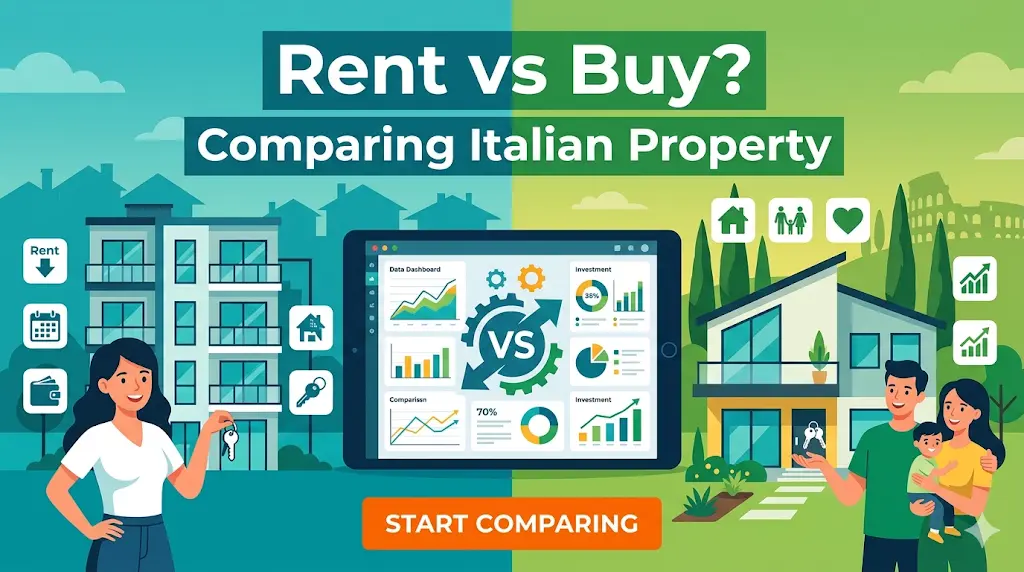
Staring at an Italian real estate window, trying to decipher if a notoriously rigid four-year lease is safer than plunging your savings into a complex property purchase, is deeply paralyzing. I spent months agonizing over whether to rent or buy in Turin, terrified of making a catastrophic financial mistake. This guide provides the exact tools and strategies you need to analyze Italian housing markets and make the right decision.
Disclosure: This post may contain affiliate links. We may earn a commission at no extra cost to you if you make a purchase through these links. Read full disclosure.
The Renting Reality versus the Buying Burden
When relocating to Italy, expats often project their home country’s real estate logic onto the Italian market. In many countries, renting is a flexible, short-term stepping stone, and buying is a seamless wealth-building exercise. In Italy, both paths are heavily regulated, bureaucratically exhausting, and require a massive upfront commitment.
Italian Rental Contracts Unpacked
Renting in Italy offers the illusion of flexibility, but the legal framework is intensely rigid. The standard residential lease is the “4+4 contract” (quattro più quattro). This means the lease is valid for an initial four years, and it automatically renews for another four years. There is also a “3+2 contract” (tre più due), which is a subsidized agreement capping the rent at municipal rates in exchange for tax breaks for the landlord.
While these long durations protect tenants from sudden evictions, they also lock you in. If you decide you hate your neighborhood or your noisy upstairs neighbors, you cannot simply give a thirty-day notice and leave. Legally breaking a standard Italian lease requires a formal six-month notice period (disdetta) sent via registered mail, and you must have a “serious reason” (gravi motivi) to do so, such as a sudden job relocation.
If you are an expat participating in Italy’s new digital residency pilot for expats, you might value geographic mobility. Signing a 4+4 lease instantly destroys that mobility, tethering you to a single municipality for years. Furthermore, Italian landlords require extensive financial documentation, often demanding a permanent Italian employment contract, which newly arrived foreigners simply do not possess.
The Hidden Costs of Buying Property
Buying property in Italy removes the landlord from the equation, but it replaces them with the Italian state and a mountain of upfront taxes. You cannot simply look at the listing price of an Italian villa and assume that is what you will pay.
When you purchase a home, you must pay the buyer’s real estate agency fee, which is typically between 3 and 4 percent of the purchase price, plus a 22 percent VAT on that fee. You must also pay the Notaio (notary), a public official required to legally transfer the deed, whose honorarium can cost thousands of euros.
The heaviest burden is the property registration tax (Imposta di Registro). If you are buying the property as your primary residence (Prima Casa) and commit to moving your official residency there within 18 months, the tax is a manageable 2 percent of the cadastral value (which is usually much lower than the market price). However, if you are buying a vacation home or fail to move your residency in time, you will be hit with the “Seconda Casa” rate, which is a punishing 9 percent. Managing this bureaucratic timeline is just as critical as tracking the Timelines for picking up your permesso di soggiorno in Italy. If you fail to officially register your address, the tax agency will hunt you down for the difference, plus heavy penalties.
Essential Tools to Analyze Italian Real Estate
Because the stakes are so high, you cannot rely on the anecdotal advice of your local barista or an overly enthusiastic real estate agent to gauge if a property is priced fairly. You must rely on raw, verifiable data. Fortunately, Italy offers robust tools for this if you know where to look.
Using the OMI Database for Official Valuations
The single most powerful tool for any buyer or renter in Italy is the Osservatorio del Mercato Immobiliare (OMI). Maintained directly by the Agenzia delle Entrate (the Italian Revenue Agency), this database is the gold standard for property valuations.
The government literally slices every city and town in Italy into distinct micro-zones. Every six months, the OMI publishes the actual, recorded transaction data for these zones. It provides a minimum and maximum price per square meter for both sales and rentals, categorized by property condition (e.g., “poor,” “normal,” “excellent”) and property type (e.g., apartment, villa, garage).
If an agent is pushing a “luxury” apartment in Florence for €5,000 per square meter, but the OMI database shows the maximum recorded transaction in that specific micro-zone for an excellent apartment is only €3,800, you immediately know the property is wildly overpriced. You can access the OMI database for free on the Agenzia delle Entrate website. It is dense and entirely in Italian, but running it through a translation browser extension will give you the objective leverage you need during negotiations.
Commercial Portals and Market Trends
While the OMI provides historical transaction data, commercial real estate portals provide the current market sentiment. The two dominant portals in Italy are Immobiliare.it and Idealista.
Do not just use these sites to look at pretty pictures. Both platforms have dedicated “Mercato” (Market Insights) sections. These pages provide interactive graphs showing the asking price per square meter for specific neighborhoods over the last several years. You can instantly see if a neighborhood in Rome is gentrifying rapidly or if prices have stagnated for a decade.
It is crucial to understand the cultural nuance of Italian listing prices. Unlike markets in North America where bidding wars frequently drive the final sale price above the asking price, Italian real estate operates on a negotiation culture. The listing price on Idealista is almost always inflated by 10 to 15 percent. Buyers are expected to make lower offers. When you are calculating your budget and organizing your Acceptable financial proof for Italy self-employment visa, factor this negotiation margin into your financial planning.
| Market Metric | Renting in Italy | Buying in Italy |
| Upfront Capital | 2-3 months deposit + 1st month rent + Agency Fee | 20%+ Down Payment + 7-10% in Taxes/Notary/Agency Fees |
| Commitment Length | 3 to 4 years minimum (with 6 months notice to exit) | Long-term asset holding |
| Maintenance Burden | Tenant does ordinary; Landlord does structural/extraordinary | Buyer covers absolutely everything |
| Price Analysis Tool | OMI Database (Rental Yields) & Portal Averages | OMI Database (Sales Data) & Portal Asking Prices |
Strategic Logistics for the Transition
Deciding between renting and buying is rarely something you can do effectively from your home country. You must be on the ground, walking the neighborhoods, and experiencing the local infrastructure before you sign a binding legal document.
Bridge Housing and Neighborhood Testing
The biggest mistake expats make is attempting to buy a house or sign a four-year lease during their first week in the country. You might fall in love with a charming piazza on a Tuesday afternoon, only to discover it transforms into an unbearably loud open-air nightclub from Thursday to Sunday.
To protect yourself, you need bridge housing. Relying on Spotahome is the most strategic move an expat can make during their initial transition. Spotahome specializes in medium-term transitional contracts (from a few months to a year). By booking an apartment through Spotahome, you secure a fully furnished, legally registered home base without trapping yourself in a rigid 4+4 lease. You can use this bridge period to physically explore different municipalities, observe the real estate market, and decide if buying is truly right for you. Having a registered transitional address also satisfies the immigration authorities when you are preparing your Checklist: All You Need Before Moving to Italy.
If you are relocating with your family under the Conditions for working while on Italy Family Reunification Visa, using Spotahome allows your spouse and children to settle into a comfortable routine while you dedicate your time to the intense, localized property hunt.
Navigating Viewings and Empty Properties
When you finally begin viewing properties to buy or lease long-term, your smartphone is your most vital tool. You will be cross-referencing listings, translating complex cadastral documents on the fly, and constantly messaging agents on WhatsApp.
Italian public Wi-Fi is notoriously unreliable, and you cannot afford to lose your connection while standing in front of a potential dream home trying to check the local OMI data. Downloading an eSIM from Airalo before your flight lands is an absolute necessity. With Airalo, you guarantee immediate, high-speed Italian mobile data across all your devices. Having uninterrupted Airalo connectivity means you can quickly send photos of a property to your partner, verify a real estate agent’s credentials online, and navigate unfamiliar neighborhoods using Google Maps without any friction.
The Reality of Italian Move-Ins
When you finally sign the deed to buy a house, or sign a long-term lease, you will face one final cultural shock. Italian properties are frequently handed over completely bare. Sellers and departing tenants often take the light fixtures, the appliances, the kitchen cabinets, and sometimes even the bathroom mirrors.
You will likely receive the keys to a completely empty shell. Since navigating a suburban Italian hardware store without a car is an exhausting endeavor, leveraging Amazon Italy is your greatest logistical advantage. You can order power drills, step ladders, temporary lighting, and basic hardware through Amazon Italy and have them delivered directly to an automated locker in your new neighborhood. Utilizing Amazon Italy allows you to outfit your new property with basic survival gear immediately, saving you from spending your first week sleeping on a bare floor in the dark.
Throughout this entire process, you must maintain absolute administrative hygiene. The moment you finalize your property decision and move in, you must update your registered residency at the local town hall. Following the exact steps for How to change your address with the Questura in Italy ensures your immigration file aligns perfectly with your new housing status. Failing to update your police file can be disastrous, mirroring the severe Consequences of losing your permesso di soggiorno card, as official tax bills and immigration notices will be sent to the wrong address. Whether you are navigating the market as a foreign investor or utilizing the Italian visa policy for dual nationals, treating your housing search with localized, data-driven strategy ensures your Italian dream does not turn into an administrative nightmare.
References
Primary sources (official)
- Agenzia delle Entrate (OMI – Osservatorio del Mercato Immobiliare): https://www.agenziaentrate.gov.it/portale/web/guest/schede/fabbricatiterreni/omi
- Ministero delle Infrastrutture e dei Trasporti (Housing Policies): https://www.mit.gov.it/
Other helpful sources
- Immobiliare.it (Market Insights and Trend Data): https://www.immobiliare.it/mercato-immobiliare/
- Idealista (Real Estate Price Trends in Italy): https://www.idealista.it/en/mercato-immobiliare/
Disclaimer
The information provided in this article is for general informational purposes only and does not constitute official legal, financial, or real estate advice. Italian property laws, the exact calculation of the Imposta di Registro, and OMI micro-zone data are highly complex and subject to regional variations and frequent legislative updates. Always consult with a registered Italian real estate agent (agente immobiliare), a qualified tax accountant (commercialista), and an official notary (notaio) to evaluate your specific housing situation before signing any binding contracts or transferring substantial financial deposits.