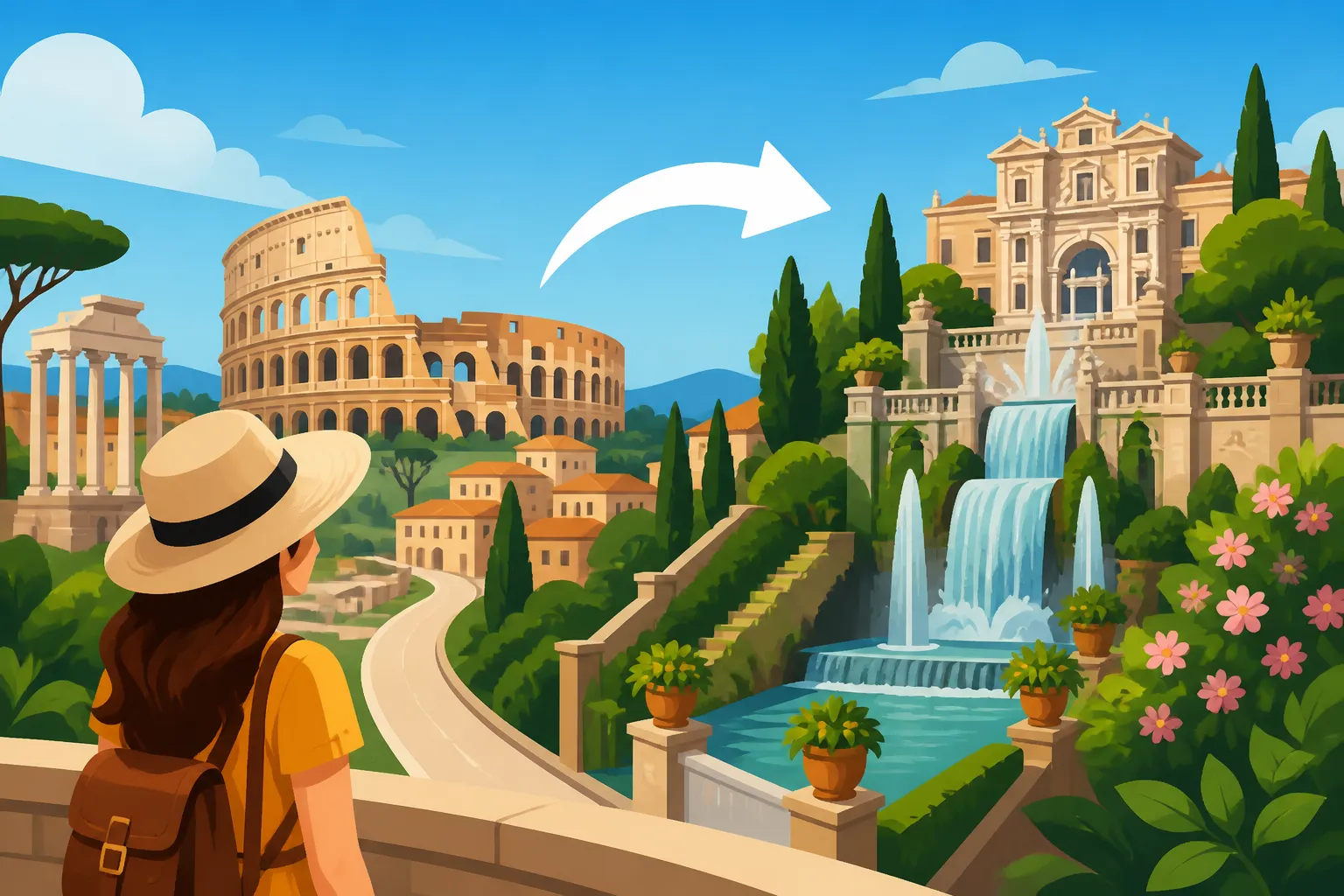
How to Visit Tivoli and Its Villas From Rome
Most visitors find themselves trapped in the "Rome Bubble," exhausted by the Colosseum crowds and unsure how to navigate the regional transport to see the wonders just outside the city walls. This guide solves the logistical puzzle of visiting Tivoli, providing a step-by-step roadmap to exploring Villa d'Este and Villa Adriana without the typical Roman stress.
Disclosure: This post may contain affiliate links. We may earn a commission at no extra cost to you if you make a purchase through these links. Read full disclosure.
Getting from Rome to Tivoli: Navigating the Logistics
If you have spent even a few days in the capital, you know that Roman transport can feel like a beautiful, chaotic dance. Leaving the city for a day trip to Tivoli requires a bit more foresight than just hopping on the Metro. Most people assume they can just "wing it" at Termini Station, but as someone who has stood confused on a platform more times than I care to admit, I can tell you that a little bit of preparation goes a long way. There are two primary ways to reach Tivoli: the regional train and the Cotral bus. Each has its quirks, and your choice will likely depend on which villa you want to see first.
Taking the Train from Roma Tiburtina
While some trains to Tivoli do leave from Termini, the majority of the regional FL2 line departures happen at Roma Tiburtina. This is a common point of confusion for expats and tourists alike. Tiburtina is a massive, modern hub, and it is generally less claustrophobic than Termini. You can use platforms like Omio to check the schedules in advance, which I highly recommend so you don't end up waiting forty minutes for the next departure. The train journey usually takes between 45 minutes to an hour, winding through the Roman countryside as the flat plains begin to rise into the Tiburtini Mountains.
When you arrive at the Tivoli station, you are actually quite well-positioned for Villa d'Este. It is a pleasant 15-minute walk from the station into the town center. However, if your goal is Villa Adriana first, the train station is not your friend. Villa Adriana is located in the valley, about 5 kilometers away from the town center. If you take the train, you will need to find a local bus or a taxi to get down to the archaeological site. For those still getting their bearings in the country, How to Buy Trenitalia and Italo Tickets and Save Money is an essential read to ensure you aren't overpaying for these regional hops.
The Cotral Bus Option from Ponte Mammolo
The Cotral bus is the "local" way to travel, and it is often the most efficient if you are heading straight to Villa Adriana. You will need to take Metro Line B (the blue one) to the Ponte Mammolo stop. Downstairs is a busy bus terminal. You are looking for the bus headed toward "Tivoli via Prenestina" or "Tivoli via Tiburtina." The "via Tiburtina" route is generally faster.
The real-world frustration here is the ticket situation. You cannot buy tickets on the bus. You must buy them at the Tabacchi inside the station or via the Cotral app. The bus will drop you off on the main road near the entrance to Villa Adriana (look for the "Bivio Villa Adriana" stop). It is a bit of a walk from the drop-off point to the ticket office, so wear comfortable shoes. This method is cheaper and drops you closer to the ruins than the train does, but it requires a bit more "street smarts" to navigate the Italian bus system. If you are worried about the language barrier, Survival Italian for Travelers: Key Phrases to Learn First can help you ask the driver where to get off.
Driving and the ZTL Headache
I generally discourage newcomers from driving to Tivoli unless they are very confident with Italian traffic. While the drive is only about 30 kilometers, the center of Tivoli is a Restricted Traffic Zone (ZTL). If you accidentally drive past one of those small glowing signs that say "ZTL Attiva," you will receive a hefty fine in the mail months after you've returned home.
If you do choose to drive, park in the large "Piazza Matteotti" lot. It is paid parking, but it is outside the ZTL and puts you right at the doorstep of the town. For those who prefer a completely hands-off experience, booking a guided excursion through GetYourGuide is a popular alternative that handles the transport for you, allowing you to just sit back and look at the olive groves.
Exploring the Masterpieces: Villa d'Este and Villa Adriana
Once you have arrived in Tivoli, you are faced with two of the most spectacular UNESCO World Heritage sites in Italy. They represent two very different eras: the sprawling, ruined grandeur of the Roman Empire and the refined, watery elegance of the High Renaissance. Trying to see both in one day is a marathon, not a sprint, and understanding the layout of each will help you prioritize.
Villa Adriana: Hadrian’s Roman Retreat
Villa Adriana is not a "villa" in the modern sense; it is a sprawling imperial complex that was once the size of a small city. Built by Emperor Hadrian in the 2nd century AD, it was intended to be his retreat from the pressures of Rome. As you walk through the site, you are seeing Hadrian's travel diary brought to life in stone. He recreated the buildings and landscapes that impressed him during his travels across the empire, from Egypt to Greece.
The highlight of Villa Adriana is undoubtedly the Canopus. This long, rectangular pool, surrounded by statues and columns, was inspired by a sanctuary near Alexandria. In the height of summer, the reflection of the arches in the water is breathtaking. However, because the site is so vast and largely unshaded, it can be brutal in the afternoon sun. I always suggest visiting Villa Adriana first thing in the morning. Much like Staying Safe in Italy: Common-Sense Tips for Travelers suggests for any major site, keep an eye on your belongings, though the site is generally peaceful and far less crowded than the ruins in central Rome.
Villa d'Este: The Renaissance Water Garden
After you have explored the dusty ruins of the empire, head up into the town of Tivoli to visit Villa d'Este. This 16th-century masterpiece is the ultimate "flex" of Renaissance wealth and engineering. Cardinal Ippolito II d'Este, disappointed that he wasn't elected Pope, decided to build a garden that would make the Vatican jealous.
The villa itself is covered in beautiful frescoes, but the real draw is the garden. It features hundreds of fountains, all powered entirely by gravity and the natural pressure of the Aniene River. The "Fontana dell'Organo" (Organ Fountain) actually plays music using water-driven bellows. It is a sensory experience—the sound of rushing water follows you everywhere, cooling the air even on the hottest July days. If you find yourself overwhelmed by the history, checking out Italy's UNESCO World Heritage Sites: A Visitor's Guide can give you more context on why this specific garden changed European landscaping forever.
Managing Your Time Between Both Villas
The biggest mistake people make is underestimating the distance between the two sites. They are not walking distance from each other. To get from Villa Adriana (down in the valley) to Villa d'Este (up in the town), you need to take the local "CAT" bus or a taxi.
| Feature | Villa Adriana | Villa d'Este |
|---|---|---|
| Historical Period | 2nd Century AD (Ancient Rome) | 16th Century (Renaissance) |
| Main Attraction | Archaeological Ruins and Pools | Fountains and Terraced Gardens |
| Walking Required | Extensive (4-6 km to see it all) | Moderate (Lots of stairs/slopes) |
| Estimated Time | 3 – 4 Hours | 2 – 3 Hours |
| Best For | History buffs and archaeology fans | Photography and garden lovers |
To make the most of your day, start at Villa Adriana at 9:00 AM, take a lunch break in the town of Tivoli around 1:00 PM, and spend your afternoon in the shaded terraces of Villa d'Este. If you decide that one day just isn't enough to soak it all in, you can find charming boutique guesthouses on Booking.com that allow you to stay overnight and enjoy the town after the tour buses have departed.
Practical Tips for a Smooth Visit
Tivoli is a real Italian town, not a curated museum. This means it follows the rhythms of Italian life, including the afternoon "riposo" where many shops and smaller restaurants close between 3:00 PM and 7:00 PM. Planning your meals and breaks around this schedule is vital to avoiding "hangry" episodes on the streets of Tivoli.
Eating and Resting in Tivoli
The area around the entrance to Villa d'Este is packed with restaurants. Some are excellent, while others are classic tourist traps. If you want a view, there are places like "Sibilla" which are famous but can be pricey. For a more authentic experience, wander a few blocks away from the main square into the medieval quarter.
When you sit down to eat, remember the cultural nuances of dining. You will likely see a "coperto" charge on your bill, which is a standard cover charge. To navigate this like a local, read up on Restaurant Etiquette in Italy: Coperto, Courses, and the Bill. Also, don't feel pressured to tip 20%; it’s not the norm here. For a breakdown of how to handle the bill, Tipping in Italy: When, Where, and How Much offers great veteran advice. A simple "primo" (pasta dish) and a carafe of house wine is often the best way to refuel before your afternoon exploration.
Avoiding the Crowds and Heat
Tivoli is significantly cooler than Rome because of its elevation, but the sun is still incredibly strong. The white marble of Villa Adriana reflects heat, making it feel like a toaster oven by midday. If you are visiting in the summer, wear a hat and bring a refillable water bottle. There are "nasoni" (drinking fountains) in the town where you can get ice-cold, fresh mountain water for free.
Crowd-wise, Tuesdays through Thursdays are your best bet. Avoid weekends if possible, as Tivoli is a favorite day-trip destination for Romans, and the narrow streets of the town can become quite congested. If you are traveling from further away, like arriving from the airport, make sure you've settled your luggage first; How to Get From Rome Fiumicino Airport to the City Center has tips on where to store bags so you aren't dragging a suitcase through the gravel of a Roman villa.
Essential Packing and Footwear
I cannot stress this enough: do not wear flip-flops or high heels to Tivoli. Villa Adriana involves walking on uneven ancient stones, dirt paths, and grass. Villa d'Este involves hundreds of stone steps that can be slippery from the fountain mist. A sturdy pair of sneakers or walking sandals is mandatory.
Additionally, many of the churches in Tivoli are worth a quick peek, such as the Chiesa di Santa Maria Maggiore right next to the entrance of Villa d'Este. Remember that these are active places of worship. Even in the heat, you should have something to cover your shoulders if you plan to go inside. This is a standard rule across the country, as noted in Italian Social Customs: Greetings, Gestures, and Personal Space, which helps visitors navigate the delicate balance of being a guest in a traditional community.
Regional Healthcare and Emergency Awareness
While we all hope for a perfect trip, it’s worth knowing that Tivoli has its own local hospital (Ospedale San Giovanni Evangelista) located right in the center. If you were to trip on a Roman stone or suffer from heat exhaustion, the local healthcare services are quite used to helping visitors.
For EU citizens, having your EHIC card ready is important, and for non-EU residents, ensure your travel insurance is easily accessible. If you want to understand how the system works before you need it, Emergency Medical Services in Italy: 112 and Hospitals provides a clear overview of what to expect in a medical situation. Always carry a small battery pack for your phone as well; navigating back to the train station in the dark with a dead phone is a hurdle you don't want to face after a long day of sightseeing.
Disclaimer
This guide is provided for informational purposes only. While every effort has been made to provide accurate and up-to-date information regarding transport, ticket prices, and opening hours, these details are subject to change by local authorities and transport providers. Always check official websites like Trenitalia or the official Villa d'Este portal before your trip to confirm current schedules and regulations. The author is not responsible for any travel disruptions or local policy changes.