How to Get Around Sicily Without a Car
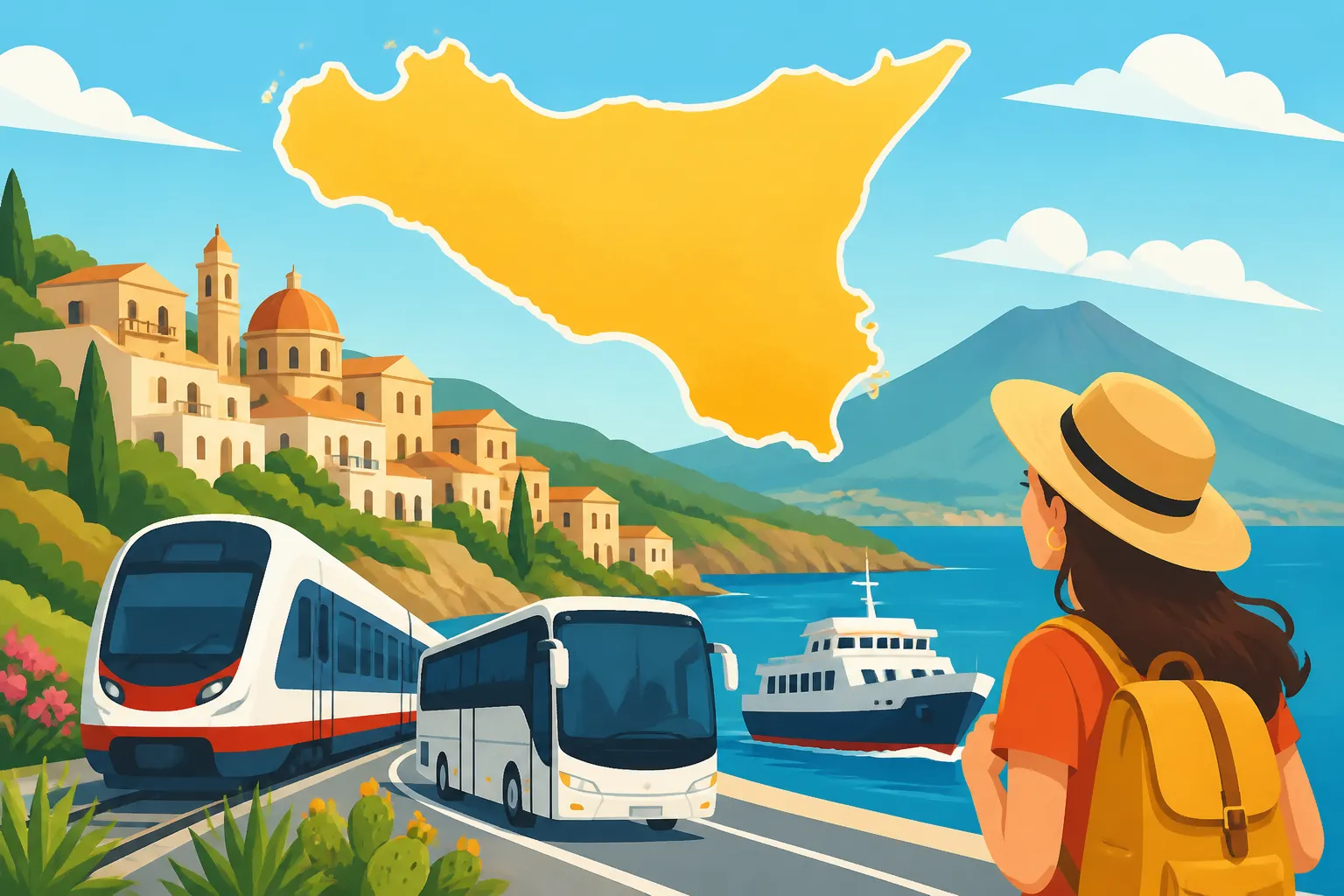
Many travelers are intimidated by the rugged terrain and historical reputation of Sicily's infrastructure, often hearing that a car is mandatory for survival. This guide breaks down exactly how to navigate the island using its extensive intercity bus networks, coastal railways, and regional ferries. You will learn how to bypass the stress of narrow Sicilian roads while effectively reaching the island's most iconic sites.
Disclosure: This post may contain affiliate links. We may earn a commission at no extra cost to you if you make a purchase through these links. Read full disclosure.
Understanding the Sicilian Transport Mindset
If you have spent any time in Northern Italy, you might be used to the precision of the high-speed Frecciarossa trains. In Sicily, you need to shed that expectation immediately. Navigating Sicily without a car is entirely possible, but it requires a shift in how you perceive time and logistics. The island does not function on a centralized "hub and spoke" model like London or Paris; instead, it relies on a patchwork of private bus companies and a rail network that is spectacular for views but often secondary for speed.
Buses are the Secret Kings of Sicily
While the rest of Italy is famous for its trains, Sicily is truly a bus island. Because the mountainous interior makes laying rail tracks difficult and expensive, a robust network of intercity buses has filled the gap. These are not the local city buses that stop at every corner; these are comfortable, air-conditioned coaches that connect major hubs like Palermo, Catania, Syracuse, and Agrigento.
The real challenge for newcomers is that there isn't one single website that governs all these routes. You have to know which company owns which territory. For instance, SAIS Autolinee tends to dominate the eastern routes and connections to Palermo, while Etna Trasporti is your go-to for the area around Catania and Taormina. To make sense of these overlapping schedules, using a platform like Omio can be a lifesaver, as it aggregates many of these private operators into a single searchable interface, saving you from navigating five different Italian-only websites.
The Train Network Coastal Scenery vs Inland Realities
The Sicilian railway, operated by Trenitalia, is a tale of two worlds. The coastal lines—specifically the routes connecting Messina to Palermo and Messina down to Catania and Syracuse—are actually quite efficient and offer some of the most breathtaking Mediterranean views you can find from a window. However, if you try to take a train into the "deep" interior, such as from Catania to Enna or Agrigento, you might find yourself on a slow, winding journey that takes twice as long as the bus.
For a veteran expat, the train is the preferred choice for the "Great Cities" tour. If you are staying in a central area—which I always recommend booking via Booking.com to ensure you are within walking distance of the station—the train is stress-free. You don’t have to worry about the "Zona Traffico Limitato" (ZTL) fines that plague drivers, and you can simply enjoy a granata while the landscape rolls by. For more on the logistics of the national rail system, you should check out Regional Trains in Italy: How to Use Them and Save to understand the nuances of validating tickets and regional tiers.
Navigating the Intercity Bus Network
When you decide to ditch the car, the bus stations (often called "Autostazione") become your primary gateways. Unlike train stations, which are usually grand historical buildings, Sicilian bus stations can sometimes just be a dusty piazza with several parked coaches. Don't let this lack of formality discourage you. The system is surprisingly reliable if you know the "rules of the road."
Identifying the Big Three AST Sais and Etna Trasporti
To master Sicily, you need to recognize the logos of the major carriers. AST (Azienda Siciliana Trasporti) is the regional workhorse. They cover the smaller villages and the hard-to-reach spots, but their websites are notoriously difficult to navigate and schedules can change based on the school year. If you are heading to the Baroque towns of the Val di Noto, you will likely find yourself on an AST bus at some point.
For the longer hauls, such as Palermo to Catania, SAIS is the gold standard. These buses run almost every hour and are incredibly punctual. They use the main highways (autostrade), so they are often faster than the train for cross-island travel. When planning these longer legs, I always suggest checking Intercity Buses in Italy: FlixBus and Regional Networks to see how these local Sicilian players compare to the larger European networks that are starting to creep into the island’s major hubs.
Booking Tips and Station Etiquette
One of the biggest culture shocks for tourists is the Sunday schedule. In Sicily, Sunday is truly a day of rest. Bus frequency drops significantly, and some rural routes disappear entirely. If you are planning a move between cities on a Sunday, book your tickets in advance through Omio or the company website to ensure you have a seat on the limited departures.
When you arrive at a bus hub, such as the one behind the Catania Centrale train station, look for the small ticket booths (biglietteria) often located in nearby cafes or small kiosks. You generally cannot buy intercity tickets on the bus; you must have them in hand before boarding. If you find yourself in a bind where a specific remote beach or archeological site isn't serviced by a major line, this is where GetYourGuide becomes a strategic asset. You can book organized day trips that include transportation, effectively using them as a private shuttle to fill the gaps in the public network.
Making the Most of the Sicilian Railways
While I’ve touted the bus as the king of the interior, the train remains the most romantic and often the most comfortable way to see the coastline. The Italian government has been investing in the Sicilian rail infrastructure, and the newer "Pop" and "Rock" trains are now appearing on the Palermo-Catania-Messina routes, offering USB chargers and plenty of luggage space.
The Palermo Messina Catania Triangle
This is the busiest corridor on the island and the easiest to navigate without a car. Trains run frequently, and because the tracks often hug the coast, you get a front-row seat to the Tyrrhenian and Ionian seas. When you arrive in these cities, you are dropped off in the heart of the action. This is a massive advantage over driving, where you would have to park in an expensive garage on the outskirts and trek in with your bags.
If you are using these cities as your base, I recommend reading Getting Around Italian Cities: Metro, Tram, and Buses to understand how to move from the train station to your specific neighborhood. In Catania, for instance, there is a small but functional metro that connects the train station to the city center and the outskirts, which many tourists completely overlook.
Exploring the Val di Noto by Rail
The Val di Noto, home to the stunning Baroque towns of Ragusa, Modica, and Noto, is a UNESCO World Heritage site that many people assume requires a car. While a car offers flexibility, the "Baroque Line" train is a hidden gem. It is a slow, scenic route that chugs through the rocky canyons and carob groves of southeastern Sicily.
Taking the train to Ragusa Ibla involves arriving at the station in the "new" town and taking a local circular bus or a long, beautiful walk down the stairs to the old town. It requires more physical effort than driving, but the reward is experiencing the scale and drama of these hilltop cities as they were meant to be seen. To prepare for the walking involved, make sure you know How to Order Coffee in Italy Like a Local so you can find the right fuel (espresso) at the right price before your trek.
Specialized Transit Ferries and Local Connections
Sicily is not just one island; it is an archipelago. Some of the best experiences are found on the smaller islands like the Aeolians (Lipari, Salina, Stromboli) or the Aegadians (Favignana, Levanzo). Naturally, cars are either prohibited or completely unnecessary on many of these smaller islands.
Island Hopping to the Aeolians and Aegadians
To reach these islands, you will head to the ports of Milazzo (for the Aeolians) or Trapani (for the Aegadians). Both ports are easily reachable by bus or train from the major airports. Once at the port, you will use the "Aliscafo" (hydrofoil) or the "Traghetto" (ferry). The hydrofoil is much faster and more expensive, while the ferry is a slow-motion dream that allows you to stand on the deck and watch the volcanic cones rise from the sea.
For detailed logistics on these water routes, refer to Getting Around Sicily and Sardinia by Ferry. It is essential to remember that ferry schedules are highly dependent on sea conditions. If the "Scirocco" wind is blowing too hard, the hydrofoils will stay in port. Always have a backup plan or an extra night booked via Booking.com near the port if the weather looks grim.
Airport Transfers and City Hubs
Sicily has two main airports: Falcone-Borsellino (PMO) in Palermo and Fontanarossa (CTA) in Catania. Both are excellently connected to their respective city centers. In Palermo, the "Prestia e Comandè" bus runs every half hour and is much cheaper than a taxi. In Catania, the "ALIBUS" is your best friend, whisking you from the terminal to the train station in about 20 minutes.
If your destination is a bit more obscure—perhaps a luxury resort in the countryside or a remote villa—check GetYourGuide for private transfer options. Sometimes, the cost of a pre-booked shuttle is comparable to the headache of trying to coordinate three different local buses with heavy luggage.
Practical Comparison Table: Transport Options in Sicily
| Method | Best For | Pros | Cons |
|---|---|---|---|
| Intercity Bus | Cross-island (Palermo-Catania), Inland towns | Direct, air-conditioned, faster than trains inland | Confusing websites, limited Sunday service |
| Regional Train | Coastal routes (Palermo-Messina-Syracuse) | Scenic, comfortable, central station locations | Very slow in the interior, occasional strikes |
| Ferry/Hydrofoil | Reaching smaller islands (Aeolians, Aegadians) | Essential for islands, beautiful views | Weather-dependent, can be expensive |
| Local Tours | Agrigento, Piazza Armerina, remote beaches | No planning needed, expert guides | Higher cost, fixed schedules |
Strategies for Success Without a Vehicle
Living in Sicily as an expat has taught me that the "slow road" is often the most rewarding, but you must be prepared. Always carry small change (coins) for local city buses, as drivers rarely have change for a 20-euro note. Download the offline maps for your destination on your phone, as some bus stops are not clearly marked, and you’ll want to track your GPS location to know when to pull the "stop" cord.
Furthermore, don't be afraid to ask locals for help. Sicilians are incredibly proud of their island and generally very helpful to travelers. Even if your Italian is limited to a few phrases, a simple "Per favore, per [Destination]?" will usually get you pointed to the right bus bay.
When dining between your travels, remember that bus and train stations are often surrounded by "tourist traps." To avoid a bad meal during a layover, consult How to Find Authentic Restaurants in Italy (Not Tourist Traps) to ensure your Sicilian culinary experience matches the quality of the scenery.
Final Advice for the Car-Free Traveler
The biggest mistake you can make is trying to see the entire island in one week without a car. Sicily is the largest island in the Mediterranean; it is essentially a small country. If you are going car-free, pick one side of the island. Focus on the East (Catania, Taormina, Syracuse, Noto) or the West (Palermo, Trapani, Cefalù, Agrigento). By limiting your geographic scope, you reduce your transit time and allow yourself to sink into the Sicilian rhythm.
Use Omio to book your long-distance legs a few days in advance, keep your Booking.com app ready for central accommodation, and use GetYourGuide for those "must-see" spots that sit just outside the reach of the bus lines. You’ll find that by not driving, you’ll see more of the real Sicily—the conversations on the bus, the hidden views from the train tracks, and the salt spray on the ferry—than you ever would have from behind a steering wheel.
Disclaimer
The information provided in this guide is for informational purposes only. Transportation schedules, prices, and service availability in Sicily are subject to change based on seasonal demands, regional regulations, and weather conditions. Always verify specific routes and times with the official service providers before beginning your journey.