Family, Accessible, and Slow Travel in Italy
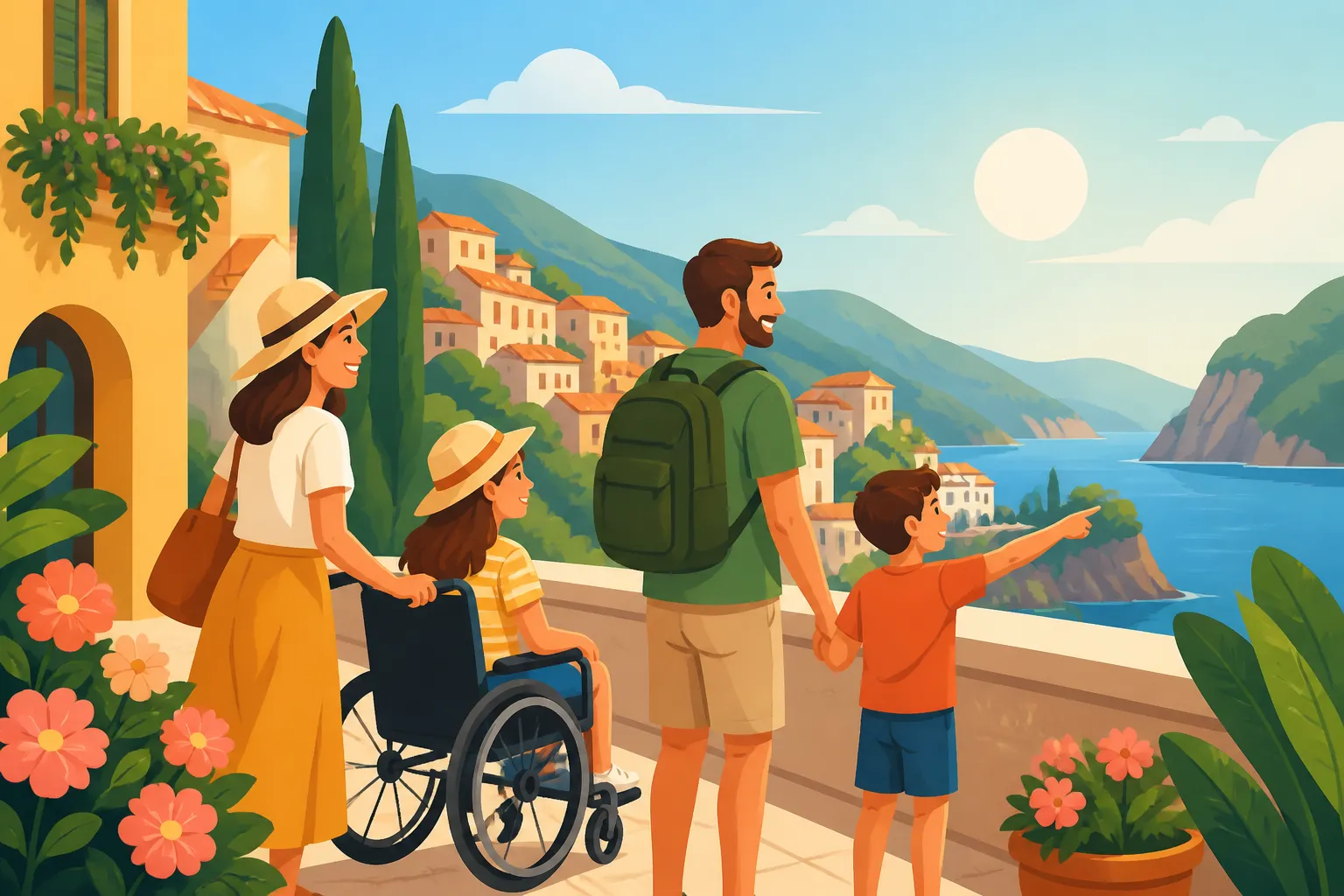
Your train pulls into Florence and the lift to the platform underpass is out of service. Your toddler fell asleep in the pram, your mother uses a walking frame, and the rental flat is up four flights of stone stairs. This guide shows you how to plan an Italy trip that works for children, limited mobility and a slower pace, so days like that stay rare.
Disclosure: This post may contain affiliate links. We may earn a commission at no extra cost to you if you make a purchase through these links. Read full disclosure.
Why Family, Accessible, and Slow Travel Belong in the Same Plan
People tend to treat these as three separate travel styles. I think they share one root. Each of them is about refusing the standard tourist itinerary, the one that crams Rome, Florence, Venice and the Amalfi Coast into nine days. I’ve lived here long enough to watch countless visiting friends try that itinerary. Here is who comes off worst:
- The families with small children.
- The relatives who use a cane or a wheelchair.
- Anyone who simply wanted to enjoy Italy rather than survive it.
The Pace Problem Most Itineraries Ignore
The classic Italy route is built for a fit, childless adult in their thirties who travels with one carry-on bag. That person can sprint from a high-speed train to a museum slot, eat a standing lunch, climb a bell tower and catch an evening train onward. Put a five-year-old, a pram or a knee replacement into that plan and it collapses by day three.
I remember hosting a cousin with two young kids who had booked a different city every two nights. By the time they reached Venice, the children refused to walk another step. The parents were arguing over the luggage, and nobody remembered the Uffizi. They told me later that the best day of the trip was the one when they “gave up.” They stayed in a small town outside Lucca, played in a piazza and ate gelato twice.
Slow travel solves the same underlying problem that family and accessible travel struggle with: transitions. Every hotel change brings packing, a station, stairs, a taxi queue, a new set of rules and a new neighbourhood to decode. Fewer transitions means fewer chances for things to go wrong. That matters most when your group has limited energy or limited mobility.
What Italy Gets Right and Where It Fights You
Italy is a remarkably warm place to travel with children. Waiters fuss over babies. Strangers offer toddlers bits of bread. Nonne in the piazza will happily tell you your child needs a hat. Restaurants rarely blink at a family arriving with a high-chair request, and piazzas work as free, car-free playgrounds in the evening.
Accessibility is a more complicated story. The country is built on hills, cobblestones, medieval stairways and canals. Many historic buildings were never designed for wheelchairs, and retrofitting is limited by heritage protections. Lifts exist but break down. Pavements in some cities are narrow, uneven or blocked by parked scooters. None of this means Italy is off-limits. It means research matters more here than in many other European destinations.
Slow travel is where Italy really shines. The country rewards people who stay put. The longer you remain in one town, the more you find:
- The bakery that saves you the last loaf.
- The bar where the barista knows your order.
- The weekly market where prices and produce shift with the season.
That rhythm suits families and travellers with disabilities beautifully. It also happens to be how Italians themselves holiday. For a deeper look at family-specific planning, see Family Travel in Italy: Kid-Friendly Cities and Activities.
Choosing Bases That Work for Kids, Wheels, and Long Stays
The single biggest decision you will make is where to sleep. A good base cuts out most of the daily friction. A bad one turns every outing into an expedition. I always tell friends to choose bases first and sights second, which is the opposite of how most people plan.
Northern Italy: Flat Cities, Lakes, and Venice
Northern Italy holds some of the country’s most manageable cities for reduced mobility and prams.
- Turin: Wide boulevards, long arcaded porticoes and a largely flat centre make it pleasant to roll through. The porticoes also give shade in summer and cover when it rains.
- Ferrara: Flat, compact and built around cycling. Families can rent bikes, and bike seats or trailers for small children are common.
- Bologna: Famous for its kilometres of porticoes, which give the same shelter as Turin’s. Do watch for the occasional step between portico sections, which can surprise a wheelchair user.
- Milan: Busy, but it has a modern metro and tram network. It is mostly flat and makes a practical arrival point.
- The lakes: Lake Garda and Lake Maggiore have lakeside promenades that are often level and car-free. Ferries link the towns, so you can see a lot without driving. The steep villages of Lake Como are prettier on postcards but harder on legs and wheels.
Venice deserves its own warning. The city is car-free, which families love. It is also made of bridges, and most of those bridges have steps. A pram or wheelchair journey across the centre can mean a dozen or more of them. The comune has mapped routes that avoid bridges, and the water buses on the Grand Canal are the most practical way to move between areas.
Staying on the Lido, or in a hotel right beside a water bus stop, makes Venice far gentler. Day-tripping from Mestre is an option, but it adds a daily transfer that tires small children quickly.
Central Italy: Tuscany, Umbria, Lazio, and Rome
Central Italy is where most first-timers want to be, and where the terrain gets more challenging.
- Florence: Compact and walkable, but its pavements are narrow and the stone surface is hard on small pram wheels. Areas like the Oltrarno feel calmer for families. Stay close to the centre to cut walking distances, but check carefully for lifts in older buildings.
- Hill towns: Places in Tuscany and Umbria such as Montepulciano, Cortona, Orvieto and Assisi are spectacular but steep. They are lovely as day visits by car. As bases for anyone with limited mobility, they are much harder going. Orvieto has a funicular up from the station, which helps.
- Lucca: My go-to recommendation. It is flat inside its walls, and the wide tree-lined path on top of those walls is ideal for bikes, scooters and wheelchairs alike.
- Rome: Huge and rewarding, and genuinely tiring. Distances between sights are long, cobblestones are everywhere, and not all metro stations have working lifts. Prati and parts of the area around Piazza del Popolo are flatter and calmer than the tangle around the Pantheon.
- Beyond Rome: Within Lazio, the lakeside town of Bracciano and the Castelli Romani hills make relaxing bases for slower stays. Both are reachable by regional train.
In the countryside of Tuscany and Umbria, an agriturismo on a working farm can be a dream for children. Many have pools, animals and open space. Ask for ground-floor rooms if mobility is a concern.
Southern Italy and the Islands
The south brings warmth, generous hospitality and lower crowds outside the coastal high season. It also has more variable infrastructure.
- Naples: Thrilling but chaotic. Its traffic, steep streets and crowded pavements demand energy.
- Sorrento: A calmer base for the Bay of Naples, with ferry links to the islands.
- The Amalfi Coast: Beautiful and vertical. It is not where I would send anyone with a wheelchair or a heavy pram.
- Puglia: One of my favourite regions for families and slow travellers. Coastal towns like Polignano a Mare and Monopoli, and inland towns like Ostuni and Alberobello, give you a mix of beaches, flat countryside and masserie with space for children to roam. Lecce’s old centre is relatively flat and paved in smooth local stone.
- Matera: Its Sassi cave districts are stunning and full of stairs. The modern upper town is much easier to manage.
- Sicily: Combines dramatic sights with long distances. Palermo and Catania are busy cities. Syracuse’s island quarter of Ortigia is compact and largely flat, which makes it a good slow base.
- Sardinia: Known for long, shallow beaches that suit small children well. Its seaside towns tend to be relaxed rather than vertical.
| Base | Family Appeal | Mobility Friendliness | Slow Travel Potential | Watch Out For |
|---|---|---|---|---|
| Lucca | High, with walls for biking and scooters | High, flat inside the walls | High, easy day trips by train | Summer heat in the centre |
| Turin | Medium to high, with museums and parks | High, porticoes and flat streets | High, affordable and uncrowded | Fewer obvious child attractions |
| Bologna | High, food-focused and lively | Medium to high, porticoes with occasional steps | High, rail hub for day trips | Busy university atmosphere |
| Lake Garda | High, with beaches and ferries | Medium to high, level promenades in many towns | High, many towns to explore | Peak-season crowds |
| Venice | High, car-free and magical | Low to medium, many bridges with steps | Medium, costly for long stays | Bridges, flooding, crowds |
| Rome | Medium, rich but tiring | Medium, long distances and cobbles | Medium to high in calmer districts | Metro lifts, heat, crowds |
| Puglia countryside | High, with space and beaches | Medium, depends on property | High, strong agriturismo culture | Need a car for most trips |
| Ortigia in Syracuse | Medium to high, compact and seaside | Medium to high, mostly flat | High, relaxed island pace | Heat in high summer |
Getting Around Without Wrecking the Day
Transport is where well-meaning plans unravel. A forty-minute delay is an annoyance for a solo traveller. For a family with a napping baby, or a wheelchair user who has booked assistance for a specific train, it can wreck the whole day.
Trains: The Backbone of a Gentle Itinerary
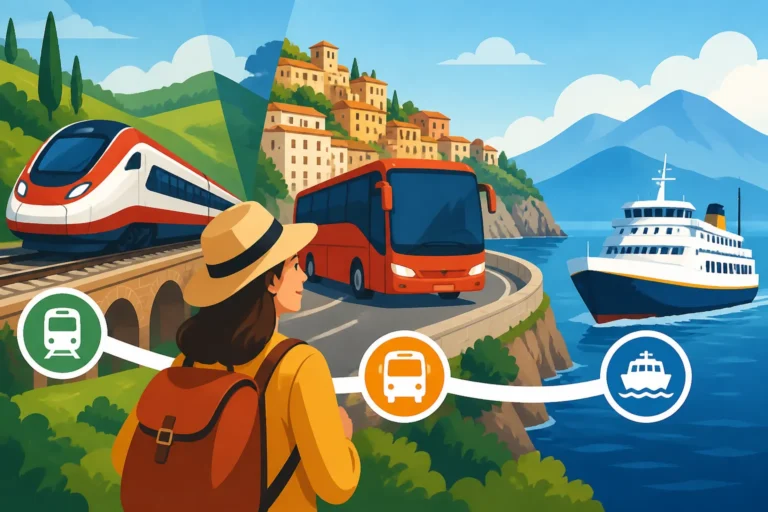
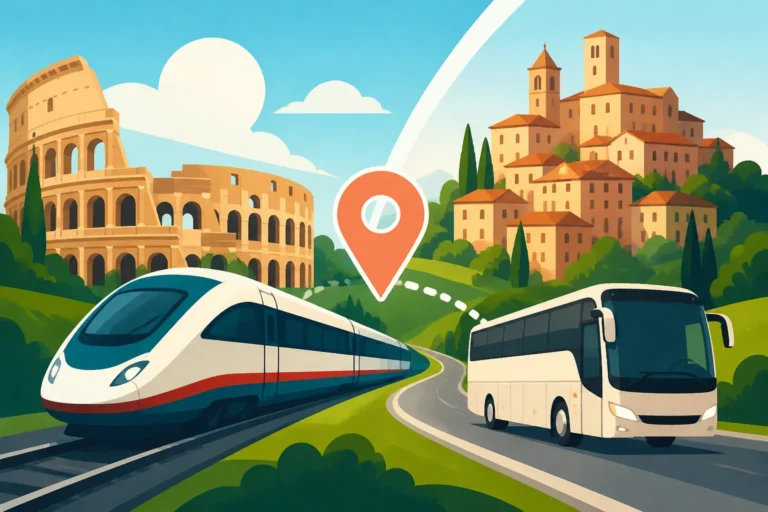
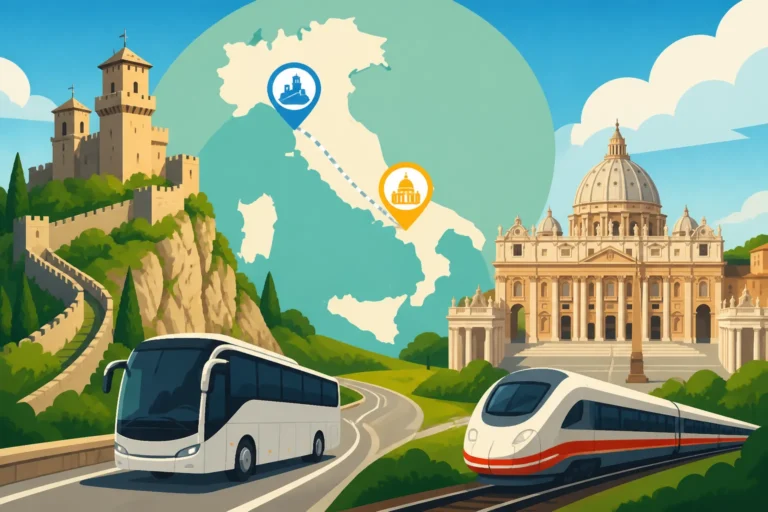
Italy’s rail network is, for most visitors, the best way to move between bases. High-speed Frecciarossa trains run by Trenitalia, and Italo trains, connect the main cities quickly and comfortably. They have wide aisles, luggage space and onboard toilets. Regional trains are slower and cheaper and reach smaller towns, but they vary a lot in age and step-free access.
For travellers with reduced mobility, RFI runs a national assistance service through its Sala Blu offices at major stations. Staff can help you board and alight, sometimes with a platform lift, but you need to request it in advance. I walk through the whole process in Accessible Travel on Italian Trains: Booking Sala Blu Assistance. Book the assistance as soon as your tickets are confirmed, and arrive early. If you miss the slot, you may wait a long time for the next available helper.
Families should think about seating. Reserved seats on high-speed trains let you sit together. Some trains have spaces near the vestibules where a folded pram fits, and the bigger stations have lifts down to the platforms, although they do not always work.
When you are comparing train and bus options for a route you don’t know, a booking platform such as Omio can help you see the operators side by side. Always double-check the specific train’s accessibility details with the operator itself before you rely on them. Families should also read Booking Italian Transport With Kids: Child Fares, Seats, and Prams before buying tickets.
Cars, ZTLs, and Parking Permits
A car gives you freedom in the countryside of Tuscany, Umbria and Puglia. It can feel essential when you’re staying at a rural agriturismo or travelling with someone who can’t walk far. The catch is that most historic centres are Zone a Traffico Limitato, or ZTLs. Cameras photograph number plates, and unauthorised entry brings fines that often arrive by post months after you get home.
If you hold a disability parking badge, bring it. The EU parking card is designed to be recognised across member states, and many comuni allow badge holders to enter ZTLs. The catch is that they often require the car’s plate to be registered with the local police in advance, and the rules differ from town to town. When you book, ask your hotel or rental host whether they can register the plate for you. Many of them do this routinely.
For families, car hire means you can carry the cot, the pram, the beach toys and the snacks. Book child seats in advance, or bring your own. On winding coastal and mountain roads, children prone to car sickness may struggle, so plan shorter drives with stops in between.
Local Transport, Ferries, and the Last Hundred Metres
Each city’s buses, trams and metro differ in how accessible they are. Newer trams in Milan, Turin and Florence often have low floors. Many older buses have steps. Rome’s metro has some stations with lifts and some without, and a working lift is never guaranteed.
Lake and island ferries can be a delight for children, who love being on the water. Accessibility depends on the vessel and the pier. Larger car ferries usually have ramps. Small hydrofoils may involve steps and a gap you have to cross. When the sea is choppy, boarding becomes harder for everyone.
The “last hundred metres” is my name for the stretch from the station or car park to your actual door. It is where many trips fall apart. A rental can be described as “central” and still sit up a steep lane, or behind a set of stairs that the photos never show. Ask the host directly how far it is from the nearest drop-off point and whether there are any steps on the way. Then ask for a photo of the entrance.
Family Travel in Practice
Children see Italy differently. They remember the pigeons in the piazza, the gelato flavours and the fountain they splashed in. They rarely remember the Renaissance altarpiece. The families who enjoy Italy most build their days around that reality.
Daily Rhythm: Meals, Riposo, and Late Evenings
Italian daily life has a rhythm that catches visiting families off guard.
- Lunch tends to be the main meal.
- The afternoon break, called riposo, sees many shops in smaller towns close for several hours, especially in the south and in the summer heat.
- Dinner often starts much later than families from northern Europe or North America are used to. Restaurants may not even open for dinner until the evening is well underway.
My advice is to embrace the rhythm rather than fight it. Do your sightseeing in the cooler morning, have a long lunch, then retreat for a rest during riposo, when the streets are hot and quiet anyway. Head back out in the early evening, when the passeggiata fills the piazzas with families and children play until late. Italian kids routinely stay up later than many visiting children, and nobody will judge yours for doing the same.
If your children need an early dinner, pizzerias and casual places tend to open earlier than formal restaurants. A picnic from the local alimentari, with bread, cheese, cured meats and fruit, is a perfectly Italian alternative. For more on seasonal closures, see What Closes During Italian Holidays and Ferragosto?, which also covers the holiday closures that can catch families out in August.
Babies, Toddlers, and Prams on Cobblestones
The pram question comes up in every conversation I have with visiting parents. A lightweight stroller with small wheels will rattle and jam on cobblestones and is miserable on Rome’s sampietrini. A larger all-terrain pram with bigger wheels copes better, but it is heavy on stairs and awkward on crowded trains. Many parents I know bring both a compact stroller and a baby carrier, then switch between them depending on the day.
Pharmacies, the farmacie with their green crosses, stock nappies, formula, baby food and children’s medicines. Pharmacists are usually helpful and used to advising tourists. Supermarkets carry baby supplies too, though their range varies. If your baby uses a specific formula, bring enough to get you through the first few days. Equivalent brands may look different here.
Changing facilities in public places are less consistent than you might hope. Larger museums, shopping centres and motorway service areas usually have them. Small cafés often do not. When you book, ask about cots, high chairs and bath tubs. I break the whole topic down further in How to Travel Italy With a Baby or Toddler.
Keeping Older Kids Engaged
School-age children often get bored in museums and churches. Italy offers plenty of ways to keep them interested:
- Hands-on sites: Archaeological sites like Pompeii, Herculaneum and the Roman Forum come alive when kids imagine life there, or when a guide tells gruesome gladiator stories.
- Climbs: Many towers and domes can be climbed, but check the step counts. Some are long and narrow, and none of them are suitable for anyone with mobility limits.
- Cooking: Pasta-making classes, gelato workshops and pizza-making sessions are hugely popular with children.
- Tours built for kids: Treasure-hunt-style walking tours and children’s museum trails turn sightseeing into a game. Platforms such as GetYourGuide list many of these family-focused activities alongside skip-the-line entries. It makes sense to read reviews from other parents before booking, since tour quality varies widely.
- Outdoor time: The beaches, lakes, Dolomite meadows and city parks such as Villa Borghese in Rome give children space to burn off energy after a morning of culture.
Let children choose part of the day. When kids feel ownership of the itinerary, they complain far less. One friend let her nine-year-old pick a gelato flavour to taste in every town and rate it. The game carried the whole family through two weeks of churches without a single meltdown.
Accessible Travel in Practice
I’ve accompanied friends and relatives with mobility challenges around Italy many times. The most important lesson I’ve learned is not to trust a vague “accessible” label. Ask specific questions, ask for photos, and build in buffers.
Reading Accessibility Claims Honestly
A hotel listing that says “accessible” might mean any of these:
- A lift, but one too small for a standard wheelchair.
- Step-free access to reception, but not to the breakfast room.
- An “accessible bathroom” that still has a shower tray step.
Here are the questions I always send before booking:
- How many steps are there between the street and the entrance, and is there a ramp?
- What are the internal dimensions of the lift and its door?
- Does the room have a roll-in shower, or a tub or tray?
- Is there step-free access to the breakfast area and any outdoor spaces?
- Where is the nearest step-free drop-off point for a car or taxi?
When you search on Booking.com, the accessibility filters help you narrow down options. Then contact the property directly with your specific questions before you confirm. In my experience, the hotels and rentals that reply promptly and in detail are the ones that really understand accessibility. For more on finding accessible venues and sights, see How to Find Wheelchair-Accessible Attractions in Italy.
Museums, Churches, and Archaeological Sites
Many of Italy’s major museums have made real efforts to improve access. Lifts, accessible routes and accessible toilets are increasingly common at the bigger institutions, including the Vatican Museums, the Uffizi and the Accademia. Disabled visitors and their companions often get reduced or free admission, but the rules differ from museum to museum. Check each official site and bring documentation of your disability.
Churches are more mixed. Major basilicas often have ramps or side entrances, but some smaller churches have steps at the door and nothing to bypass them. St Peter’s Basilica has accessible routes, though the scale of the building means long distances inside. Many churches also expect covered shoulders and knees, so bring a light scarf.
Archaeological sites are the hardest. Pompeii has worked on accessible paths that cover parts of the site, but much of the ground remains uneven ancient paving. The Roman Forum and Palatine involve slopes and rough surfaces. If mobility is limited, plan a shorter route that concentrates on the most accessible sections rather than trying to see everything. For a broader view of the topic, see Accessible Travel in Italy: Mobility and Planning Tips.
Beaches, Lakes, and Nature
Italian beaches fall into two kinds:
- Spiagge libere: Free public beaches.
- Stabilimenti balneari, or lidi: Private beach clubs that rent sunbeds and umbrellas.
Many lidi now provide walkways across the sand down to the waterline. Some also offer amphibious beach wheelchairs that can be taken into the water. Facilities vary a lot from place to place, so call ahead to confirm what is available. Free beaches typically have no facilities at all.
The northern lakes often suit wheelchair users and families with prams well. Their promenades are level, cafés sit by the water, and the larger ferries usually have ramps. For a gentle day in nature with limited mobility, the lakes are hard to beat.
Mountain areas such as the Dolomites have cable cars and gondolas that can carry wheelchair users up to alpine meadows. Some resorts also promote accessible trails. Check specific lift accessibility directly with the operator, because it differs widely, and remember that the high mountains can be cold even in summer.
Slow Travel: Staying Longer and Living Lighter
Slow travel is my favourite way to experience Italy, and the one I recommend most often to families and travellers with mobility needs. Stay a week or more in one place and the logistics of travel shrink, while the depth of the experience grows.
Picking a Rental or Agriturismo for a Month
For longer stays, a rented apartment, a residence with kitchens, or an agriturismo usually beats a hotel. You get a kitchen, a washing machine, space for children to play, and a chance to shop and cook like a local. Many properties offer discounts for weekly or monthly bookings. It is always worth asking, especially outside peak season.
On Booking.com and similar platforms, check the following carefully before you commit:
- Floor level and lift: Many Italian apartments are on upper floors of older buildings with no lift at all.
- Bed configuration: It can differ from what you expect, especially for families of four or more, since many Italian hotel rooms are limited in capacity. See Why Italian Hotels Cap Rooms at Three: Booking for Families of Four Plus.
- Air conditioning: Its absence makes summer unbearable in many regions.
- Heating: Matters in winter, even in the south.
- Washing machine: Common. Dryers are not, and Italians typically line-dry their clothes.
I explore the trade-offs between accommodation types in Monthly Stays in Italy: Hotel vs Residence vs Short-Term Rental. My personal rule is to always ask for a video call or extra photos of the bathroom and the entrance before committing to a long stay.
Building a Week That Breathes
The trap of slow travel is turning it back into fast travel by filling every day with excursions from your base. A week that breathes alternates active days with lazy ones. A typical pattern might look like this:
- One day of sightseeing in a nearby city.
- A day of pool or beach time.
- A morning at the local market followed by a long lunch.
- A day of doing almost nothing at all.
Spend your first two days learning your new neighbourhood. Find the nearest supermarket, pharmacy, bakery, bar and park. Work out when the weekly market happens. Check bus times to the nearest station. These small tasks cut down later stress and help you feel at home quickly.
| Day | Activity Type | Example From a Bologna Base | Energy Level |
|---|---|---|---|
| Day 1 | Settle in | Explore the neighbourhood, shop at a market, early night | Low |
| Day 2 | City sightseeing | Walk the porticoes, Piazza Maggiore, a food tour | Medium |
| Day 3 | Rest day | Park, pool or a long lunch at home | Low |
| Day 4 | Day trip | Regional train to Ferrara for cycling, or to Modena | Medium to high |
| Day 5 | Local life | Cooking class or a market morning | Medium |
| Day 6 | Day trip | Train to Ravenna for its mosaics | Medium |
| Day 7 | Free day | Whatever the group feels like | Low |
For a month-long version of this approach, see How to Travel Italy Slowly Over a Month, and for the philosophy behind it, see Slow Travel in Italy: Staying Longer in One Place.
Settling In Like a Temporary Local
The joy of slow travel is the small daily rituals:
- Standing at the bar for a morning coffee.
- Learning the names of the people who run the shop downstairs.
- Joining the evening passeggiata.
- Becoming a regular at the local trattoria, which often earns you an extra plate of something special.
Learn a few phrases of Italian. Even “buongiorno,” “grazie” and “per favore” transform how locals respond to you. Children often pick up words faster than adults and enjoy practising them at the market or gelateria.
Pay attention to the local calendar. Saints’ days, sagre (food festivals) and markets give your stay a sense of occasion. Strikes, or scioperi, happen regularly in Italian transport, but they are usually announced in advance. Check before any travel day, and see Strikes in Italy: How Sciopero Days Work and How to Rebook for how to handle them.
Planning Checklist and Common Mistakes
After years of helping visiting friends, I’ve distilled what I’ve learned into a sequence that works for families, accessible travel and slow travel alike. I’ve also watched the same mistakes repeat themselves over and over.
A Step-by-Step Planning Sequence
- Decide how many bases you will use. Fewer is almost always better: aim for one or two on a two-week trip and three at most on a longer one.
- Choose bases that match your group’s needs: flat towns for mobility challenges, space and outdoor areas for children, good transport links for day trips.
- Book accommodation early and ask specific questions about steps, lifts, bathrooms, bed layouts, air conditioning and the walk from drop-off to the door.
- Plan transport between bases. Book trains with reserved seats, request Sala Blu assistance if you need it, and confirm car-hire details including child seats and ZTL plate registration.
- Make a short list of key sights, then book timed-entry tickets in advance for the major museums so you don’t queue in the sun.
- Check the local calendar for holidays, strikes, festivals and market days, and the opening hours of the places you want to visit.
- Pack for the terrain: comfortable shoes, a carrier or suitable pram, sun protection, a light scarf for churches and any medication you need.
- Leave free days in your plan. Build in rest and spontaneity rather than filling every slot.
- On arrival, spend your first day or two learning the neighbourhood and its rhythms before starting heavy sightseeing.
Mistakes I See Over and Over
Mistake one: too many bases. Every move costs a morning or an afternoon, and it leaves children and travellers with limited energy depleted. If you are torn between two towns, pick one and do a day trip to the other.
Mistake two: trusting the word “central.” An apartment two minutes from the Duomo might be up a hundred stone steps or at the end of an unpaved lane. Ask for photos and directions, and make sure the “last hundred metres” really works for your group.
Mistake three: underestimating heat and distances. Summer in Italy, especially the south and the big cities, can be intensely hot. Distances that look short on a map feel much longer with a pram, a wheelchair or a tired child in the heat of the afternoon.
Mistake four: not booking assistance or timed tickets. Turn up at the Vatican Museums without a reservation in high season, or at a major station without pre-booked Sala Blu assistance, and you risk long waits or missing out entirely.
Mistake five: ignoring the Italian rhythm. Shops close at lunchtime in many towns, dinner is late, and August brings the Ferragosto holiday, when businesses shut down. Work with these patterns rather than against them.
Mistake six: forgetting the joy of doing nothing. The best moments of an Italian trip are rarely the sights on your list. They are long lunches, children playing in the piazza, the light on a hillside at sunset. Give yourself time for those.
Italy can be a wonderful destination for families, travellers with disabilities and anyone who wants to slow down. With the right bases, the right questions and a gentle pace, you can enjoy the country the way Italians themselves do, one unhurried day at a time.
Disclaimer
This article is for general informational purposes only and does not constitute professional advice. Laws, prices and regulations vary by location and change over time. Consult a qualified professional for guidance on your specific situation.