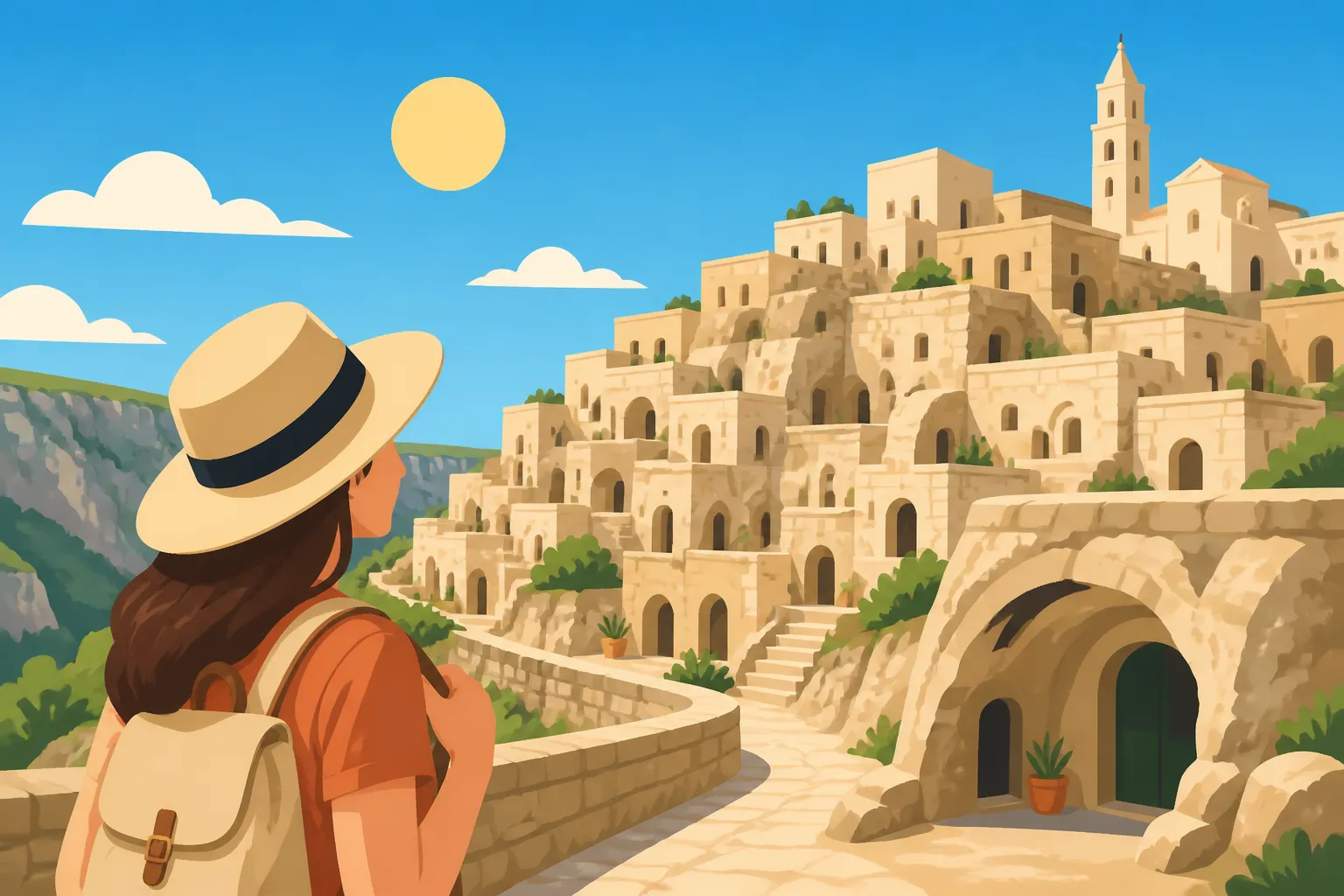
How to See Matera’s Cave Dwellings (Sassi)
Many travelers arrive in Southern Italy expecting the slick efficiency of the northern high-speed rail networks, only to realize that reaching the ancient city of Matera requires a bit more grit and planning. This guide solves the logistical puzzle of accessing the Basilicata region and provides a veteran's deep dive into navigating the labyrinthine Sassi districts without getting lost.
Disclosure: This post may contain affiliate links. We may earn a commission at no extra cost to you if you make a purchase through these links. Read full disclosure.
Getting to Matera: The Logistics of the Deep South
The first thing you need to understand about Matera is that it is not served by the national railway, Trenitalia. This often catches newcomers off guard. If you are coming from Rome or Naples, your journey will likely involve a transfer in Bari, the capital of the Puglia region. When I first moved to the south, I spent an embarrassing amount of time at the main Bari Centrale station looking for a platform that didn't exist. To find the train to Matera, you actually have to exit the main station and head to the Ferrovie Appulo Lucane (FAL) station nearby. These are narrow-gauge private trains that take about 90 minutes to chug through the olive groves and rocky landscapes of the Murgia.
If the idea of navigating a secondary private station feels daunting, there are other options. Using a platform like Omio can help you compare the FAL train times with the "Freccialink" bus services or private coach lines like Itabus and MarinoBus. Often, the bus is actually faster and more comfortable than the regional train, especially during the sweltering summer months when the older FAL train cars might have "ambitious" air conditioning at best. If you prefer more autonomy, Renting a Car in Italy: ZTLs, Insurance, and Driving Tips is worth reviewing, as driving into Matera involves navigating strict limited traffic zones (ZTL) that can result in hefty fines if you aren't careful.
Once you arrive at the Matera Centrale station, don't expect a city of caves immediately. The modern part of the city, the "Piano," is what greets you first. It is a beautiful 17th-century expansion with wide piazzas and baroque churches. To see the Sassi, you have to walk toward the edge of the ridge, where the ground simply disappears into a canyon. This is where the logistics of Getting Around Italy: Trains, Buses, Flights, and Car Hire really come into play; you’ll want to have your luggage situation sorted before you descend into the stone districts, as dragging a suitcase over 9,000-year-old limestone stairs is a rite of passage you definitely want to avoid.
Navigating the Sassi: Barisano vs Caveoso
Matera is divided into two main Sassi districts: the Sasso Barisano and the Sasso Caveoso. Understanding the difference between them is crucial for planning your daily walks and choosing where to spend your energy. The Sasso Barisano is generally more developed. When the city was being "reclaimed" in the 1980s and 90s, this was the area that saw the first influx of investment. Today, it is filled with boutique hotels, upscale restaurants, and craft shops. It is beautiful, but it feels a bit more manicured.
The Sasso Caveoso, on the other hand, feels much more like the "Old Matera." It is oriented toward the south and is where you will find more caves in their original, rugged state. This district is closer to the edge of the Gravina canyon, and the view across the ravine to the prehistoric caves on the opposite side is nothing short of haunting. If you are looking for that specific, ancient atmosphere, this is where you should focus your time. To get the most out of these walks, I always recommend checking Southern Italy and the Islands: Sicily, Sardinia, and Beyond to see how Matera fits into the broader cultural landscape of the Mezzogiorno.
When walking these districts, forget your GPS. The stone walls are thick, and the streets are often three-dimensional—meaning the roof of one house is the street for the house above it. You will find yourself walking in circles, and that is part of the magic. However, if you are short on time, booking a local guide through GetYourGuide can be a lifesaver. A good guide won't just show you the path; they will explain the "vicinato" system. This was a communal way of living where several families shared a common courtyard and a cistern for water. Understanding this social structure changes how you see the holes in the ground; they aren't just caves, they were the heart of a complex, resilient society.
| Mode of Transport | Departure Point | Duration | Best For |
|---|---|---|---|
| FAL Train | Bari FAL Station | 1h 30m | Budget travelers and solo explorers |
| Freccialink Bus | Bari Centrale | 1h 10m | Travelers with luggage and those seeking AC |
| Private Car | Bari Airport (BRI) | 55m | Families and those staying in Sassi hotels |
| Shuttle Bus | Bari Airport | 1h 15m | Direct airport transfers without city stops |
Where to Stay and What to Eat: Authentic Basilicata
Staying overnight in a cave is an experience you shouldn't skip, but it requires some mental preparation. Because these rooms are carved into the rock, they are naturally humid. Most high-end "alberghi diffusi" (scattered hotels) use sophisticated ventilation systems to keep things dry, but you should still expect a certain earthy scent. When searching on Booking.com, look specifically for rooms labeled as "grotta" or "ipogeo." My advice is to stay in the Sasso Caveoso for the views, but keep in mind that the walk back up to the modern city for dinner can be a workout.
Speaking of dinner, the food in Basilicata is a stark departure from the seafood-heavy diet of neighboring Puglia. This is peasant food ("cucina povera") at its finest. You must try the Pane di Matera, a sourdough bread with a conical shape that represents the mountains of the region. It has a thick, dark crust that was designed to keep the bread fresh for weeks. Another staple is "Crapiata," a hearty legume and grain soup that was traditionally cooked in a communal pot to celebrate the end of the harvest. For more on the culinary nuances of the region, take a look at Italian Regional Cuisine: How Food Changes Across Italy.
When you sit down at a trattoria, you will also see "peperoni cruschi." These are sweet Senise peppers that have been dried and then quickly fried in olive oil to make them incredibly crunchy. They are often crumbled over "orecchiette" or salt cod. It is a simple flavor, but one that is deeply evocative of the local soil. If you are interested in the wider etiquette of dining in the south, Italian Food Culture: Eating Well as a Visitor is an essential read to avoid common tourist faux pas, such as asking for a cappuccino after a heavy bowl of Crapiata.
Deep Dives: Museums, Rock Churches, and History
To truly "see" Matera, you have to look beyond the limestone facades and understand why this city was once called "The Shame of Italy." In the 1950s, the living conditions in the Sassi were so dire—with families and livestock living in unventilated caves plagued by malaria—that the government forcibly evacuated the entire population. The city was a ghost town for decades. To see what this life was like, visit the Casa Grotta di Vico Solitario. It is a reconstructed cave dwelling that shows the cramped, difficult reality of life before the evacuation.
You should also explore the "Chiese Rupestri" (rock churches). There are over 150 of them in the area, many containing Byzantine-style frescoes painted directly onto the stone. The Santa Lucia alle Malve and the Convicinio di Sant’Antonio are two of the most impressive. These are often tucked away in corners of the Sassi that feel completely abandoned. For those who want to see the architectural genius of the city’s water management, the Palombaro Lungo is a must. It is a massive underground cathedral of water—a giant cistern carved under the main square, Piazza Vittorio Veneto. You can walk through it on iron gangways, and the scale of it is staggering.
If you are feeling adventurous, hike across the Tibetan Bridge (Ponte Tibetano) that spans the Gravina. This leads you to the Murgia Timone, the plateau opposite the city. From here, you get the panoramic view of Matera that you see on postcards. It’s also where many of the scenes from "The Passion of the Christ" and "No Time to Die" were filmed. Navigating these paths can be tricky, so referring to Getting Around Italian Cities: Metro, Tram, and Buses might give you a sense of how the urban transport connects (or doesn't) to these more rugged outskirts. Generally, for the Murgia, your own two feet are the only reliable transit.
As you plan your journey, remember that Matera is best experienced slowly. It is a place that rewards those who sit on a stone wall at sunset and watch the lights flicker on in the caves across the valley. If this is your first time heading this far south, How to Plan a First Trip to Southern Italy can help you balance your time between the stone city and the coastal gems nearby. Whether you are booking your activities via GetYourGuide or simply wandering with a map, Matera will likely be the highlight of your Italian travels, provided you embrace the stairs and the history they represent.
The city's transformation from a national embarrassment to a UNESCO World Heritage site and the 2019 European Capital of Culture is one of the great success stories of modern Italy. When you walk the Sassi today, you are walking through a living museum of human endurance. To understand the administrative context of visiting such a significant site, you might find Italy's Regions: A Traveler's Overview helpful for seeing how Basilicata manages its unique heritage compared to more tourist-heavy regions like Tuscany.
Important Disclaimer
The information provided in this guide is for educational and informational purposes only. While every effort has been made to ensure the accuracy of the details regarding travel logistics, opening times, and local regulations in Matera, these factors are subject to change by local authorities. Travelers are encouraged to verify current transport schedules and ZTL regulations before their trip. The author and publisher are not responsible for any inconveniences, fines, or losses incurred while following the advice in this article.