Where to Stay in Siena and San Gimignano: Tuscan Hill Town Bases
Picture this: you’ve booked a “central Siena” room, only to discover it sits behind a ZTL you can’t drive into. Or you’ve chosen San Gimignano and find yourself walking out through a medieval gate at 11pm, hauling a suitcase uphill to a car park. This guide shows you exactly where to stay in Siena and San Gimignano, and how to book the right base the first time.
Disclosure: This post may contain affiliate links. We may earn a commission at no extra cost to you if you make a purchase through these links. Read full disclosure.
Siena or San Gimignano: Choosing the Right Hill Town Base
I have lived in Tuscany long enough to have made almost every accommodation mistake possible. I’ve slept in a beautiful room with no lift and a staircase that felt like climbing the Torre del Mangia with luggage. I’ve also booked an agriturismo that looked close to San Gimignano on a map and turned out to be a twenty-minute drive down an unpaved road. These two hill towns are close to each other, but they work very differently as bases, and picking the wrong one can quietly reshape your whole trip.
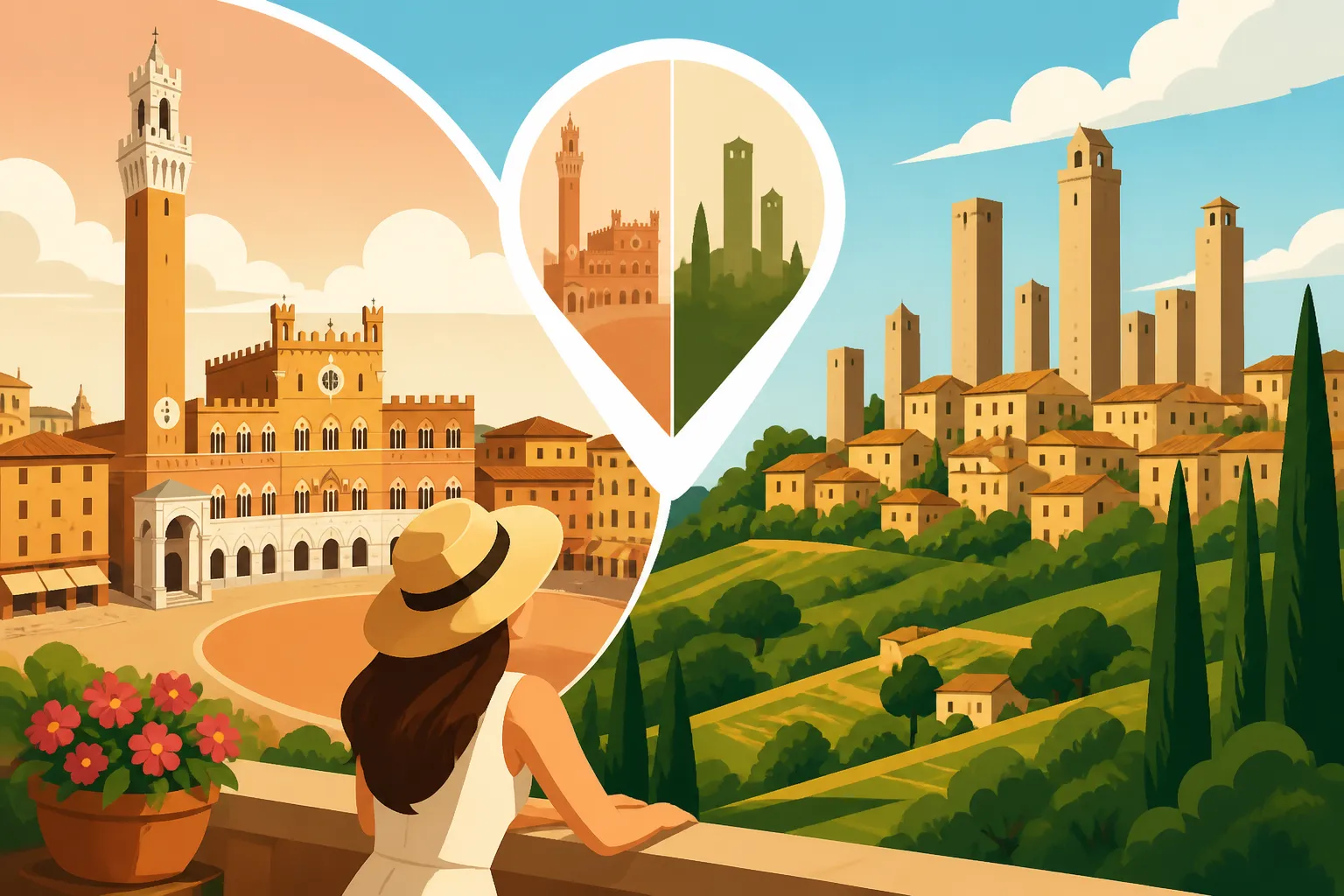
Before going neighborhood by neighborhood, it helps to know what you’re choosing between. Siena is a real, working city with a university, hospitals, offices and a fierce local identity built around its contrade, the historic neighborhoods that compete in the Palio. San Gimignano is a small walled town of towers that swells enormously during the day with tour groups and empties out in the evening. Both are wonderful. They just suit different travelers.
What Each Town Feels Like After the Day Trippers Leave
Here is the single most useful piece of advice I can give you: the magic of both towns happens after the coaches leave. Between late morning and late afternoon, Via di Città in Siena and Via San Giovanni in San Gimignano can feel like airport terminals. Then, as the light softens, the day visitors drain away and the towns hand themselves back to residents and overnight guests.
In Siena, the evening belongs to the Sienese. You’ll see families doing the passeggiata along Banchi di Sopra, students drinking spritz on the steps around Piazza del Campo, and contrada members gathering at their local headquarters. The city stays lively well into the night, especially in the San Martino area around Via Pantaneto, where the university crowd hangs out. It never feels like a museum after hours.
San Gimignano is the opposite. By nine in the evening, Piazza della Cisterna can be almost silent, with just a few couples eating gelato on the well steps and swallows wheeling around the towers. If you want romance, stillness and that “I have this medieval town to myself” feeling, it’s unbeatable. If you want bars, choice of restaurants and a sense of a living city, you may find it too quiet after two nights.
Who Should Base in Siena and Who Should Choose San Gimignano
Siena makes more sense if you’re relying on public transport, staying more than three nights, or want a wide range of restaurants, shops and pharmacies within walking distance. It has a train station and frequent coach connections to Florence, and it works well as a hub for the Crete Senesi, Montalcino and the Val d’Orcia. If you’re planning your wider route, my guide on Where to Stay in Tuscany: Choosing a Base for Wine Country or the Coast puts Siena in context with the rest of the region.
San Gimignano suits couples on a short romantic stay, travelers who love Vernaccia wine and countryside walks, and anyone with a rental car who wants to explore the Val d’Elsa and Volterra. It has no train station of its own, so without a car you’ll be relying on buses via Poggibonsi. That’s perfectly doable, and I explain how in How to Visit San Gimignano Without a Car, but it shapes how far you can roam each day.
Many of my friends who visit end up splitting their stay: two or three nights in Siena, then one or two nights in or near San Gimignano. That combination gives you city energy and small-town calm without a long transfer, since the two towns are close enough for an easy hop by car or bus.
| Base | Best For | Evening Atmosphere | Car Access | Main Trade-Off |
|---|---|---|---|---|
| Siena, around Piazza del Campo | First-timers, short stays, sightseeing on foot | Lively, social, busy until late | Inside ZTL, park outside the walls | Noise and crowds at peak times |
| Siena, San Martino or Camollia | Longer stays, local feel, quieter nights | Neighborhood bars, student life in San Martino | Inside ZTL, closer to some car parks | Some uphill walking to the Campo |
| Siena, outside the walls | Drivers, budget travelers, train users | Residential, very quiet | Easy, often with on-site parking | Walk or escalator ride into the centre |
| San Gimignano, inside the walls | Romantic short stays, evening atmosphere | Very quiet, almost silent late | Inside ZTL, luggage drop rules apply | Fewer services, crowded by day |
| San Gimignano countryside | Drivers, wine lovers, families wanting space | Rural and peaceful | Easy, usually free on-site parking | Car needed for almost everything |
| Colle di Val d’Elsa or Monteriggioni | Drivers wanting value and a central position | Small-town calm | Easy, short drives to both towns | Less of the classic postcard setting |
Where to Stay in Siena: Neighborhoods Inside and Outside the Walls
Siena’s historic centre is divided into three terzi: Terzo di Città, Terzo di San Martino and Terzo di Camollia. Each contains several contrade, and each has its own personality. The centre is compact, but it’s built on three ridges, so “close on the map” can still mean a steep climb. When I help friends choose a room, I always ask two questions first: will you have a car, and how much do you mind hills?
The entire historic centre sits within a ZTL, a limited traffic zone, enforced by cameras. Unless your hotel registers your plate for access, driving in can trigger a fine that arrives at your home address months later. Read What Is a ZTL in Italy and How to Avoid Fines before you pick up a rental car, because Siena is one of the places where visitors get caught most often.
Around Piazza del Campo and the Terzo di Città
If this is your first visit and you want to step out of your door into the heart of things, look at rooms within a few minutes’ walk of Piazza del Campo. The fan-shaped square is the city’s living room, and staying nearby means you can see it at dawn, before the cafés set out their tables, and again late at night when it glows under the lamps.
The Terzo di Città, just south and west of the Campo, holds the Duomo, the Santa Maria della Scala museum complex and the Pinacoteca Nazionale. Via di Città and Via del Capitano are lined with historic palazzi, some converted into boutique hotels and guesthouses. It’s a beautiful, atmospheric area, and it’s ideal if your days revolve around art and architecture.
The trade-off is noise and crowds. Rooms directly overlooking the Campo can be loud on summer nights, and the streets near the Duomo are packed with tour groups by mid-morning. One friend of mine booked a gorgeous room with a Campo view and spent half the night listening to a student celebration below. My advice: if you’re a light sleeper, choose a room on a side street a minute or two away and visit the square on your own schedule.
Practically, check whether the property has a lift. Many palazzi in this area are centuries old, and “third floor” in Italy means three flights above the ground floor, which can feel like five when you’re carrying a suitcase in July heat.
San Martino and Camollia for Quieter Local Life
The Terzo di San Martino stretches east from the Campo. Via Pantaneto is the university quarter’s main artery, full of inexpensive bars and casual places to eat, which makes it a favorite with younger travelers. Further out, around the Basilica of Santa Maria dei Servi, things become quiet and residential, with lovely views back across the city. This is where I’d send someone staying a week who wants to feel like a temporary resident rather than a tourist.
Camollia, the northern terzo, follows Via Banchi di Sopra and Via Montanini up toward Porta Camollia. It’s the elegant shopping spine of Siena and has a more everyday, local rhythm. The big advantage for many visitors is its position: it’s closer to the Fortezza Medicea, the Piazza Gramsci bus area and several car parks, which makes arriving and leaving much easier. The walk to the Campo is mostly gentle and downhill, which you’ll appreciate on the way in rather than on the way back.
Near Camollia’s western edge sits the Fontebranda area and the Sanctuary of Saint Catherine. It’s a characterful, quieter pocket with an ancient fountain, but the streets are notably steep. If you have mobility concerns, check the exact location of the property and the walking route before you book. A route that looks short can include a punishing climb.
Outside the Walls: Station Area, Viale Cavour and the Countryside
Staying just outside the walls is underrated, especially for drivers. Hotels along Viale Cavour, near the train station and in the residential areas beyond the gates often have their own parking, larger rooms and better air conditioning than converted palazzi inside the centre. Several public car parks around the city are linked to the historic centre by escalators, such as the one serving the San Francesco area and the one below Santa Caterina, which make the climb far less punishing.
The train station sits in the valley below the city. There’s an escalator link from the station area up toward the northern gates, and local buses run into the centre, so staying near the station can work well if you’re arriving by rail and plan day trips to Florence or elsewhere. If you’re coming from Florence for the day before deciding where to stay, How to Take a Day Trip to Siena From Florence walks through the train and coach options.
Further out, the countryside around Siena is full of country houses and agriturismi, from the soft clay hills of the Crete Senesi to the edges of Chianti. These are wonderful if you have a car and want space, a pool and silence. Just be realistic: you’ll drive in, park outside the walls, and walk. For a deeper look at what farm stays typically include, from breakfast to dinners and minimum stays, read Agriturismi in Italy: What’s Included and How the Booking Works.
Where to Stay in San Gimignano and the Val d’Elsa
San Gimignano is tiny. You can walk from Porta San Giovanni in the south to Porta San Matteo in the north in a matter of minutes, passing Piazza della Cisterna and Piazza del Duomo on the way. That compactness is its charm, but it also means the accommodation choice inside the walls is limited and fills early in busy months.
Sleeping Inside the Walls
Staying inside the walls gives you the reason to visit San Gimignano at all: the evening and early morning, when the towers belong to you. I’ll never forget my first night there, sitting on the steps of the cistern after dinner, hearing nothing but footsteps on stone. At seven the next morning I climbed up to the Rocca di Montestaffoli for views across the vineyards with only a jogger and a cat for company. By eleven, the same spot was shoulder to shoulder.
Inside the walls you’ll find a handful of hotels, family-run guesthouses and apartments in tower houses and palazzi. Rooms facing the valley can have extraordinary views over vineyards and olive groves. Rooms facing the main streets can be noisy in the early evening as the last day visitors leave and restaurants fill.
The car situation here needs care. The centre is a ZTL, and access is tightly controlled. Some properties can arrange temporary access for unloading luggage, while others ask you to use a car park outside the gates and walk in. Check this with the property before arrival, not when you’re sitting at the gate with the engine running. My guide to Parking at Italian Hotels: ZTL Zones and Why ‘Parking Available’ Costs Extra explains why “parking available” in a listing rarely means a free space outside your door.
Also, think about services. San Gimignano inside the walls has restaurants, wine bars, gelaterie and small shops, but fewer pharmacies, supermarkets and everyday services than Siena. For a two-night stay this hardly matters. For a week, it can start to feel limiting.
Agriturismi and Villas on the Surrounding Hills
The hills around San Gimignano are some of the most beautiful countryside in Tuscany, and they’re dotted with farm stays and restored stone farmhouses, many producing their own Vernaccia di San Gimignano and olive oil. For families or anyone wanting a pool, space for kids to run, and a slower pace, this is often a better fit than a room inside the walls.
I stayed on one such farm with visiting relatives, and the evenings were the highlight: dinner on a terrace with the towers lit up on the horizon, the owners explaining their wine, children chasing fireflies. The flip side was that every outing, even a quick coffee in town, meant getting in the car. Some farms are on white gravel roads, so check whether your rental car and your nerves are suited to that.
When comparing these properties, look closely at the distance to town in actual driving time, whether dinner is offered on site, and whether there’s a minimum stay in busy months. Many rural properties prefer bookings of several nights during summer, and that can affect how you plan the rest of your route.
Colle di Val d’Elsa, Poggibonsi and Monteriggioni as Practical Alternatives
If you have a car and want one base for both Siena and San Gimignano, look at the towns in between. Colle di Val d’Elsa is an underrated gem with a medieval upper town famous for crystal-making and a more modern lower town with everyday services. It often offers better value than San Gimignano and sits within easy driving distance of both.
Poggibonsi is less romantic but very practical. It has a train station and bus connections to San Gimignano and Siena, supermarkets and plenty of accommodation, which makes it a sensible base for travelers on a budget or those relying on public transport. Think of it as a functional springboard rather than a destination in itself.
Monteriggioni, the tiny walled village on the Via Francigena, is a lovely option for a night or two. Its ring of walls and towers is almost absurdly picturesque, and staying there feels like sleeping inside a castle. It’s very small and very quiet, so it suits travelers who want calm above all, with Siena a short drive away.
How to Book Your Tuscan Hill Town Stay on Booking.com
After years of booking rooms for myself, friends and visiting family, I keep coming back to Booking.com for Siena and San Gimignano. The reason is simple: these towns are full of small, family-run guesthouses, agriturismi and historic hotels that don’t have polished websites of their own, and Booking.com puts them all side by side with a map, verified guest reviews and filters that answer exactly the questions that matter in hill towns. You can see whether a property has parking, a lift or air conditioning before you commit, instead of discovering it on arrival.
Filters That Actually Matter in Siena and San Gimignano
Here are the filters and listing details I check every time, and why each one matters in these particular towns:
- Map view: Always switch to the map. A property listed as “Siena” might be in the centre or in a suburb, and the map shows you instantly which side of the walls it’s on and how close it is to the Campo, a car park or the station.
- Parking: Filter for parking if you’re driving, then read the details. Look for whether it’s on site, nearby, free or paid, and whether reservation is needed. In ZTL areas this detail can save you a fine.
- Lift: In historic palazzi, filter for a lift or read the facilities list carefully. Stairs in medieval buildings are steep and narrow.
- Air conditioning: Summer in the Sienese hills can be very hot, and thick stone walls only help so much. My guide to Air Conditioning and Heating in Italian Accommodation: What to Verify explains what to look for in the listing wording.
- Reception hours and check-in instructions: Many small guesthouses don’t have a 24-hour desk. Booking.com shows check-in windows, and you can message the property through the platform to arrange a late arrival.
- Guest review keywords: Search reviews for words like “noise,” “stairs,” “parking” and “walk.” Recent guests are brutally honest about hills and street noise.
I also like that Booking.com lets you message properties directly before and after booking. When I booked a room inside San Gimignano’s walls for my parents, I asked through the platform whether they could arrange luggage access by car. The owner replied with clear instructions and even registered our plate for the ZTL. That one message turned a potentially stressful arrival into a smooth one.
If you book often, the Genius loyalty program can unlock discounts and perks at participating properties, such as free breakfast or room upgrades. The value varies by property and level, so read Booking.com Genius Levels in Italy: What the Discounts Are Actually Worth before you let it sway your decision.
Timing Your Booking Around Seasons and the Palio
High season in Siena and San Gimignano runs from late spring through summer into early autumn, with July and August the most crowded and most expensive stretch. Rooms inside the walls of both towns can sell out well in advance during these months, especially at weekends. The quietest and often best-value period runs from November through March, outside the Christmas holidays, when you’ll share the towns mainly with locals.
Siena’s Palio changes everything. The horse race in Piazza del Campo takes place twice each summer, on 2 July and 16 August, and the days leading up to each race are filled with trial runs, processions and contrada dinners. Rooms near the Campo are in huge demand, minimum stays are common, and some properties fill months ahead. If you want to be there, book as early as you can. If you’d rather avoid the crush, check the dates and plan around them. For a detailed look at pricing patterns around the race, see Siena’s Palio: What Accommodation Actually Costs Around the Race.
Cancellation policy matters more than usual in high season. Booking.com clearly labels free cancellation and non-refundable rates, and in busy months I often lock in a refundable room early, then keep an eye out for something better. For the full reasoning on when a cheaper non-refundable rate is worth the risk, read Refundable vs Non-Refundable Rates in Italy: When the Discount Is Worth It.
Finally, budget for the local tourist tax, which is usually paid at the property and is not always included in the price you see online. Both towns apply it, and rules differ by type of accommodation and length of stay. My guide to Italy’s Tourist Tax by City: Tassa di Soggiorno and What You Pay explains how it works and what to expect at check-in.
A Step-by-Step Booking Checklist
This is the exact routine I follow when booking a hill town stay for myself or for friends:
- Decide your base first: Siena, San Gimignano, the countryside, or a town in between, using the comparison table earlier in this guide.
- Confirm whether you’ll have a car for this part of the trip, because it determines whether a countryside property is realistic and whether ZTL access matters.
- Open Booking.com, enter your dates, and immediately switch to the map view to see exactly where each property sits relative to the walls.
- Apply the filters that matter to you: parking, lift, air conditioning, free cancellation and review score.
- Shortlist three or four properties and read the most recent guest reviews, searching for “noise,” “stairs,” “parking” and “walk.”
- Check the check-in window and reception hours against your expected arrival time.
- Message your top choice through the platform with any questions about luggage access, ZTL registration or late arrival.
- Book a refundable rate if your dates are in high season or around the Palio, and note the cancellation deadline in your calendar.
- A few days before arrival, reread the property’s instructions for directions, parking and key collection, and save them offline on your phone.
- On arrival, have your passport ready, since Italian accommodation is required to register guests, and be prepared to pay the tourist tax locally.
Booking a hill town base doesn’t have to be stressful. Once you understand the walls, the hills and the ZTL, the choice becomes clear, and Booking.com gives you the map, the filters and the direct line to the owner that make getting it right easy. Pick your base, check your filters, and get ready for that first evening when the day crowds leave and the towers turn gold.
Disclaimer
This article is for general informational purposes only and does not constitute professional advice. Laws, prices and regulations vary by location and change over time. Consult a qualified professional for guidance on your specific situation.