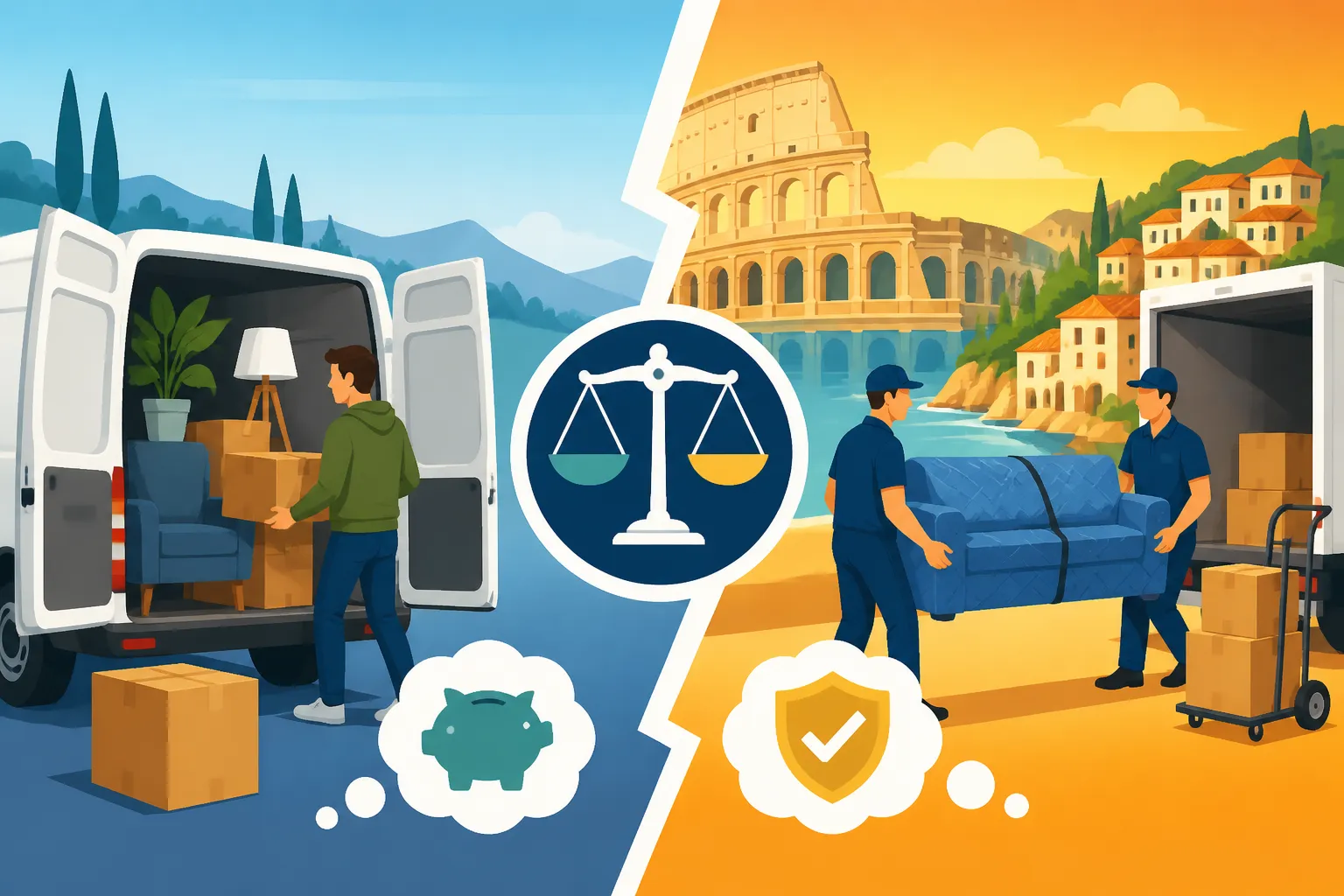
DIY Van Move vs Professional Movers to Italy: Real Cost Comparison
Picture this: you’ve found a flat in Bologna, the contract is signed, and you’re staring at a van hire quote that seems far cheaper than any removal company. Then the extras start appearing. Tolls, a one-way drop fee, a ZTL fine, and a fourth-floor walk-up. This guide compares a DIY van move with professional movers to Italy, cost line by cost line.
Disclosure: This post may contain affiliate links. We may earn a commission at no extra cost to you if you make a purchase through these links. Read full disclosure.
Why the DIY Van Move Looks Cheaper Than It Is
I’ve done both. My first move into Italy was a rented van, two friends, a cooler full of sandwiches, and a lot of optimism. My second was with a removal company I found after comparing quotes on Sirelo. The second move cost more on paper. Once I added up everything the first one really cost, including a strained back and a parking fine that arrived months later, the gap was much smaller than I expected.
The van hire price is one number on a screen. A move into Italy is a chain of small costs, and many of them only appear after you’ve committed. Below is how that chain works.
The Quote You See Versus the Bill You Pay
A van rental quote usually covers the vehicle, a basic mileage allowance, and minimum insurance. It does not cover fuel for a long cross-border run, motorway tolls, Alpine tunnel fees, ferry crossings, or the extra insurance you’ll want once your entire life is in the back. It also leaves out packing materials, furniture blankets, straps, a hand truck, overnight accommodation on the way, and food for everyone helping.
A professional quote, when it’s a proper written one, tends to work the other way round. It bundles labour, fuel, tolls, the vehicle, and often packing into one figure. The extras it may exclude are access-related: long carries from the truck to your door, stairs without a lift, permits to park in a historic centre, or an external furniture lift. These are worth checking line by line, and the guide on Hidden Costs in Italian Moving Quotes: ZTL Permits, Stairs, and Access Fees covers them.
So a fair comparison sets a full DIY estimate against a full professional quote, with the access extras included on both sides. Comparing a bare van rental with an all-in removal quote tells you nothing useful.
One-Way International Van Hire and Drop-Off Fees
This is where many DIY plans stall. Plenty of rental companies don’t allow their vans to be dropped in another country at all. The ones that do usually charge a one-way international fee, and it can be large because the company has to get the vehicle back. Some only allow cross-border one-way hire between particular branches, and those branches may be nowhere near your new Italian town.
The alternative is a return trip. You drive to Italy, unload, then drive the empty van all the way back, and fly back to Italy again. That doubles your fuel, tolls, and driving days, and adds a flight. For a move from somewhere close, like Munich to Verona, a round trip can still work. For anything longer, the numbers turn against you fast.
There’s also the vehicle itself. If you hire in the UK, you’ll get a right-hand-drive van. On Italian roads, where traffic keeps to the right, that puts the driver on the kerb side, so overtaking and reading tollbooth lanes get harder. A van hired on the continent is left-hand-drive, the normal layout for Italy, so the sensible choice is often to fly out and collect a van from a continental branch. That only makes sense if the one-way terms allow it.
Your Own Time as a Line Item
Your time costs money, even if no one invoices you for it. A DIY international move usually takes several days of packing, a full day of loading, one to three days of driving depending on the origin, a day of unloading, and often a return journey. If you’re self-employed or using unpaid leave, those days have a real value.
Then there’s the help. Friends who drive across Europe with you will want their travel covered, at the very least. A rented van may also limit who can drive it legally. Some rental contracts only cover drivers above a certain age or with a licence held for a minimum period, so read the terms before you count on a co-driver.
Finally, there’s risk to your body. Carrying a washing machine down three flights of stone stairs in a palazzo with no lift is how people end up visiting an Italian pronto soccorso in their first week. I’m not being dramatic. The building stairwells in older Italian centres are narrow, steep, and often worn smooth.
The Real Cost Breakdown: DIY Van vs Professional Movers to Italy
Here is the honest structure of both options. Rates change with fuel prices, season, origin city, and volume, so the figures have to come from your own quotes. The shape of the costs stays the same, and that’s what lets you build your own estimate.
Line-by-Line Cost Components
| Cost component | DIY van move | Professional movers |
|---|---|---|
| Vehicle | Daily hire rate plus mileage, often with a one-way international surcharge | Included in the quote |
| Fuel | You pay all of it, both ways if you return the van | Included |
| Motorway tolls | You pay at each country’s system, with van classes sometimes charged above car rates | Included |
| Alpine tunnels and vignettes | You pay per crossing and buy any required vignettes | Included |
| Labour | Your own time plus friends, or paid local helpers at each end | Included, usually a two- or three-person crew |
| Packing materials | Boxes, tape, blankets, bubble wrap bought separately | Often included or available as an add-on |
| Professional packing | Not available unless you hire it separately | Optional add-on service |
| Accommodation en route | Hotels for driver and helpers | Not your cost |
| Insurance for goods | Basic van cover rarely protects contents; separate cover is needed | Liability cover usually included, with full-value cover as an option |
| Parking permits at delivery | You arrange with the Comune yourself | Often arranged by the mover, sometimes charged as an extra |
| Furniture lift | You hire it locally, if you can find one | Often available as a quoted extra |
| Return journey | Fuel, tolls, and time again, or a flight back | Not your cost |
| Damage risk | Entirely yours | Shared with the mover under contract terms |
| Fines | ZTL and parking fines arrive at the rental company, which passes them on with an admin charge | The mover’s responsibility when they’re driving |
When you put the rows side by side, the DIY option is only cheaper where several things line up at once. You need a short distance, a small volume, a building with easy access, free help, and a rental company that allows sensible one-way terms.
A Worked Scenario: A One-Bedroom Flat From Munich to Bologna
Let’s take Clara, a graphic designer moving from Munich to Bologna. She has a one-bedroom flat with a bed, a sofa, a desk, books, kitchen boxes, and a bike. The volume fits comfortably in a medium van.
Going DIY, Clara rents a van in Munich. Her rental company allows one-way hire to Italy, but only to a branch near Bologna airport, with a surcharge. She buys an Austrian digital vignette, pays the separate Brenner motorway toll, then pays Italian autostrada tolls from the border to Bologna. She drives in one long day with a friend sharing the driving. In Bologna her new flat is inside the ZTL, so she has to arrange temporary access and a spot to park the van. She also pays the friend’s train ticket home. On balance, Clara’s DIY move comes out cheaper than the professional quotes she got. The route is short and EU-internal, her volume is small, and her building has a lift.
For Clara, the professional alternative worth comparing is a part-load or groupage service, where her goods share a truck with other households heading south. That can narrow the gap a lot, so she should still request quotes before renting anything. The guide Moving to Italy from Germany: Road Freight Costs and Transit Times explains how those shared routes work.
A Worked Scenario: A Family Home From Manchester to Lucca
Now take the Harrisons, a family of four moving from a three-bedroom house near Manchester to a rented villa outside Lucca. They have beds, wardrobes, a dining table, a piano they can’t bear to sell, and years of accumulated belongings. A single large van won’t hold it all. Realistically they’d need two vans or several trips, and the largest vans may push past what a standard car licence allows.
The DIY route here means a Channel crossing, the full length of France, and an Alpine crossing or the coastal route into Liguria. After Brexit there is also a customs dimension, because the UK is now outside the EU. The family would need to handle import declarations themselves and claim duty relief on personal effects, which involves paperwork a professional international mover deals with every week. The details are in Moving to Italy from the UK: ToR Relief, Customs Declarations, and Costs.
Add the piano, which needs specialist handling, and a gravel access road at the villa that a large van struggles with. DIY stops being a budget option and becomes a high-risk one. For the Harrisons, a professional full-load move is almost certainly the better value. Their job then is to find the right company at a fair price, and that’s where comparing several quotes through Sirelo pays off.
Driving a Loaded Van Into Italy: What Actually Happens on the Road
If you’re still leaning towards DIY, good. It can work, and I don’t want to put you off a perfectly sensible plan. But go in with your eyes open about the journey itself, because Italy has a few quirks that catch first-time van drivers.
Alpine Crossings, Tolls, and Vignettes
Unless you’re coming from the south of France along the coast, you’ll probably cross the Alps. The main road routes are the Brenner Pass from Austria, the Fréjus and Mont Blanc tunnels from France, and the Gotthard and San Bernardino routes through Switzerland. Each has its own fee structure. The Mont Blanc and Fréjus tunnels charge per crossing, with vehicle classes based on size. Austria requires a vignette for its motorways, plus a separate toll for the Brenner section. Switzerland requires its own motorway vignette.
Switzerland adds one more complication. It isn’t in the EU customs union, so a van full of household goods passing through is technically carrying goods in transit through a non-EU country. Check Swiss customs guidance for private household goods in transit before you plan that route. Many DIY movers from Germany simply take the Brenner instead to keep the whole route within the EU.
Once you’re in Italy, the autostrada network is tolled, and you’ll collect a ticket on entry and pay on exit. Toll classes depend on the number of axles and the vehicle’s height at the front axle, so a tall van may be charged at a higher class than a car. Telepass lanes are for subscribers, so stick to the lanes marked for cards or cash. Driving into the yellow Telepass lane without a device is a stressful mistake to make with a queue of lorries behind you.
ZTLs, Centro Storico Streets, and Parking Permits
This is the part that hurts DIY movers most. Almost every Italian city with a historic centre has a Zona a Traffico Limitato, a restricted traffic zone watched by cameras at every entry gate. Drive through an active gate without authorisation and a fine follows, often months later. With a rental van, the fine goes to the rental company first, and it passes the fine on to you with an administrative charge added. If you take a wrong turn and pass several gates, each one can generate its own fine. Read What Is a ZTL in Italy and How to Avoid Fines before you set off, and contact your local Comune or the city’s mobility office about temporary access for a move.
Parking is the second problem. On many historic streets you can’t stop a van for three hours while you unload. You’ll usually need a permit for temporary use of public space, known as occupazione di suolo pubblico, issued by the Comune or local police. It takes time to process and needs to be applied for in advance. Professional movers working regularly in Italian cities know this process and often handle it for you. For a DIY mover it’s one more bureaucratic step, in Italian, just as you’re juggling everything else.
I learned this in Florence. I had a van, a street barely wider than the van, a scooter rider shouting at me, and a polite but firm vigile urbano explaining that I couldn’t stay there. We unloaded in record time, half the boxes went in the wrong rooms, and I paid for it in sore shoulders for a week.
Unloading Without a Furniture Lift
Italian apartment buildings have their own logic. Older palazzi often have tiny lifts, if any, that won’t take a sofa or a wardrobe. Professional movers in Italy routinely use an external furniture lift, called a montamobili or autoscala, which extends up the facade to a window or balcony. Your sofa then goes in through the window instead of up the stairs.
As a DIY mover you can hire one of these with an operator locally, but you’ll need to find the company, book it, and coordinate it with your arrival time and parking permit. If your van is delayed by a tunnel closure or traffic, the whole schedule falls apart. More detail on access challenges is in Delivery Day in an Italian Building: Narrow Streets, Lifts, and Permits.
Also think about whether your furniture will actually fit once you get it there. Italian apartments often have narrow doorways, awkward hallways, and fitted kitchens that leave no space for a large fridge-freezer. See Will Your Furniture Fit? Italian Apartment Layouts vs Northern European Homes before you pay to transport something across a continent that won’t go through the front door.
Customs, Paperwork, and Insurance Risks
The road is the visible part of a move. The paperwork is the hidden part, and it’s where a cheap move can turn expensive in a way you can’t fix with a bit more effort.
EU Moves Versus Non-EU Moves
If you’re moving from another EU country, your household goods move freely. There’s no customs declaration for personal belongings, and a DIY van move is administratively simple. That’s a big reason DIY works best for EU-internal moves over modest distances.
Moving from outside the EU, including from the UK, Switzerland, or further afield, is different. Your goods are an import. Italy offers relief from duty and VAT on personal effects when you transfer your residence. To claim it, you need the right documentation: proof of your move, an inventory, and evidence that you’ve owned and used the items for the required period. The rules are explained in Trasferimento di Residenza: The Italian Duty Exemption for Personal Effects.
A professional international mover will prepare the inventory, submit customs documents, and often use a customs broker. A DIY mover can do this personally, but it means dealing with customs procedures at a border or an inland office, in a language you may still be learning. A missing document can leave you with an unexpected duty bill, or with your van stuck at a customs office.
Damage, Theft, and Who Pays
Standard van rental insurance covers the vehicle, usually with an excess. It generally doesn’t cover your belongings inside it. Your home contents insurance may stop covering goods once they leave your old address, and it may not cover goods in transit across borders at all. Check both policies carefully, because a single motorway service area break-in could wipe out years of possessions.
Van security matters too. On a multi-day route you’ll probably stop overnight, and a loaded rental van in a hotel car park is an obvious target. Professional movers use secure depots and trucks built for long-haul removals, and their staff are used to managing the risk.
Professional moves come with contractual liability, though basic liability is often limited and valued by weight rather than by what an item is worth. Full-value transit insurance is usually offered as an extra. Learn the difference before signing, and read Moving Insurance for Shipments to Italy: Coverage, Valuation, and Claims for the claims side.
| Risk area | DIY van move | Professional movers |
|---|---|---|
| Goods damaged during loading | You absorb the loss | Covered under the mover’s liability, within contract limits |
| Goods damaged in transit | Usually not covered by van insurance | Covered by transit cover if purchased |
| Theft from vehicle | Rarely covered for contents | Mover’s responsibility under contract |
| Vehicle damage | Covered by rental insurance minus excess | Not your concern |
| Customs errors for non-EU moves | Your responsibility, including duty bills | Handled by mover or their customs broker |
| Missed delivery slot or permit | You re-book and absorb costs | Mover reschedules, with terms set in contract |
| Injury while lifting | Your own health and costs | Crew is trained and insured |
Where Professional Movers Earn Their Fee
Once you can see the whole DIY picture, the professional quote starts to look different. You’re not paying someone to drive a truck. You’re paying for logistics, equipment, insurance, and experience with Italian buildings and bureaucracy.
Groupage, Part Loads, and Shared Trucks
The biggest change in recent years is how affordable shared transport can be. With groupage, also called part-load, your goods share a truck with other households heading in the same direction. You pay for the volume you use, not the whole vehicle. The trade-off is time. Delivery windows are wider, because the truck waits to fill up and makes several stops.
For a small move where you’re flexible on dates, groupage can come close to DIY cost while removing most of the risk and effort. For larger moves, a dedicated full load becomes more economical per cubic metre and gives you a fixed delivery date. Our guide on Full Load vs Groupage to Italy: Cost Break-Even by Cubic Metre walks through where the switch-over happens.
The catch is that groupage is offered by some removal companies and not others, and pricing varies widely by route. This is a strong reason to compare quotes through Sirelo, where you send one moving request and receive offers from several international movers. Some will offer shared loads on your route; others won’t.
Packing, Crating, and Access Equipment
A good removal crew can pack a two-bedroom home in a day. They bring the right boxes, wardrobe cartons, mirror crates, and blankets, and they know how to stack a truck so nothing shifts on the hairpin bends near the Brenner. For fragile or valuable items like artwork, glass tables, antiques, and pianos, custom crating is often the only safe way to make the trip.
On the Italian end, the crew may bring or arrange the furniture lift, handle the Comune permit, and carry heavy items up stairs that would defeat you and two friends. Many crews will also reassemble the beds and wardrobes they took apart at the origin. After a cross-continental drive, that alone is worth a lot.
Then there’s scheduling. Heavy trucks in Italy face driving bans on certain weekends and public holidays, especially in summer. Experienced movers plan around these. A DIY renter in a smaller van usually isn’t affected, which is a small point in favour of doing it yourself.
When DIY Genuinely Wins
To be fair, DIY can be the right call, and I’d do it again in the right circumstances. It makes sense when most of these are true:
- You’re moving within the EU, so no customs paperwork applies.
- The distance can be covered in one long day of driving, or two at most.
- Your volume fits easily in a single medium van that your licence covers.
- You have strong, reliable friends, or can hire local helpers at both ends.
- Your Italian address has easy access, ideally outside a ZTL and with a usable lift.
- Your rental company offers a reasonable one-way international option, or you’re happy to drive back.
- You have few fragile, valuable, or very heavy items.
- You have flexible time off and don’t mind a few hard days.
If you can tick nearly all of these, DIY may well save you money. If you can only tick half, request professional quotes before deciding. If you’re moving from outside the EU, with a family-sized household or a historic-centre address, a professional move will almost always win once you count the real costs.
Using Sirelo to Get Real Numbers Before You Decide
Everything above leads to one practical point. You can’t make an honest DIY-versus-professional comparison without real professional quotes in hand. Estimates from forums or rough guesses won’t do, because international removal prices to Italy vary so much by route, season, and volume. Sirelo is the tool I’d recommend for this. It’s a moving comparison platform that lets you describe your move once and receive quotes from several international removal companies, so you compare actual offers rather than guessing.
How to Request and Compare Quotes
When you fill in a moving request on Sirelo, you’ll provide your origin, your Italian destination, your approximate moving date, and details about your home and belongings. Be as precise as you can. Mention stairs and lift access at both ends, whether your Italian address is in a historic centre, and any special items like a piano or artwork. The more accurate your request, the more accurate the quotes, and the fewer surprise extras later.
When quotes come in, don’t just sort by the headline price. Look at what each one includes: packing, labour, insurance level, furniture lift, parking permits, customs handling for non-EU moves, and the delivery window. A quote that looks cheap but excludes the furniture lift and the Comune permit may end up costing more than a pricier all-in offer. The breakdown in Comparing International Removal Quotes for Italy: Line Items That Hide Costs is useful to have open at this stage.
Then build your DIY estimate using the cost table earlier in this guide, with real figures from your rental company, the toll operators, the tunnel operators, and your local Comune. Set it against the best two or three professional quotes from Sirelo. Now you’re comparing like with like, and the decision usually makes itself.
Reading Reviews and Spotting Red Flags
Sirelo also publishes reviews of removal companies from customers who have used them. For an international move, these are gold. Look for reviewers who moved on a similar route to yours, and pay attention to how companies handled problems like delays, damage claims, or customs hold-ups. Every company has a bad day sometimes. What matters is whether they sorted it out.
Red flags worth watching for include:
- A quote far below every other offer, with vague terms.
- No physical address, or no visible company registration.
- Pressure to pay a large deposit in cash or through unusual methods.
- Refusal to provide a written inventory or contract.
- Unclear answers about insurance coverage and how claims work.
- No experience with your specific route or with Italian access conditions.
For a broader look at vetting a removal firm, see Choosing Movers for a Relocation to Italy, which pairs well with the reviews you’ll find on Sirelo.
A Step-by-Step Decision Process
Here’s the process I’d follow if I were planning my move to Italy today:
- Make a room-by-room inventory of what you’re actually taking, and be ruthless about selling bulky items that won’t suit Italian apartments.
- Estimate your volume roughly, or use a mover’s survey to get it right.
- Check your Italian address for ZTL status, lift access, street width, and parking restrictions, ideally by asking your landlord or agent.
- Confirm whether your move is EU-internal or involves customs, and gather residence-transfer paperwork if needed.
- Submit a detailed moving request on Sirelo to get several professional quotes, asking specifically about groupage options if your volume is small.
- Get a full DIY estimate, covering one-way van hire terms, fuel, tolls, tunnels, vignettes, ferry crossings, accommodation, helpers, materials, contents insurance, permits, and the return trip.
- Compare both totals on equal terms, including the value of your own time and the risk of damage or injury.
- Read reviews for your shortlisted movers and ask each one detailed questions about access, insurance, and delivery windows.
- Book early, especially for summer moves, then work back through a timeline such as An International Move to Italy: The 12-Week Planning Calendar.
- Apply for the Comune parking permit or confirm the mover is handling it, and book a furniture lift if needed.
Moving to Italy is exciting and exhausting in equal measure, and you deserve to arrive with your energy intact rather than spent on a van wrestling a wardrobe through a medieval doorway. Whether you end up behind the wheel yourself or handing the keys to a professional crew, get the real numbers first. Start by requesting your quotes on Sirelo, set them against your honest DIY estimate, and choose the move that leaves you ready to enjoy your first evening on an Italian balcony.
Disclaimer
This article is for general informational purposes only and does not constitute professional advice. Laws, prices and regulations vary by location and change over time. Consult a qualified professional for guidance on your specific situation.