Rome to Milan: Trenitalia vs Italo on Price, Time, and Comfort
Your trip goes Rome, then Milan. You open two booking sites and the same afternoon shows two different prices. Both trains have four names for their seats, and none of them match. The departure times only partly overlap. This guide compares Trenitalia and Italo on the Rome to Milan route by price, journey time, and comfort, so you can pick the right train and book it in a few minutes.
Disclosure: This post may contain affiliate links. We may earn a commission at no extra cost to you if you make a purchase through these links. Read full disclosure.
Why Rome to Milan Is Italy’s Most Competitive Rail Route
The first time I took a train from Rome to Milan, I stood in the main hall at Roma Termini with two apps open. I was sure I had missed something. Two companies were selling high-speed tickets on the same tracks, at nearly the same times, with fares that rose and fell as I refreshed the screen. It felt like booking a flight, not a train. In practice that is exactly how it works.
This corridor links the capital with the country’s business and fashion hub, so both operators put their best trains and most frequent schedules here. For travelers, competition is good news: more departures, more fare options, and a real reason for each company to keep its trains clean and comfortable. The downside is choice overload. If you don’t understand how the two operators differ, you can overpay, sit in a carriage you didn’t want, or arrive at the wrong Milan station.
Two Operators Sharing One High-Speed Line
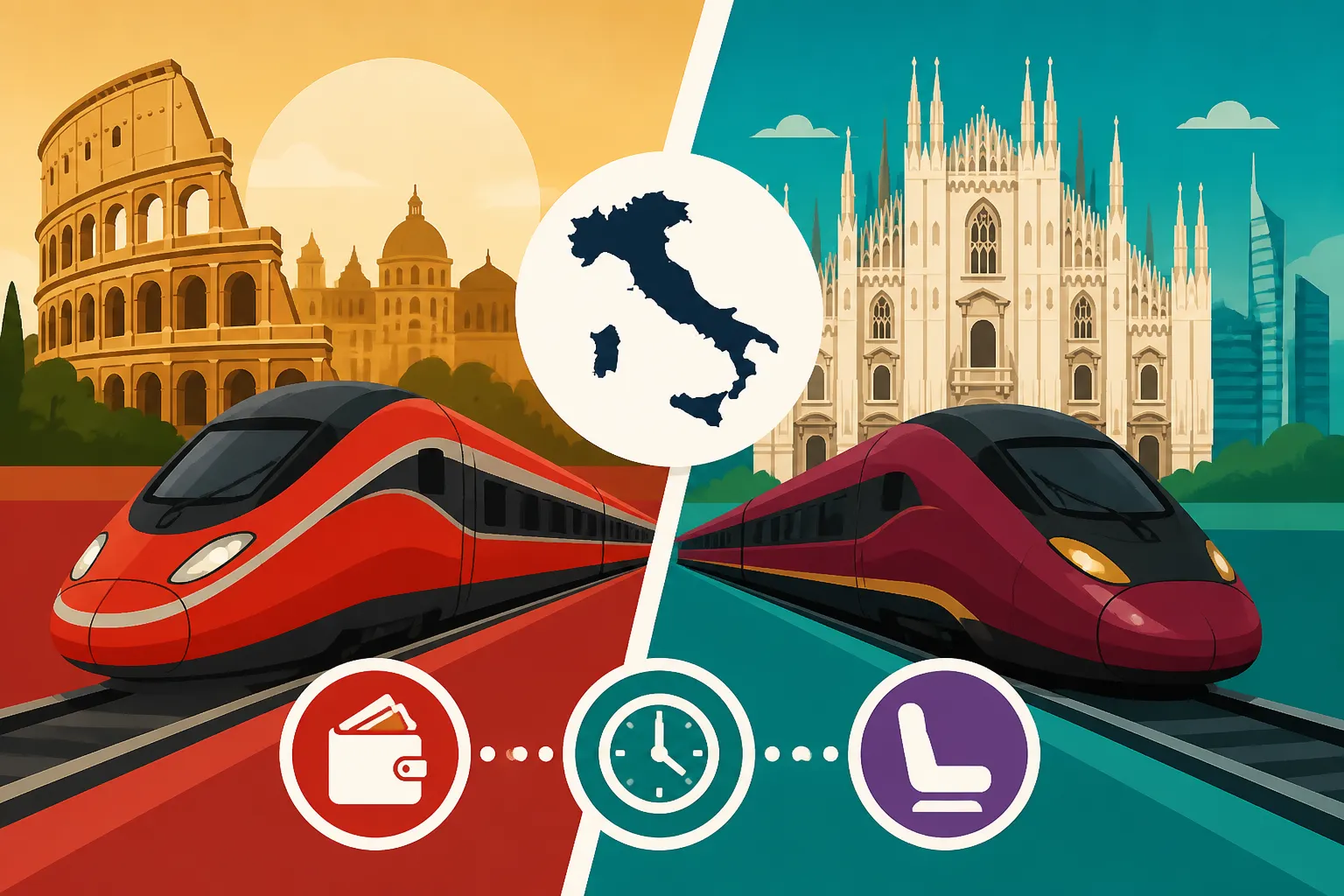
Trenitalia is the state-owned operator. Its high-speed brand on this route is the Frecciarossa, the red-nosed train you will see on posters across Italy. Italo is a private competitor. Its burgundy trains run only on the high-speed network. Both use the same dedicated line through Florence and Bologna, the same signalling, and largely the same main stations.
Since the tracks are shared, the trip itself feels similar. Both trains glide out of Rome, cross the Tuscan countryside, stop or pass through Florence, go through the long Apennine tunnels to Bologna, and then run across the flat Po Valley into Lombardy. The real differences are fare structure, seating classes, onboard service, and the timetable of each specific departure. If you want the wider picture of how both companies operate across the whole country, I cover it in High-Speed Trains in Italy: Trenitalia, Italo, Routes, and Savings.
Picture a typical case. Sarah is a teacher from Manchester spending a week in Italy. She books Trenitalia because it’s the “official” railway and pays far more than her friend, who booked Italo for the same morning a week earlier. Neither choice was wrong. Sarah simply didn’t compare. On this route the brand matters much less than when you book and which fare you pick.
The Stations at Each End and Why They Matter
In Rome, both operators serve Roma Termini, the central hub, and Roma Tiburtina, a modern station in the east of the city. Termini is the obvious choice if you’re staying near the centre, Esquilino, or Monti. Tiburtina can be more convenient if you’re in the eastern districts. It is also generally calmer than the crowds at Termini.
In Milan, both operators serve Milano Centrale, the huge station whose main hall alone is worth seeing. Both also serve Milano Rogoredo in the south-east. Some Italo departures also call at Milano Porta Garibaldi, which sits beside the Porta Nuova business district and the Isola neighbourhood. If your hotel is near Garibaldi or you have a meeting in the glass towers around Piazza Gae Aulenti, arriving there can save you a metro ride.
Check the arrival station on every ticket. This is the single detail that most often trips up travelers on this route. A friend of mine once booked a cheap Rome to Milan fare, saw “Milano” on the confirmation, and went to Centrale for her return. Her train was leaving from Rogoredo. She made it, but only after a stressful metro dash. Before you pay, read both station names in full.
Price: How Trenitalia and Italo Fares Actually Work
If you remember one thing about pricing on this route, make it this: neither operator is always cheaper. Both use dynamic pricing. Fares depend on demand, how far ahead you book, the time of day, and how many seats in each fare bucket are already sold. A Tuesday mid-morning train booked weeks ahead can cost a fraction of a Friday evening train booked the day before. That is true whichever logo is on the side.
Dynamic Pricing and the Booking Window
Both companies release seats at several price levels. The cheapest levels sell out first. Book early and you’re likely to find the lowest fares on both operators. Book late, especially on busy business-commuter departures at the start and end of the working day, and you’ll often see only the highest flexible fares left.
Demand follows patterns. Early-morning trains on Monday and evening trains on Friday fill with business travelers, consultants, and Milanese returning home from Rome. Mid-morning and early-afternoon trains midweek are often quieter and cheaper. Weekends around major holidays, trade fairs, and events in Milan push prices up across the board. I explain how fares move as departure gets closer in Italian Train Price Curves: How Fares Move From 90 Days Out to Departure.
Here is a practical example. Marco is an American graduate student who needs to get from Rome to a job interview in Milan. He knows the date two weeks ahead. He checks a Monday early-morning departure, which is expensive on both operators. He then checks the Sunday-evening departures before it and finds both noticeably cheaper. He takes a Sunday-evening train, stays in a modest hotel near Centrale, and arrives at the interview rested instead of rushing off a dawn train. Being flexible by even a few hours often saves more than switching operators.
Fare Types and Flexibility on Each Operator
Trenitalia sells its high-speed tickets in fare types that trade price against flexibility. The Base fare is the most flexible. It allows changes and refunds under the conditions Trenitalia sets. Economy is cheaper but more restricted. Super Economy is the cheapest and the most restrictive. Treat it as a fixed commitment to that train. The full rules for each type are set out in Italian Fare Types: Base, Economy, and Super Economy Change Rules.
Italo uses its own names. Flex is the flexible option. Economy and Low Cost are the cheaper, more restricted options. The logic matches Trenitalia’s: the less you pay, the less you can change. Change and refund conditions differ in detail between the two operators and can be revised, so read the conditions on the fare you’re actually buying before you pay.
When should you pay for flexibility? If your plans might shift, such as a business meeting that could move, a connecting flight that could be delayed, or travel with small children, a flexible fare is often worth it. If your dates are fixed and you’re travelling light for a holiday, the cheapest restricted fares on either operator usually make the most sense. In my experience, a flexible fare pays for itself the first time plans change. If plans never change, the extra cost buys nothing.
Comparing Both Operators in One Search With Omio
This is where most of the frustration on this route comes from. Trenitalia and Italo have separate websites and separate apps. Neither shows the other’s trains. To compare properly on your own, you have to search one, note the times and fares, search the other, and line them up yourself, often while prices keep changing. On a phone, between other tasks, that soon gets tedious.
Omio fixes this by showing Trenitalia and Italo departures for Rome to Milan in one list, ordered by time or price. You see the competing trains next to each other: which leaves closer to your preferred time, which arrives at the Milan station you want, and how the fares compare at that moment. For first-time visitors who don’t yet know the two brands, a single view like this prevents the classic mistake of booking whichever site happened to appear first.
Omio’s interface is in English, it accepts the foreign cards most visitors carry, and it delivers mobile tickets you can show on your phone. That matters on this route because the operators’ own sites sometimes reject foreign cards or confuse travelers with Italian-only steps. The usual card and name-matching problems are explained in Booking Italian Trains From Abroad: Foreign Cards, Names, and Failures. Omio may add a booking or service fee on top of the operator fare, and that changes how cheap a fare really is. Check Omio’s own checkout page for the current total before you confirm. For most travelers who value seeing both operators at once, the convenience is worth it.
Time: Journey Length, Frequency, and Stopping Patterns
On this route the operator matters less for journey time than the specific train. Both run fast departures with few or no stops, and both run slower departures that call at several cities. The fastest services from each operator are broadly comparable. What separates them is the stopping pattern of the departure you choose and how many trains each operator runs at the time of day you need.
Non-Stop Versus Stopping Services
The quickest trains run Rome to Milan with no intermediate stops, or call only at one or two major stations. These are the services business travelers compete for. They are the reason many people now take the train instead of flying between the two cities. Other departures stop at Florence, Bologna, and sometimes Reggio Emilia AV Mediopadana, Rome Tiburtina, or Milano Rogoredo. Each stop adds time.
The search results on both operators’ sites, and on Omio, show the number of stops and the total journey time for each departure. Before you choose purely on price, compare the journey times. A slightly cheaper train with several extra stops can cost you much of an afternoon. For a sightseeing trip that may not matter. Before an evening dinner reservation in Brera, it might.
Consider two travelers. Priya, a consultant from Bangalore, has a presentation in Milan the same afternoon she leaves Rome. She filters for the fastest departures and picks a non-stop train. It happens to be on whichever operator has the better time that morning. Tom and Lucy, a retired couple from Toronto, are happy on a stopping service. The extra calls give them time to watch the Tuscan hills, and they pay a lower fare for it. The same route suits different priorities.
Frequency and the Departure Board
Here Trenitalia has a practical edge. It generally runs more Frecciarossa departures through the day on this corridor and connects them with the wider national network, including regional trains to smaller towns. If you need to travel at a specific hour, you’re more likely to find a Trenitalia option close to it. If your journey continues beyond Milan or starts before Rome, that broader network makes onward connections easier.
Italo also runs a frequent schedule on Rome to Milan, its flagship route, so there’s rarely a long gap without a departure from one company or the other. Taken together, the two operators give you a dense timetable, which is why comparing both together is so useful. When I tell friends “there’s always a train,” I mean the combined board, not one operator alone.
This is why Omio’s combined list works well in daily use. You don’t need to know which company runs the 10:00 and which runs the 10:15. You just see both and pick the one that fits. When you’re planning a day around a midday lunch in Florence or an evening flight out of Malpensa, seeing every departure across both brands at once is useful.
Delays, Strikes, and Disruption
Both operators share the same infrastructure, so problems on the line affect them in similar ways. A signal fault near Florence or a weather problem in the Apennines can delay trains from both companies. High-speed punctuality in Italy is generally good, but it isn’t guaranteed. Leave a sensible buffer before tight connections such as flights or a ticketed opera at La Scala.
Strikes are a separate issue. Italy has organised transport strikes, called sciopero, which are announced in advance. A strike may affect one operator, the other, or rail workers more broadly, and each operator guarantees certain services during these periods. If a strike falls on your travel day, check which trains are guaranteed and what your rebooking options are. I explain how to plan around these days in Strikes in Italy: How Sciopero Days Work and How to Rebook.
If your train is cancelled or seriously delayed, your rights to a refund or compensation depend on the operator’s conditions and the fare you bought. If you booked through a third party such as Omio, the first step is usually to work through that booking rather than the operator’s counter. Keep your confirmation handy. The detailed rules on what you actually get back are covered in Refunds and Changes on Italian Transport: What You Actually Get Back.
Comfort: Classes, Seats, and the Onboard Experience
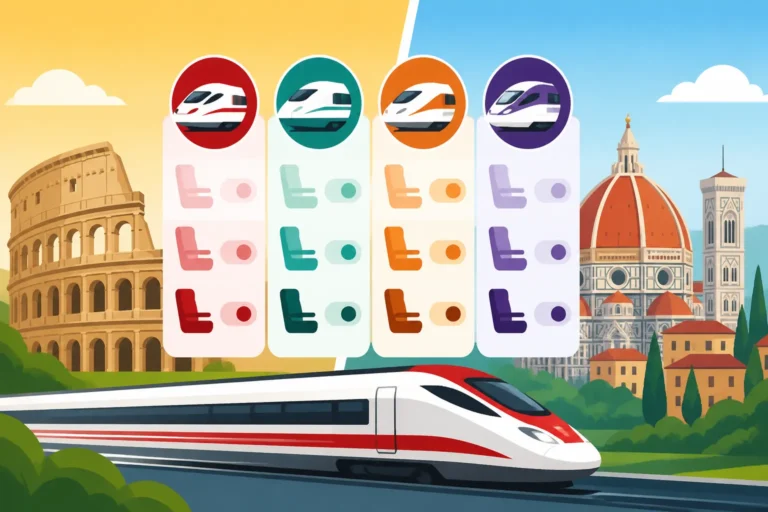
Comfort is where the two operators really differ. On a long run up the spine of Italy, the class you choose shapes the whole trip. Both companies offer four main service levels. They name them differently, and what’s included is not identical. Below I walk through what each level means in practice so you can match your seat to your budget and the kind of journey you want.
Trenitalia’s Four Service Levels
Trenitalia’s Frecciarossa trains offer Standard, Premium, Business, and Executive. Standard is the everyday class. You get comfortable seats, power sockets, and Wi-Fi in an open carriage, and it is perfectly good for most travelers. Premium is a step up, with somewhat more space and usually a complimentary drink or snack, aimed at those who want a little extra without a big jump in price.
Business offers wider leather seats and more legroom. It typically has a quiet section, the Area del Silenzio, where phone calls and loud conversation are discouraged. This is the class I pick when I need to work on a laptop for the whole journey. Executive is the top tier: a small number of large seats at the front of the train, with meal service and a more exclusive, private feel. The full breakdown is in Italian Train Classes Explained: Standard, Premium, Business, Executive.
To make this concrete: Daniela, a project manager from Madrid, regularly travels Rome to Milan for work. She books Business when she has a report to finish, because the quiet area and extra space make the journey productive. She books Standard for weekend trips, when she just wants to listen to music and look out of the window. The same traveler can rationally choose different classes for different trips.
Italo’s Four Service Levels
Italo’s classes are Smart, Comfort, Prima, and Club Executive. Smart is the standard class, the one most travelers book, with comfortable seating, power, and Wi-Fi. Comfort offers wider seats and more legroom than Smart, with fewer seats per carriage, so it feels more spacious. It is often good value if you want a roomier ride without paying for a premium class.
Prima is Italo’s premium class. It has leather seats, extra space, and usually a welcome drink or snack. Club Executive is the top level, with a small number of large seats. Some trains have small enclosed compartments, which are popular with groups and colleagues who want privacy. Inclusions such as food service and lounge access vary by fare and can change, so check what the specific ticket includes before you buy.
What I like about Italo’s layout is that Comfort fills the gap between the basic and premium classes well. It gives you most of the extra space without the full premium price. That said, Trenitalia’s Premium does a similar job. The operator’s own booking page, or the class description in Omio’s results, will tell you what you’re actually getting.
Side-by-Side Class Comparison
The table below lines up each operator’s classes by rough equivalent so you can compare like with like. Exact seat dimensions, food, and inclusions vary by train and fare, so use this to orient yourself, not as a guarantee.
| Service level | Trenitalia Frecciarossa | Italo | Best suited for |
|---|---|---|---|
| Everyday | Standard | Smart | Budget travelers and most holiday trips |
| Step up | Premium | Comfort | Extra space without a big price jump |
| Premium | Business | Prima | Working on a laptop or a calmer journey |
| Top tier | Executive | Club Executive | Maximum space, privacy, and service |
| Quiet option | Area del Silenzio in Business | Varies by train and class | Calls and noise kept to a minimum |
When the class names start to blur, I keep it simple. Pick by what you’ll do on board. If you’ll sleep, read, or look out of the window, everyday class is fine on both operators. If you’ll work, the premium tier with a quiet area is worth it. If you’re celebrating or travelling as a small group that wants privacy, look at the top tier, especially Italo’s enclosed compartments.
Wi-Fi, Food, Luggage, and Quiet
Both operators offer free onboard Wi-Fi and power sockets at most seats. Expect patchy connectivity between Florence and Bologna, where the line runs through long tunnels under the Apennines. Download anything you need before you board, such as presentation files, maps, or a film for the journey. Don’t count on streaming through the tunnel section.
Food differs by class. Premium and top-tier travelers on both operators often get some form of complimentary snack or meal. In everyday class you can usually buy drinks and snacks from a bar car or trolley, depending on the train. Many Italians simply bring a panino and a bottle of water from a café at the station, and I’d suggest you do the same. Grabbing a coffee and a cornetto at Termini before you board is a small, worthwhile habit.
Luggage on both operators goes in overhead racks and in dedicated spaces at the ends of carriages. Big suitcases can be a problem on busy trains, when the end racks fill early. Board promptly and keep valuables with you rather than at the far end of the carriage. The specific rules and any limits are set out in Luggage Rules on Italian Trains and Buses: Limits and Fees. If you or someone in your group needs mobility support, Trenitalia’s Sala Blu assistance service is explained in Accessible Travel on Italian Trains: Booking Sala Blu Assistance.
Booking Rome to Milan Step by Step
Now for the practical part: turning all this into a booked ticket in your inbox. Whether you’re planning weeks ahead from home or deciding at a café in Trastevere that you want to be in Milan by dinner, the process is the same. The steps below assume you’re using Omio to compare both operators together, since that is the most direct way to see the whole market on this route.
How to Book Your Rome to Milan Train With Omio
The process is short once you’ve done it once:
- Open the Omio app or website and enter Rome as your origin and Milan as your destination, then choose your travel date and the number of passengers.
- Look at the full list of departures, which shows Trenitalia and Italo trains together, and sort by time or price depending on what matters most to you.
- Check the departure and arrival stations for each train, confirming whether you leave from Termini or Tiburtina and arrive at Centrale, Rogoredo, or Porta Garibaldi.
- Compare the journey time and number of stops so you don’t trade a small saving for a much slower trip.
- Select your preferred train and choose your class and fare type, paying attention to the change and refund conditions shown for that fare.
- Enter passenger names exactly as they appear on each traveler’s passport or ID.
- Review the full total, including any Omio booking fee, before you confirm and pay with your card.
- Save the mobile ticket to your phone and take a screenshot as a backup in case your connection drops at the station.
On the day, go to the departure board at your Rome station, find your train number, and head to the platform shown. High-speed tickets with an assigned seat don’t need to be stamped in the station validation machines, which are meant for open regional tickets. Find your carriage number on the platform display, board, and take your seat.
Real Scenarios: Which Train Suits Which Traveler
The right choice depends on who you are and why you’re travelling. These are the patterns I see most among expats and visitors on this route.
| Traveler type | Priority | What to look for | Suggested class |
|---|---|---|---|
| Budget backpacker | Lowest fare | Early booking, midweek mid-morning departures, restricted fares | Standard or Smart |
| Business traveler | Speed and work time | Non-stop departures, flexible fare, quiet area | Business or Prima |
| Holiday couple | Comfort and scenery | Daytime departure, a little extra space | Premium or Comfort |
| Family with children | Space and flexibility | Seats together, flexible fare, luggage space | Standard, Smart, or Comfort |
| Small group or colleagues | Privacy | Enclosed compartments where available | Club Executive or Executive |
| Traveler with a flight to catch | Reliability | Generous buffer, arrival station near the airport link | Any, booked with time to spare |
Families have specific needs: child fares, seats together, and space for prams. Booking early for a family of four helps keep everyone together and gives you more fare options. I go through the details in Booking Italian Transport With Kids: Child Fares, Seats, and Prams.
If you’re connecting to a flight, plan the link to the airport as carefully as the train. In Milan, Malpensa and Linate have different connections, and both work better from certain stations. The options are explained in Milan Airport Transfers: Malpensa, Linate, and Bergamo Options. If your trip starts with a flight into Rome, the onward link from the airport to Termini is covered in Rome Fiumicino Transfers: Leonardo Express, Regionale, and Bus Compared.
Train Versus Flying Between Rome and Milan
Every so often a friend asks whether they should just fly. For most people the high-speed train wins. It goes from city centre to city centre. There’s no long airport security queue and no transfer out to a distant terminal, and you can move around, work, and look out of the window the whole way. Once you add the journey to and from each airport, the train is usually just as fast door to door, often faster, and far more relaxing.
Flying can still make sense if you’re connecting to an international flight or have a very particular itinerary. If you’re weighing a domestic flight, account for baggage fees and airport transfers as well as the base fare, because they change the comparison a lot. That trade-off is examined in Ryanair, ITA Airways, and easyJet Within Italy: Total Cost With Bags.
One handy point: Omio searches buses and flights as well as trains, so you can see all of them for Rome to Milan in one place. For most travelers the train will still come out on top. Seeing the full picture lets you make that call with confidence instead of guessing.
Trenitalia vs Italo: Weighing the Pros and Cons
After all of this, you’ll want to know which one to book. The honest answer is that it depends on your priorities, and on this route the gap between them is narrower than their marketing suggests. Each has real strengths. Below I set them out plainly so you can decide quickly next time you’re comparing fares.
Where Trenitalia Shines
Trenitalia’s biggest practical advantage is frequency and network breadth. It typically runs more departures through the day on this corridor and connects them with the national network, including regional trains to smaller towns. If your trip continues beyond Rome or Milan, perhaps to a lake town north of Milan or a hill town south of Rome, Trenitalia makes those connections easier.
Its class range is also clear and well established, from Standard up to Executive, and Business includes a dedicated quiet area. The downsides are the ones you’d expect from a large national operator: popular trains can feel busy in everyday class, and the cheapest restricted fares come with firm conditions you must accept when you book.
Where Italo Shines
Italo’s strengths are on board. Many travelers enjoy its trains and service, and its Comfort class is a well-judged middle step. The enclosed compartments available on some trains are a real draw for groups and colleagues who want privacy. It also serves Milano Porta Garibaldi on some departures, which suits travelers heading to the Porta Nuova business district or Isola.
Its limits come from being a high-speed-only operator. Italo doesn’t run the regional network, so onward connections to smaller towns mean switching to another operator. Its schedule on this route is frequent, but combined with Trenitalia you get a denser board than Italo alone, which is one more reason to compare both rather than stick with one brand.
The Bottom Line for Your Booking
This summary table brings the main points together.
| Factor | Trenitalia | Italo |
|---|---|---|
| Fastest services | Comparable non-stop and limited-stop departures | Comparable non-stop and limited-stop departures |
| Frequency on this route | Generally more departures through the day | Frequent, though fewer than Trenitalia |
| Network beyond high speed | Connects with regional trains nationwide | High-speed routes only |
| Rome stations | Termini and Tiburtina | Termini and Tiburtina |
| Milan stations | Centrale and Rogoredo | Centrale and Rogoredo, plus Porta Garibaldi on some departures |
| Class names | Standard, Premium, Business, Executive | Smart, Comfort, Prima, Club Executive |
| Fare types | Base, Economy, Super Economy | Flex, Economy, Low Cost |
| Standout comfort feature | Area del Silenzio quiet section in Business | Enclosed compartments on some trains |
| Loyalty programme | CartaFreccia | Italo Più |
If you travel this route often, the loyalty programmes are worth a look: CartaFreccia for Trenitalia and Italo Più for Italo. Points add up quickly for frequent travelers. For a fuller look at how these schemes compare and which routes each operator covers, see Trenitalia vs Italo: Fares, Loyalty, and Which Route Each One Serves.
My advice, after years of riding this line in both directions, is this: don’t be loyal to a brand on a one-off trip. Be loyal to the best departure. Pick your travel time, decide what level of comfort you want, and let the fares tell you which operator wins on the day. The simplest way to do that is to search Rome to Milan on Omio, look at Trenitalia and Italo together, check the stations and journey time, and book the train that fits. Then get a coffee at the station and enjoy the trip north.
Disclaimer
This article is for general informational purposes only and does not constitute professional advice. Laws, prices and regulations vary by location and change over time. Consult a qualified professional for guidance on your specific situation.