Rome to Bari and Lecce: Reaching Puglia by Rail
Picture yourself at Roma Termini with a heavy suitcase and a departure board full of trains to Naples, Florence and Milan. Puglia barely appears, and booking sites quote very different fares and routes. This guide explains how the Rome to Bari and Lecce rail journey actually works, which trains to look for, how to book them through Omio, and what happens once you reach the heel of Italy.
Disclosure: This post may contain affiliate links. We may earn a commission at no extra cost to you if you make a purchase through these links. Read full disclosure.
Why the Rome to Puglia Rail Trip Catches People Out
I have made this journey more times than I can count. I’ve done it for a long weekend of orecchiette in Bari Vecchia, to help a friend move into a flat near Lecce’s Porta Napoli, and once in August with two overtired children. Every time, someone on the platform asks me whether they are on the right train. It is a reasonable question.
Rome and Puglia are not linked by the smooth high-speed spine that joins Rome, Florence, Bologna and Milan. The route has its own quirks. Once you understand them, the trip becomes one of the most relaxing rides in the country.
The Apennine Crossing Most Itineraries Ignore
The core thing to understand is geography. Rome sits on the Tyrrhenian side of Italy, and Bari and Lecce sit on the Adriatic. Between them runs the Apennine chain. Trains do not race down a dedicated high-speed line the whole way. Instead, they head south-east towards Caserta, climb inland through Benevento and Campania’s interior, and cross the hills into Puglia. They drop onto the flat Tavoliere plain around Foggia, then run down the Adriatic coast into Bari.
In practice, even a train branded “Frecciarossa” or “Frecciargento” runs at conventional speeds for much of the trip. This is not a bad thing. The views through Irpinia and the Daunian foothills are lovely, with sheep on green slopes in spring, golden wheat in early summer and hilltop villages perched like crumbs on a tablecloth. But it explains why the Rome to Bari leg feels slower than Rome to Florence.
The second consequence is frequency. There are fewer direct departures to Bari than to Naples. If you show up at Termini without a booking on a Friday afternoon or the start of a holiday weekend, the direct trains may already be full or priced at the top fare tier. Planning a few days ahead matters far more here than on the busy northern corridors.
Bari Versus Lecce as Your Arrival Point
Many first-timers think of Puglia as one destination. For rail purposes it is really two. Bari is the regional capital and the main rail hub. It has the most direct trains from Rome, an airport rail link, and onward lines into the Valle d’Itria and towards Matera. Lecce sits much further south, at the end of the main Adriatic line. It is the gateway to the Salento peninsula, with its baroque churches, Otranto, Gallipoli and the beaches facing Albania and Greece.
Some trains from Rome continue past Bari to Brindisi and Lecce. Others terminate in Bari, and you continue south on a separate train. That one detail changes how you search for tickets and how much luggage hauling your day involves. If your holiday centres on the Salento, a through train to Lecce is worth hunting for. If you are basing yourself in Polignano a Mare, Monopoli or the trulli towns, Bari is the natural end point.
If you are still deciding where to sleep, Where to Stay in Puglia: Bari, Lecce, Ostuni, and the Trulli Valley breaks down each base in detail. Your choice of base should drive which station you book to, not the other way around.
Your Main Options From Rome to Bari and Lecce
You have three realistic rail approaches, plus a coach fallback. Here is how I think about each one after years of trial, error and the occasional missed connection in Foggia.
Direct High-Speed Frecce
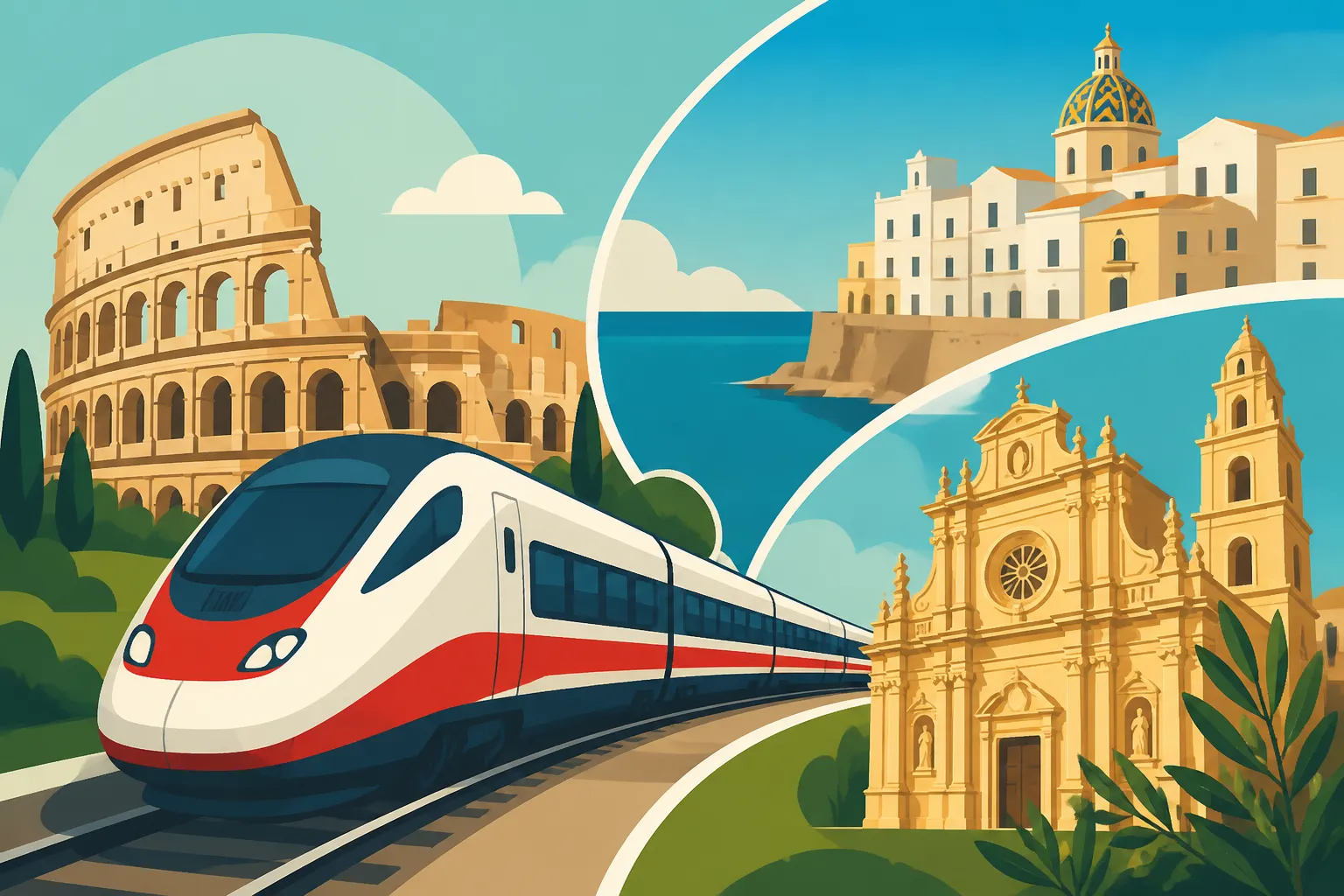
Trenitalia’s Frecce services are the backbone of this route. Direct trains leave Roma Termini, some calling at Roma Tiburtina, and run via Caserta, Benevento and Foggia to Bari Centrale. A selection carry on down the coast to Brindisi and Lecce. For most travellers this is the best option. You get one seat, one booking and no changes, and the train delivers you into the centre of town.
The comfort level is high. You get reserved seats, power sockets, a café car on many services, and luggage racks at the end of each carriage plus overhead shelves. Trenitalia also sells several classes and fare types on these trains, and the cheapest fares come with tighter change rules. Before you click buy, read Italian Fare Types: Base, Economy, and Super Economy Change Rules so you know what you are giving up for a lower price.
Italo, Trenitalia’s private competitor, has a strong presence on the Rome to Naples corridor. Its offer further into the south has shifted over time. The easiest way to see whether Italo runs anything useful on your exact date is to search the route on Omio, which lists the operators side by side. For the bigger picture on how the two companies divide up the network, see Trenitalia vs Italo: Fares, Loyalty, and Which Route Each One Serves.
Intercity and Night Trains
Below the Frecce sit Trenitalia’s Intercity trains. These are slower, older in style, and usually make more stops. They are often cheaper, and they can be a lifesaver when the Frecce are sold out. Some Intercity services run along the Adriatic coast rather than across the Apennines. That can suit you if you are coming from somewhere like Pescara or Ancona rather than Rome itself.
Then there are the Intercity Notte overnight trains. These run on long north to south routes and include sleeper cabins and couchettes. Whether one fits your Rome departure depends on the timetable for your travel dates, so search and see what comes up rather than assume. A night train can turn the journey into a free night of accommodation. You fall asleep in Lazio and wake up with olive groves outside the window. For a realistic view of the experience, including what the cabins are actually like, see Night Trains in Italy: Intercity Notte Routes and Whether They’re Worth It.
Connecting Itineraries and the Coach Alternative
If no direct train fits your schedule, connecting routes open up. The most common is to travel from Rome to Naples or Caserta, then pick up a service heading east towards Foggia and Bari. Another option is to change in Foggia or Bari for a train continuing to Lecce. Connections can work well, but they introduce risk. A delay on the first leg can cost you the second. Omio flags itineraries that include changes and shows the connection window, so you can judge whether a short transfer is realistic with your luggage.
If you are interested in splitting the trip with a night or two in Naples, Rome to Naples: High-Speed Options and When the Regionale Is Enough covers that first leg in depth. Naples to Bari: Crossing Southern Italy by Rail and Bus picks up the second.
Long-distance coaches are the other fallback. They are slower than the best trains and less comfortable over long distances. But they sometimes run at hours when trains do not, and they can drop you in towns without a convenient rail stop. Omio lists coach options alongside trains on many Italian routes, so you can compare them in one search. For a closer look at the coach operators themselves, see FlixBus vs Itabus and MarinoBus: Long-Distance Coach Operators Compared.
| Option | Changes | Comfort | Best For | Main Drawback |
|---|---|---|---|---|
| Direct Frecce to Bari | None | High, reserved seats | Most travellers heading to Bari or the Valle d’Itria | Limited departures sell out at peak times |
| Direct Frecce to Lecce | None | High, reserved seats | Salento-bound travellers who want one booking | Fewer through trains than to Bari |
| Intercity daytime | Sometimes none | Moderate | Budget travellers and sold-out days | Slower, more stops |
| Intercity Notte | Depends on route | Variable by cabin type | Saving a hotel night | Timetable may not fit a Rome start |
| Connection via Naples or Caserta | One or more | High on each leg | Combining a Naples stopover | Missed connection risk |
| Long-distance coach | Usually none | Basic | Off-hours travel, towns off the rail line | Longer and less comfortable |
Booking the Journey Step by Step With Omio
You could book separately on each operator’s site. I did that for years, juggling tabs and retyping passport names. The reason I now use Omio for this route is simple: Rome to Puglia is a journey where the options genuinely differ. Seeing direct Frecce, Intercity trains, connections and coaches on one results screen saves real time and stops you from missing a better itinerary. Omio’s app also keeps your tickets in one place, which helps when you are juggling a suitcase on a platform in Foggia.
Searching and Comparing Your Options
Here is the process I follow every time.
- Open Omio on the website or app and enter Rome as the origin. Choosing the city rather than a specific station lets you see departures from both Termini and Tiburtina.
- Enter Bari or Lecce as the destination, depending on your base. If you are going to the Salento, search Lecce directly, so through trains appear rather than only Bari-terminating ones.
- Pick your date and passenger details, including any children, since child fares can apply.
- Filter the results to show trains first. Then sort by departure time or duration to spot the direct services.
- Look at the number of changes on each result. A zero-change Frecce train is usually your first choice. Connections show the transfer time, so you can judge whether it is realistic.
- Compare the fare types on your preferred train. Cheaper fares often restrict changes and refunds, while flexible fares cost more.
- Run a second search with buses included. This tells you whether a coach covers an odd hour or a smaller town better than the train.
This side-by-side view is where Omio earns its place. On a recent trip in late spring, the direct train I wanted was showing only the top fare tier. Two rows down was a slightly earlier direct departure at a far gentler price. I would never have spotted it scrolling one operator’s site with a fixed time in my head. For current booking fees, payment options and any service charges, check Omio’s own pages before you pay, since these can change.
Fare Rules, Seats and Luggage
Once you have chosen your train, slow down for a moment before paying. On the Frecce, your ticket is tied to a specific train and a specific reserved seat. If you miss it, you cannot simply hop on the next one without consequences. The rules depend on the fare type you bought. This is why reading the conditions matters more than chasing the cheapest number on the screen.
Seat choice on a long ride like this deserves a thought. For the Apennine scenery between Benevento and Foggia, a window seat makes the journey. If you are travelling with a large suitcase, sitting near the end of a carriage keeps you close to the luggage racks. Italian trains have no formal check-in or weighing, but space is first come, first served. On a busy August departure to Puglia, the racks fill fast with beach bags and family-sized cases. For details on what you can bring and where it goes, see Luggage Rules on Italian Trains and Buses: Limits and Fees.
If you are booking from outside Italy, enter your name exactly as it appears in your passport or ID. Ticket inspectors on the Frecce sometimes check ID against the ticket. Payment hiccups with foreign cards are another common headache, and Booking Italian Trains From Abroad: Foreign Cards, Names, and Failures walks through what to do if a payment is declined.
On the Day: Termini, Tickets and Platforms
Roma Termini is enormous, chaotic and wonderful. Give yourself time. Southbound long-distance trains are announced on the big departure boards with a platform number that often appears only shortly before departure. I usually arrive with enough margin to buy water and a panino, then stand within sight of the board. When the platform appears, a small crowd will surge towards it, and you will want to be among them.
Your Omio ticket on your phone is all you need for a Frecce or Intercity train with a reserved seat. You do not need to validate these tickets at the platform machines, because they are already tied to a specific train. Regional trains are different. If you later buy a paper regional ticket for a short hop inside Puglia, you will need to validate it before boarding. How to Validate a Regional Train Ticket in Italy explains exactly how.
One more thing to check before travel day is whether a strike, or sciopero, is scheduled. Italian rail strikes are announced in advance. Certain guaranteed services usually still run during set time bands, but disruption on long southern routes can be significant. If you see a strike notice for your date, read Strikes in Italy: How Sciopero Days Work and How to Rebook and consider shifting your trip. Omio sends updates about your booking, but the strike calendar is worth checking yourself too.
Arriving in Puglia and Going Further South
Stepping off the train in Puglia always feels like a change of climate, even in winter. The light is whiter, the air smells faintly of sea salt, and the pace drops noticeably. Here is what to expect at each arrival point and how to keep moving.
Bari Centrale and Onward Connections
Bari Centrale sits on the edge of the Murat district, the grid-patterned nineteenth-century part of the city. You can walk from the station to the old town, Bari Vecchia, along Via Sparano, one of the main shopping streets. With a suitcase on cobbles the walk becomes a workout, so many people take a taxi from the rank outside the station instead.
The station is also a hub for several separate railway companies, and this confuses newcomers. Besides Trenitalia, regional operators run their own lines from Bari. Ferrovie del Sud Est runs trains towards the Valle d’Itria, including towns like Alberobello, Locorotondo and Martina Franca. Ferrovie Appulo Lucane heads inland towards Altamura and Matera. Ferrotramviaria operates the line to Bari’s airport and towns to the north-west. These companies often have their own platforms, ticket offices or entrances near the main station. Read the signs carefully and allow extra time for your first transfer.
If you are heading inland to Matera, note that it sits just over the border in Basilicata and is not on the main national rail network. See Reaching Matera and Basilicata: Where the Rail Network Runs Out before you assume a simple train ride. For trips along the coast to Polignano a Mare and Monopoli, Trenitalia regional trains running south from Bari are usually the simplest option. They stop at both towns on the way towards Brindisi.
Lecce and the Salento Lines
Lecce’s station lies a short walk or taxi ride from the historic centre, with its honey-coloured baroque stone, Piazza del Duomo and the Roman amphitheatre in Piazza Sant’Oronzo. If you arrive on a through train from Rome, you are simply at the end of the line. If you changed in Bari, your regional train will pull into the same station.
From Lecce, Ferrovie del Sud Est runs the lines into the Salento. These trains reach towns such as Gallipoli on the Ionian coast, Otranto on the Adriatic side, and smaller villages in between. They are slower, more rural and less frequent than mainline services. In summer some routes are supplemented or replaced by buses. Schedules vary by season and by day of the week, and Sunday service in particular can be thin. Coverage of these smaller regional operators on booking platforms varies. Check what Omio shows for your route, and confirm local timetables at the station or on the operator’s own channels for the final stretch.
Many visitors who base themselves in the Salento end up renting a car for the beach days and using trains for the big Rome to Lecce leg. That is a perfectly sensible split. For more on reaching the coast and trulli country without driving, Reaching Puglia’s Coast: Trulli Country and the Salento by Rail covers the regional network in much more depth.
A Sample Rome to Puglia Itinerary in Practice
To bring this together, here is a realistic plan I have used with visiting friends who wanted a week split between Bari’s coast and the Salento.
- Book a direct morning Frecce train from Roma Termini to Bari Centrale on Omio a week or two before travel, choosing a window seat on the left-hand side for some of the inland views.
- Spend the first two or three nights in Bari or Polignano a Mare, using Trenitalia regional trains for short coastal hops and validating any paper regional tickets before boarding.
- Take a day trip into the Valle d’Itria on the Ferrovie del Sud Est line from Bari, checking the return times carefully because rural services thin out in the evening.
- Continue south from Bari to Lecce on a regional or mainline train, booked through Omio if it appears in the results, or bought at the station if it is a short regional hop.
- Base yourself in Lecce for the remaining nights and use Salento trains or a short car rental for Otranto and Gallipoli.
- For the journey home, search Lecce to Rome on Omio and look specifically for a direct through train, so you avoid hauling luggage through a change in Bari or Foggia.
This rhythm keeps the long-distance legs simple and leaves the slower local trains for days when you are not under time pressure. It also matches how the network is built: fast, reserved trains for the big crossing, and a patchwork of regional lines for exploring once you arrive.
Final Practical Tips From Someone Who Has Done It Too Often
Bring food and water even if your train has a café car. On the long Apennine stretch, the café can run out of anything appealing, and stations along the way offer little time to step off. Carry a light layer, because air conditioning on Italian trains swings between arctic and absent. Download your tickets in the Omio app before you leave your accommodation. Mobile signal can drop in the hills between Benevento and Foggia, and you do not want to be fumbling for a QR code when the inspector appears in a tunnel.
Finally, accept that the south runs on its own clock. A train arriving a little late into Bari is not a disaster. The focaccia barese in the old town will still be there, and so will the sunset over the harbour. If you book sensibly, leave buffers around connections and keep your tickets organised in one place with Omio, the Rome to Puglia rail journey becomes one of the gentlest transitions you can make in Italy. Search your dates on Omio now, compare the direct trains against the alternatives, and lock in the departure that fits your trip before the best seats go.
Disclaimer
This article is for general informational purposes only and does not constitute professional advice. Laws, prices and regulations vary by location and change over time. Consult a qualified professional for guidance on your specific situation.