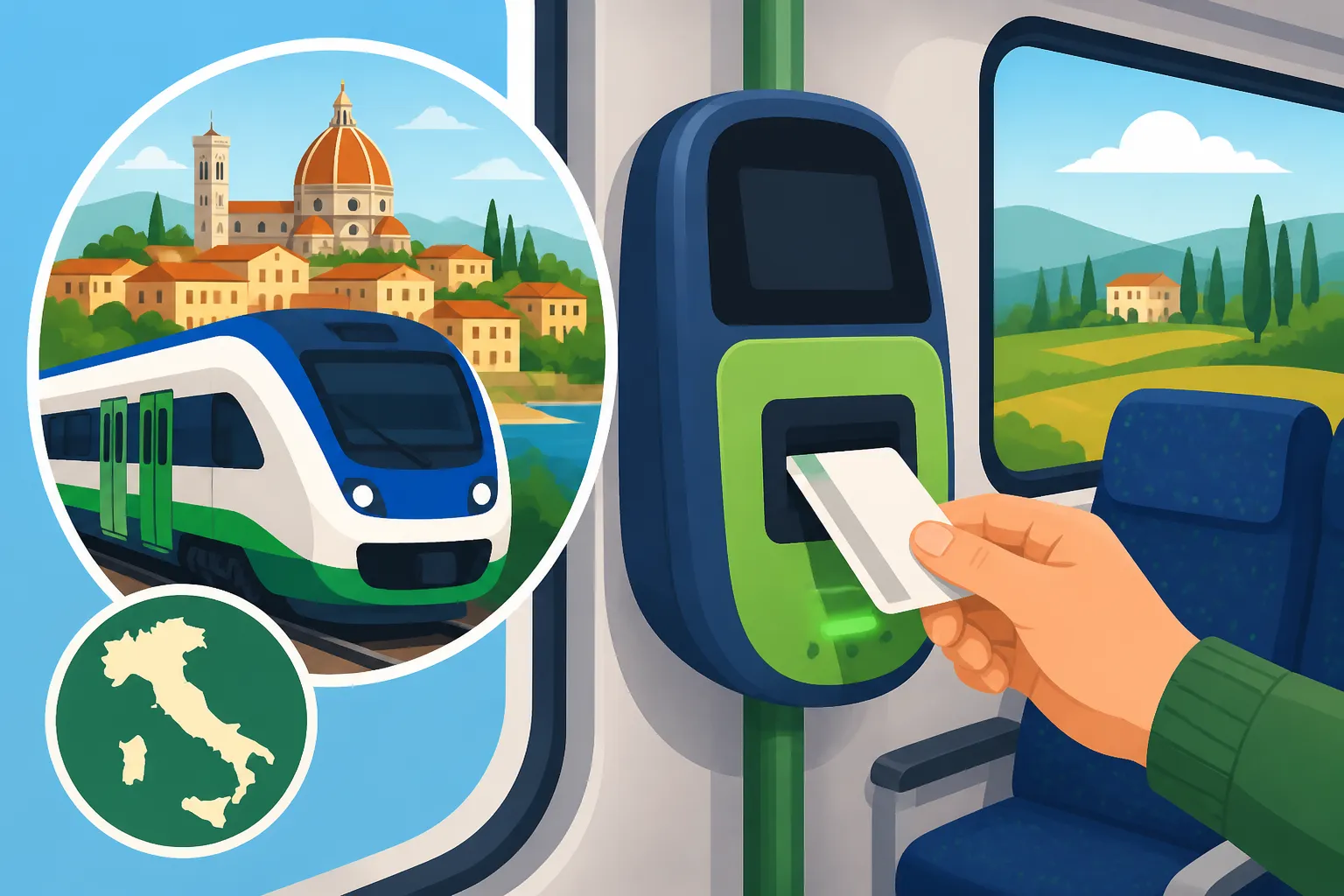
How to Validate a Regional Train Ticket in Italy
Oh, Italy! The land of breathtaking beauty, delicious food, and sometimes, utterly bewildering bureaucracy. One of the classic "welcome to Italy" moments for many expats and tourists alike involves the humble regional train ticket. You've bought your ticket, you're ready to explore, but then you hear the whispers, or worse, see the conductor's stern face: "Did you validate your ticket?" This guide is here to save you from that particular brand of Italian travel anxiety, explaining exactly how to validate your regional train ticket and why it’s so crucial.
Disclosure: This post may contain affiliate links. We may earn a commission at no extra cost to you if you make a purchase through these links. Read full disclosure.
What is Ticket Validation and Why is it Necessary in Italy?
Let's be real, the concept of "validating" a ticket can feel a bit arcane, especially if you're used to systems where you just buy a ticket and hop on. But in Italy, particularly for regional trains (known as treni regionali), it's a non-negotiable step that dates back ages and is still very much enforced today. Neglecting it can turn a lovely journey into a costly headache, often involving fines far exceeding the ticket's original price.
The "Convalida" Concept Explained
"Convalidare" means to validate or stamp. When you buy a regional train ticket at a station, whether from a ticket counter or an automated machine, it's typically an "open" ticket. This means it's valid for a certain period (usually a few hours, sometimes up to a couple of months, depending on the type and region) but not for a specific time slot or train number. It's essentially a blank check for travel within its stated validity. The act of validation, or convalida, timestamps your ticket, officially marking it for use on that particular journey. It tells Trenitalia (the national railway company) that you are using that specific ticket now. Without this timestamp, a ticket could theoretically be reused multiple times, which is exactly what the system is designed to prevent.
Imagine you bought a ticket from Florence to Pisa. If you didn't validate it, you could, in theory, use it to travel from Florence to Pisa on Monday, then again on Tuesday, and so on, until the paper disintegrates. The validation machine ensures that the ticket is used for one journey only. It's a system that can feel antiquated in an age of digital ticketing, but it's deeply ingrained in the Italian travel experience.
The Risks of Not Validating: Fines, Penalties, and Stress
So, what happens if you forget or simply don't know to validate your ticket? Well, my friend, you're in for a potential world of pain. Italian train conductors are generally quite diligent, especially on regional routes where ticket validation is most common. They will almost certainly check your ticket, and if it's not validated, even if you just bought it five minutes before boarding, you will be considered to be traveling without a valid ticket.
The penalties for non-validation are substantial. Typically, you'll face a fine, often starting around €50 or €60, in addition to the cost of the ticket itself. This fine can increase significantly if you dispute it or refuse to pay on the spot. Conductors often have little patience for "I didn't know" excuses, especially from foreigners, as the validation requirement is clearly posted (though often only in Italian) at stations and near the machines. This stressful encounter, potentially in a foreign language, is something every expat and tourist would rather avoid. I've seen more than one tearful tourist trying to explain their predicament, and believe me, it's not a memory you want from your Italian adventure.
Step-by-Step Guide to Validating Your Regional Train Ticket
Fear not, fellow traveler! Once you know the drill, validating your ticket is incredibly simple and becomes second nature. Let's walk through it.
Locating the Validation Machines (Macchinette Convalida)
The first step is finding the validation machines themselves. These are officially called macchinette convalidatrici or obliteratrici. They aren't usually hidden, but you need to know what you're looking for.
- Appearance: Historically, these machines were bright yellow or green. While you might still see some of these vintage models, most modern machines are now green and white, or grey, often bearing the Trenitalia logo. They usually have a slot where you insert your ticket and some instructions, which, again, might be in Italian.
- Location: You'll typically find them in several key areas at train stations:
- Near the tracks/platforms (binari): This is the most common spot. Look for them just before you step onto the platform, or sometimes even on the platform itself.
- Near the ticket office (biglietteria): Often, there will be machines close to where you buy your ticket, both at manned counters and automated machines.
- At station entrances: In smaller stations, they might be near the main entrance or waiting areas.
Always keep an eye out for these machines as you enter the station or head towards your platform. Don't wait until the last minute, especially in larger, busier stations like Roma Termini or Firenze Santa Maria Novella, where you might have a bit of a walk.
The Validation Process
Once you've spotted a machine, the process is straightforward:
- Insert Your Ticket: Take your paper regional train ticket (usually a long, thin paper strip) and look for the end that doesn't have the magnetic strip or bar code. This is usually the blank end, or the one with the least printing. Insert this end into the slot on the validation machine.
- Listen for the Stamp/Beep: Push the ticket firmly into the slot until you hear a mechanical whir, a thud (the sound of it stamping), or a beep. The machine will print the date and time of validation onto your ticket. Sometimes, it also prints the station name.
- Retrieve and Check Your Ticket: Pull your ticket out and immediately check for the printed timestamp. Ensure it's clear and legible. This is your proof of validation.
That's it! You're good to go. Keep your validated ticket in a safe, easily accessible place, as the conductor will come by to check it during your journey.
What if the Machine Doesn't Work?
This is where the true test of Italian ingenuity and patience comes in. It happens. You find a machine, dutifully insert your ticket, and… nothing. No stamp, no beep, just an unvalidated ticket staring back at you. Don't panic, but don't ignore it either. This is a critical moment to avoid a fine.
Here's what you need to do:
- Try Another Machine: Often, there's more than one machine available. If the first one fails, calmly try another.
- Seek Out a Conductor Before Boarding: If no machines are working, or you're truly out of time, you absolutely must find a conductor (capotreno) on the platform before you get on the train. Explain the situation. They can often manually validate your ticket or, at the very least, make a note of your attempt and advise you.
- Write on Your Ticket (as a last resort): In very rare circumstances, if you absolutely cannot find a working machine or a conductor before boarding, the common wisdom (though not officially sanctioned by Trenitalia as a primary solution) is to legibly write the date, time, and the name of your departure station on the back of your ticket before the train departs. Then, immediately seek out the conductor once you're on board and explain what happened, showing them what you wrote. This demonstrates good faith, but it's a last-ditch effort and relies on the conductor's discretion. It's always, always better to find a working machine or a staff member.
This situation really highlights why arriving at the station with ample time is crucial. Lingering at the last minute and discovering broken machines is a recipe for stress.
Beyond Paper Tickets: Digital and Online Alternatives
While the paper ticket validation ritual is very much alive for regional trains, the digital age has brought some welcome changes. Many travelers now opt for electronic tickets, which largely bypass the need for physical validation.
E-Tickets and Online Purchases
If you buy your regional train ticket online or through an app, like the official Trenitalia app or third-party platforms such as Omio, you're usually buying an e-ticket. These tickets are generally tied to a specific date and time, and often a specific train number, rendering the physical validation machine redundant.
When you purchase an e-ticket:
- It's often pre-validated: The act of buying it for a specific journey serves as its validation. You'll simply show the QR code or PNR (Passenger Name Record) on your phone or a printed copy to the conductor.
- Flexibility is limited: Unlike paper regional tickets, e-tickets for specific trains usually can only be changed or refunded under specific conditions and within a certain timeframe before departure. Make sure you understand the terms when purchasing.
Using an app like Omio can actually simplify things considerably, as it aggregates options and often provides e-tickets directly to your phone, eliminating the validation machine hunt. When planning a multi-city itinerary, checking out options for accommodation on Booking.com for your arrival cities or discovering unique local experiences through GetYourGuide in tandem with your train travel can streamline your trip.
The Importance of Activation (Check-in) for Digital Tickets
Here's a crucial point that trips up many: even with some e-tickets, particularly those for regional trains purchased digitally without a specific train time (e.g., a regional ticket valid for a 4-hour window on a specific date), you might still need to "activate" or "check-in" your ticket.
Trenitalia, for instance, has a "check-in" function within its app for certain regional e-tickets. This means that an hour or two before your intended departure, or once you are at the station, you must open the app and tap "check-in" for your ticket. This digitally validates your ticket, marking it for the specific journey you are about to take. If you don't do this, even with an e-ticket, it's considered unvalidated and you could still face a fine. The app will usually prompt you or make it clear if this step is required. Always double-check the instructions on your digital ticket!
Common Pitfalls and Pro Tips for Expats
As an expat living in Italy, I've seen and experienced almost every possible scenario when it comes to train travel. Here are some seasoned tips to help you navigate the system with ease.
Understanding Different Ticket Types and Their Validation Rules
It's vital to distinguish between regional tickets and high-speed tickets.
- Regional Trains (Regionale, Regionale Veloce): These are the workhorses of Italian rail, connecting smaller towns and making more frequent stops. Their tickets are the ones that almost always require physical validation at the macchinette convalidatrici if they are paper, or digital "check-in" if they are flexible e-tickets. These are perfect for exploring local gems and Day Trips and Weekend Getaways Across Italy.
- High-Speed Trains (Frecce – Frecciarossa, Frecciargento, Frecciabianca; Italo): These are Italy's sleek, fast trains that connect major cities like Rome, Florence, Milan, and Venice. Tickets for these trains are always for a specific seat, date, and time. They never need physical validation. Your ticket, whether printed or on your phone, is ready to go. Just show it to the conductor. Don't confuse the two, or you'll be frantically searching for a yellow box for your Frecciarossa ticket that doesn't exist! If you're comparing services, you might want to read more about High-Speed Trains in Italy: Trenitalia, Italo, Routes, and Savings.
Language Barriers and How to Overcome Them
Encountering a non-working machine or a stern conductor can be intimidating when you don't speak Italian. A few key phrases can make a big difference:
- "Scusi, non funziona la macchina per convalidare il biglietto." (Excuse me, the machine to validate the ticket isn't working.)
- "Ho provato a convalidare il biglietto, ma non ha timbrato." (I tried to validate the ticket, but it didn't stamp.)
- "Dov'è il capotreno?" (Where is the conductor/train manager?)
Even a few words in Italian can show respect and a willingness to understand, often leading to more empathetic responses. You can find more helpful phrases in our guide on Italian Language and Everyday Communication for Visitors.
Always Arrive Early
This might sound like a broken record, but it cannot be stressed enough: always arrive at the train station well in advance of your regional train's departure. This gives you time to:
- Locate your platform: Especially in larger stations, this can take a few minutes.
- Find a working validation machine: You might need to try a couple.
- Address any issues: If a machine isn't working, you'll have time to find a conductor or ticket agent without the added panic of the train leaving.
- Grab a coffee: It's Italy, after all! Relax and enjoy a quick espresso.
This simple practice will save you immense stress and ensure a smooth start to your journey, whether you're taking Regional Trains in Italy: How to Use Them and Save or simply moving between major hubs like those covered in Rome, Florence, and Venice: Italy's Great Cities Explorer's Guide. Remember, exploring Italy's diverse regions requires good logistical planning, as discussed in Getting Around Italy: Trains, Buses, Flights, and Car Hire.
Understanding Your Ticket and Its Specifics
Before you even get to the station, take a moment to look at your regional train ticket. Does it have a specific train number and departure time? Or does it just state a date and a validity period (e.g., "valid for 4 hours from validation")? This will tell you if it's a "flexible" regional ticket requiring validation or an e-ticket already tied to a specific train. For digital tickets, if you used the Trenitalia app, make sure to understand the "check-in" process. For more tech-savvy tips, check out How to Use the Trenitalia App to Plan Train Travel.
It's all part of the charming, sometimes challenging, experience of Travel Logistics in Italy: Money, Safety, and Connectivity.
To summarize the key differences for your peace of mind, here's a quick overview:
| Ticket Type | Where Purchased | Validation Required? (Paper) | Digital Activation (Check-in) | Conductor Check |
|---|---|---|---|---|
| Regional Train (Paper) | Station Counter/Machine | YES (Green/Yellow Machine) | NO | Always |
| Regional Train (Flexible e-ticket) | Trenitalia App/Website | NO | YES (via App/Website) | Always |
| Regional Train (Specific e-ticket) | Trenitalia App/Website/Omio | NO | NO (Pre-validated) | Always |
| High-Speed Train (Frecce/Italo) | Any Channel | NO | NO (Pre-validated) | Always |
| Bus/Tram Tickets | Tobacconist/Newsstand/App | YES (on-board machine) | Sometimes (App-specific) | Usually, random spot checks |
It might seem like a lot to remember, but once you've done it a couple of times, it truly becomes second nature. Just remember the green box, the stamp, or the app check-in, and you'll be whizzing through the Italian countryside worry-free, ready to embrace all the beauty and culture Italy has to offer. Just like learning any new cultural nuance, such as Italian Customs, Etiquette, and Social Life, understanding ticket validation is part of truly settling into the Italian rhythm.
Disclaimer
The information provided in this guide is for general informational purposes only and is subject to change. While we strive to keep the content up-to-date and accurate, Italian regulations and train services can evolve. Always check the latest official information from Trenitalia or your ticket provider, and pay attention to signage at train stations. Travel rules, including those for validation, can vary slightly by region or specific train service.