Booking Multiple Italian Cities: Sequencing Around Rail Routes
You have three Italian cities in mind, a rough window of nights, and a browser full of hotel tabs. Then you notice the problem. You booked Florence first, Venice second and Rome last, and now your rail plan zigzags across the country with wasted half-days on trains. This guide shows you how to order your cities along Italy’s rail lines first, then lock in your rooms.
Disclosure: This post may contain affiliate links. We may earn a commission at no extra cost to you if you make a purchase through these links. Read full disclosure.
Why Rail Geography Should Decide Your Hotel Order
I made this mistake on my first long trip to Italy, years before I moved here. I booked hotels by mood and by the deals I saw, then tried to join them up with trains afterwards. The result was a lot of time in Bologna Centrale’s underground high-speed platforms. I passed through Bologna three times in ten days without ever leaving the station. The hotels were lovely. The sequence was the problem.
Italian rail travel is excellent once you work with its shape and not against it. The country is long and narrow, and the fast trains run along one main corridor. Branches peel off from it. If you order your stays to follow that corridor in one direction, every transfer day becomes short and predictable. If you order them by whim, you pay for it in hours, fares and hotel check-in headaches.
The High-Speed Spine and Its Branches
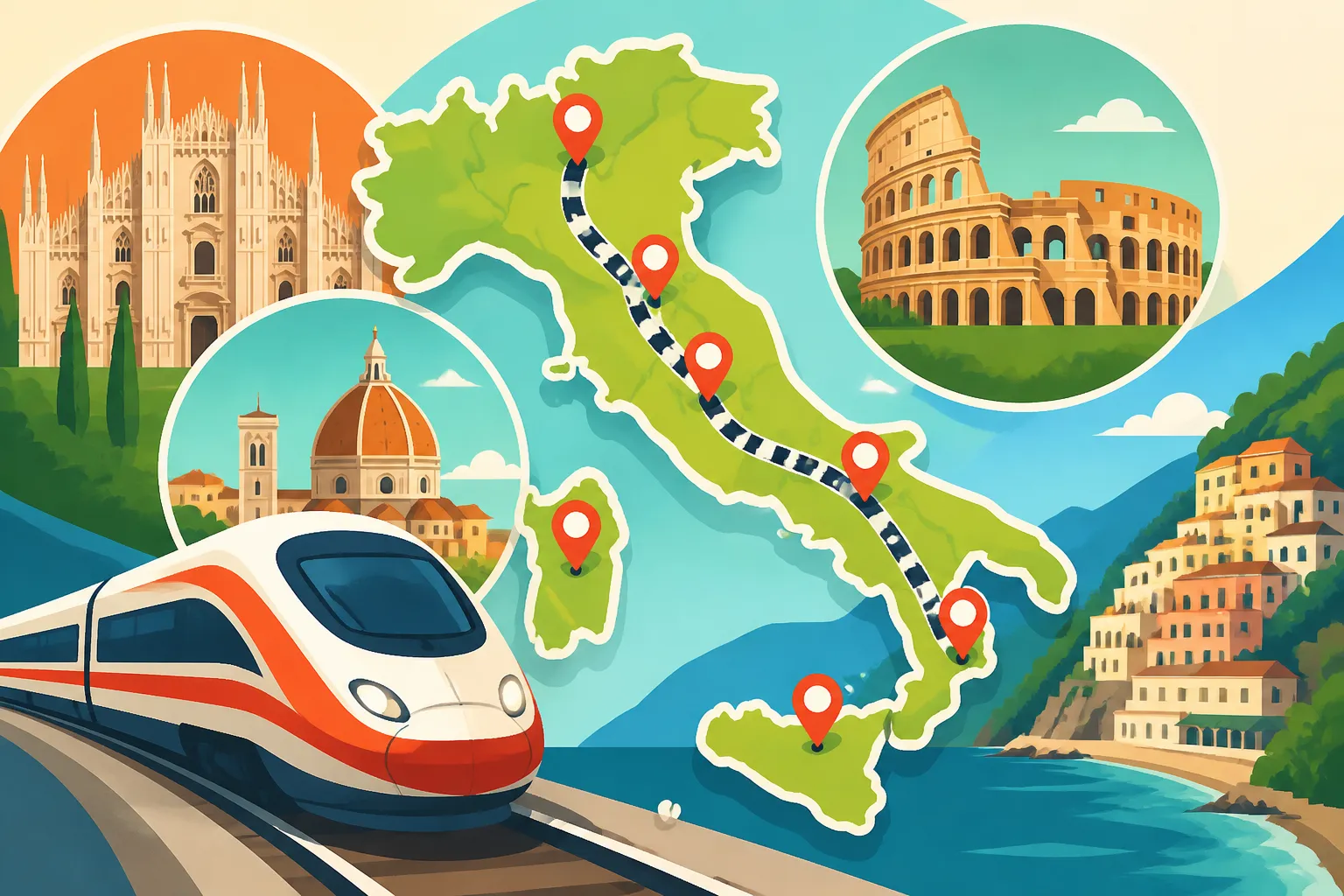
The backbone of Italian high-speed rail runs roughly from Turin and Milan in the north, down through Bologna and Florence, to Rome and then Naples. Salerno sits just beyond Naples. Both Trenitalia’s Frecciarossa services and Italo run along this corridor. Picture it as a single line with stations strung along it like beads.
Two important branches matter for most visitors. The first heads northeast from Bologna towards Padua and Venice. The second runs east from Milan through Brescia and Verona, then on to Venice. That gives you a triangle in the north: Milan, Venice and Bologna, with Verona and Padua along its sides. South of Rome, the main high-speed line ends around Naples and Salerno. Anything beyond that, such as Puglia, Calabria or Sicily, means slower Intercity trains, regional services, buses or a flight.
For a deeper look at the operators and fare classes on this corridor, see High-Speed Trains in Italy: Trenitalia, Italo, Routes, and Savings. For this guide, just hold the shape in your head: a north-south spine, a northern triangle, and a south where the fast network thins out.
Linear Routes Versus Hub-and-Spoke
There are two ways to structure a multi-city Italy trip, and each has a place. A linear route moves you from one end of the spine to the other. You check out of one city and into the next, always heading the same direction. Milan, then Florence, then Rome, then Naples is a textbook linear route. You never cover the same stretch of track twice.
A hub-and-spoke route keeps you in one or two well-connected bases while you take day trips. Florence is the classic hub. Siena, Pisa, Lucca, Bologna and Arezzo are all reachable as day trips. Rome works the same way for Orvieto, Tivoli and Naples at a push. The benefit is that you unpack once and your hotel booking stays simple. The cost is that you spend more total time on trains, and you see the small towns by day but never in the evening.
Most good itineraries are a hybrid: a linear route between three or four bases, with one or two day trips from each base. Pick your bases along the spine in geographic order, then hang the day trips off them. That is the core logic of everything that follows.
Open-Jaw Flights Make the Line Work
A linear route only saves time if you are not forced back to your starting point at the end. That is why open-jaw flights are so useful: you fly into one city and out of another. Arriving at Milan Malpensa and leaving from Rome Fiumicino or Naples lets you run the spine once, cleanly, with no return leg.
If you have to fly in and out of the same airport, the plan changes. Say you must arrive and depart through Rome. You have two good options. You can do a loop, heading north to Florence and Venice by one route and coming back via a different stop such as Bologna or Verona. Or you can use Rome as a hub, taking one long day trip south to Naples or Pompeii. What you want to avoid is unplanned backtracking, where you pass through the same city twice simply because your hotels were booked in the wrong order.
Proven City Sequences for Common Itineraries
Here is where the theory turns into bookings. These are the sequences I recommend most often to friends and readers. Each one follows the rail network in a single direction, or uses a deliberate loop, so your accommodation dates fall into place naturally. For more detail on the train side, see How to Plan an Italy Itinerary by Train.
| Itinerary | Recommended Order | Best Flight Pattern | Suggested Day Trips From Bases | Main Pitfall to Avoid |
|---|---|---|---|---|
| Classic Highlights | Venice, Florence, Rome | Into Venice, out of Rome | Bologna or Siena from Florence | Booking Rome in the middle |
| Highlights Plus South | Venice, Florence, Rome, Naples | Into Venice, out of Naples | Pompeii from Naples, Orvieto from Rome | Visiting Naples before Florence |
| Northern Triangle | Milan, Lakes, Verona, Venice | Into Milan, out of Venice | Bergamo from Milan, Padua from Venice | Treating Verona as a day trip from Milan and from Venice |
| Rome Round Trip | Rome, Florence, Venice, Bologna, Rome | Into and out of Rome | Siena from Florence | Repeating the same stops on the return |
| Slow Central Route | Bologna, Florence, Rome | Into Bologna, out of Rome | Ravenna from Bologna, Lucca from Florence | Adding too many one-night stops |
The Classic North-to-South Run
The classic run for a first trip is Venice, then Florence, then Rome. You arrive at Venice Marco Polo, take the bus or water transfer into town, and spend your first nights on the lagoon. From Venezia Santa Lucia, a high-speed train takes you to Firenze Santa Maria Novella. From there, another fast train takes you to Roma Termini. You fly home from Fiumicino.
This order works because each transfer is a single direct high-speed journey, and you finish in the city with the best long-haul flight options. It also has a nice emotional arc: Venice’s quiet canals at the start, Florence’s Renaissance density in the middle, and Rome’s scale to finish. The reverse order, Rome then Florence then Venice, works just as well if your flights favour it.
The order that does not work is putting Rome in the middle: Florence, then Rome, then Venice. That makes you ride the whole Rome-Florence stretch twice. When you are building your bookings, the first check is simple: does any leg retrace a previous leg? If so, swap two cities. For more on balancing nights between these three, see How to Combine Rome, Florence, and Venice in One Trip.
Adding Naples and the South Without Retracing Steps
Naples belongs at the southern end of your route, never in the middle. If you want Naples, Pompeii or the Amalfi Coast, add them after Rome. The cleanest version is Venice, then Florence, then Rome, then Naples, flying home from Naples or connecting onwards from there.
Picture a scenario I see often. A couple books Rome, then Naples, then Florence, because a lovely Florence apartment happened to be free at the end of their dates. On paper it looks fine. In practice, they travel south from Rome to Naples, then all the way north again, passing back through Rome on the way to Florence. That is the backtracking pattern to avoid. The fix is to move Florence before Rome, so the whole trip flows south and ends in Naples.
If you cannot fly out of Naples, end in Naples anyway and take one fast train back to Rome on your final day. That is a single return leg to the airport, not a loop through a city you have already explored. Better still, skip the Naples hotel entirely and visit Pompeii as a long day trip from Rome. Which you choose depends on whether you want Naples evenings, which in my opinion are worth staying for.
Venice, Lakes, and Milan Combinations
Some trips skip the centre and south entirely. A northern route might run Milan, then Lake Como or Lake Garda, then Verona, then Venice. Every stop on that list lies on or near the Milan-Venice line, so the whole trip moves steadily east. You fly into Milan and out of Venice, or the reverse.
The lakes are the tricky part. Lake Como’s lakeside towns are reached by regional trains from Milan, followed by ferries. Lake Garda is reached from stations such as Desenzano del Garda or Peschiera del Garda, which sit right on the Milan-Venice line. That makes Garda the easier lake to slot into an eastward route. Como fits better as either a stay before you head east, or a day trip from Milan.
Verona is the stop people most often double-count. They visit it as a day trip from Milan, then again from Venice, because they did not realise it sits right between them. Give Verona its own night or two in the middle of the route, and both day trips become unnecessary.
Booking Accommodation Around Stations
Once your order is fixed, the next question is where in each city to stay. The answer depends on how many nights you have there and how heavy your luggage is. This is also where your accommodation search tool earns its keep. I use Booking.com for most multi-city trips because I can see every property on a map against the station, filter by what matters on transfer days, and keep all the reservations in one place.
Station Hotels Versus Historic Centres
Hotels near the main stations, such as the streets around Roma Termini or Firenze Santa Maria Novella, are practical. You step off the train, wheel your case a few minutes, and drop it. On a one-night stop or an early departure, that is gold. The trade-off is atmosphere. The blocks around Termini in particular can feel busy and a bit gritty late at night, and you will be walking or taking the metro to the sights.
Historic-centre hotels give you the evenings you came for: the piazza after dinner, the church bells in the morning. But cobblestones, stairs, and the lack of lifts in old buildings can turn a five-minute taxi into a struggle. In Venice, the centre also means hauling luggage over bridges, which is why some travellers choose Mestre on the mainland. For a candid comparison of those Venice options, see Budget Beds in Venice: Mestre, Lido, and Giudecca on Price and Commute.
My rule of thumb is this: for stays of three nights or more, choose the neighbourhood you want to wake up in. For one- or two-night stops, or a city you are leaving on an early train, stay within easy walking distance of the station. For neighbourhood guidance, see Where to Stay in Florence: Duomo, Oltrarno, Santa Croce, and San Frediano and Where to Stay in Rome: Centro Storico, Trastevere, Monti, and Prati.
Using Booking.com Map View to Measure the Walk
This is the part of my routine I would recommend to anyone. When I search a city on Booking.com, I switch to the map view and drop the main station into my mental picture. Then I shortlist properties based on two distances: the walk from the arrival station, and the walk to the places I actually want to spend time.
Remember that some cities have more than one important station. Rome has Roma Termini and Roma Tiburtina, and some high-speed trains stop at both. Venice has Santa Lucia on the island and Mestre on the mainland. Florence’s fast trains mostly use Santa Maria Novella, though a few services stop elsewhere. Check which station your train actually uses before you judge a hotel’s location. A hotel that looks perfect near Termini is less perfect if your Italo train stops only at Tiburtina.
I also read recent guest reviews for comments about the walk from the station, lifts, stairs and street noise. Reviews on Booking.com are tied to completed stays, so they tend to mention exactly the practical details that matter on a travel day, such as a fourth-floor room with no lift or a front door that is hard to find at night.
Check-In Windows and Luggage on Transfer Days
Transfer days have an awkward rhythm. You check out in the morning, ride the train, and often arrive in the next city before check-in opens. Or your evening train arrives after the reception desk has closed. Small Italian guesthouses and apartments frequently have limited reception hours, and many expect you to message ahead with your arrival time.
Before you book, read the property’s check-in window and whether it offers luggage storage. Plan your train so you either arrive close to check-in time or can drop bags and go out. If a property has a narrow window, choose a train that fits it rather than hoping. When I book, I also message the property through the platform with my train’s arrival time. That way the host has it in writing.
Also plan for the check-in formalities. Italian accommodation is required to register guests, which is why you will be asked for your passport or ID on arrival. See Why Italian Hotels Ask for Your Passport: Check-In Registration Explained. Most cities also charge a local tourist tax per person per night, often paid at the property. It varies by city and hotel category, so check Italy’s Tourist Tax by City: Tassa di Soggiorno and What You Pay when budgeting.
Timing Your Bookings: Rooms First or Trains First
Here is the question I get asked most: should you lock in hotels first, or trains first? My answer, after many trips, is neither in isolation. You fix the sequence first, then book flexibly in a particular order so that a change in one does not ruin the other.
The Order of Operations
This is the step-by-step routine I use for every multi-city trip in Italy:
- Fix your arrival and departure airports and dates, ideally open-jaw.
- Choose your base cities and put them in geographic order along the rail network, checking that no leg retraces another.
- Allocate nights to each base, counting transfer days as half-days.
- Search accommodation for every base on Booking.com, using free-cancellation filters, and save shortlists for each city.
- Book refundable rooms for all bases so your dates are secured.
- Check train timetables for each transfer day and confirm the trains suit your check-out and check-in times.
- Book train tickets once timetables are open and fares are attractive.
- Go back and swap any refundable room for a cheaper non-refundable rate only if you are sure of your dates.
The logic is simple. Rooms in popular cities can sell out, especially in peak season and around events. Trains rarely sell out completely, but the cheapest fares disappear as departure approaches. Holding refundable rooms gives you security while you wait for the best train fares. For how train prices typically move, see Italian Train Price Curves: How Fares Move From 90 Days Out to Departure.
Flexible Rates as Insurance
Multi-city trips have more moving parts than a single-city break. A strike, a timetable change, or a delayed flight can push one city back by a night, and the effect ripples through every booking after it. That is why I lean on free-cancellation rates, at least until the trip’s shape is certain.
The trade-off is cost. Non-refundable rates are often cheaper, but if a single leg changes, you can lose that whole booking. Cancellation terms differ property by property, so read the specific deadline on each Booking.com reservation rather than assuming. For a fuller breakdown of when the discount is worth the risk, see Refundable vs Non-Refundable Rates in Italy: When the Discount Is Worth It.
A sensible middle ground: keep the first and last nights flexible, since those are the most exposed to flight changes. Consider non-refundable rates only for middle cities where your dates are locked in and your trains are already booked. Having every reservation in one Booking.com account also helps here, because you can see every cancellation deadline at a glance instead of digging through confirmation emails from different sites.
Night Counts per City
The single biggest mistake I see on itineraries is too many one-night stops. Each move costs you a check-out, a walk or taxi to the station, a train, and a check-in. Even on a short high-speed hop, that easily eats half a day. Do it four times in a week and you have lost two days to logistics.
As a general guide, give Rome at least three nights, Florence at least two or three, and Venice at least two. Naples deserves two or more if you want Pompeii as well as the city. If you are tempted to add a fifth or sixth base, ask whether it could be a day trip from a neighbouring base instead. Bologna, Siena, Verona and Padua are all very doable as day trips if you are short on time.
Here is a realistic scenario. You have ten nights, flying into Venice and out of Rome. A balanced plan would be two nights in Venice, three in Florence with a day trip to Siena or Bologna, and five in Rome with a day trip to Orvieto or Tivoli. Every transfer is one direct train heading south, and you only check in three times. Compare that with a plan of Venice, Verona, Bologna, Florence, Siena and Rome in the same ten nights, and you can see how much of the trip would be spent wheeling luggage.
Handling Disruptions and Edge Cases
Italian trains are generally reliable on the high-speed corridor, but things still go wrong. Strikes, delays and engineering works all happen. A well-sequenced itinerary is easier to rescue because each leg is a single direct journey on a busy route with frequent alternatives.
Strikes and Cancelled Trains
Italy has organised transport strikes, which are usually announced in advance. Some services are guaranteed during strikes, but you cannot rely on your specific train running. If a strike falls on one of your transfer days, you have a few options: travel the day before, travel the day after, or switch to the other high-speed operator if it is not affected. For how these work and how to rebook, see Strikes in Italy: How Sciopero Days Work and How to Rebook.
This is precisely where flexible rooms pay off. If you need to leave Florence a day early, you want to be able to cancel your last Florence night and add one in Rome without penalty. With refundable rates on Booking.com, that usually means cancelling one reservation and amending or adding another. With non-refundable rates, you may simply eat the cost.
Before any transfer day, I check the operator apps for the latest status of my train, and I keep a note of the hotel’s phone number and reception hours. If I am going to arrive late, I message the property immediately. Italian hosts are, in my experience, very understanding about train delays as long as you tell them.
Day Trips From a Base Instead of Another Move
Day trips are your secret weapon for keeping the hotel count low. A city on the spine, such as Bologna, can be visited from Florence or Venice in a day thanks to the fast trains. Small hill towns are a different story. Siena, for example, is best reached from Florence by bus or regional train, and those are slower and less frequent.
When you plan a day trip, check the last return train or bus, not just the first one out. Regional and bus services in smaller towns can thin out in the evening, and you do not want to be stuck. If the last return is early, either accept a shorter visit or consider one night there, in which case it becomes a base and needs its own place in your sequence.
For luggage, day trips are wonderful because you leave everything at your hotel. When you do move cities, travel light. High-speed trains have limited luggage space, and wrestling a large case through a crowded carriage is no fun. See Luggage Rules on Italian Trains and Buses: Limits and Fees for the practical detail.
Sunday and Holiday Transfers
Transfer days that fall on Sundays or Italian public holidays need a little extra care. High-speed trains still run, but local buses, regional trains and ferries may follow reduced schedules. Small hotels and guesthouses may also have shorter reception hours. If your route includes a lake, a coastal village or a hill town, check the holiday timetable for that final leg.
Around the busiest holidays, accommodation in popular cities fills early and prices climb. If your trip spans Easter or mid-August, book your rooms first and early, using refundable rates, then sort the trains. Holiday weekends are also when last-minute availability on any platform becomes thin, so do not leave the middle of a multi-city trip unbooked hoping something will turn up.
Finally, if a particular property matters to you, such as a special agriturismo or a palazzo with a view, it is sometimes worth contacting the hotel directly about special requests or late arrivals. For when that makes sense, see Booking Platforms vs Direct Booking in Italy: When Calling the Hotel Wins. For everything else, I keep my multi-city bookings on Booking.com so the whole trip lives in one app, with every check-in time, address and cancellation deadline in the same place.
Putting Your Italian Rail Itinerary Together
To bring it all together: sequence first, book second. Lay your cities along the rail network in one direction, give each base enough nights to make the move worthwhile, and attach day trips rather than adding more hotels. Hold refundable rooms while you wait for good train fares, and check stations and check-in windows before you commit.
When I help friends plan, I sit down with them, sketch the order on paper as a numbered list, and only then open Booking.com to fill in each city. It takes ten minutes to get the order right, and it saves hours of zigzagging. Open your search now, start with your first city, and build forward along the line.
Disclaimer
This article is for general informational purposes only and does not constitute professional advice. Laws, prices and regulations vary by location and change over time. Consult a qualified professional for guidance on your specific situation.