Booking a Base for the Via Francigena: Stage-by-Stage Options
So, you're dreaming of walking the Via Francigena, aren't you? The ancient pilgrim path from Canterbury to Rome, full of breathtaking landscapes, historical towns, and incredible Italian food. But then reality hits: where on earth do you sleep each night? Planning accommodation along a multi-day walking route in Italy can feel like an administrative labyrinth, especially when you're tired and your feet ache. This guide will walk you through everything you need to know about booking your stage-by-stage accommodation, showing you why Booking.com is truly your best friend for a smooth and stress-free journey.
Disclosure: This post may contain affiliate links. We may earn a commission at no extra cost to you if you make a purchase through these links. Read full disclosure.
Understanding the Via Francigena and its Stages
The Via Francigena isn't just one path; it's a network of routes, historically trodden by archbishops, merchants, and common pilgrims heading to Rome. When you commit to walking a significant portion of it, you're signing up for an adventure that blends physical challenge with profound cultural immersion. But unlike a traditional vacation where you stay in one place, the Via Francigena demands a new bed almost every night.
The Pilgrim's Journey and Daily Distances
Walking the Via Francigena means embracing a rhythm of daily stages, typically ranging from 15 to 30 kilometers (about 9 to 18 miles). Your choice of destination for each evening isn't just about a pretty view; it's a critical decision based on your physical limits, the availability of services, and, of course, where you can actually lay your head down. Many guidebooks break the route down into suggested stages, complete with town names and recommended distances. However, these are just suggestions, and your pace might differ significantly.
You might find yourself pushing an extra few kilometers on a good day, or needing to stop short if the weather turns or a blister decides to make a grand appearance. This flexibility is part of the journey, but it also means your accommodation planning needs to be adaptable. Relying solely on a rigid, pre-booked itinerary can lead to unnecessary stress if your plans deviate. Having a robust platform like Booking.com at your fingertips, even mid-walk, can be a game-changer. It allows you to search for options in upcoming towns with surprising ease, letting you adjust on the fly without panicking.
The beauty of the Via Francigena often lies in its remote stretches, but these also present the biggest challenges for finding spontaneous lodging. Towns that cater heavily to pilgrims might have ostelli (hostels) or case per pellegrini (pilgrim houses), which fill up quickly, especially during peak season. Smaller villages, while charming, might only have a handful of rooms available, often managed by locals who aren't always online. Understanding these dynamics is crucial for setting realistic expectations and deciding when to book in advance and when you can afford to be a bit more spontaneous.
Key Accommodation Concepts for Pilgrims
When you’re walking the Via Francigena, "accommodation" takes on a different meaning than a luxury resort stay. You're primarily looking for a safe, clean, and ideally, affordable place to rest your weary bones, shower, and recharge for the next day's trek. The concept of accoglienza pellegrina – pilgrim hospitality – is central to the experience. This often translates to simpler, communal lodgings, sometimes at reduced rates for those carrying a credenziale (pilgrim's passport).
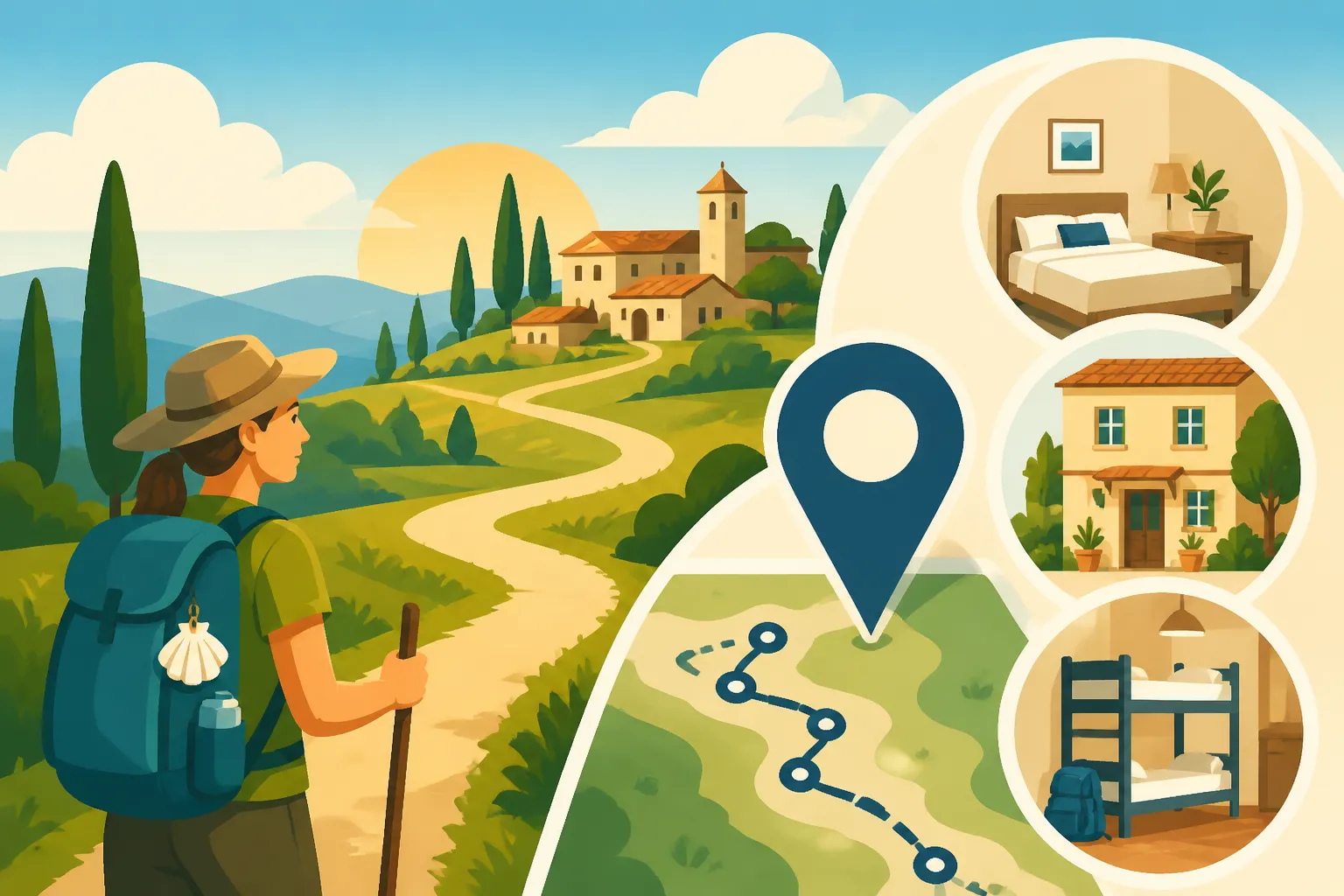
However, not every town offers dedicated pilgrim housing. You'll encounter a wide array of options, from municipal ostelli (hostels), sometimes run by volunteers or the local parish, to family-run Bed & Breakfasts, charming agriturismi (farm stays), and traditional hotels. Each type offers a different level of comfort, privacy, and cost. It's important to know what you're looking for and what each type of establishment typically provides. For instance, an ostello will likely mean a shared dormitory and basic facilities, while a B&B offers a private room and breakfast, usually with a more personal touch from the owners.
Knowing how to differentiate these types of stays and how to find them efficiently is key. Many traditional pilgrim ostelli might not be listed on major booking platforms, relying instead on word-of-mouth or direct contact. However, a significant number of private establishments that cater to pilgrims do list themselves on platforms like Booking.com. This is where the platform becomes incredibly useful, offering a comprehensive view of what's available in a given town beyond just the strictly pilgrim-focused places. It also allows you to branch out if the dedicated pilgrim options are full or not to your taste, giving you more control and choice over your overnight stays.
Why Booking.com is Your Best Friend for the Via Francigena
Let's be honest, after a long day of walking dusty roads and charming strade bianche, the last thing you want to do is hunt for a place to sleep. This is where a reliable booking platform becomes indispensable. For a journey like the Via Francigena, Booking.com stands out as an incredibly valuable tool, offering features that directly address the unique needs of a long-distance walker.
Unmatched Selection and Filtering Options
Italy's diverse landscape means that the accommodation along the Via Francigena varies wildly from one region to the next. You might be in a bustling Tuscan town one day and a tiny Lazio village the next. Booking.com shines here because it boasts an enormous inventory, ranging from dedicated pilgrim hostels to quaint B&Bs, sprawling agriturismi, and even small, independent hotels. This extensive selection means you’re much more likely to find something available, even in less-frequented areas or during busier seasons.
The real power, however, lies in its filtering system. You can easily filter by price, property type (hostel, B&B, hotel, guesthouse), distance from the town center or specific landmarks, and even amenities like laundry facilities (a pilgrim's dream!), Wi-Fi, or breakfast included. Imagine stumbling into a town after a rainy day, knowing you desperately need to wash your clothes. A quick search on Booking.com with the "laundry facilities" filter can immediately narrow down your options, saving you precious time and energy. This level of granular control over your search ensures you find a place that meets your immediate needs and budget, rather than settling for whatever you stumble upon first.
Furthermore, the map view feature on Booking.com is incredibly useful for the Via Francigena. Instead of guessing how far a place is from your endpoint for the day, you can visually see its proximity to the actual Via Francigena path or the main points of interest in a town. This spatial awareness helps you avoid unnecessary detours, which can be critical when every step counts. For example, if you're looking for a place in Siena, you can pinpoint options directly on the path, ensuring a minimal walk after you've already completed your stage. This intuitive functionality makes planning and booking significantly more efficient, reducing the chances of any unwelcome surprises.
Real Reviews from Fellow Travelers
One of the greatest anxieties when booking accommodation sight unseen, especially in rural or less-trafficked areas, is the unknown quality of the stay. Is the bed comfortable? Is it clean? Is the host welcoming? The review system on Booking.com is a treasure trove of information, providing invaluable insights from other travelers, many of whom are likely fellow pilgrims. These candid reviews often detail the exact things you care about: how close it is to the Via Francigena, whether the breakfast is substantial enough for a walker, or if the owners are particularly friendly and helpful.
Reading through reviews can help you set realistic expectations and avoid potential disappointments. A quick scan can reveal if a place is noisy, if the Wi-Fi is unreliable, or if the beds are surprisingly uncomfortable – all crucial details when you're relying on a good night's rest. You can often spot comments like "perfect for pilgrims" or "the owner drove us to the path in the morning," which tell you a lot about the establishment's suitability for your specific journey. This community-generated feedback acts as a form of peer recommendation, giving you confidence in your booking choices.
Beyond just the written reviews, Booking.com offers a rating system that covers various aspects like cleanliness, comfort, location, facilities, and staff. This allows for a quick assessment at a glance. If a place has consistently high ratings across the board, especially for location and staff helpfulness, you can generally trust it will be a good experience. When you're tired and need to make a quick decision, seeing a high average score and positive comments can make all the difference in quickly securing a suitable spot. This transparency helps you choose wisely, prioritizing factors that truly matter after a demanding day on the Via Francigena.
Flexible Cancellation Policies for the Unpredictable Path
The Via Francigena is an unpredictable journey. Weather can change plans, injuries can occur, or you might simply find yourself wanting to linger longer in a particularly beautiful spot. A rigid, non-refundable booking policy can become a huge source of stress and financial loss. This is why the flexible cancellation options offered by many properties on Booking.com are absolutely invaluable for pilgrims. Being able to cancel or modify your reservation without penalty up to a certain point (often 24-48 hours before check-in) provides a much-needed safety net.
Imagine you've planned to walk 25 km to a specific town, but a sudden downpour makes the path unsafe, or you twist an ankle. With a flexible booking, you can quickly cancel your reservation in the original town and search for alternative accommodation in your current location or a closer village, all without losing your money. This peace of mind allows you to adapt to circumstances as they arise, rather than feeling pressured to push through pain or adverse conditions just to avoid a cancellation fee. It empowers you to prioritize your well-being and enjoy the journey at your own pace.
When you're browsing on Booking.com, always pay close attention to the cancellation terms. While many options are flexible, some budget stays might have stricter policies. It's a trade-off: a non-refundable rate is often slightly cheaper, but the flexibility is worth its weight in gold for a pilgrim. Weigh your options based on your personal risk tolerance and how far in advance you're booking. For crucial stages or during peak season, booking well in advance with a flexible option is often the smartest strategy, giving you the security of a guaranteed bed without locking you into an unchangeable itinerary. This foresight can prevent a minor hiccup from turning into a major headache on your pilgrimage.
Types of Accommodation You'll Encounter Along the Way
Italy offers a wonderful variety of places to stay, and the Via Francigena takes you through regions where each type of accommodation has its own charm and benefits. Understanding these options will help you make informed choices, whether you're looking to save money, immerse yourself in local culture, or simply enjoy a touch of comfort.
Pilgrim Hostels (Ostelli) and Budget Stays
For many walking the Via Francigena, the pilgrim hostel, or ostello, is the quintessential accommodation experience. These are often the most budget-friendly option, typically offering dormitory-style beds with shared bathrooms. The vibe is usually communal, with shared kitchen facilities, common rooms, and a chance to meet fellow pilgrims from all corners of the globe. Many ostelli are run by religious orders, municipalities, or non-profit associations, focusing on simple hospitality rather than luxury.
While basic, ostelli provide everything a weary traveler needs: a bed, a shower, and often a warm welcome. Some even offer a simple dinner (a cena del pellegrino) and breakfast, which can be a huge convenience after a long day of walking. The cost is usually significantly lower than private rooms, making them ideal for those on a tight budget. Remember to carry your credenziale (pilgrim's passport) as many ostelli offer special pilgrim rates or require it for entry. While some smaller, more traditional pilgrim houses might not be on Booking.com, many modern or privately-run hostels and budget guesthouses are, making it easy to find and book them in advance.
However, don't expect hotel-level amenities or privacy. Shared rooms mean shared spaces, and snoring roommates are part of the deal! It's a great opportunity to connect with others, share stories, and truly feel like part of the pilgrim community. These places are often situated conveniently close to the path or in the heart of small towns, making them ideal for minimizing extra walking. Always check the rules and curfew times, as some ostelli have specific hours for coming and going to maintain peace for all guests.
Bed & Breakfasts and Guesthouses (B&B, Affittacamere)
If you're seeking a bit more comfort and privacy than an ostello offers, or if you simply prefer a good night's sleep in your own space, then Bed & Breakfasts (B&B) and affittacamere (guesthouses) are fantastic choices. Italy excels at these charming, often family-run establishments. They provide private rooms, usually with en-suite bathrooms, and, as the name suggests, include breakfast in the price. The experience is typically more intimate and personal, allowing for better interaction with local hosts.
Many B&Bs along the Via Francigena are beautifully restored historic homes or farmhouses, offering a glimpse into local life. The hosts are often passionate about their region and can provide invaluable local tips, from recommending the best trattoria in town to advising on the next day's route. The breakfasts, too, are usually a step up from a simple cornetto and coffee, often featuring homemade cakes, local cheeses, and fresh fruit – perfect fuel for the day ahead. You'll find a vast selection of these on Booking.com, with detailed descriptions, photos, and those crucial reviews from previous guests.
The price point for B&Bs and guesthouses is generally higher than an ostello but significantly less than a full-service hotel. This makes them a popular middle-ground choice for pilgrims who want a blend of comfort and authenticity without breaking the bank. They offer a peaceful retreat after a challenging day, providing the personal space needed to recharge. Booking.com allows you to easily filter for "B&B" or "Guesthouse" and read up on the specifics, ensuring you find a spot that feels like a home away from home.
Agriturismi and Rural Retreats
For those walking through Italy's breathtaking countryside, particularly in regions like Tuscany, Umbria, or Lazio, staying at an agriturismo is an experience not to be missed. An agriturismo is essentially a working farm that also offers accommodation, providing guests with a direct connection to rural Italian life. They often feature homemade food, sometimes grown on site, and offer a tranquil escape from urban bustle. These are perfect for stages that take you through more remote, agricultural areas.
Many agriturismi are beautifully restored farmhouses, complete with swimming pools, stunning views, and a sense of deep calm. While they might be slightly off the main Via Francigena path, the extra kilometer or two of walking to reach them is often rewarded with an unforgettable evening. Imagine enjoying a delicious, locally sourced dinner with wine produced on the farm, under a canopy of stars, far from city lights. The experience is often rustic yet refined, deeply authentic, and incredibly relaxing after a long walk. Booking.com is an excellent resource for finding agriturismi, as they are generally well-represented on the platform.
The cost of an agriturismo can vary greatly depending on its amenities and location, but it often offers incredible value, especially when a multi-course dinner is included. They provide a unique opportunity to taste regional specialties and experience genuine Italian hospitality. When searching on Booking.com, you can specifically look for "farm stay" or "agriturismo" as a property type. Do check their location carefully in relation to the Via Francigena route, and consider if they offer a shuttle service if they are particularly remote, which some happily do for pilgrims.
Hotels and Case Vacanze for Comfort
Sometimes, after days of simple living and shared spaces, a bit of luxury or a fully self-contained apartment is exactly what you need. Traditional hotels and case vacanze (vacation rentals) offer a different kind of comfort and convenience, especially when you pass through larger towns or cities along the Via Francigena like Siena, Lucca, or Viterbo. These options provide more privacy, amenities, and often more extensive services, from 24-hour reception to room service.
Hotels range from charming boutique establishments to larger chains, offering consistent standards and predictable services. If you're looking for a comfortable bed, a quiet room, and perhaps an on-site restaurant or bar, a hotel is a solid choice. Case vacanze, on the other hand, give you a fully furnished apartment, complete with a kitchen. This can be ideal for longer stays in one town, for families, or for those who prefer to self-cater and enjoy a more independent experience. Having your own kitchen means you can prepare your own meals, which can be a budget-friendly option and a nice change from restaurant food every night.
Both hotels and case vacanze are extensively listed on Booking.com, making them incredibly easy to find and compare. You can filter for specific star ratings, amenities like air conditioning (a blessing in summer!), or even properties with washing machines in the case of case vacanze. While typically more expensive than ostelli or even many B&Bs, they offer a break from the pilgrim routine and a chance to truly relax and rejuvenate. It's often worth splurging on a hotel or apartment every few days, especially if you're taking a rest day, to fully recover and prepare for the next stretch of your journey.
Strategizing Your Bookings Stage-by-Stage
Successfully navigating the Via Francigena doesn't just involve walking; it's also about smart planning, especially when it comes to where you'll rest your head each night. A strategic approach to booking your accommodation can significantly reduce stress and enhance your overall experience.
Planning Ahead vs. Last-Minute Bookings
One of the biggest questions for any pilgrim is whether to book accommodation months in advance or to play it by ear, booking only a day or two ahead. There are merits to both approaches, and the best strategy often involves a hybrid model, leaning on Booking.com to support either choice. Planning ahead provides immense peace of mind. Knowing you have a guaranteed bed after a long, arduous day, especially in popular towns or during peak season (like summer or around major holidays), can be a huge relief. This is particularly true for longer sections of the Via Francigena or if you have specific requirements, like a private room or a specific type of property.
For example, if you're walking the section through Tuscany in May or September, popular towns like San Gimignano, Siena, or Lucca can see accommodations fill up quickly. Booking your stays in these high-demand locations a few weeks or even months in advance is a wise move. Booking.com allows you to secure these critical spots early, often with flexible cancellation policies, as discussed before, which gives you the best of both worlds. You get the security of a confirmed bed but retain the ability to adjust if your plans unexpectedly change.
On the other hand, the joy of the Via Francigena can also be in its spontaneity. You might discover a charming village not on your original itinerary, or perhaps a sudden downpour makes you want to stop earlier than planned. In these moments, Booking.com becomes your real-time lifeline. With a smartphone and signal, you can search for immediate availability in your current or upcoming location. While last-minute options might be more limited, especially for pilgrim-specific ostelli, the broad selection on Booking.com still offers a decent chance of finding something suitable, whether it's a small guesthouse or a family-run hotel. This flexibility is what makes the platform truly invaluable for the unpredictable nature of a long walk.
Factors to Consider for Each Stage's Stay
Each stage of your Via Francigena journey will present unique considerations for accommodation. It’s not a one-size-fits-all approach. First and foremost, consider the town size and popularity. Larger towns or those renowned for tourism will have more options but might also be more expensive and fill up faster. Smaller, more rural villages might have limited choices, so booking ahead here is often a good idea. Think about the specific region you're in; the accommodation landscape can differ significantly between, say, the Ligurian coast and the hills of Lazio.
Next, your personal needs and budget should guide your choices. Are you traveling solo and happy to share a dorm for cost savings and camaraderie? Or are you with a partner or family and prefer a private room? Do you have any dietary requirements that would make a B&B with a good breakfast or a casa vacanze with a kitchen more appealing? These practical considerations should be at the forefront of your search on Booking.com. Don't forget about proximity to the actual Via Francigena path; minimizing extra walking at the end of a long day is often a high priority for pilgrims.
Finally, think about the time of year. Peak season inevitably means higher prices and lower availability. During the off-season, you might find more flexibility and better deals, allowing for more spontaneous bookings. However, some smaller places might even close for the winter. Always factor in local holidays and festivals too; a small town hosting a sagra (local festival) will have its accommodations booked solid. Using Booking.com's filters for price range, property type, and checking availability for your specific dates will help you navigate these variables and choose the most suitable option for each leg of your journey. Remember, a well-chosen bed can make all the difference to your morale!
Using Maps and Location Filters on Booking.com
For the Via Francigena, the "location, location, location" mantra is amplified. After hours of walking, you absolutely do not want to add another kilometer to find your accommodation. This is where Booking.com's integrated maps and location filters become a superpower. When you search for a town, the platform doesn't just show you a list; it offers a comprehensive map view that plots all available properties. You can easily zoom in and out, seeing exactly where each guesthouse, ostello, or hotel is situated in relation to the main path or town center.
This visual aid is incredibly helpful for pilgrims. You can identify accommodations directly on the edge of town, minimizing your post-walk search. Or, if you know a particular landmark marks the end of your stage, you can find places within a very close radius. Sometimes, a property might look far on a list but turns out to be perfectly positioned on the map, perhaps just off the trail but avoiding the need to walk through a busy city center. This can save your tired feet from unnecessary wandering and frustration, a feeling I know all too well from my own travels in Italy.
Beyond the general map, Booking.com also allows you to filter by specific neighborhoods or points of interest. If you know you want to be near the train station for an early departure, or close to a specific church that's part of your pilgrimage, you can refine your search accordingly. This level of detail ensures that your accommodation isn't just a place to sleep, but a strategically chosen base that complements your daily walking plan. Pair this with the price and amenity filters, and you've got a truly powerful tool for finding the perfect overnight spot, tailored precisely to the demands of your Via Francigena adventure. For general travel tips around Italy, you might want to read our guide on Getting Around Italy: Trains, Buses, Flights, and Car Hire.
Essential Tips for a Smooth Accommodation Experience
Even with the best booking platform in hand, a little local knowledge and foresight can go a long way in ensuring your accommodation experience on the Via Francigena is as smooth as possible. After all, you're not just booking a room; you're stepping into a host's world.
Communicating with Hosts in Italy
When you're traveling in Italy, particularly in smaller towns along the Via Francigena, direct communication with your host can make a significant difference. While Booking.com facilitates the initial reservation, sometimes a quick message or phone call can confirm details, arrange a late check-in, or even inquire about a pilgrim-specific service like bag transfer or a packed lunch. Remember that English isn't universally spoken, especially outside of major tourist hubs, so having a few key Italian phrases ready or using a translation app can be incredibly helpful.
Many Italian hosts are incredibly warm and hospitable, especially towards pilgrims, and they appreciate the effort to communicate, even if your Italian is rudimentary. Phrases like "Ho una prenotazione a nome [Your Name]" (I have a reservation under the name [Your Name]) or "Arriverò verso le [Time]" (I will arrive around [Time]) can smooth over any potential misunderstandings. If you have specific needs, such as a preference for a ground-floor room due to sore knees, or an allergy, it's always best to communicate this in advance. Booking.com often has a messaging feature that translates, which can be a lifesaver, but don't hesitate to follow up with a phone call if something feels urgent. For more on navigating conversations, check out Italian Language and Everyday Communication for Visitors.
A little patience and understanding go a long way. Italian communication styles can sometimes seem indirect or less rushed than what you might be used to, but it rarely signifies a problem. Trust that your hosts want you to have a good stay. Many will go out of their way to assist you, offering valuable local insights or even small gestures of kindness that truly enhance the pilgrim experience. Being prepared to engage, even with a language barrier, demonstrates respect and often leads to a more memorable and positive interaction.
Understanding Check-in/Check-out and Local Taxes
Unlike large hotels with 24/7 reception, many smaller accommodations along the Via Francigena, especially B&Bs, agriturismi, and ostelli, have specific check-in times. It’s crucial to pay attention to these, as arriving too early or too late without prior notice can cause issues, especially if your host is a single individual managing the property. Always double-check the listed check-in window on Booking.com and, if you anticipate arriving outside of it, send a message or call your host to inform them. This small act of courtesy can prevent you from waiting outside a locked door after a tiring day.
Upon arrival, you'll often be asked for your passport for registration purposes. This is standard procedure in Italy, as all accommodations are legally required to report guest details to the local police. Don't be alarmed; it's simply bureaucracy. You'll also likely encounter a tassa di soggiorno or city tourist tax. This is a small, per-person, per-night fee levied by local municipalities and is not usually included in the Booking.com price, but paid directly to the accommodation upon arrival or departure. The amount varies by city and property type, but it's typically just a few euros per night.
Regarding check-out, most places require you to vacate your room by a specific time, usually around 10:00 or 11:00 AM. This allows hosts time to clean and prepare for new arrivals. If you need a later check-out, always ask in advance; some places might accommodate you for a small fee, or allow you to leave your bag for a few hours. Understanding these basic rules and being prepared for them will ensure a smooth transition between stages. For general money matters, including payment, you can refer to Money Matters in Italy: Banking and Finance for Expats.
Utilizing Booking.com's App On the Go
While planning your entire Via Francigena journey in advance has its merits, having the flexibility to adapt is priceless. This is where the Booking.com mobile app truly shines as an indispensable tool for pilgrims on the go. The app allows you to manage your existing reservations, make new bookings, and search for immediate availability with remarkable ease, all from the palm of your hand. Its user-friendly interface is designed for quick decision-making, which is exactly what you need when you're tired, hungry, and in need of a bed.
Imagine this: you've walked further than expected, or perhaps the weather has changed, and you need to find an alternative overnight stop in the next town. With the Booking.com app, you can pull up a map, see available accommodations in real-time, filter by price or amenities (like a hot bath!), and book a room within minutes. The app often stores your payment details securely, streamlining the booking process so you don't have to fumble with credit card numbers while perched on a roadside bench. This spontaneity can be liberating, allowing you to truly embrace the journey's natural flow without rigid adherence to a pre-set plan.
Furthermore, the app provides access to all your booking confirmations, contact details for your hosts, and even maps to your booked property. This means you have all essential information readily available, even if you lose internet connectivity for a moment (though having a good local SIM or eSIM is always recommended; see Mobile Data and eSIMs for Travel in Italy). It acts as your personal accommodation concierge, ensuring that finding a place to sleep is never a source of undue stress. Just make sure your phone is charged!
Navigating Common Challenges and Solutions
Even with careful planning, the Via Francigena will inevitably throw a few curveballs your way. From fully booked towns to managing solo travel, anticipating these challenges and knowing how to use Booking.com to overcome them can save you a lot of grief.
Dealing with Fully Booked Towns
It’s a pilgrim's worst nightmare: arriving in a small town after a long day of walking, only to find every single accommodation is fully booked. This can happen, especially in popular towns during peak season, on weekends, or if there's a local event you weren't aware of. While disheartening, it's not the end of the world, and Booking.com can still be your best ally in these situations.
The first step is to expand your search radius on Booking.com. Instead of focusing solely on the exact town you planned to stop in, broaden your map search to include surrounding villages or the next town down the path. Often, a small, lesser-known village just a few kilometers away will have availability. You might need to adjust your walking plans for the next day, but securing a bed is the priority. You can also filter by "distance from current location" or "distance from a point of interest" to find the closest available options, even if they're not precisely on your intended route.
Secondly, don't be afraid to try different property types. If all the ostelli and B&Bs are full, check for larger hotels or even case vacanze if you're desperate. Sometimes, a more expensive option for one night is preferable to sleeping rough. In dire situations, local bars, churches, or tourist information offices can sometimes point you towards informal accommodation not listed online, but this should be a last resort. Having Booking.com as your primary search tool in these moments means you've exhausted most online options before resorting to asking around town. For a broader look at lodging, refer to Accommodation in Italy: Hotels, B&Bs, and Agriturismi.
Finding Solo Traveler-Friendly Options
Solo travel on the Via Francigena is a deeply rewarding experience, but it can present unique challenges, particularly when it comes to accommodation. Single rooms in Italy are sometimes scarce or priced disproportionately high, and not everyone is comfortable with dormitory-style ostelli every night. Finding a balance between cost, privacy, and safety is key for the solo pilgrim. Booking.com offers several features that cater specifically to individuals journeying alone.
When searching, you can specify "1 adult" in your search criteria, which will show you properties with single rooms or the option to book a double room for solo occupancy (though this will often come at a higher cost). Crucially, the platform also lists many guesthouses and B&Bs that offer private rooms at a more reasonable price point than traditional hotels. These often provide a friendly, welcoming environment that can alleviate feelings of isolation, allowing you to still connect with hosts or other guests.
For those who do embrace the ostello experience, Booking.com's filtering system allows you to specifically search for "hostels" or "dorm beds." This makes it easy to find those budget-friendly, communal options where you can connect with fellow walkers. Remember to read reviews for solo travelers; they often highlight whether a place is particularly safe, sociable, or has good common areas for meeting people. The reviews can also indicate if the staff are particularly attentive to solo guests, which can make a big difference to your comfort and confidence.
When to Splurge for Comfort or Convenience
The Via Francigena is fundamentally a simple journey, but there are definitely times when a strategic splurge on accommodation can significantly enhance your experience and well-being. After days of walking, sleeping in shared dorms, or enduring basic facilities, investing in a night or two of comfort can be a true blessing. Knowing when and where to treat yourself can be a crucial part of your overall strategy.
Consider a splurge after particularly challenging stages, like mountainous sections or long, exposed stretches. A night in a comfortable hotel with a private bathroom, a proper restaurant, and perhaps even a spa can provide the physical and mental reset you need. Similarly, if you're taking a rest day in a city like Siena or Lucca, a slightly nicer B&B or hotel with better amenities can make your recovery more effective and enjoyable. It allows you to fully relax, do laundry with ease, and feel refreshed, rather than just tolerating another night.
Booking.com makes it easy to find these "splurge" options. You can adjust your price filters upwards, search for specific amenities like "spa," "swimming pool," or "restaurant," and select higher-rated properties. Remember, a splurge doesn't necessarily mean five-star luxury; it could simply be a private room with a comfortable bed and a great breakfast after several nights in dorms. These moments of comfort aren't just about indulgence; they're about sustainable pilgrimage, ensuring you stay motivated, healthy, and ready for the next section of your incredible journey through Italy. For insights on social interactions in Italy, you might find our article on Italian Customs, Etiquette, and Social Life helpful.
Disclaimer
This article is for general informational purposes only and does not constitute professional advice. Laws, prices and regulations vary by location and change over time. Consult a qualified professional for guidance on your specific situation.