How Much Tax Do Freelancers Pay Under the Forfettario?
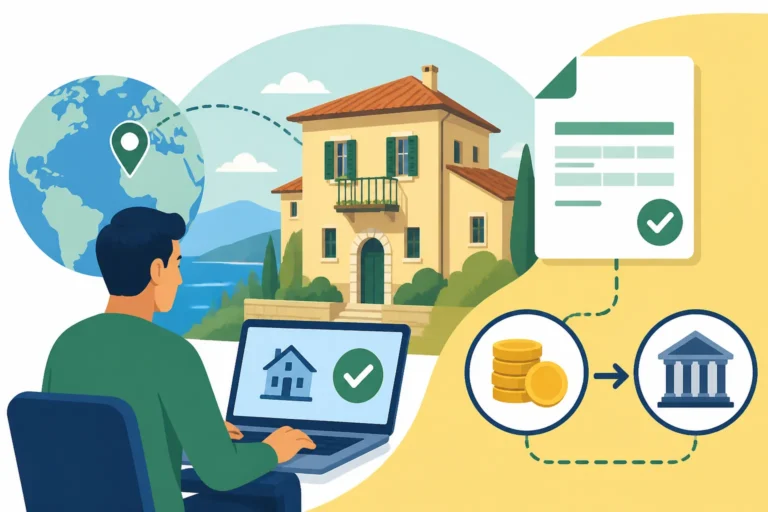
Figuring out your tax bill in Italy often feels like trying to read a menu in a dark room without glasses. I remember staring at my first Italian tax simulation and nearly packing my bags because the numbers just didn't add up for a freelance writer. This guide breaks down exactly how the Regime Forfettario works so you can keep more of your hard-earned euros.
Disclosure: This post may contain affiliate links. We may earn a commission at no extra cost to you if you make a purchase through these links. Read full disclosure.
What Exactly is the Regime Forfettario
When I first moved here, I was terrified by stories of Italian tax rates hitting 43%. However, the Italian government introduced a "flat-rate" scheme designed specifically to encourage small businesses and freelancers. This is essentially The Regime Forfettario in Italy: Flat-Rate Tax for Freelancers, and it is a complete game-changer for those of us trying to build a life under the Mediterranean sun without losing half our income to the Agenzia delle Entrate.
The Concept of Flat-Rate Taxation
In a standard tax system, you track every single receipt—every coffee with a client, every ream of printer paper—and subtract those from your total earnings to find your taxable income. The Forfettario throws that out the window. Instead, the government assigns you a "profitability coefficient" based on your industry. If you are a consultant, they might assume 78% of your revenue is profit and 22% is expenses. You pay tax only on that 78%, regardless of whether your actual expenses were higher or lower.
This "I've-been-there" advice: if you have very high overhead costs, like a physical shop or expensive raw materials, this might not be for you. But for digital nomads, writers, and consultants who mostly just need a laptop and a steady Wi-Fi connection, it is an incredible deal. It simplifies your life significantly because you don't need to keep boxes of fading thermal paper receipts for every small purchase.
Why Expats Love and Need This System
The administrative burden in Italy is legendary. By opting for this regime, you are excused from many of the complex accounting requirements that haunt larger companies. You don't have to deal with the complex regional taxes like IRAP, and you are largely exempt from the labyrinthine VAT (IVA) reporting system.
For many of us, the draw is the predictability. When you are using a tool like Wise to receive payments from clients in the US or UK, you can calculate almost exactly how much you need to set aside for the taxman. There are no nasty surprises at the end of the year because the math is straightforward. It allows you to focus on your work rather than spending every Friday afternoon arguing with an accountant.
Eligibility Criteria Can You Join the Club
Before you get too excited, you need to know if you actually qualify. Italy doesn't just hand out low tax rates to everyone. There are strict gates you have to pass through, and if you trip over one of them, you could find yourself pushed into the "Regime Ordinario," where the tax brackets are much steeper and the accounting fees will make you wince.
The 85000 Euro Revenue Cap
As of 2026, the ceiling for the Forfettario is 85,000 euros in gross annual revenue. This is a hard limit. If you earn 85,001 euros, you are technically out. However, there is a bit of a "buffer" rule. If you exceed 85,000 but stay below 100,000, you finish the year in the Forfettario but must switch the following year. If you blow past 100,000 euros, you are kicked out of the regime immediately, and your current year's income will be taxed under the standard brackets.
I always tell people to monitor their income closely in the final quarter of the year. If you are getting close to that 85k mark, you might want to delay an invoice until January 1st. When you are receiving international transfers via Wise, keep a close eye on the exchange rates, as the Agenzia delle Entrate cares about the value in euros on the day the payment hits your account, not the day you sent the invoice.
Residency Requirements and the Role of the Codice Fiscale
To even apply, you must be a tax resident of Italy. This means living here for more than 183 days a year. If you are just starting your journey, you might first need to look at How to Get a Codice Fiscale in Italy (and Why You Need One) before you even think about taxes. That little plastic card (or paper slip) is your key to the entire Italian kingdom.
Furthermore, you cannot be a majority shareholder in a company that does the same type of work as your freelance business, and you cannot have earned more than 30,000 euros from a salaried job in the previous year (unless that job was terminated). It is a regime designed for "true" freelancers, not people trying to mask a high salary to pay lower taxes. When you are ready to pull the trigger, follow a guide on How to Open a Partita IVA in Italy: Step-by-Step to ensure your application is coded correctly for the Forfettario from day one.
Calculating Your Taxable Base It Is Not Just Revenue
This is where most expats get confused. If you earn 50,000 euros, you do not pay tax on 50,000 euros. The Italian system is actually much kinder than that, provided you understand the "Coefficiente di Redditività." Every business activity in Italy is assigned an ATECO code, which is basically a category for what you do.
Understanding Profitability Coefficients
Each ATECO code comes with a percentage. For example, if you are an IT consultant, your coefficient might be 67%. This means the government assumes that for every 100 euros you earn, 33 euros went to expenses and 67 euros is your actual "income." You are only taxed on that 67 euros.
This is a massive benefit for service-based expats. If you work from home, your real expenses might only be 5% of your revenue (internet, electricity, and a new laptop once in a while). But the government still lets you "deduct" the full 33% automatically. Before invoicing, make sure you understand the nuances of Registering for Partita IVA (VAT Number) in Italy so your ATECO code matches what you actually do, as a wrong code can result in a higher tax percentage than necessary.
Social Security Contributions INPS Deductions
Before the final tax is calculated, you get to subtract your social security contributions. In Italy, social security is often a bigger bill than the actual income tax. Most freelancers fall into the "Gestione Separata" category of INPS.
The magic of the Forfettario is that the INPS you paid during the current year is deducted from your taxable base. So, if your "coefficient-adjusted" income is 30,000 euros and you paid 8,000 euros to INPS, your final taxable income is 22,000 euros. This "tax on a tax" deduction is one of the few times Italian bureaucracy actually works in your favor.
The Tax Rates 5 Percent vs 15 Percent
This is the "Hero" feature of the Forfettario. While your friends back home might be paying 20%, 30%, or 40% in income tax, you could be looking at a single-digit rate. It sounds too good to be true, but it is a legitimate incentive to get people to move to Italy and contribute to the economy.
The Start-up Incentive The 5 Percent Rate Explained
If you are starting a brand-new business and haven't done this type of work in the last three years, you qualify for a 5% tax rate for the first five years. Yes, you read that right: five percent. For someone coming from the US or UK, this feels like a tax holiday.
I remember the relief I felt during my first year. It allowed me to reinvest in my business, buy better equipment, and actually enjoy a weekend in Tuscany without worrying about a massive tax bill. If you are an American expat, you will still need to report this to the IRS, and companies like Taxes for Expats are invaluable here. They understand how the 5% Italian rate interacts with the Foreign Earned Income Exclusion or Foreign Tax Credits, ensuring you don't get taxed twice.
Moving to the 15 Percent Standard Rate
After your initial five years are up, or if you don't qualify for the "new business" incentive, your tax rate jumps to 15%. While tripling your rate sounds scary, 15% is still incredibly low compared to the standard Italian income tax brackets (IRPEF).
Even at 15%, the Forfettario remains the most competitive system in Western Europe for independent professionals. If your income is significantly higher than the 85k cap, you might want to investigate Italy’s Special Tax Regimes: 100k Flat Tax and More for New Residents, though that is for a different demographic. For the average freelancer, the jump to 15% is simply a sign that your business has matured and is now a stable part of the Italian economy.
Beyond Income Tax VAT Invoicing and Hidden Costs
One of the best parts of being "Forfettario" isn't just the low income tax; it is the freedom from VAT. In Italy, VAT (known as IVA) is usually 22%. If you were in the standard regime, you would have to add 22% to all your invoices, collect that money, and then pay it back to the government every quarter.
VAT Exemption A Major Competitive Edge
As a Forfettario freelancer, you do not charge VAT. This makes you 22% cheaper than your "standard" competitors for any client who cannot recover VAT (like private individuals or non-profits). One of the biggest perks is the VAT (IVA) in Italy: How It Affects Prices and Freelancers exemption. You simply add a small note to your invoice stating that you are in the Forfettario regime and therefore exempt from IVA.
However, because you don't charge VAT, you also cannot "reclaim" VAT on your purchases. When you buy a 2,000-euro MacBook, you pay the full price including VAT, and you don't get that money back. For most freelancers, the savings on the income tax side far outweigh the loss of VAT reclamation.
Mandatory E-Invoicing and Administrative Fees
While the regime is simplified, it is not "paperwork free." As of 2024, all Forfettario freelancers must use electronic invoicing (Fatturazione Elettronica). You cannot just send a PDF and call it a day. You need software that communicates directly with the Agenzia delle Entrate.
You also need to account for the "Marca da Bollo." Any invoice over 77.47 euros must have a 2-euro tax stamp applied to it. In the digital age, this is usually paid virtually through your invoicing software. It is a small annoyance, but missing it can lead to fines. Finding professional help to set this up is vital, so check How to Find an English-Speaking Commercialista in Italy to avoid these small but costly mistakes.
Practical Comparisons and Examples
To make this real, let’s look at a hypothetical scenario. Imagine you are a freelance graphic designer (ATECO code coefficient 78%) earning 40,000 euros a year and you are in your first five years (5% tax).
| Step | Calculation Item | Amount (Euros) |
|---|---|---|
| 1 | Total Gross Revenue | 40,000 |
| 2 | Taxable Base (78% of 40k) | 31,200 |
| 3 | INPS Social Security (approx 26% of 31.2k) | – 8,112 |
| 4 | Final Taxable Income (Base minus INPS) | 23,088 |
| 5 | Income Tax (5% of 23,088) | 1,154 |
| 6 | Total Deductions (Tax + INPS) | 9,266 |
| 7 | Net Take-Home Pay | 30,734 |
In this scenario, your effective tax and social security rate is roughly 23%. Considering this includes your pension contributions (INPS) and health insurance, it is remarkably efficient. If you were a salaried employee in Italy earning the same gross amount, your take-home pay would likely be significantly lower.
To manage these funds, many of us start by Opening a Bank Account in Italy: Requirements and Tips to keep our business and personal funds separate. Using Wise for your business banking can also help you save on the hidden "tax" of poor currency exchange rates when dealing with foreign clients.
Ultimately, the Forfettario is a gift to the expat community. It provides a clear, manageable pathway to residency and professional stability. While the initial setup requires some patience with the local bureaucracy, the long-term financial benefits are undeniable. If you are serious about making Italy your home, sit down with a professional from a firm like Taxes for Expats to ensure your global tax strategy is as efficient as your Italian one.
Disclaimer
This guide is provided for informational purposes only and does not constitute legal, financial, or tax advice. Tax laws in Italy are subject to frequent change, and individual circumstances vary significantly. Always consult with a qualified Italian commercialista or a certified tax professional before making any decisions regarding your business or tax residency status. While I have lived through these administrative hurdles, I am a blogger, not an accountant. Responsibility for compliance with the Agenzia delle Entrate rests solely with the individual taxpayer.