Using Contactless Payments Abroad Safely in Italy
Staring at a declined payment screen while an impatient line of locals sighs behind you is a uniquely stressful expat initiation. I once had my only foreign card frozen while trying to tap for a train ticket in Milan, leaving me completely stranded. This guide breaks down exactly how to navigate Italy’s contactless payment systems securely without exorbitant banking fees.
Disclosure: This post may contain affiliate links. We may earn a commission at no extra cost to you if you make a purchase through these links. Read full disclosure.
The New Reality of Contactless Payments in Italy
For decades, Italy was infamous for being a cash-first society. Expats were warned to carry thick wads of euros just to buy a morning cappuccino or a newspaper. However, that stereotype is completely outdated. The Italian government has waged a massive war on tax evasion, and a key part of that strategy involves forcing the rapid adoption of digital payments.
The Legal Mandate for POS Terminals
Since June 2022, Italian law explicitly mandates that all merchants, artisans, and independent professionals must accept electronic payments, regardless of how small the transaction is. If a vendor refuses your card for a €1 espresso or a €2 slice of pizza, they face immediate administrative fines from the tax authorities.
As a result, Point of Sale (POS) terminals are absolutely everywhere. From the tiniest gelateria in Sicily to the massive outdoor antique markets in Florence, tapping to pay is the new cultural standard. But while the physical infrastructure is ready, your foreign bank account might not be. When you first arrive, relying on your home country’s debit or credit card exposes you to aggressive algorithmic fraud triggers. Banks heavily monitor foreign transactions, and multiple rapid taps in a foreign country within a short window often look like physical theft to a risk-management algorithm.
If you are currently sorting out your Checklist: All You Need Before Moving to Italy, ensuring you have a multi-card strategy is non-negotiable. Do not rely on a single piece of plastic. When a foreign card gets flagged and frozen, calling your bank back home often involves navigating extreme timezone differences and expensive international calling rates, leaving you financially paralyzed in the meantime. The anxiety of having your primary card blocked while buying basic groceries is something every expat experiences at least once, and it forces a rapid reevaluation of how you handle your cross-border money.
Which Card Networks Actually Work
The type of card you carry matters immensely in Italy. Visa and Mastercard are universally accepted across the entire Italian peninsula. American Express, however, is frequently rejected by smaller merchants because of its notoriously high vendor processing fees. If you try to tap an Amex at a family-run trattoria or a rural gas station, you will likely be met with a swift shake of the head and a request for a different card.
When preparing the initial capital required for Acceptable financial proof for Italy self-employment visa, you must also ensure that the daily operating capital you bring over is loaded onto widely accepted European payment networks to avoid daily friction. Relying strictly on foreign networks will constantly disrupt your daily life.
Common Pitfalls and Banking Fees for Expats
The most insidious threat to your expat budget is not pickpockets in crowded piazzas; it is the invisible banking fees attached to every single swipe. When you tap a foreign card at an Italian terminal, you are completely at the mercy of your home bank’s foreign transaction policies.
The Dynamic Currency Conversion Trap
Many traditional banks charge a flat transaction fee plus a 3 percent markup on every single international purchase. If you are buying a cheap coffee, that percentage seems insignificant, but extrapolated over months of paying for groceries, train tickets, and dinners, you are losing hundreds of euros to phantom charges.
The biggest trap, however, is Dynamic Currency Conversion (DCC). When you tap your card, the Italian POS terminal may recognize it as a foreign card and present you with a screen offering to charge you in your home currency (such as USD or GBP) rather than local euros. The terminal will often highlight the home currency option with a green button, making it look like a convenient courtesy. Do not fall for this trick. Choosing your home currency allows the Italian merchant’s bank to set the exchange rate, which is universally terrible and heavily marked up. Always, without exception, choose to be charged in euros.
To bypass this trap entirely, veteran expats use Wise. Because Wise provides you with local European banking details and a multi-currency card, you can hold euros natively. When you tap your Wise card in Italy, the terminal sees a local euro balance. There is no Dynamic Currency Conversion prompt triggered, and you completely avoid the predatory spread fees charged by traditional banking institutions.
Bridging the Bureaucratic Gap
This localized approach is absolutely vital when you first arrive in the country. The Italian bureaucracy is notoriously slow; you cannot simply walk into a local bank and open a full checking account on day one without jumping through massive hoops.
Navigating exactly How long after entry to apply for a residence permit in Italy takes patience, and traditional Italian banks will strictly require your physical residency card before granting you a domestic account. Using a borderless solution like Wise bridges this agonizing administrative gap, giving you a functional, zero-fee tapping experience while you wait for the government to process your immigration paperwork.
Strategies for Safe and Fee-Free Tapping
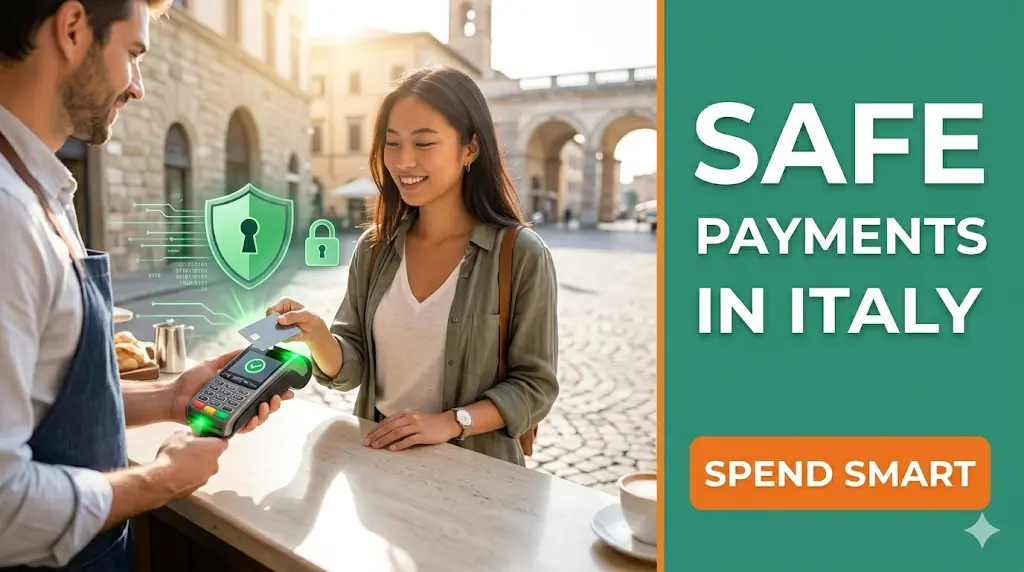
Security is a massive concern when you are tapping a card dozens of times a day in crowded tourist hubs like Rome or Venice. Physical card skimming is still a reality, and if your card is stolen, the contactless feature allows thieves to make multiple small purchases without needing a PIN.
Tokenization via Apple Pay and Google Wallet
This is why you should digitize your payment methods immediately upon arrival. Loading your cards into Apple Pay or Google Wallet adds a critical layer of security known as tokenization. When you tap your smartphone or smartwatch at an Italian cash register, your actual card number is never transmitted to the merchant. Instead, a unique, encrypted token is used for that specific transaction.
Furthermore, your device requires biometric authentication—such as FaceID or a fingerprint scan—to approve the tap. Even if your phone is physically stolen on the Milan Metro, the thief cannot tap it to buy goods.
While you are anxiously tracking the Timelines for picking up your permesso di soggiorno in Italy, separating your daily spending money from your life savings is a fundamental security practice. Never link a contactless app to the account holding your primary wealth. I keep a strictly limited monthly budget on my Wise virtual cards specifically designed for daily tapping. If the virtual card details are ever compromised online or at a shady vendor, I can instantly freeze and delete the digital card from the Wise app, ensuring my main funds remain entirely untouched.
Protecting Your Wealth While Living Abroad
For the bulk of your expat wealth, you need a highly secure, non-transactional fortress. This is why veteran expats park their long-term savings and investment capital in Interactive Brokers. By keeping your primary wealth in Interactive Brokers, you completely isolate your life savings from the daily risks of street-level contactless payments.
Interactive Brokers offers incredibly robust security and allows you to hold your funds in multiple currencies, safe from the high custody fees and localized risks of traditional Italian retail banks. If your long-term plan involves leveraging the Italian visa policy for dual nationals to build a permanent life in Europe, using Interactive Brokers as your secure wealth vault while using Wise exclusively for daily, ground-level tapping creates an impenetrable financial firewall around your money.
Navigating Specific Italian Payment Scenarios
The actual mechanics of paying in Italy have unique cultural quirks that can leave foreigners feeling awkward if they do not know the local rhythm.
Tapping at Bars versus Restaurants
If you are drinking an espresso at a traditional Italian bar, the etiquette is often to tap your card at the cassa (cash register) first, get a small receipt known as a scontrino, and then take that receipt to the barista to actually order your drink.
Conversely, at sit-down restaurants, you must explicitly ask to pay with a card by saying “Posso pagare con la carta?” before they bring the machine to your table. Under no circumstances should you let a waiter walk away with your physical credit card; they are legally required to bring the wireless POS terminal directly to you so you can tap it yourself in plain sight.
Public Transit and Highway Tolls
Public transit has also fully embraced the contactless revolution. In major cities, you no longer need to scramble for loose change to buy paper tickets at a broken machine. For instance, Rome’s ATAC transit system features “Tap & Go” turnstiles. You simply tap your phone or card directly on the turnstile reader to enter the metro, and the system automatically calculates the best fare for your day’s journey. Milan’s ATM system operates identically.
This seamless integration is a lifesaver when you are running administrative errands, like figuring out How to change your address with the Questura in Italy, and need to hop on and off buses across the city quickly without worrying about ticket validation fines. Even the Italian Autostrada (highway toll system) supports contactless payments. When driving through toll booths, look for the lanes marked with the blue “Carte” sign. You do not need to enter a PIN; you simply insert or tap your card, the gate lifts, and you drive through in seconds.
For expats navigating the new remote-work landscape, perhaps utilizing Italy’s new digital residency pilot for expats, mastering these seamless payment methods is crucial for an integrated lifestyle. However, it is important to remember that if you rely on a spouse’s income for your daily tapping budget, you should closely review the Conditions for working while on Italy Family Reunification Visa to ensure your household’s incoming funds are properly structured and legally compliant before transferring them to your daily spending cards.
Comparison of Expat Payment Strategies
| Payment Method | Fees in Italy | Risk Level | Best Used For |
| Foreign Bank Debit Card | High (3% FX markup + Flat fees) | High (Subject to home-bank fraud freezing) | Emergency backup only. |
| Cash (Euros) | None at the register | Moderate (Theft risk in crowded areas) | Small rural vendors, tipping guides. |
| Wise Virtual Card (Apple Pay) | None (Mid-market FX rate) | Very Low (Tokenized, easy to freeze) | Daily transit, coffees, groceries, restaurants. |
| Interactive Brokers Account | N/A (Not for daily spend) | Extremely Low (Highly regulated brokerage) | Holding life savings, investing wealth securely. |
Always remember that carrying a small amount of emergency cash is smart, but your primary operational strategy in modern Italy should revolve around localized, low-fee digital tapping. Keep your administrative documents pristine, protect your main wealth, and never let a terminal choose your currency exchange rate for you.
References
Primary sources (official)
- Banca d’Italia (Bank of Italy – Electronic Payments and Co-badged cards): https://economiapertutti.bancaditalia.it/aree-tematiche/pagamenti/carta-cobadge/index.html
- Agenzia delle Entrate (Italian Revenue Agency – Electronic Payment Mandates): https://www.agenziaentrate.gov.it/
Other helpful sources
- ATAC Roma (Tap & Go Contactless System Guidelines): https://www.atac.roma.it/en/frequently-asked-questions/how-does-tap-go-work
- European Central Bank (Contactless payment security standards): https://www.ecb.europa.eu/
Disclaimer
The information provided in this article is for general informational purposes only and does not constitute official financial, legal, or banking advice. Italian point-of-sale regulations, dynamic currency conversion practices, and public transit contactless policies are subject to frequent changes. Always verify current foreign transaction fees with your specific card issuer and consult with a licensed financial advisor to structure your cross-border wealth safely.