What happens if you overstay your visa in Italy?
Watching the border agent stare at my passport for five agonizing minutes while I sweated through my shirt because of an expired visa was the most terrifying moment of my expat life. This guide explains exactly what happens if you overstay your Italian visa in the new era of digital borders, and how to protect your immigration status from automated bans.
Disclosure: This post may contain affiliate links. We may earn a commission at no extra cost to you if you make a purchase through these links. Read full disclosure.
The Reality: Digital Borders and the EES
In the past, expats used to swap stories about dodging overstays by flying out of lenient airports where tired guards barely glanced at faded passport stamps. If you are traveling or living in Italy, those days are permanently over.
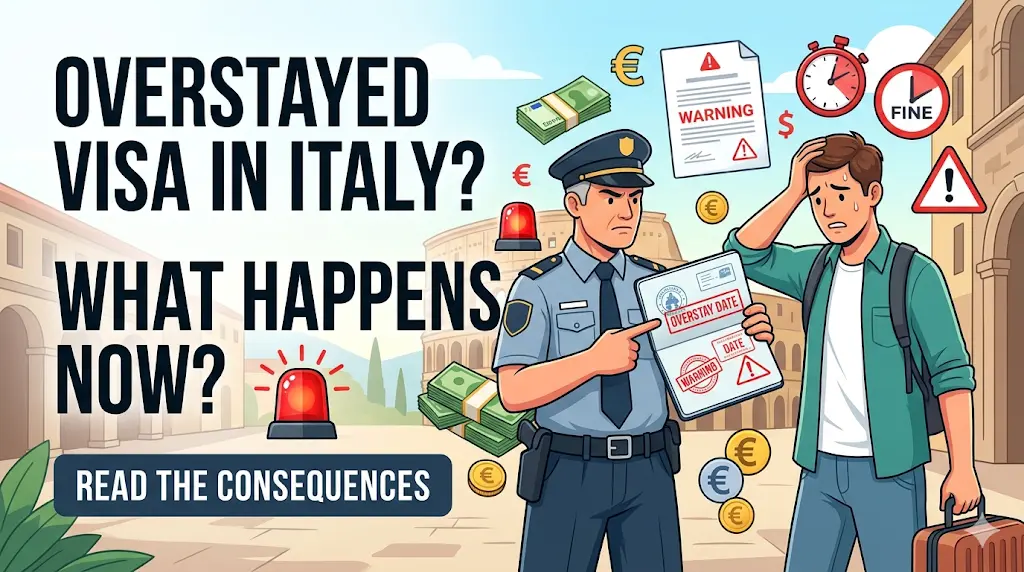
Overstaying your visa in Italy can lead to serious legal and immigration consequences. If you remain beyond the permitted duration of your visa or residence permit, you are considered irregular (irregolare) under Italian law. The immediate consequence may include fines and an official order to leave the country (expulsion or “decreto di espulsione”). Depending on the length and circumstances of the overstay, you could also face a ban on re-entering Italy and potentially other Schengen countries for a specified period. This ban can affect future travel, work, or study plans within the Schengen Area.
In addition, overstaying may complicate future visa applications, as immigration authorities review past compliance closely. Even a short overstay can raise concerns and lead to stricter scrutiny or rejection of future applications. If you are stopped by authorities, you may be required to present valid documentation. Failure to do so can result in administrative detention in some cases until your situation is resolved.
However, there may be limited options to regularize your status, depending on your circumstances. For example, if you have applied for a renewal or conversion of your permit before it expired, you may be allowed to stay while the application is processed. It is always best to act proactively. If you realize you are at risk of overstaying, contact immigration authorities or a legal expert immediately. Timely action can help minimize penalties and protect your ability to remain in or return to Italy legally in the future.
With the full rollout of the European Union’s Entry/Exit System (EES) completed in April 2026, the entire concept of the manual passport stamp has been abolished. Every single entry and exit by a non-EU national is now recorded digitally via facial recognition and biometric fingerprints. The moment you exceed your 90th day out of a 180-day period—or the specific expiration date of your national visa—the centralized computer system instantly flags you as an “overstayer.”
There is no longer a margin of human error to hide behind. Even a one-day overstay triggers a silent alarm visible to every border agent across the entire Schengen Area. Knowing exactly how this digital dragnet operates is a crucial addition to your Checklist: All You Need Before Moving to Italy, especially as the continent aggressively tightens its automated security protocols. Furthermore, with the upcoming Italy’s ETIAS implementation date and what travelers need on the horizon, this tracking infrastructure will only become more precise, completely eliminating the old loopholes of spontaneous, undocumented travel.
The Penalties for an Italian Visa Overstay
Italian immigration law (the Consolidated Immigration Act) treats overstaying as a severe administrative—and occasionally criminal—offense. While the leniency you experience might depend slightly on the specific border agent and your attitude, the legal framework is brutally clear and highly punitive.
Administrative and Criminal Fines
Unlike some Northern European countries that issue fixed, automated tickets, Italian penalties operate on a highly discretionary, escalating scale. Standard administrative fines for a short overstay usually fall between €100 and €3,000. However, if your overstay is prolonged and you are formally charged with unlawful stay under Article 10-bis of the immigration act, you can face staggering criminal fines ranging from €5,000 to €10,000.
Deportation and Entry Bans
If you are caught overstaying during a random police check within an Italian city, rather than at the airport as you attempt to leave, you will likely be issued an expulsion order (foglio di via). You are given a strict window (usually 7 to 15 days) to voluntarily leave the country at your own expense.
The most devastating consequence, however, is the entry ban. When the EES flags your overstay, Italian authorities can register your profile into the Schengen Information System (SIS). This results in an automatic, region-wide ban preventing you from entering any of the 29 Schengen countries for a period of one to five years. If you are navigating the complex Italian visa policy for dual nationals, an SIS ban on your non-EU passport will instantly flag your biometrics regardless of which passport you present, destroying your global mobility.
| Length of Overstay | Likelihood of Detection | Typical Italian Penalty | Schengen Entry Ban Risk |
| 1 to 3 Days | 100% (EES Automated) | €100 – €500 Fine, Formal Warning | Low to Moderate (1 Year) |
| 4 to 30 Days | 100% (EES Automated) | €500 – €3,000 Fine | High (1 to 3 Years) |
| 30+ Days | 100% (EES Automated) | Expulsion Order, €5,000+ Fine | Guaranteed (3 to 5 Years) |
Lapsed Permesso di Soggiorno vs. Tourist Overstays
It is vital to distinguish between a tourist who simply ignored their 90-day limit and a legal expat caught in the agonizing crawl of the Italian bureaucracy.
If you entered Italy on a valid long-stay visa, tracking exactly How long after entry to apply for a residence permit in Italy is your absolute priority. Once you apply for your Permesso di Soggiorno at the post office, you are handed a paper receipt (ricevuta). This postal receipt legally protects you from overstay penalties while you wait for the police to process your actual card.
However, navigating the Timelines for picking up your permesso di soggiorno in Italy can take six to eight months. During this waiting period, your original entry visa will almost certainly expire. Because you hold the ricevuta, you are not illegally overstaying in Italy. But here is the trap: you cannot transit through other Schengen countries. If you try to fly from Rome to Paris with an expired visa and a postal receipt, the French border guards will view you as an illegal overstayer and detain you.
The same logic applies to maintaining your physical documents; suffering the Consequences of losing your permesso di soggiorno card while trying to leave the country can falsely flag you as an overstayer in the EES system, leading to a catastrophic administrative nightmare. For those exploring Italy’s new digital residency pilot for expats, keeping your digital profiles and physical paperwork perfectly aligned is the only way to avoid the automated overstay dragnet.
Defending an Overstay: Medical Emergencies and Legal Appeals
The only universally accepted defense for overstaying a Schengen visa is force majeure—an unforeseeable circumstance entirely outside your control, such as a severe medical emergency that physically prevented you from traveling.
If a sudden hospital stay prevented you from flying home, having a top-tier international policy with Cigna Global is your ultimate safety net. Because Cigna Global policies are universally recognized, their documentation easily proves you were genuinely incapacitated and not just trying to extend your vacation. You can present your Cigna Global claim records to the border police to legally justify a medical force majeure. Furthermore, if your illness requires specialized transport home, a comprehensive Cigna Global plan often covers emergency medical repatriation, ensuring you are legally removed from the country without triggering a punitive immigration ban. Dealing with these emergencies is a brutal reality of expat life, making your understanding of the Cost of Healthcare in Italy: What Expats Need to Know an absolute priority before you ever cross the border.
However, handing an Italian border guard a stack of home-country medical history or foreign legal records to defend your case is entirely useless unless it is perfectly translated. This is where you must use RushTranslate. By submitting your foreign evidence to RushTranslate, you receive certified Italian translations that hold up in court. Whether you are appealing an expulsion order or proving a sudden family emergency, relying on RushTranslate ensures the immigration judge actually understands your defense. Do not risk a five-year entry ban over a translation error; utilizing RushTranslate guarantees absolute administrative precision when your entire expat future is on the line.
References
Primary sources (official)
- European Commission – Migration and Home Affairs (Entry/Exit System): https://home-affairs.ec.europa.eu/policies/schengen-borders-and-visa/smart-borders/entry-exit-system_en
- Ministero dell’Interno (Italian Ministry of Interior): https://www.interno.gov.it/it
Other helpful sources
- Polizia di Stato (Immigration and Borders): https://www.poliziadistato.it/articolo/10617
- ETIAS.com (EU’s Entry/Exit System Flags 4,000 Overstays): https://etias.com/articles/eu%E2%80%99s-entry/exit-system-(ees)-flags-4,000-overstays
Disclaimer
The information provided in this article is for general informational purposes only and does not constitute official legal or immigration advice. Italian immigration law, the enforcement protocols of the digital Entry/Exit System (EES), and the specific penalties for overstaying under the Consolidated Immigration Act are highly complex and subject to strict enforcement. Always consult with a registered Italian immigration lawyer (avvocato immigrazionista) to evaluate your specific visa status, address an overstay, or appeal an expulsion order to ensure your rights are fully protected under Italian and European law.