What Are the Most Useful Italian Phrases for Tourists?
Stepping into a bustling Roman piazza or a quiet Tuscan village can feel like walking onto a film set, but the magic quickly fades when you realize you cannot communicate basic needs. This guide solves the frustration of the language barrier by providing high-impact, realistic Italian phrases that transform you from a confused outsider into a respected guest.
Disclosure: This post may contain affiliate links. We may earn a commission at no extra cost to you if you make a purchase through these links. Read full disclosure.
The Social Contract: Greetings and Politeness
In Italy, language is more than just a tool for information; it is the foundation of the social contract. I remember when I first moved to Florence, I would walk into a "tabaccheria" and immediately ask for what I wanted. I was often met with a cold stare or a slow, deliberate response. I soon learned that in Italy, you do not exist until you have greeted the person behind the counter. Whether you are checking into a hotel you found on Booking.com or just buying a bottle of water, the initial greeting dictates the quality of your entire interaction.
The Power of the Formal Greeting
The most common mistake tourists make is overusing "Ciao." While it is the most famous Italian word, it is strictly informal. If you use it with a shopkeeper, a waiter, or a person older than you, it can come across as slightly disrespectful. Instead, use "Buongiorno" (Good morning/day) until about 4:00 PM, and "Buonasera" (Good evening) after that. These words are your keys to the city. By opening with a formal greeting, you signal that you respect the local culture and the individual’s professional standing.
When you enter a small boutique or a restaurant, a simple "Buongiorno" toward the staff is expected. It is not just a greeting; it is an acknowledgement of their space. If you want to dive deeper into these nuances, you should read our guide on Italian Social Customs: Greetings, Gestures, and Personal Space. Understanding the "why" behind the "what" will make these phrases stick in your memory much longer than rote memorization.
The Magic of Cortesia: Please and Thank You
"Per favore" (Please) and "Grazie" (Thank you) are non-negotiable. However, to truly sound like a seasoned traveler, you should use "Vorrei" instead of "Voglio." "Voglio" means "I want," and it sounds incredibly demanding in Italian. "Vorrei" is the conditional "I would like," and it immediately softens your request. For example, "Vorrei un caffè, per favore" sounds exponentially better than "Voglio un caffè."
When someone does something for you, "Grazie mille" (A thousand thanks) is a wonderful way to show extra appreciation. If they respond with "Prego," they are saying "You're welcome," but "Prego" also means "Please, after you" or "How can I help you?" depending on the context. If you are struggling with the basics, check out our Survival Italian for Travelers: Key Phrases to Learn First for a condensed list of these essential building blocks.
Apologies and Interruptions
You will inevitably need to move through a crowd or catch someone’s attention. "Scusi" is the formal "Excuse me" (use this with strangers), while "Scusa" is the informal version. If you are trying to physically push past someone on a crowded bus in Rome, use "Permesso." This specifically means "permission to pass" and is much more effective than "Scusi" in tight spaces.
If you make a mistake—like accidentally walking into a restricted area or bumping into someone—"Mi dispiace" (I'm sorry) is the phrase to use. It carries more emotional weight than a simple "Scusi." Mastering these subtle differences is a core part of How to Learn Enough Italian for a Two-Week Trip, as it allows you to navigate social friction with grace.
Mastering the Italian Dining Experience
Eating is a secular religion in Italy, and the language surrounding it is precise. You might find a great food tour on GetYourGuide, but once you are on your own in a local "trattoria," you need to know how to handle the "rituale della tavola." From the moment you walk in to the final "conto," your phrases will define your experience.
At the Bar: Coffee and Quick Bites
The Italian "bar" is where life happens. It is not a place for cocktails at 10:00 AM, but a place for espresso and "cornetti." If you want to drink your coffee standing at the counter (which is cheaper), you simply walk up and say, "Un caffè, per favore." In Italy, "un caffè" is always an espresso. If you want a long coffee, ask for "un caffè americano."
A common tourist trap is ordering a cappuccino after 11:00 AM. While the waiter will bring it to you, they will know you are a tourist. Italians believe milk inhibits digestion after a large meal. If you want to blend in, stick to "un macchiato" (espresso with a tiny drop of milk) or "un caffè corretto" (espresso "corrected" with a splash of grappa or sambuca) in the afternoon. For a deeper dive into these specifics, read our Ordering Food and Drinks in Italian: A Practical Phrasebook.
At the Ristorante: Sitting Down for a Meal
When you arrive at a restaurant, you should ask, "Avete un tavolo per due?" (Do you have a table for two?). If you have a preference, you can add "all'aperto" (outside) or "dentro" (inside). Once seated, the first thing you will be asked is "Acqua naturale o frizzante?" (Still or sparkling water?).
Ordering is done in stages: "Antipasto" (Appetizer), "Primo" (Pasta/Rice), "Secondo" (Meat/Fish), and "Contorno" (Side dish). You do not have to order every course, but you should know the names. When you are finished and ready to leave, do not expect the waiter to bring the check automatically—that is considered rude in Italy, as if they are kicking you out. You must ask for it: "Il conto, per favore." If you are curious about how to handle the service charge, our article on Tipping in Italy: When, Where, and How Much explains exactly when to leave a few extra euros and when the "coperto" covers it.
Handling Dietary Restrictions
If you have allergies, you must be very clear. "Sono allergico a…" (I am allergic to…) followed by the ingredient: "noci" (nuts), "crostacei" (shellfish), or "lattosio" (lactose). If you are vegetarian, say "Sono vegetariano/a" or "Non mangio carne" (I don't eat meat). Italy is surprisingly accommodating to dietary needs, but you have to speak up. Knowing How to Ask for the Bill in an Italian Restaurant and other table-side phrases will ensure your meal ends as smoothly as it began.
| English Phrase | Italian Phrase | Context |
|---|---|---|
| I would like… | Vorrei… | Ordering food or tickets |
| Where is the bathroom? | Dov'è il bagno? | Essential in any cafe |
| The check, please | Il conto, per favore | To pay at a restaurant |
| Do you speak English? | Parla inglese? | Use after a formal greeting |
| How much does it cost? | Quanto costa? | Shopping at markets |
| A table for two | Un tavolo per due | Arriving at a restaurant |
| I am allergic to… | Sono allergico a… | Health and safety |
| Excuse me (to pass) | Permesso | Moving through crowds |
On the Move: Transportation and Logistics
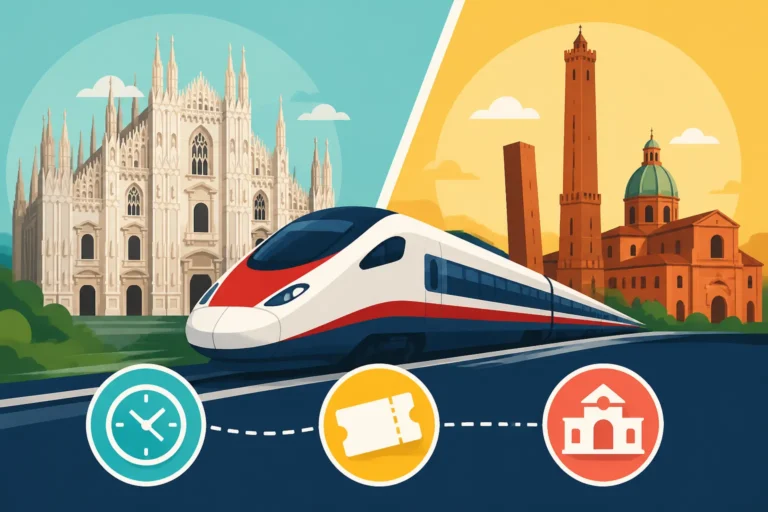
Navigating the Italian transport system can be a beautiful adventure or a bureaucratic nightmare. Whether you are booking a high-speed train on Omio or trying to find your bus stop in a confusing Sicilian terminal, having the right words will save you time and stress.
Finding Your Way
The most useful question in your arsenal is "Dov'è…?" (Where is…?). Use it for everything: "Dov'è la stazione?" (Where is the station?), "Dov'è la fermata dell'autobus?" (Where is the bus stop?), or "Dov'è il binario?" (Where is the platform?). If you are lost, you can approach a local and say, "Mi scusi, mi sono perso" (Excuse me, I am lost).
When you get directions, listen for "Gira a destra" (Turn right), "Gira a sinistra" (Turn left), and "Vai sempre dritto" (Go straight). Most Italians will use their hands to help you visualize the path, which is a lifesaver if your vocabulary is limited.
Purchasing Tickets and Travel
While many people book their transport through apps like Omio to avoid the ticket counter, there are times you will need to buy a ticket in person, especially for regional trains or local buses. "Vorrei un biglietto per [Destination]" is your go-to phrase. If you want a return ticket, ask for "andata e ritorno."
One of the biggest mistakes tourists make—and one that leads to heavy fines—is forgetting to validate their physical tickets. You must look for the small yellow or green machines at the start of the platform. If you aren't sure how to do this, check out our guide on How to Validate a Regional Train Ticket in Italy. For those planning to travel between major hubs, understanding How to Buy Trenitalia and Italo Tickets and Save Money is essential for a budget-friendly trip.
Dealing with Delays and Emergencies
"In ritardo" (Delayed) is a phrase you might see on the "tabellone" (departure board). If you see this, you might need to ask, "Perché il treno è in ritardo?" (Why is the train delayed?). In the rare case of an emergency, the most important word is "Aiuto!" (Help!). If you need a doctor, say "Ho bisogno di un medico." Hopefully, you will never need these, but knowing them provides a safety net that allows you to enjoy your trip with peace of mind.
Shopping and Everyday Services
From the high-end boutiques of Milan to the leather markets of Florence, shopping is an integral part of the Italian experience. However, the etiquette of shopping is different here than in North America or the UK.
Browsing and Sizes
In many smaller Italian shops, it is considered polite to wait for the clerk to assist you rather than grabbing items off the rack yourself. If they approach you and you just want to look, say "Sto solo guardando, grazie" (I'm just looking, thanks).
If you find something you like, you might need a different size: "Ha una taglia più grande?" (Do you have a larger size?) or "Ha una taglia più piccola?" (Do you have a smaller size?). To try something on, ask "Posso provarlo?" (Can I try it on?). They will point you toward the "camerino" (fitting room).
Paying and Receipts
When you are ready to pay, you can ask "Posso pagare con carta?" (Can I pay with a card?). While most places in Italy now accept cards, some smaller "alimentari" or market stalls still prefer "contanti" (cash).
Crucially, always take your "scontrino" (receipt). In Italy, the Guardia di Finanza (tax police) can theoretically stop you outside a shop to ensure you were given a receipt, as a way of combating tax evasion by shopkeepers. Even if it seems like a small purchase, wait for that little slip of paper.
Seeking Local Recommendations
The best part of knowing a little Italian is the ability to ask for local secrets. Instead of relying solely on the top-rated spots on Booking.com, ask a local shopkeeper, "Qual è il suo ristorante preferito in zona?" (What is your favorite restaurant in the area?). This simple question often leads to the most memorable meals of your trip—the kind of places that don't have English menus and serve the best "pasta e fagioli" you've ever tasted.
By putting in the effort to learn these phrases, you aren't just making your life easier; you are showing the people of Italy that you value their culture. This effort is almost always rewarded with a warmer smile, better service, and a deeper connection to the "Bel Paese."
Disclaimer
This guide is intended for informational purposes for tourists and expats in Italy. While these phrases are commonly used and culturally appropriate, regional dialects and local customs can vary. Language and travel regulations, including ticket validation rules, may change over time. Always verify current local requirements during your travels.