How to Ask for the Bill in an Italian Restaurant
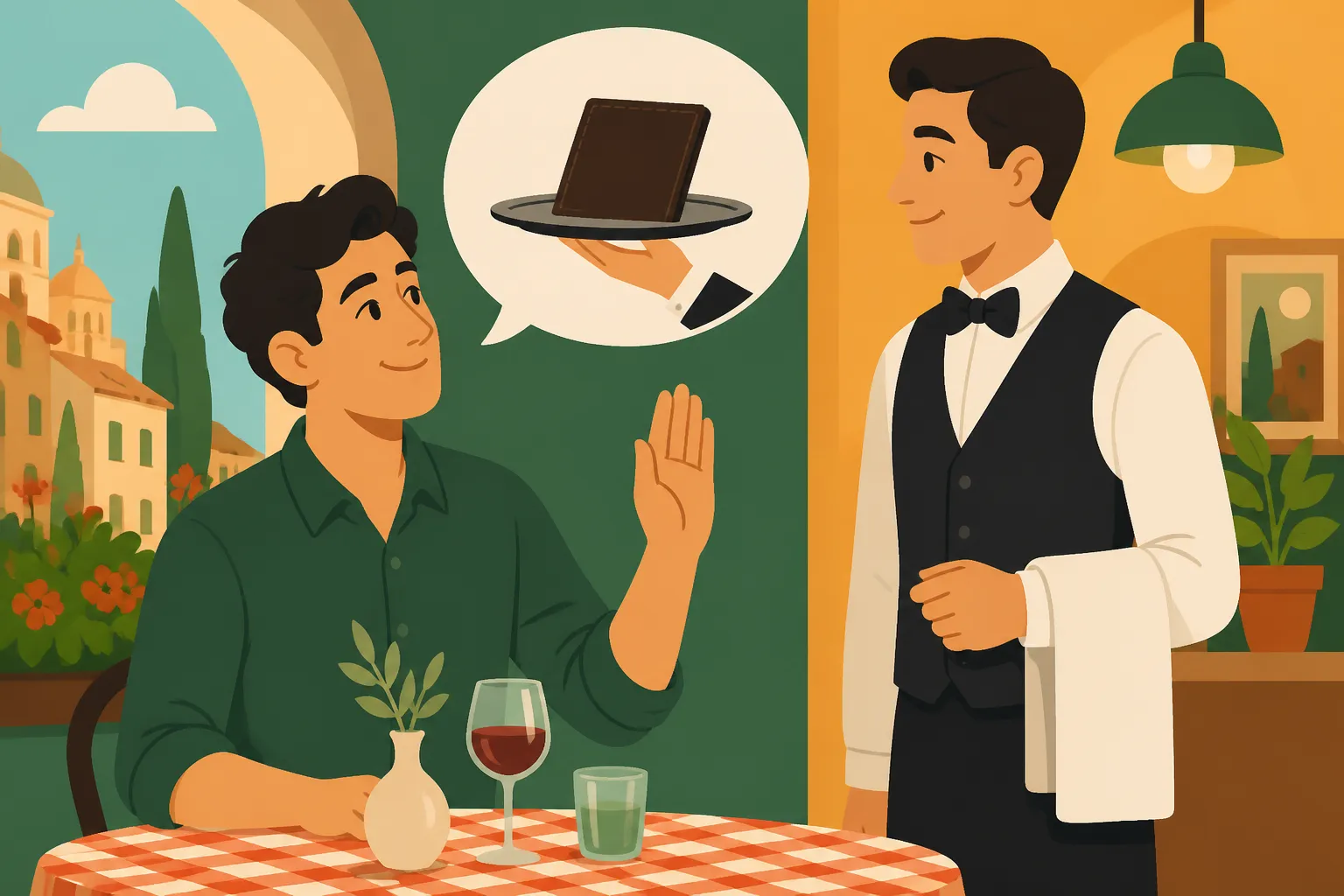
Sitting at a beautiful trattoria in Rome or a seaside osteria in Puglia, you finish your espresso, set down your spoon, and wait. And wait. Thirty minutes pass, yet no check appears. You might feel ignored or even unwelcome, but in reality, you are experiencing a fundamental cultural divide. This guide solves the mystery of the "missing bill" and teaches you exactly how to navigate Italian dining etiquette to get your check efficiently and politely.
Disclosure: This post may contain affiliate links. We may earn a commission at no extra cost to you if you make a purchase through these links. Read full disclosure.
Understanding the Italian Pace of Dining
In many English-speaking cultures, particularly in the United States or the UK, a waiter bringing the bill as soon as you finish your last bite is seen as efficient service. In Italy, however, this same act is considered incredibly rude. It is interpreted as the restaurant trying to kick you out to turn the table. When you sit down at an Italian restaurant, that table is yours for the duration of the lunch or dinner service. The staff will never rush you, which is a blessing when you want to linger over wine, but a curse when you have a train to catch booked via Omio and need to leave promptly.
Why the Waiter Will Not Bring the Bill Automatically
The philosophy of "il dolce far niente"—the sweetness of doing nothing—is nowhere more evident than at the dinner table. To an Italian waiter, your presence is a compliment to the chef. Bringing the bill unprompted is equivalent to saying, "Get out." Therefore, they wait for a clear signal from you. If you don't ask, they won't bring it. I remember my first month in Florence, sitting for nearly an hour at a tiny family-run spot, feeling increasingly invisible. It took a local friend to explain that the waiter was actually being "polite" by leaving me alone.
This hands-off approach to service is part of the broader Italian Social Customs: Greetings, Gestures, and Personal Space that expats must learn. Unlike the hovering service common in North America, Italian service is reactive. You are the conductor of your meal. If you want more water, you ask. If you want the bill, you must initiate the process. It is a sign of respect for your time and your conversation.
The Philosophy of Linger and Talk
Dining in Italy is a social ritual, not a logistical necessity. This is why What Time Do Italians Eat Lunch and Dinner? is such a crucial piece of knowledge. Since dinner often starts late (around 8:30 PM), the meal is expected to be the main event of the evening. The staff assumes you want to discuss politics, family, or the quality of the olive oil long after the plates are cleared.
If you are staying at a central hotel found through Booking.com, you might notice that the restaurants downstairs are still buzzing at midnight. This is normal. The expectation is that you will stay until you are ready to leave. If you are on a tight schedule, perhaps because you have a morning tour scheduled through GetYourGuide, you need to be proactive. Waiting for the waiter to "notice" you’re done is a losing game.
Essential Phrases for Requesting the Check
When you are finally ready to settle up, you need the right words and the right timing. You don't need a degree in linguistics, but a few key phrases from a Survival Italian for Travelers: Key Phrases to Learn First list will make the interaction much smoother. The goal is to be firm but gracious, maintaining the positive "bella figura" (good impression) you’ve built throughout the meal.
How to Say It in Italian
The most standard and polite way to ask for the bill is: "Il conto, per favore" (eel KOHN-toh, pehr fah-VOH-reh). This translates literally to "The bill, please."
If you want to be slightly more formal or if you are in a high-end restaurant, you might say: "Possiamo avere il conto, per favore?" (poh-SYAH-moh ah-VEH-reh eel KOHN-toh). This means "May we have the bill, please?"
Under no circumstances should you just shout "Check!" or snap your fingers. This is a fast track to being ignored for another twenty minutes. If you are practicing your How to Order Food and Drinks in Italian: A Practical Phrasebook skills, keep it simple. Most waiters in tourist-heavy areas understand "The bill," but using the Italian "il conto" shows a level of respect for the local culture that is always appreciated.
Non-Verbal Cues and Body Language
Italians are famous for their hand gestures, and there is a specific one for the bill. If the restaurant is loud or the waiter is across the room, catch their eye, raise your hand slightly, and mimic the action of writing on your palm with an invisible pen. This "scribbling" gesture is universally understood in Italy as "I’m ready for the check."
It’s a subtle dance. You want to make eye contact without staring aggressively. A slight nod combined with the scribbling motion is usually enough to get the waiter to head toward the POS station. If you’ve spent the day on a walking tour booked via GetYourGuide and your feet are tired, this non-verbal communication saves you the effort of getting up to find someone.
Decoding the Bill: What You Are Actually Paying For
When the bill finally arrives, it might look a bit different than what you are used to back home. There are specific line items in Italy that often confuse newcomers, leading to unnecessary frustration at the end of an otherwise lovely meal. Understanding Restaurant Etiquette in Italy: Coperto, Courses, and the Bill is essential to avoiding "bill shock."
The Coperto: Italy’s Famous Cover Charge
The first thing you will likely see on your receipt is the "Coperto." This is a standard per-person cover charge that usually ranges from €1.50 to €4.00. It covers the bread on the table, the use of the tablecloth, and the general service. It is a legal charge, provided it is listed on the menu (usually in small print at the bottom or on the back).
Many tourists feel cheated by the coperto, thinking they are being charged for "free" bread. In reality, it’s just the way the Italian system compensates for the fact that you can sit at a table for four hours. For a deep dive into this, you should read What Is the Coperto on an Italian Restaurant Bill? to understand the historical context. It’s not a scam; it’s just part of the price of admission to the Italian dining experience.
Tipping Etiquette and Service Charges
One of the most common questions expats ask is about tipping. Unlike in the US, where 20% is standard, or the UK, where 10-12% is common, Italy does not have a strong tipping culture. The waiters are paid a living wage and have benefits. If you see "Servizio" (service charge) on the bill, usually in very touristy areas or for large groups, you definitely do not need to tip extra.
If there is no service charge, leaving a few coins or rounding up the bill is a nice gesture but never mandatory. For example, if your bill is €47, leaving €50 is considered a generous tip. If you want to know more about the nuances, check out Tipping in Italy: When, Where, and How Much. Note that if you pay by credit card, there is often no line on the receipt to add a tip, so you’ll need to leave cash on the table.
| Charge Type | Typical Amount | Is it Mandatory? | Notes |
|---|---|---|---|
| Coperto | €1.50 – €4.00 | Yes | Covers bread and table settings. |
| Servizio | 10% – 15% | Yes (if listed) | Usually for groups or tourist hotspots. |
| Mancia (Tip) | Optional / Change | No | Not expected, but appreciated for great service. |
| IVA | Included | Yes | This is the Value Added Tax, already in the price. |
Checking the Scontrino (Official Receipt)
In Italy, the law requires the restaurant to provide a "Scontrino Fiscale"—an official fiscal receipt. You might first be given a hand-written note or a "pro forma" bill (the pre-conto), but once you pay, you must receive the printed receipt from the cash register. Technically, the Guardia di Finanza (tax police) could stop you outside the restaurant and ask to see your receipt to ensure the business is reporting its income. Always take your receipt with you.
If you notice an extra bottle of wine or a dish you didn't order, point it out politely: "C'è un errore qui" (There is an error here). Most of the time, it's an honest mistake in a busy kitchen. If you've spent the day traveling on an Omio-booked bus and are feeling cranky, try to maintain your cool; a smile gets a correction much faster than an accusation.
Payment Methods and Practical Tips
The final step is the actual exchange of money. While Italy has modernized significantly in the last few years, there are still some local quirks when it comes to the "how" of paying the bill.
Cash vs. Card: The POS Drama
By law, every merchant in Italy is required to accept debit and credit cards for any amount. However, you will still occasionally hear the phrase "Il POS è rotto" (The card machine is broken). While this is sometimes true, it is often a tactic to avoid transaction fees or to keep the transaction off the books.
If you prefer to pay by card, it’s always a good idea to ask "Posso pagare con carta?" (Can I pay with a card?) before you sit down. Most reputable restaurants, especially those near Booking.com listed properties, will have no problem. When you pay by card, the waiter will usually bring a small handheld terminal to your table. They do not take your card away to a hidden station, which is actually more secure than the system used in many other countries.
Splitting the Bill: Alla Romana
If you are dining with a group of Making Friends in Italy as a Foreigner, you might want to split the bill. The Italian term for splitting the bill equally is "pagare alla romana" (paying Roman style). This means everyone pays the same amount regardless of what they ate.
If you want to pay only for what you personally ordered ("pagare separatamente"), you must inform the waiter before they start ringing up the total. Many smaller restaurants find separate checks for a table of ten to be a nightmare, and they may refuse. It is often easier for one person to pay the whole bill and for the others to pay them back via a bank transfer or an app.
Catching Your Next Destination
If you have a tight itinerary—perhaps catching a high-speed train booked through Omio or meeting a guide for a GetYourGuide sunset tour—don't wait until the last minute to ask for the bill. I always recommend asking for "il conto" at the same time you order your coffee or digestivo (like Limoncello). This gives the waiter plenty of time to process the request while you finish your drink.
If the waiter is truly overwhelmed, it is perfectly acceptable to walk up to the "cassa" (cashier desk) near the entrance and pay there. In many casual pizzerias or bars, this is actually the preferred method. You simply tell them your table number or point to where you were sitting, and they will pull up your bill on the screen.
Understanding the flow of a meal—from How to Order a Full Italian Meal: Courses Explained to the final payment—is what transforms you from a frustrated tourist into a savvy expat. It’s about adjusting your internal clock to the rhythm of the Mediterranean. Once you stop expecting the bill to arrive automatically, you can finally relax and enjoy that extra glass of Grappa.
Disclaimer
This guide is intended for informational purposes only. While every effort has been made to provide accurate and up-to-date information regarding dining customs and laws in Italy, regional variations and individual restaurant policies may differ. Always verify local regulations and specific restaurant terms during your visit. Information regarding third-party services like Omio, Booking.com, and GetYourGuide is based on general industry knowledge and is not a substitute for checking their current terms of service.