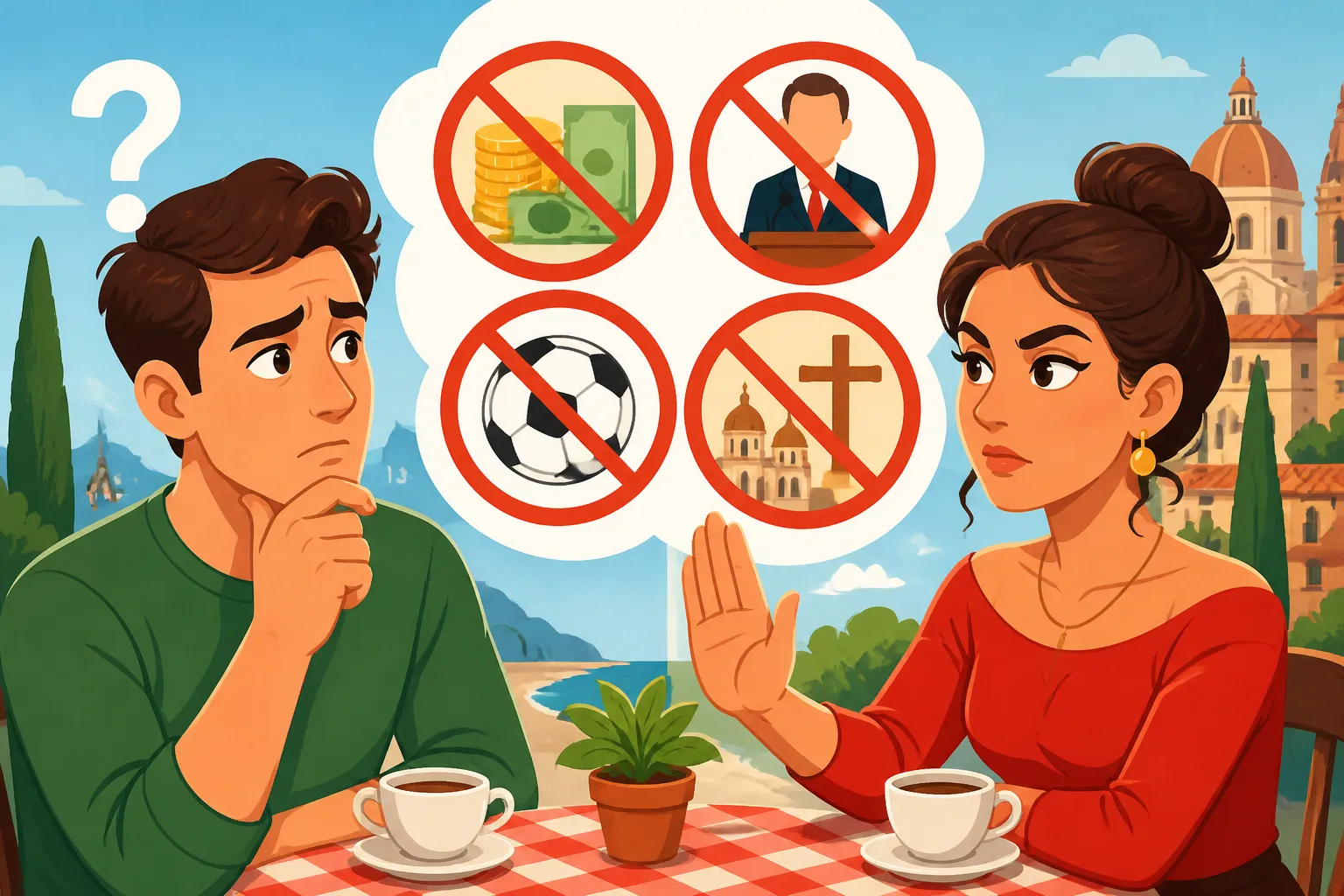
What Topics to Avoid in Casual Conversation in Italy
You’re at an aperitivo in Bologna, the conversation is flowing, and then you make a harmless joke about The Godfather. The table goes quiet. Many foreigners in Italy have had a moment like this. This guide covers the topics that tend to backfire in casual conversation in Italy, explains why they sting, and suggests what to talk about instead.
Disclosure: This post may contain affiliate links. We may earn a commission at no extra cost to you if you make a purchase through these links. Read full disclosure.
Why Some Topics Land Badly in Italy
Italians are not a fragile audience. Conversation here is loud, opinionated and full of interruptions, and a heated debate over dinner is often a sign of affection rather than hostility. That makes it more confusing when a comment you thought was light falls flat. The topics themselves are rarely forbidden. The problem is usually who raises them and how.
The Difference Between Complaining and Being Complained At
Italians complain constantly about their own country. The trains, the bureaucracy, the politicians, the post office and the cousin who never returns the casserole dish are all fair game around a kitchen table. Expats often mistake this for permission. They hear a Roman friend cursing the Comune and assume they can join in with equal enthusiasm.
There is an unwritten rule, though. Criticism that comes from inside the family is fine. Criticism from a guest is not. Think of how you might mock your own sibling but bristle if a stranger did it. When a newcomer who has been in Italy for three months says “Nothing works here,” it sounds like a verdict. When a local says it, it sounds like weary love.
Here is a scenario I have watched play out more than once. A colleague is grumbling about waiting weeks for a Questura appointment, and the newly arrived American chimes in with “Well, in my country this would take ten minutes.” Nobody argues, but the warmth drains away. The safer move is to listen, nod and offer sympathy. “That sounds exhausting” will earn you far more goodwill than a comparison with home.
Regional Identity Runs Deeper Than National Identity
Italy unified relatively late, and many people still identify first with their city or region and second with the nation. A Neapolitan is Neapolitan before being Italian. A Venetian may have firm views about people from Padua, which is barely half an hour away. This campanilismo, or loyalty to your own bell tower, shapes how people hear what you say.
So a casual remark such as “Florence is much prettier than Bologna” is not just an aesthetic opinion. It can come across as a slight against someone’s hometown, their family and their identity. Even the language carries this weight. Expressions and pronunciations vary hugely from place to place, a point covered in Italian Dialects and Regional Languages: What to Expect. Mocking someone’s accent or dialect, even gently, rarely goes down well with people you have only just met.
The Topics Most Likely to Cause Friction
These are the subjects that most often turn a friendly chat sour. None of them is taboo among close friends who know you well. For a first coffee, a dinner party or a chat with your landlord, though, they are best left alone until someone else opens the door.
The Mafia and Organized Crime Stereotypes
This is the big one. Jokes about the mafia, mobster impressions, “Do you know anyone in the family?” quips and Godfather references are probably the most common way foreigners embarrass themselves in Italy. To many visitors it is pop culture. To many Italians it is a real tragedy with real victims, including judges, journalists, shopkeepers and ordinary citizens who were killed for standing up to it.
This is especially true in Sicily, Calabria and Campania. People in those regions are tired of having their whole identity reduced to crime. Imagine being a Palermo schoolteacher who has spent years teaching children about anti-mafia activists, only to have a tourist ask if your uncle is “connected.” It is not funny to them, and it is exhausting.
If organized crime genuinely interests you as a historical or social subject, wait until a local raises it. Then ask serious, respectful questions, and listen more than you speak. Many Sicilians are proud of the anti-mafia movement and will happily talk about it once they can see that you are not treating it as entertainment.
Politics, Fascism, and the Government
Italian politics is complicated, fragmented and emotionally charged. Even well-informed Italians struggle to explain coalition dynamics to each other. As a foreigner, offering firm opinions on a particular party or leader is a quick way to alienate half the room, and you often won’t know which half.
The Fascist period needs particular care. Families can hold very different memories of that era, of the war and of the Resistance. Some of those wounds are still raw, and some towns have their own local history of reprisals or partisan fighting. Throwaway comments such as “At least the trains ran on time” are not clever. They are hurtful and widely seen as ignorant.
If politics comes up, the safest stance is curious neutrality. Questions like “How do people here feel about that?” or “What does it mean for your city?” keep you in listening mode. You will learn far more this way, and you avoid being cast as the outsider who arrived with ready-made judgments.
The North-South Divide
The economic and cultural gap between northern and southern Italy is real. Italians discuss it endlessly, and sometimes bitterly. What foreigners should not do is repeat the stereotypes: southerners as lazy, northerners as cold and money-obsessed, the South as “not really Europe.” Comments like these reopen old resentments, and people from the South often feel they have heard them all their lives.
Picture this. You are at a dinner in Milan, someone mentions a trip to Naples, and you say, “Isn’t it dangerous down there?” Across the table sits a colleague whose parents moved north from Caserta decades ago. You have just insulted their family without knowing it. Internal migration means that many northerners have southern roots, so you can never be sure who you are talking to.
The better approach is to show genuine appreciation for each region’s strengths. Ask about the food, the landscapes and the festivals. If you are planning to travel south and want to understand what you will find, a local guide is a good person to ask. Guides on a walking tour booked through GetYourGuide in Naples or Palermo are often happy to explain the city’s history and its complicated reputation in context. Hearing it from them is very different from voicing your own assumptions at a dinner table.
Money, Salaries, and the Price of Things
Asking someone how much they earn, what they paid for their apartment or how much their car cost is considered rude in most of Italy, at least until you know each other well. Salaries are generally lower than in many northern European or North American countries. A direct question can feel like an invitation to be judged.
Talking about your own money is equally awkward. Saying that something is “so cheap here” can make locals feel patronized, especially when the same price is a real strain on an Italian salary. The same goes for mentioning how much you paid for your villa or how little your rent is compared with home. Expats who are open about their budgets online sometimes forget that, in person, it can sound like boasting.
Of course, people still talk about rising costs, rent and bills, usually in the same weary, communal way they talk about bureaucracy. Join that kind of conversation by sympathizing rather than comparing. “Prices have gone up everywhere” is a safe line. “Back home I’d pay triple for this” is not.
Food, Football, and Faith: Handle With Care
These three subjects are not off limits. In fact, they are among the best ways to connect with Italians. They are also full of traps, though, and the line between enthusiastic interest and accidental insult is thin.
Criticizing Italian Food or Comparing It to the Version Back Home
Italians care deeply about food, and every region, town and family has strong opinions about how a dish should be made. Saying “Our pizza back home is better,” asking for pineapple on a margherita with a straight face, or describing chicken alfredo as your favorite Italian dish can earn you anything from teasing to visible disappointment. Recipes are tied to family and to place, so mocking a tradition can feel personal to the person who grew up with it.
Even well-meaning curiosity can misfire. Asking a Roman why carbonara doesn’t include cream may start a passionate lecture, and that is fine as long as you take it in good humor. Insisting that your version is more authentic is where things go wrong. If you want to understand the reasoning behind the rules, the habits around coffee are a great place to start; see Why You Shouldn’t Order a Cappuccino After Lunch in Italy. To understand why recipes differ so much from one town to the next, read Italian Regional Cuisine: How Food Changes Across Italy.
At someone’s home the stakes are higher. Refusing a dish, criticizing the cooking or rushing off before the coffee can wound your hosts. The guide on How to Behave at an Italian Family Meal covers the unspoken expectations that keep both hosts and guests comfortable.
Football Loyalties
Calcio is closer to a religion than a sport for many Italians, and club loyalties are often inherited like a surname. Football is a fantastic icebreaker, but casually praising a fierce rival is risky. Telling a Lazio fan that you love Roma, or telling a Napoli supporter that Juventus is your favorite team, can turn a warm chat chilly in seconds. Some rivalries carry regional and historical baggage that goes well beyond the pitch.
The trick is to ask before you declare. “Which team do you support?” is one of the best openers you can use. Let them talk, because they will. If you have no loyalty of your own, a light “I’m still choosing, convince me” usually goes down brilliantly. Before you go to a match or watch one in a bar with locals, read Football in Italy: Watching Serie A as a Visitor so you know the basic rivalries and stadium culture.
Matchdays affect more than conversation. Big games, derbies and away travel can fill trains between cities. If you are booking intercity travel for a weekend with a major fixture, comparing train and bus times in advance on a platform like Omio helps you avoid ending up in a carriage full of chanting supporters, unless that is the experience you are after.
Religion and the Church
Italy is home to the Vatican, and Catholic traditions shape the calendar, the architecture and family rituals. That does not mean every Italian is devout. Many people are non-practicing, critical of the Church or somewhere in between. A visitor cannot easily tell where someone stands, which makes jokes about the Pope, the clergy or saints risky in either direction.
Avoid two common mistakes. The first is assuming that everyone is a believer and steering the conversation toward faith. The second is assuming that everyone is secular and openly mocking religious practice. The patron saint festival in a small town may mean a great deal to the elderly woman next to you, even if her grandson rolls his eyes at it. Show respect for the traditions, especially during festivals and in churches, and save your personal opinions on the institution for close friends.
What to Talk About Instead and How to Recover From a Misstep
The good news is that Italians are generally warm, patient and generous with foreigners who make an effort. A few choices about what to bring up, and a graceful apology when you get it wrong, go a very long way.
Safe Openers That Actually Work
The best conversations in Italy usually start with genuine curiosity about local life. Ask where to eat, what dish the town is known for, which festival you should not miss or where they go at the weekend. Locals love recommending places, and you will gain both a conversation and an excellent dinner tip.
Your own efforts at Italian are another reliable icebreaker. Stumbling through a few phrases, laughing at your mistakes and asking for corrections tends to win people over quickly. Survival Italian for Travelers: Key Phrases to Learn First is a good place to start. Many guesthouse owners are especially happy to chat with guests who try. If you book a family-run B&B through Booking.com rather than a large chain hotel, your host can become your first informal language partner and local guide.
Here is a comparison you can keep in mind:
| Risky Topic | Why It Can Backfire | Safer Alternative |
|---|---|---|
| Mafia jokes or movie references | Trivializes real violence and stereotypes entire regions | Ask about local history or festivals |
| Opinions on Italian politicians | Charged, divisive, and you rarely know who you are talking to | Ask how locals see an issue in their city |
| Fascism or wartime remarks | Family memories and local wounds are still sensitive | Listen if someone else raises it |
| North vs South stereotypes | Many people have roots in both, and the jokes feel tired | Praise each region’s food and landscape |
| Salaries and property prices | Feels intrusive and can sound boastful | Sympathize about rising costs in general terms |
| Criticizing food or recipes | Recipes are tied to family and place | Ask how a dish is traditionally made |
| Backing a rival football club | Club loyalty is part of personal identity | Ask which team they support first |
| Jokes about the Church | Beliefs vary widely and you cannot tell who holds which | Show respect for traditions and festivals |
Small social cues matter too, from how you say hello to how close you stand. See Italian Social Customs: Greetings, Gestures, and Personal Space and How to Greet People in Italy: Handshake or Kiss? so that your first impression is as good as your topic choice.
How to Recover When You Put Your Foot In It
Everyone slips up eventually. I once confidently told a group in Turin that I found the city “basically French,” not realizing how much that would irritate them. The recovery matters more than the mistake. Italians tend to forgive quickly when they can see sincerity.
When you realize you have hit a nerve, try these steps:
- Stop and acknowledge it straight away with something simple like “Scusa, non volevo offendere” (“Sorry, I didn’t mean to offend”).
- Don’t over-explain or defend the comment. Lengthy justifications usually dig the hole deeper.
- Turn it into a question: “Tell me how it really is.” This shows humility and gives the other person the floor.
- Listen properly to the answer and show that you have taken it on board.
- Move the conversation somewhere warm, such as food, family or local recommendations, once the moment has passed.
Over time you will learn to read the room. You will notice who jokes about politics freely and who goes quiet, and which friends love to debate football and which ones don’t care. Many expats find that the deeper friendships come later and slowly, as explained in Making Friends in Italy as a Foreigner, and that topics once off limits become fair game with people who know you well. The broader cultural backdrop is covered in Italian Customs, Etiquette, and Social Life, and the concept that underpins so much social behavior here is explained in What Is Bella Figura and Why Does It Matter?. For a quick refresher on the classic visitor blunders beyond conversation, see What Should You Not Do in Italy as a Visitor?.
The underlying rule is simple. Be curious rather than judgmental, ask more than you assert, and remember that you are a guest in someone’s home, even when that home is an entire country.
Disclaimer
This article is for general informational purposes only and does not constitute professional advice. Laws, prices and regulations vary by location and change over time. Consult a qualified professional for guidance on your specific situation.