Where Can You Ski in Italy and When?
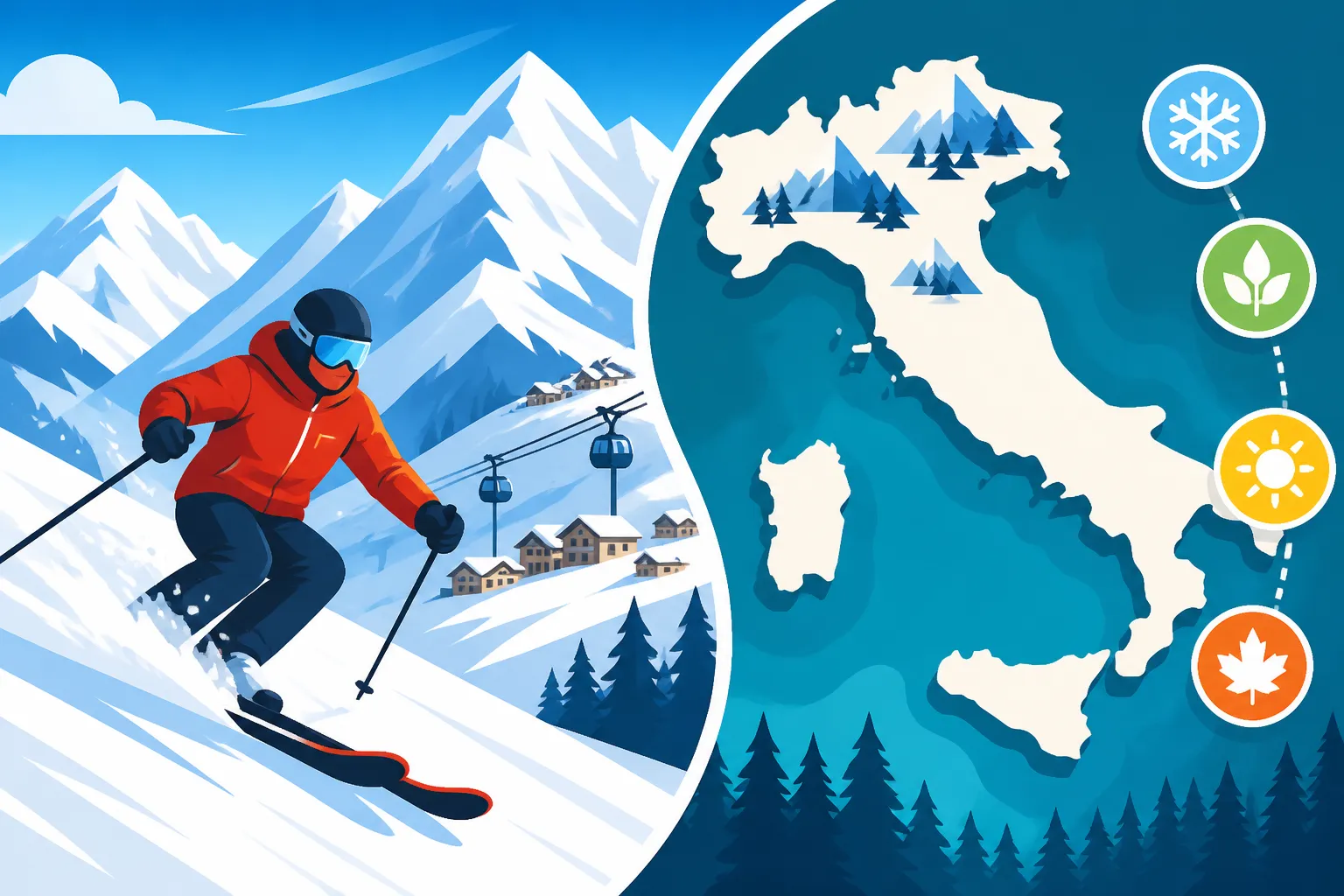
Many newcomers to Italy are surprised to find that the land of sun-drenched coastlines and olive groves is also a premier destination for world-class skiing, but navigating the administrative and logistical hurdles of a mountain holiday can be overwhelming. If you have ever stood at a train station confused by regional schedules or realized too late that your favorite resort doesn't have snow-making capabilities in early December, this guide is for you. We will break down exactly where to find the best powder, how to time your trip to avoid the infamous Italian crowds, and the practicalities of making it to the peaks without losing your mind.
Disclosure: This post may contain affiliate links. We may earn a commission at no extra cost to you if you make a purchase through these links. Read full disclosure.
Choosing Your Region: The Great Italian Divide
When you start planning a ski trip in Italy, the first thing you need to realize is that the "Italian Alps" is a massive, diverse category that covers several distinct regions, each with its own personality, price point, and snow reliability. As someone who has spent years navigating the north, I can tell you that picking the wrong region is the number one mistake expats and tourists make. You might be tempted to just head "north," but the difference between the craggy peaks of the Dolomites and the high-altitude glaciers of the Aosta Valley is significant.
The Dolomites: Trentino-Alto Adige and Veneto
The Dolomites are perhaps the most famous mountains in Italy, and for good reason. They are a UNESCO World Heritage site, and the scenery is unlike anything else on earth. The rock has a pinkish hue that glows at sunset—a phenomenon locals call enrosadira. For skiers, the biggest draw here is the Dolomiti Superski, a massive network that covers 12 different ski areas with a single pass.
In this region, you are often dealing with a blend of Italian and Ladin cultures. You will find that Italian Regions: A Traveler's Overview hardly does justice to the specific cultural pocket of South Tyrol, where German is often the primary language. The infrastructure here is incredibly efficient. If you are looking for meticulously groomed runs and high-end dining, this is your spot. However, be warned: the Dolomites are slightly lower in altitude than the Western Alps, meaning they rely heavily on their world-class snow-making technology during warmer winters.
The Aosta Valley: High Altitude and Glaciers
If your priority is "big mountain" skiing and guaranteed snow, the Aosta Valley (Valle d'Aosta) is where you need to be. This is home to the giants: Mont Blanc (Monte Bianco), the Matterhorn (Cervino), and Monte Rosa. Because the resorts here, like Cervinia, sit at much higher altitudes, the season lasts significantly longer. You can often find people skiing here well into May.
The vibe here is more rugged and distinctly Franco-Italian. It is the perfect place for those who want to cross borders on their skis; for example, from Cervinia, you can ski right over the ridge into Zermatt, Switzerland. Just make sure you check your lift pass coverage before you cross, or you might find yourself stuck with a very expensive taxi ride back around the mountain. To plan the transit for these cross-border trips, using a platform like Omio is helpful for comparing the few bus and train links that skirt the base of these massive peaks.
Piedmont and the Milky Way
Piedmont, specifically the Via Lattea (Milky Way) circuit, offers a more athletic, straightforward skiing experience. This area hosted the 2006 Winter Olympics, so the runs are wide, fast, and challenging. Sestriere is the hub here, sitting at a high altitude that keeps the snow in good condition. It is a bit more functional and less "fairytale" than the Dolomites, but for a serious skier, the sheer mileage of interconnected runs is hard to beat. Since it is so close to Turin, it is one of the easiest areas to access if you are looking for Best Day Trips From Milan or Turin that involve a bit of snow.
Timing Your Trip: The Italian Ski Calendar
Timing is everything in Italy. If you show up during a national holiday, you will spend more time in lift lines than on the snow. Conversely, if you arrive too early in the season, you might find only a handful of artificial snow strips open amidst a sea of brown grass. Understanding the rhythm of the Italian winter is essential for a successful trip.
December and the Christmas Rush
The season officially kicks off around the feast of the Immaculate Conception (December 8th). This is a massive holiday in Italy, and if the snow has arrived, the mountains will be packed. However, the period between December 8th and December 20th is often a "sweet spot" where prices are lower before the Christmas madness begins.
Christmas through Epiphany (January 6th) is what I call the "danger zone" for your budget. Accommodation prices on Booking.com can triple during this window, and the slopes are crowded with families. If you enjoy the festive atmosphere and don't mind the crowds, it's magical, but for pure skiing, it is the most frustrating time of year.
January: The Cold Snap and Quiet Slopes
Once the children head back to school after January 6th, the mountains go quiet. This is my personal favorite time to ski. The temperatures drop—sometimes reaching -15°C or lower. The snow is usually at its crispest and driest in January. It is also the time when you can find the best deals on mid-week stays.
February: The Settimana Bianca
February is the month of the Settimana Bianca (White Week). Almost every Italian family with school-aged children heads to the mountains for a week during this month. The slopes become very busy again, particularly in the mid-morning. If you are skiing in February, the secret is to be at the lift the second it opens (usually 8:30 AM) and take an early lunch at 11:30 AM to avoid the 1:00 PM rush at the rifugi.
March and April: Spring Skiing and Sun
As the days get longer, the focus shifts from hardcore skiing to the aperitivo culture. In the Dolomites and the Aosta Valley, March offers beautiful sunny days where the snow is firm in the morning and turns to "slush" (which we call pappa) by the afternoon. This is the best time for beginners or those who prefer long lunches on sun-soaked terraces. You can often book guided snowshoe tours or specialized lessons via GetYourGuide during this season to take advantage of the softer conditions and warmer weather.
| Month | Snow Reliability | Crowd Level | Best For |
|---|---|---|---|
| December | Variable (High in Aosta) | Very High (Late Dec) | Festive vibes and lights |
| January | Very High | Low (Mid-month) | Serious skiers, budget deals |
| February | High | Very High | Families, social atmosphere |
| March | Moderate (High on Glaciers) | Moderate | Spring skiing, sun-seekers |
| April | Low (Except High Altitude) | Low | Late-season bargains |
Navigating the Logistics: Getting There and Gear
One of the most daunting aspects of an Italian ski trip for an expat is the "last mile" of travel. Italy’s rail network is fantastic between cities, but mountains are, by definition, hard to reach. If you are looking at Getting Around Italy: Trains, Buses, Flights, and Car Hire, you’ll find that the train will take you to the valley, but the bus will take you to the peak.
Transport Hacks
For the Dolomites, the train will take you to Bolzano or Bressanone. From there, you rely on the SAD bus network. In the Aosta Valley, you can take a train to Aosta city and then a gondola directly from the city center up to the Pila ski resort—one of the most seamless transitions in the country. For those coming from abroad, flying into Milan or Venice and using Omio to book a direct "shuttle bus" (like the Cortina Express or the FlySki Shuttle) is often much easier than trying to navigate multiple regional train changes with heavy ski bags.
The Ski Pass System
Do not make the mistake of buying individual daily passes if you plan to ski for more than three days. The regional passes like the "Dolomiti Superski" or the "Skirama Dolomiti" offer much better value. Most of these can now be loaded onto a "MySkiPass" card, which you can top up online. This saves you from standing in the cold at a ticket window on your first morning. If you are staying in Northern Italy: Alps, Lakes, and Cities, check if your hotel provides a "guest card," which often includes free local bus transport to the lifts.
Gear Rental vs. Bringing Your Own
If you live in Italy and plan to ski multiple times, buying gear is worth the investment. However, for a one-off trip, the rental shops (noleggio) in Italy are top-notch. They often carry the latest season's Rossignol or Head skis. Pro tip: book your rentals in advance through GetYourGuide or directly with the shop online. It is often 10-15% cheaper than walking in off the street, and they will have your boots warming on the rack when you arrive.
The Culture of the Rifugio: Eating on the Slopes
You cannot talk about skiing in Italy without talking about the food. In many other countries, ski resort food is an afterthought—a soggy burger or a cold sandwich. In Italy, the rifugio (mountain hut) is the heart of the experience. You will find that Skiing in the Italian Alps: Resorts and Season Basics often highlights the culinary aspect as much as the vertical drop.
What to Order
In the Dolomites, you must try Canederli (bread dumplings with speck) or Casunziei (beetroot ravioli with poppy seeds). In the Aosta Valley, look for Polenta Concia, which is polenta smothered in local Fontina cheese and butter. It is heavy, delicious, and exactly what you need when the temperature is sub-zero.
The Aperitivo Tradition
Around 4:00 PM, the slopes begin to empty into the "Après-ski" bars. While places like Courmayeur have a sophisticated bar scene, places like Val Gardena are famous for their lively, music-filled hut parties. Just remember that if you are staying in a mountain-top Accommodation in Italy: Hotels, B&Bs, and Agriturismi, you need to catch the last lift up before it closes, or you’ll be facing a very long hike or a snowcat ride.
Safety and Administrative Requirements
Italy has recently tightened its laws regarding mountain safety. As of January 2022, third-party liability insurance (assicurazione responsabilità civile) is mandatory for all skiers. If the police (Carabinieri) stop you on the slopes and you cannot prove you have insurance, you face a fine of up to €150 and the confiscation of your skipass.
Most people buy this insurance as a daily add-on for a few euros when they purchase their lift ticket. However, if you have a year-round travel insurance policy, check if it covers "civil liability for winter sports." Additionally, helmets are mandatory for everyone under the age of 18, though you will see most adults wearing them now too. Alcohol consumption is also monitored; being visibly intoxicated on the slopes can result in heavy fines, much like a DUI on the road. For more on general safety, see Staying Safe in Italy: Common-Sense Tips for Travelers.
Where to Stay: Finding the Right Base
Finding the right town is just as important as finding the right mountain. If you want a car-free experience, look for towns like Ortisei or Selva di Val Gardena. If you want luxury and high-end shopping between runs, Cortina d'Ampezzo is the "Queen of the Dolomites." For those on a tighter budget, look at towns slightly further down the valley and use the local "Ski Bus" to reach the lifts. Booking.com is excellent for finding these smaller, family-run garnì (B&Bs) that might not have their own websites.
If you are planning a trip from a major hub, consider the transit times carefully. How to Get to the Italian Alps by Train is a great way to travel if you are heading to Bolzano, but for more remote spots like Madonna di Campiglio, you will definitely want to look into private transfers or car rentals.
Disclaimer
This guide is intended for informational purposes only. Skiing and snowboarding are inherently risky activities. Weather conditions in the mountains can change rapidly, and snow reliability is never guaranteed. Always check local avalanche bulletins and weather forecasts before heading out. Ensure you have the legally required liability insurance and follow all local slope regulations and safety signs.
The mention of third-party services like Omio, Booking.com, and GetYourGuide is for contextual reference; users should perform their own due diligence when booking travel and activities. We do not accept responsibility for any injuries, financial loss, or travel disruptions that may occur during your trip.