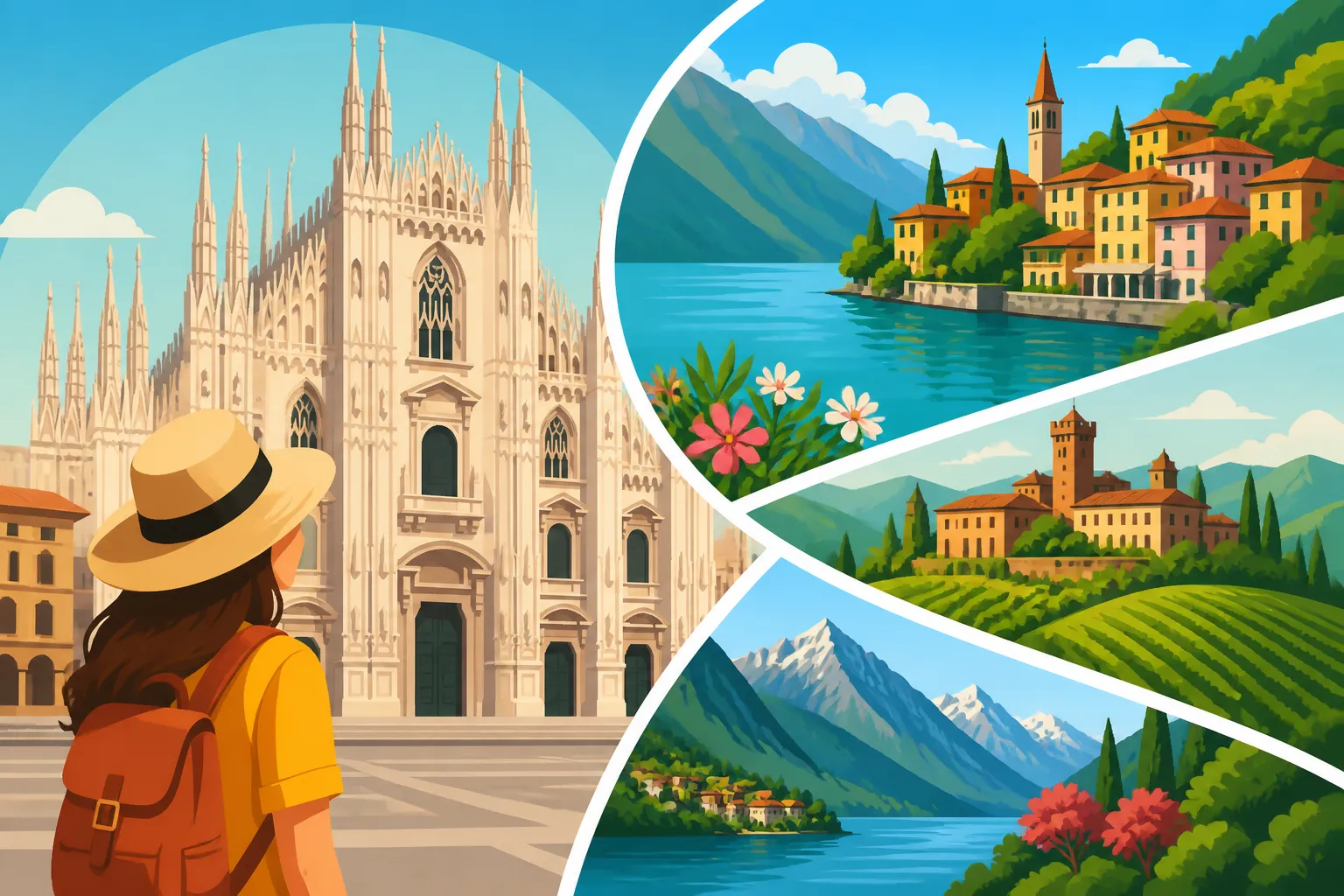
Best Day Trips From Milan
Plenty of people plan a Milan base and an ambitious list of lake and city escapes, then lose the day to the wrong station, the wrong train or a ferry timetable they never checked. This guide covers the best day trips from Milan, how to reach each one by train, and how to choose the right trip for your season, budget and pace.
Disclosure: This post may contain affiliate links. We may earn a commission at no extra cost to you if you make a purchase through these links. Read full disclosure.
How to Plan a Day Trip From Milan Without Wasting Half the Day
My first attempt at a day trip from Milan went badly. I wanted to see Lake Como. I turned up at Milano Centrale, bought a ticket from a machine, and only found out on the platform that my train went to a different Como station from the one my friend had recommended. We met three hours late at the wrong end of town, and lunch became a sad panino on a bench.
Milan is one of the best day-trip bases in Italy. Few cities give you lakes, Alpine foothills, Renaissance towns and a second major city within easy reach. The rail network is dense, but it is run by more than one operator from more than one station, and that confuses newcomers. Getting the basics right before you leave makes the trip itself much easier.
Milan’s Departure Stations Explained
Milano Centrale is the big one, with the huge white hall that looks like a monument to the state railways. Most high-speed trains to Verona, Turin, Venice, Bologna and Rome leave from here. So do many regional trains, including the Tirano line that runs along the eastern shore of Lake Como and the trains to Stresa on Lake Maggiore. If a guide just says “take the train from Milan”, Centrale is usually what it means. It is still worth checking.
Milano Porta Garibaldi is the second hub, close to the skyscrapers of Porta Nuova. Some regional and suburban services leave from here, including some routes towards Bergamo and Lecco. High-speed trains stop here too. Milano Cadorna is a separate station run by the regional operator Trenord. It serves the Ferrovie Nord network, which includes trains to Como Nord Lago, the station right on the lakefront in Como town, and the Malpensa Express to the airport. The Malpensa Express also runs from Centrale. For details on that, see How to Get From Milan Malpensa Airport to the City Center.
The practical lesson is to check the departure station on your ticket and confirm it on the timetable the night before. A metro ride between Centrale and Cadorna takes time. If you miss your train because you were at the wrong station, the next one may not suit your connection to a ferry or funicular. I keep a screenshot of the ticket with the station name circled, which sounds silly until you’re tired, slightly hungover and staring at departure boards in a crowd.
Regional Trains vs High-Speed Trains
Two kinds of train will carry you on most of these trips. High-speed services, mainly Trenitalia’s Frecciarossa and the trains of the private operator Italo, run on the main corridors to cities such as Verona and Turin. They have assigned seats and dynamic pricing: fares tend to be cheapest when booked well ahead and rise as the departure date gets closer and seats fill up. There is a full breakdown in High-Speed Trains in Italy: Trenitalia, Italo, Routes, and Savings.
Regional trains, run by Trenitalia and Trenord, cover the lakes, the smaller towns and most of the scenic routes. They usually have fixed fares, no assigned seats and frequent departures. They are slower and stop more often, but they are often the only option for places such as Varenna or Stresa. Paper regional tickets must be validated before boarding. If you’re unsure how that works, read How to Validate a Regional Train Ticket in Italy before your first trip. Conductors on Lombard trains do check, and saying you didn’t know rarely gets you out of a fine.
If you want to compare train, bus and sometimes coach options for a route in one place, Omio is useful. It shows different operators side by side, which helps when you’re weighing a fast Frecciarossa against a cheaper regional train. Check the final fare and conditions on the operator’s own page, and buy wherever the conditions suit you best.
Timing Your Day and Planning for Strikes
The biggest mistake I see is leaving too late. Italians on a weekend outing often take a mid-morning train. That suits a city like Bergamo, but it will ruin a lake day where you want to catch several ferries. For Como, Maggiore or anything involving boats, aim for an early train. You’ll arrive before the tour groups and have time for a long lunch without rushing for the last ferry.
Check the return times too. The last convenient train back is usually earlier than people expect, especially on lake lines and on Sundays, when regional timetables are often thinner. Write down the last two return trains before you leave. If you miss both, you’ll either pay for an expensive taxi or need a last-minute hotel. If you would rather stay the night on purpose, Booking.com lets you filter lakeside rooms by distance from the station or ferry pier. That matters a lot in places like Varenna, where some rooms are up long flights of steps.
Strikes, called sciopero, are part of life in Italy. They are announced ahead of time, and a minimum service is guaranteed during certain protected time bands. A strike day doesn’t have to cancel your trip, but it should change your plans. Read Strikes in Italy: How Sciopero Days Work and How to Rebook and check the operators’ strike notices before any long day out. When a strike was announced for the day of my Bernina trip, I moved the excursion and spent the day at the Pinacoteca di Brera instead.
Lake Day Trips From Milan
The lakes are why many people choose Milan as a base. Lake Como, Lake Maggiore and the smaller lakes are all reachable by train, and a good lake day mixes trains, ferries, walking and a lot of staring at the water. For a wider comparison of the three big lakes, see The Italian Lakes: Como, Garda, and Maggiore Compared.
Lake Como: Como Town, Bellagio and Varenna
Lake Como is shaped like an upside-down Y, and that shape decides your day. Como town sits at the bottom of the western branch. It is the quickest lake destination from Milan, under an hour by regional train. In Como you can walk the lakefront promenade, visit the cathedral and ride the Como–Brunate funicular up to the village of Brunate for wide views over the lake. It is a good half-day trip, or a whole day if you add a boat trip.
The other classic route uses the Milan–Tirano line from Centrale to Varenna-Esino, around an hour by regional train. Varenna is a small, very pretty village on the eastern shore. From there, frequent ferries cross to Bellagio, the “pearl of the lake”, and to Menaggio on the western shore. Many people do this triangle of Varenna, Bellagio and Menaggio in one day. They walk through Varenna’s lanes, visit the gardens of Villa Monastero, take the boat to Bellagio for lunch and come back on an evening train.
Here’s a sample day that works well:
- Take an early regional train from Milano Centrale to Varenna-Esino.
- Walk down to the village and explore the lanes and the lakeside walkway before the crowds arrive.
- Take the ferry to Bellagio, walk up its stepped streets and have a long lunch.
- Take a ferry to Menaggio, or straight back to Varenna, depending on your energy.
- Catch a return train from Varenna, checking the last two departures before you set off.
For a step-by-step version of both routes, see How to Visit Lake Como From Milan for the Day. Ferry tickets and train tickets are separate purchases, and the ticketing rules are explained in Reaching Como, Garda, and Maggiore: Rail Plus Boat Ticketing Explained.
Lake Maggiore and the Borromean Islands
Lake Maggiore gets less hype than Como, which is part of its appeal. Stresa, on the western shore, is around an hour by regional train from Centrale. It is a Belle Epoque resort with grand hotels along the front, and it is the starting point for the Borromean Islands. Isola Bella has the Baroque Palazzo Borromeo with its terraced gardens. Isola Madre is quieter and greener, with botanical gardens. Isola dei Pescatori is a small fishing village with good lakeside restaurants.
The usual plan is to buy a boat ticket covering the islands you want and hop between them. Isola Bella and Isola Madre have entry tickets for their palaces and gardens, and their opening seasons usually run from spring to autumn. If you visit in winter, you may find the gardens closed and the lake very quiet, so check the opening calendar before you go. For a fuller plan, see How to Visit Lake Maggiore and the Borromean Islands.
Maggiore is my pick for anyone travelling with older relatives or small children. The walking is flat and the distances are short. You don’t have the steep steps of Bellagio or Varenna, and the boat rides are short enough to keep everyone happy. My parents visited one October and still talk about lunch on Isola dei Pescatori more than anything they saw in Milan.
Lake Orta and Lake Iseo for Quieter Days
If you live in Milan and have already done Como and Maggiore, try the smaller lakes. Lake Orta lies west of Maggiore. Its main village, Orta San Giulio, is one of the most peaceful places in northern Italy. A short boat ride takes you to Isola San Giulio, an island taken up almost entirely by a Benedictine abbey, with a path called the Way of Silence. Getting there by train takes longer and usually involves a change, so this is a full day rather than a half day.
Lake Iseo lies east, between Bergamo and Brescia, next to the Franciacorta wine area. Its best-known sight is Monte Isola, a car-free island in the middle of the lake, reached by short ferry crossings from Sulzano and other lakeside towns. The trip usually means a train to Brescia and then the local line along the lake, so it suits travellers who don’t mind a slow journey. In return you get a lake that feels much more local and much less like a postcard.
Both lakes suit expats who want to explain Italian lake life to visiting friends without the crowds of Bellagio in August. Neither has the infrastructure of Como, so check ferry timetables and restaurant opening days carefully, especially outside peak season.
City Day Trips From Milan
Milan’s rail links let you spend a morning in one major northern city and be back for aperitivo in Milan. You can do any of these three in a single day, though each would also reward an overnight stay.
Bergamo: The Walled Upper Town
Bergamo is about an hour from Milan by regional train, and for many travellers it is the best surprise of their trip. The town has two parts. Città Bassa, the lower town, is modern and practical, and the station is there. Città Alta, the upper town, sits behind Venetian walls that are part of a UNESCO-listed defensive system. A funicular runs from the lower town up to the old centre. Riding it up and then walking down is one of the nicest ways to end the day.
In Città Alta, Piazza Vecchia is the centre of everything. Next to it are the Basilica of Santa Maria Maggiore, with its very rich interior, and the Colleoni Chapel, with its colourful marble facade. A second funicular climbs further to San Vigilio, where there are views across the plain and up towards the Alps. Bergamo is also known for its food, so try casoncelli, a filled pasta with butter, sage and bacon, and the small polenta-shaped cakes in the bakery windows.
Bergamo is also handy if you’re flying in or out of the airport at Orio al Serio, which many budget airlines use. A friend of mine always books her return flight from Bergamo in the evening and spends the day in the upper town with her luggage in a left-luggage locker.
Verona: Roman Arena and Romeo and Juliet
Verona is technically in the Veneto, but it is one of the easiest big day trips from Milan. The fastest Frecciarossa between Milan and Verona takes 1 h 10 min, and Italo quotes 1 h 12 min, so the high-speed train gets you there in just over an hour. Trenitalia runs about 46 Frecciarossa services a day on the route, which means you can choose your departure and return times freely. Regional trains are slower but can be cheaper and don’t need a reservation.
The station, Verona Porta Nuova, is a manageable walk or short bus ride from the centre. The main sights are close together: the Roman Arena in Piazza Bra, the market square of Piazza delle Erbe, the medieval Piazza dei Signori, and the much-photographed courtyard called Juliet’s House. Cross the Ponte Pietra to reach the Roman theatre and climb towards Castel San Pietro for views over the red roofs and the river Adige. If you visit in summer, the opera season in the Arena is a great reason to stay the night.
For more detail on the route and on planning a day in the city, see How to Visit Verona From Venice or Milan. A personal tip: Juliet’s House is the most crowded spot in the city. If the courtyard is packed, admire it briefly and move on. Verona’s real charm is in its quiet streets and riverbanks.
Turin: The Elegant Capital of Piedmont
Turin is the other big-city day trip, and it is very different from Milan. The fastest nonstop high-speed trains do the trip in under an hour, while most Frecciarossa and Italo services with stops take a little longer. Turin was the first capital of unified Italy, and it shows in its long arcaded streets, grand squares and royal palaces. Many people who visit expecting an industrial city leave a little in love with it.
The essentials are the Egyptian Museum, one of the most important collections of its kind in the world, the Mole Antonelliana with the National Cinema Museum and its panoramic lift, the Palazzo Reale, and Piazza Castello and Piazza San Carlo. Turin is also the home of bicerin, a layered drink of coffee, chocolate and cream, and it claims to have invented the modern aperitivo. Book the Egyptian Museum ahead of time if you’re going at the weekend, because the queues can be long.
If you’re torn between Turin and Bologna for future trips, Turin and Bologna: Two Underrated Italian Cities compares them in detail. Turin can be done in a day, but it is a city with many museums, and a single day mostly gives you a taste. Many expats I know made the day trip first and then came back for a long weekend.
Smaller Towns and Off-Beat Day Trips From Milan
Some of the best days out from Milan aren’t the big names. These options suit people who have seen the main sights, or who want a day with fewer queues and more character.
Pavia and the Certosa di Pavia
Pavia is the closest trip on this list, around half an hour from Milan by regional train. It is an old university town with a lot of Romanesque architecture, including the Basilica of San Michele Maggiore, where medieval kings were crowned. There is also the Ponte Coperto, a covered bridge over the river Ticino. The university courtyards are open to visitors and quiet at weekends.
The highlight for many people is the Certosa di Pavia, a Carthusian monastery with one of the most richly decorated facades in Lombardy. It is a short distance outside town and has its own regional train stop, Certosa di Pavia, followed by a walk. Opening hours are limited and closed at lunchtime, so check them before you go. Pavia and the Certosa together make an easy, relaxed day.
Cremona and Mantua for Food, Music and Renaissance Art
Cremona is around an hour or more from Milan by regional train, and it is the home of violin making. Antonio Stradivari worked here, and the Museo del Violino tells the story of the craft and sometimes hosts concerts on historic instruments. The cathedral and the Torrazzo, its very tall bell tower, sit in one of the best-preserved squares in Lombardy. Cremona is also famous for torrone, the nougat, and for mostarda, fruit preserved in mustard syrup.
Mantua is further, around two hours by regional train, so it is a long but rewarding day. The city was the seat of the Gonzaga family. The Palazzo Ducale contains the Camera degli Sposi, the “Bridal Chamber” painted by Andrea Mantegna, and Palazzo Te is the extravagant pleasure palace designed by Giulio Romano. The city is surrounded on three sides by lakes formed by the river Mincio, and it feels almost dreamlike in winter fog. If you plan to see both palaces, start early or consider staying overnight.
Crossing Into Switzerland: Lugano and the Bernina Line
Lugano, in the Italian-speaking Swiss canton of Ticino, is around an hour or a bit more from Milan by train. It’s a good choice if you want a taste of Switzerland without a long journey. The town sits on Lake Lugano, with a lakefront park, smart streets and funiculars up to Monte Brè and Monte San Salvatore. Switzerland is in the Schengen area but outside the EU, so carry your passport or residence permit and expect Swiss francs. Check whether your mobile plan covers Switzerland, because EU roaming rules don’t automatically apply there.
The more ambitious option is the Bernina line. You take the regional train from Milan along Lake Como and up the Valtellina to Tirano, around two and a half hours away, and then join the Swiss Rhaetian Railway over the Bernina Pass towards St. Moritz. The scenery of glaciers, high lakes and the spiral viaduct at Brusio is spectacular. It is a very long day, though, and some people make it a two-day trip. The route options are covered in Italy to Switzerland: Milan to Zurich, Geneva, and the Bernina Line.
Many travellers book the Bernina trip as a guided package because it involves operators on both sides of the border. GetYourGuide lists organised Bernina day tours from Milan that bundle the coach or train legs, which can save planning time if you don’t want to handle the connections yourself. Compare what is included, especially whether the panoramic train seats are reserved, against the cost of doing it independently.
Comparing the Best Day Trips From Milan
Once you know the options, the hard part is choosing. The table below compares the main day trips by travel time, departure station and the kind of traveller each suits best. The times are approximate, and timetables change, so always check the current schedule before you travel.
| Destination | How to Get There | Approximate Travel Time | Main Milan Station | Best For |
|---|---|---|---|---|
| Como town | Regional train | Under an hour | Centrale or Cadorna | Short lake visit, funicular views |
| Varenna and Bellagio | Regional train plus ferry | Around an hour to Varenna | Centrale | Classic lake scenery, ferry hopping |
| Stresa and Borromean Islands | Regional train plus boat | Around an hour | Centrale | Gardens, easy walking, families |
| Bergamo | Regional train | About an hour | Centrale or Garibaldi | Walled old town, food |
| Verona | High-speed or regional train | About 1 h 10-15 min by high-speed train; regional trains are slower | Centrale | Roman sights, romance, opera |
| Turin | High-speed train | Under an hour on the fastest nonstop trains; a little longer with stops | Centrale or Garibaldi | Museums, cafes, royal palaces |
| Pavia and the Certosa | Regional train | Around half an hour | Centrale or Rogoredo | Short, relaxed cultural day |
| Cremona | Regional train | Around an hour or more | Centrale | Violins, food, quiet squares |
| Mantua | Regional train | Around two hours | Centrale | Renaissance palaces, long day |
| Lugano | Regional or cross-border train | Around an hour or a bit more | Centrale | Swiss lake town, quick border trip |
| Tirano and the Bernina | Regional train plus Swiss train | Around two and a half hours to Tirano | Centrale | Alpine scenery, very long day |
Matching a Day Trip to Your Travel Style
If this is your first trip and you have only one free day, my advice is a lake: Varenna and Bellagio if you want the famous views, or Stresa if you want an easier pace. If you get bored without history and museums, choose Verona or Turin. The high-speed trains make both very comfortable, and you’ll get far more city time than you would expect from a day trip.
Families with young children do well with Stresa, Como town or Bergamo. Each has a funicular or boat ride that keeps children interested, short walks between sights and plenty of places for gelato. Couples looking for something romantic should consider Verona or Lake Orta. Foodies should head to Bergamo, Cremona or the Franciacorta area near Lake Iseo. Long-term expats in Milan can work through the whole list season by season. I keep a “next Saturday” list on my fridge, and I’m still adding to it.
Guided Tours vs Doing It Yourself
Almost every day trip on this list is easy to do independently, and doing it yourself usually costs less. Regional trains are frequent, ferries run often in season, and the towns are compact. The independent route also lets you change plans freely: a long lunch, a spontaneous boat trip, an earlier train home if the weather turns.
Guided tours make sense when there are many connections, as with the Bernina line, or when you want a guide to explain what you’re seeing in places like the Palazzo Ducale in Mantua. Tours also suit travellers who don’t speak any Italian or who are anxious about rail logistics. The downside is less freedom, fixed timings and often big groups at the most popular stops. Weigh what you’re paying for against your own confidence. If in doubt, do your first trip independently on a simple route such as Como or Bergamo and see how you feel.
Practical Tips for Day Trips From Milan
Good logistics turn a decent day into a great one. These are the lessons I learned the slow way over many years of weekend trips from Milan.
Seasons, Weather and Opening Calendars
Lake trips change a lot with the seasons. From spring to early autumn, ferries are frequent, gardens are open and the lakeside towns are lively. In winter, many ferry routes run a reduced timetable, some villa gardens and island palaces close, and some lakeside restaurants shut altogether. A November lake trip can still be lovely, with mist on the water, empty squares and warm cafes, but check what’s open before you go.
City trips are good all year. Verona and Turin can be very hot in midsummer, so start early and plan indoor visits for the afternoon. Mantua and Cremona are often foggy in winter, which suits their atmosphere. Before any trip, check for public holidays and local festivals. Some sites close on certain holidays, and trains to popular lakes can be very crowded on long weekends, so arrive at the station early if you need a seat on a regional train.
Money, Safety and Packing for the Day
For an easy day, pack a power bank, a refillable water bottle, comfortable shoes for steps and cobblestones, a light layer for boat rides, and some cash for small cafes and ferry kiosks. Many places accept cards, but small businesses in villages sometimes prefer cash for small amounts. For Lugano, remember the currency and the passport.
Crowded trains, ferry piers and busy squares attract pickpockets, especially in peak season. Keep your bag closed and in front of you, and keep your phone out of back pockets. There are more tips in Avoiding Pickpockets in Italy’s Tourist Areas. If you’re thinking about hiring a car for the lakes, consider the narrow lake roads, the parking shortages in summer, and the limited-traffic zones in Italian town centres. What Is a ZTL in Italy and How to Avoid Fines explains why many expats leave the car at home and take the train.
Making Weekend Day Trips a Habit as an Expat
When I first moved to Milan, I stayed in the city at weekends. I told myself I was too tired after a week of bureaucracy and work. Day trips changed that. A Saturday in Bergamo or a Sunday on the lake reminded me why I’d moved to Italy, and helped me through the grey winter months when Milan can feel heavy.
My advice for new residents is to pick a trip every few weekends and start with the easy ones. Como, Bergamo and Pavia need little planning. Once you’re comfortable with regional trains and ferry tickets, move on to Mantua, Orta or the Bernina line. Over time you’ll build a mental map of Lombardy and its neighbours, and that is part of really settling in. For ideas on what to do in the city itself on rest weekends, Milan City Guide: Fashion, Art, and the Duomo has plenty of suggestions.
Disclaimer
This article is for general informational purposes only and does not constitute professional advice. Laws, prices and regulations vary by location and change over time. Consult a qualified professional for guidance on your specific situation.