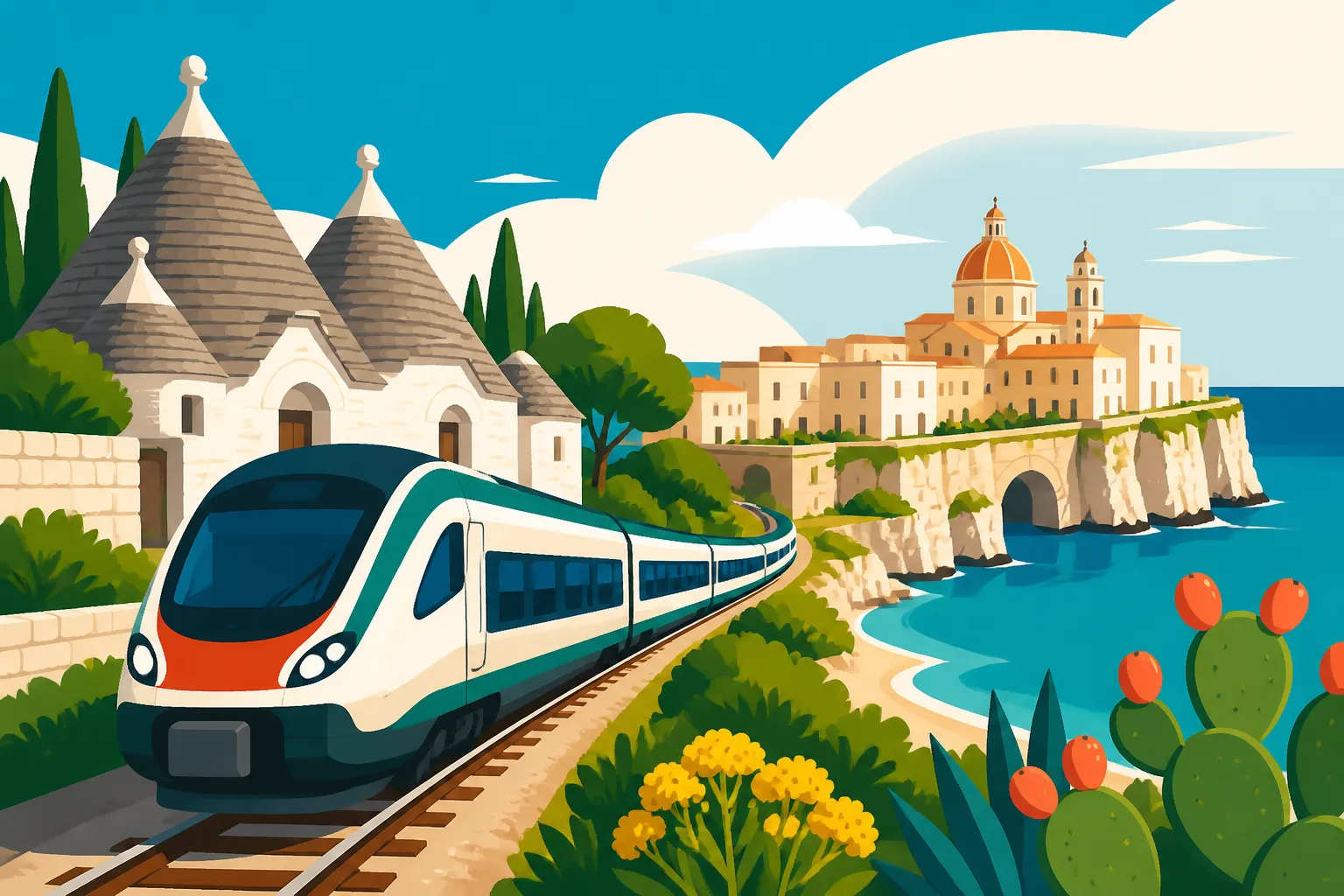
Reaching Puglia’s Coast: Trulli Country and the Salento by Rail
Most people plan a Puglia trip around trulli and turquoise coves, then run into the rail map. High-speed trains stop at Bari, regional lines run on different networks, and the most charming towns sit on single-track branches with replacement buses. This guide explains how to reach the Valle d’Itria and the Salento by rail, which operator runs each leg, and how to book them.
Disclosure: This post may contain affiliate links. We may earn a commission at no extra cost to you if you make a purchase through these links. Read full disclosure.
How the Puglia Rail Network Actually Works
The first time I took the train down to Puglia, I assumed it would work like Tuscany: one national operator, one app, done. It doesn’t. Puglia has a layered system. The national operator runs the fast main line along the Adriatic. Several regional companies run the branch lines that reach the places you actually came to see. Once you understand the layers, everything else falls into place.
The Adriatic Main Line: Your Backbone
The main artery is the coastal line that runs from Foggia through Barletta and Bari, then south through Monopoli, Fasano, Ostuni, Brindisi, and finally Lecce. This is Trenitalia territory. Frecciarossa and Frecciargento high-speed services, Intercity trains and regional trains all use it. If you’re arriving from Rome, Naples, Bologna or Milan, this is the line that delivers you to Puglia.
The main line also covers more of the coast than people expect. Polignano a Mare and Monopoli both have stations served by regional trains from Bari, and the ride is short and scenic. Ostuni has a station too. There’s a catch here, though. Ostuni station sits in the flat plain a few kilometres below the White City, so you’ll need a local bus or a taxi for the last stretch. I learned this with a suitcase in the midday sun, and I don’t recommend repeating my mistake.
For the long-haul legs into the region, our Rome to Bari and Lecce: Reaching Puglia by Rail guide covers routes and journey patterns in more detail.
Ferrovie del Sud Est: The Line Into Trulli Country and the Salento
Ferrovie del Sud Est, usually shortened to FSE, is the operator that matters most for travellers. Its network fans out from Bari into the Valle d’Itria. That is where you’ll find Alberobello, Locorotondo and Martina Franca, the heart of trulli country.
FSE also runs a web of lines across the Salento from Lecce. They reach Gallipoli on the Ionian side, Otranto on the Adriatic side, and Maglie and the southern towns towards Gagliano del Capo near Santa Maria di Leuca.
FSE is now part of the national rail group, and its rolling stock has improved a lot over the years. It still runs on its own rhythm, though. Trains are slower, frequencies are lower, and Sunday and public holiday timetables can be sparse. The single biggest frustration for visitors is replacement buses. On FSE routes, some scheduled train journeys are operated by buses, known locally as servizio sostitutivo. These substitutions can happen at any time of year, and Sundays and holidays are especially affected. The bus usually leaves from outside the station rather than the platform. Always check the departure listing for a bus symbol before you head to the tracks.
The Other Regional Operators You Might Meet
Two more companies round out the picture.
- Ferrotramviaria runs the line linking Bari Karol Wojtyła Airport to Bari Centrale, plus lines north towards Bitonto and Barletta. If you fly into Bari, this is almost certainly your first train.
- Ferrovie Appulo Lucane runs from Bari towards Altamura and into Basilicata. It is the rail route towards Matera, which our guide Reaching Matera and Basilicata: Where the Rail Network Runs Out explains properly.
At Bari Centrale, these operators can use different platform areas and separate ticket desks. Allow extra time when changing between them, and follow the signs for the specific company rather than the general departure board.
Booking Your Puglia Trains With Omio
Here’s the honest reason I send friends to Omio for Puglia trips. Most of the planning headache comes from stitching together operators, and Omio puts the main pieces on one screen. It searches trains, buses and flights together. You can see a Frecciarossa from Rome, a FlixBus from Naples and a regional train down the coast side by side, then pick on time and convenience rather than juggling four tabs.
Why a Single Search Beats Juggling Operator Sites
Picture a common scenario. You’re in Florence and want to spend four nights in Lecce with a day in Polignano a Mare on the way. On the individual operator sites, you’d search Florence to Bari, then Bari to Polignano, then Polignano to Lecce. Each search lives in a different booking flow, and you’d have to work out the connection times yourself.
On Omio, you can search the long-distance leg and then the coastal hops in one place, in English, paying with a foreign card. That last point matters more than it sounds. Some Italian booking pages reject non-Italian cards or demand details that don’t fit a foreign address. Omio’s checkout is built for international travellers, and the mobile tickets sit in the app on your phone, ready to show the conductor.
Omio may add a booking or service charge on some routes, and how it is calculated can vary by operator and ticket type. Check the final price breakdown on Omio’s own checkout page before paying, and compare it with the operator’s direct price if every cent matters to you.
Step-by-Step: Booking a Rome to Lecce Trip With a Coastal Stop
- Open the Omio app or website and enter your departure city and Bari as the destination for the first leg.
- Filter by train, then compare high-speed and Intercity options on duration and number of changes.
- Choose a fare type. Cheaper fares on Italian high-speed trains often carry stricter change and refund rules, so read the conditions shown before selecting.
- Enter passenger names exactly as they appear on your passport.
- Search the next leg separately, for example Bari to Polignano a Mare, and pick a regional departure that leaves a comfortable buffer after your arrival.
- Repeat for Polignano a Mare to Lecce on a later day, or whenever you plan to move on.
- Pay, then download the tickets to the Omio app so they’re available offline. Reception can be patchy on some Salento stretches.
- Check the app again the evening before each journey for platform or schedule updates.
Where Omio Fits and Where You’ll Buy Locally
I want to be straight with you, because an honest plan beats a frustrated one. Omio is strongest on the national network and the long-distance coach operators. That covers the big legs into Puglia and the hops along the Adriatic main line, which together make up most of the distance you’ll travel.
The small FSE branch lines are a different story. Depending on the route and the day, a specific local FSE journey may not appear in a third-party search. When that happens, buy the ticket at the FSE desk or machine at Bari Centrale or Lecce, through the operator’s own channels, or at the station tabaccheria in smaller towns. Paper regional tickets usually need validating before you board. Our guide How to Validate a Regional Train Ticket in Italy walks through exactly what to do.
So the practical approach is this: use Omio to lock in the expensive, time-sensitive legs early, then handle the short local FSE hops on the spot. For a deeper look at how the two national operators compare on the long legs, see Trenitalia vs Italo: Fares, Loyalty, and Which Route Each One Serves.
Route-by-Route Guide to the Coast, the Valle d’Itria and the Salento
This is the section I wish someone had handed me before my first trip. Below are the routes travellers actually ask about, which operator runs each, and what to watch for.
Quick Reference Table
| Route | Main Operator | Where to Book | What to Watch For |
|---|---|---|---|
| Rome or Naples to Bari | Trenitalia high-speed and Intercity | Omio or operator | Book early on busy weekends |
| Bologna or Milan to Bari or Lecce | Trenitalia via the Adriatic line | Omio or operator | Long journey, reserve seats |
| Bari Airport to Bari Centrale | Ferrotramviaria | Station machine or operator | Short, frequent shuttle-style run |
| Bari to Polignano a Mare or Monopoli | Trenitalia regional | Omio or station | Easy day trip, beaches near stations |
| Bari to Ostuni | Trenitalia regional or Intercity | Omio or station | Station is below town, plan a bus or taxi |
| Bari to Alberobello and Locorotondo | Ferrovie del Sud Est | FSE desk, machine or operator | Replacement buses can appear at any time of year |
| Bari to Martina Franca | Ferrovie del Sud Est | FSE desk, machine or operator | Sparse on Sundays and holidays |
| Bari or Brindisi to Lecce | Trenitalia | Omio or operator | Main gateway to the Salento |
| Lecce to Gallipoli | Ferrovie del Sud Est | FSE desk, machine or operator | Check for bus substitutions |
| Lecce to Otranto | Ferrovie del Sud Est | FSE desk, machine or operator | May involve a change at Maglie |
Trulli Country: Alberobello, Locorotondo and Martina Franca
The FSE line from Bari climbs gently into the Murge plateau and through the Valle d’Itria. Alberobello comes first, the famous one with whole neighbourhoods of conical stone roofs. Then comes Locorotondo, a circular whitewashed town that many people end up preferring. Martina Franca, with its baroque centre, is the larger hub further along.
A realistic day might look like this. You catch a morning FSE train from Bari Centrale to Alberobello and spend the morning in the Rione Monti trulli district before the tour groups peak. You hop one stop to Locorotondo for lunch and a sunset walk along the town’s balcony over the valley, then ride back to Bari in the evening.
Before you commit to that plan, check the return times carefully. The last departures back can be earlier than you’d expect, especially on Sundays. If a bus replaces your train, it may stop in a piazza or on the road outside the station instead of at the platform.
If you’re thinking of basing yourself in the valley rather than day-tripping, see Where to Stay in Puglia: Bari, Lecce, Ostuni, and the Trulli Valley. And if the rural masserie between towns are calling, a car may serve you better for that part. Our How to Plan a Road Trip Through Puglia guide covers that option.
The Adriatic Coast: Polignano a Mare, Monopoli and Ostuni
This is the easiest stretch of Puglia to reach by rail, and Omio covers it well because it’s on the Trenitalia main line.
- Polignano a Mare is the cliff-top town with the famous cove squeezed between rock walls. The station is a short walk from the old centre.
- Monopoli has a lovely harbour and small town beaches within walking distance.
- Ostuni shines white on its hill, but remember the gap between the station and the town.
A nice way to use this line is as a moving base. Stay in Monopoli for a few nights, day-trip north to Polignano and south to Ostuni, and move on to Lecce when you’re ready, all on Trenitalia regional trains you can search on Omio. If you’re traveling with luggage between bases, check Luggage Rules on Italian Trains and Buses: Limits and Fees before you go.
The Salento: Lecce, Gallipoli and Otranto
Lecce is the gateway to the heel of Italy, and it’s well connected to the rest of the country. High-speed and Intercity trains arrive from the north, so booking the trip down through Omio is straightforward. Lecce itself is a baroque city of honey-coloured stone and absolutely worth two or three nights.
From Lecce, FSE lines head out across the peninsula. Gallipoli, with its old town on an island joined by a bridge, is a classic summer escape. Otranto, on the Adriatic side, has a castle, a cathedral with an extraordinary floor mosaic, and clear water nearby. The Otranto route may involve a change at Maglie, so read your itinerary carefully.
In peak season, the Salento’s beaches are busy and local transport fills up. Extra seasonal bus services sometimes run between towns and beaches, but timetables change from one season to the next. Confirm locally once you arrive. For background on the region’s character, see Puglia: Trulli, Beaches, and Whitewashed Towns.
Practical Tips for a Smooth Puglia Rail Trip
Timing Your Bookings
The long-distance trains into Puglia fill up around holidays and long weekends, when half of Italy heads south to see family or hit the beach. If your dates overlap with Easter, mid-August or a ponte weekend, book the main legs early on Omio. See Ferragosto, Easter, and Ponti: Italy’s Worst Weeks to Book Late for the dates to watch.
For local FSE trips, advance booking is rarely necessary. What you need instead is an accurate timetable and a backup plan. If you miss the last train back to Bari from Martina Franca, the alternatives are limited and can be expensive.
Strikes, Delays and Replacement Buses
Italian rail strikes, called scioperi, are announced in advance and usually guarantee a minimum service during certain time windows. When one coincides with your travel day, check your booking in the Omio app and the operator’s notices. Our guide Strikes in Italy: How Sciopero Days Work and How to Rebook explains how rebooking typically works.
On FSE routes, build in patience. If the departure board shows a bus instead of a train, look for the stop outside the station building and ask staff if you’re unsure. A simple “Il bus sostitutivo per Alberobello?” will get you pointed in the right direction.
When Rail Isn’t Enough
Rail will get you to almost every town in this guide, but not to every beach, masseria or winery. Many travellers combine both. They take the train to the main bases, then rent a car for a day or two to explore the countryside. If you’re weighing up that mix, our overview Getting Around Italy: Trains, Buses, Flights, and Car Hire lays out the trade-offs.
My own preferred formula is simple. Book the long legs into and out of Puglia on Omio, plus the coastal hops between Bari, Monopoli and Lecce. Buy FSE tickets locally for the trulli towns and the Salento branches. Save the car for one or two days of deep countryside. It keeps costs predictable, avoids most ZTL headaches in the old towns, and lets you actually enjoy the view out the window.
When you’re ready to plan, start by searching your main route into Bari or Lecce on Omio. Compare the departures and lock in the legs that matter most, then build the rest of your Puglia trip around them.
Disclaimer
This article is for general informational purposes only and does not constitute professional advice. Laws, prices and regulations vary by location and change over time. Consult a qualified professional for guidance on your specific situation.