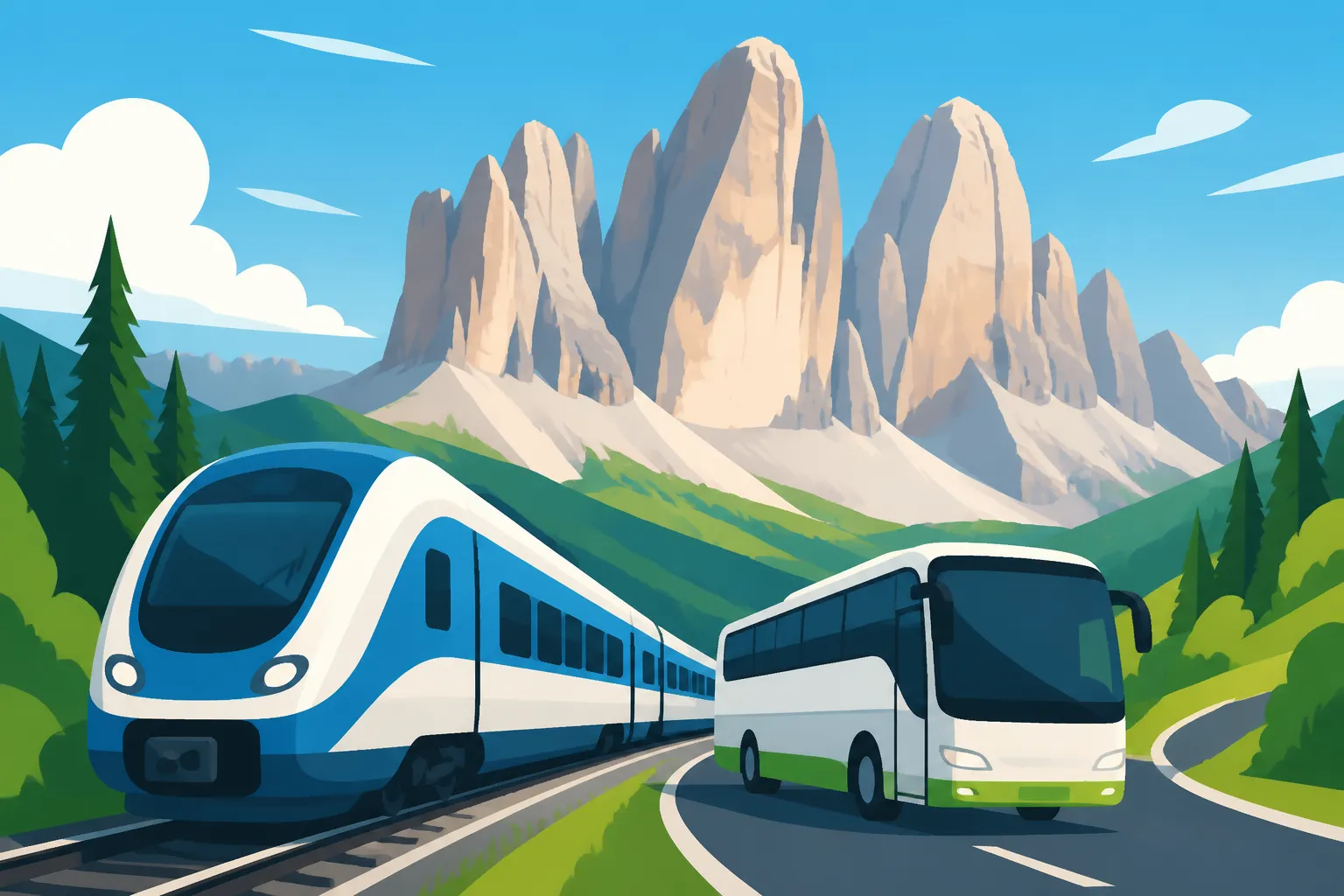
Reaching the Dolomites Without a Car: Rail Plus Bus Connections
The Dolomites call to so many of us, with their majestic peaks and stunning vistas, a true bucket-list destination. But if you're like me, living in Italy or planning an Italian adventure, the thought of renting a car, navigating narrow mountain roads, and deciphering confusing parking signs can feel more like a headache than a holiday. The good news? You absolutely can experience the magic of the Dolomites without a car, relying instead on Italy's excellent, if sometimes a little intricate, public transport system. This guide will walk you through exactly how to make that happen, using rail and bus connections, and showcasing how services like Omio can make planning your journey surprisingly simple.
Disclosure: This post may contain affiliate links. We may earn a commission at no extra cost to you if you make a purchase through these links. Read full disclosure.
The Allure of a Car-Free Dolomite Adventure (and Why it Makes Sense)
Believe me, I've been there. The freedom of having your own wheels sounds fantastic until you're staring down a tiny one-lane road with a bus coming at you, or circling a village for an hour trying to find a parking spot that doesn't require a special permit. Opting for public transport in the Dolomites isn't just a fallback; it's a savvy choice that brings its own set of advantages, transforming potential stress into pure enjoyment.
Embracing Sustainable Travel and Avoiding Mountain Driving Stress
Let's be honest, those towering peaks and pristine valleys are best enjoyed without the constant hum of an engine or the anxiety of navigating unfamiliar mountain passes. One huge benefit of going car-free is contributing to sustainable tourism. Many Dolomite regions are fiercely proud of their natural heritage and actively promote eco-friendly travel, often offering excellent public transport infrastructure to support it. You'll find well-maintained buses that glide effortlessly along routes that would challenge even seasoned drivers, allowing you to simply sit back, relax, and soak in the breathtaking views. No white knuckles on the steering wheel, no frantic GPS recalculations, just pure, unadulterated scenery.
Beyond the environmental aspect, consider the sheer relief of not having to worry about ZTLs (Limited Traffic Zones) in charming mountain towns, where historical centers are often off-limits to private vehicles. Or the dreaded parking situation: in popular spots like Cortina d'Ampezzo or the Val Gardena, parking can be incredibly scarce, expensive, and baffling if you don't speak Italian. You could easily spend precious holiday time just searching for a legal spot. By letting the trains and buses do the heavy lifting, you're embracing a stress-free way to experience the mountains, allowing you to arrive refreshed and ready to hit the trails or simply enjoy an aperitivo. It's truly a different pace of travel, one that encourages you to slow down and truly appreciate your surroundings.
The Hidden Costs and Hassles of Renting a Car in Italy
While a car might seem like the epitome of freedom, it comes with a price tag that often extends far beyond the daily rental fee. First, there's the rental itself, which can be surprisingly steep, especially during peak season, and often comes with mandatory insurance packages that inflate the cost further. Then there's fuel – Italian petrol prices are notoriously high, and you'll be doing a lot of driving up and down mountain roads, which burns through fuel quickly. Don't forget tolls on the autostrade (motorways), which can add up significantly on longer journeys to and from the Dolomites.
Beyond the monetary costs, there's the administrative burden and the potential for unexpected fines. Italy has specific Driving in Italy: Obtaining an Italian Driver’s License requirements, and if you're from outside the EU, you'll need an International Driving Permit. Ignoring this, or even small traffic violations like entering a ZTL unknowingly, can result in hefty fines sent to your home country months later. The rules around Renting a Car in Italy: ZTLs, Insurance, and Driving Tips are complex, and it’s easy to get caught out. Plus, let's not overlook the sheer anxiety of driving in a foreign country where road signs might be different, local driving habits can be… spirited, and navigating parking can be a nightmare. All these factors chip away at your holiday enjoyment. Public transport, on the other hand, means buying a ticket and letting someone else handle all these worries.
Gateway Cities: Your Starting Points for Reaching the Dolomites
The secret to a successful car-free Dolomites trip lies in choosing the right gateway city. These urban hubs serve as the perfect launchpads, offering excellent train connections that will get you close to the mountains, from where a network of local buses takes over.
Verona, Venice, and Bolzano: Strategic Hubs
When planning your assault on the Dolomites without a car, think of cities like Verona, Venice, and Bolzano as your strategic command centers. Each offers unique advantages for reaching different parts of the mountain range.
Verona is a fantastic choice, particularly if you're flying into Italy or arriving from other major Italian cities. Its central location makes it a major railway hub, connecting you to both the eastern (Veneto) and western (Trentino-Alto Adige) Dolomites. From Verona Porta Nuova station, you can catch regional trains heading north. For example, you can take a regional train towards Belluno, a charming town often considered the "Gateway to the Eastern Dolomites." The journey itself is picturesque, passing through valleys and smaller towns, slowly transitioning from urban landscapes to the dramatic foothills. The beauty of these regional train lines, as detailed in our guide on Regional Trains in Italy: How to Use Them and Save, is that they often offer a more authentic, unhurried experience than the faster lines.
Venice, with its iconic canals and historic charm, might seem a bit removed, but it's surprisingly well-connected to the eastern Dolomites, especially the Belluno province. From Venezia Santa Lucia or Mestre stations, you can take a regional train directly to Belluno. This route is often less direct than from Verona but still perfectly viable, allowing you to combine a cultural city visit with your mountain adventure. For longer journeys from further afield in Italy, remember that High-Speed Trains in Italy: Trenitalia, Italo, Routes, and Savings can whisk you to these gateway cities efficiently.
Bolzano (Bozen) is arguably the most direct and convenient gateway, especially if you're aiming for the heart of the South Tyrolean Dolomites. Situated right on the edge of the mountains, Bolzano is the capital of South Tyrol (Alto Adige) and has excellent train connections from major Italian and even Austrian cities. From Bolzano, you're practically already there. The local bus network from Bolzano is incredibly extensive and well-organized, serving all the major valleys like Val Gardena (Gröden), Val Badia (Gadertal), and Alpe di Siusi (Seiser Alm). This is often the preferred starting point for many car-free travelers because it minimizes the train-to-bus transfer time and complexity.
Moving From the City to the Mountains: Initial Connections
Once you've arrived at one of these gateway cities, the next step is to transition from the main train lines to the more localized transport that will take you deep into the Dolomite valleys. This is where the integrated nature of Italy's public transport really shines, offering seamless, if sometimes multi-leg, journeys.
From Verona or Venice, your primary train destination is often Belluno. From Belluno train station, you'll find numerous bus connections operated by Dolomiti Bus. These buses serve popular destinations like Cortina d'Ampezzo, Cadore, and Agordo. It’s important to check the schedules in advance, as frequency can vary by season, but these buses are reliable and offer stunning views as they wind through the valleys. The journey from Belluno to Cortina, for instance, is an experience in itself, showcasing dramatic landscapes.
If your destination is in the Trentino region (like Val di Fassa or Val di Fiemme), you might take a train from Verona to Trento. Trento is another excellent hub with frequent regional buses that connect to the various valleys. These bus services are often geared towards tourists and hikers, providing access to trailheads and ski resorts.
For those heading to the South Tyrol (Alto Adige) Dolomites, Bolzano is your undisputed champion. The SAD (Società Automobilistica Dolomiti) bus network from Bolzano is incredibly efficient and comprehensive. Buses depart regularly from Bolzano train station, taking you directly to towns like Ortisei (Urtijëi) in Val Gardena, Corvara in Val Badia, or Compatsch (Compaccio) on the Alpe di Siusi. Many of these routes are specifically designed to cater to tourism, dropping you off right where you need to be for hiking or skiing. Understanding Getting Around Italy: Trains, Buses, Flights, and Car Hire is key here, as you're leveraging different modes to reach your final destination. Always double-check the latest bus schedules, as they can sometimes change with the seasons (summer vs. winter vs. shoulder season timetables).
Navigating the Alpine Routes: Regional Buses and Scenic Journeys
Once you've made it to your chosen gateway town at the foot of the Dolomites, the regional bus networks become your main mode of transport. These buses are a lifeline for locals and tourists alike, connecting villages, trailheads, and ski lifts, and often offering views that rival the most scenic drives.
Key Bus Networks and How They Connect You
In the Dolomites, you'll encounter a few primary bus networks, each serving a specific region, but all working to ensure you can reach even the most tucked-away rifugio or picturesque village.
In South Tyrol (Alto Adige), the SAD (Società Automobilistica Dolomiti) bus company is king. Their routes are extensive, connecting major towns like Bolzano, Merano, and Bressanone to popular valleys such as Val Gardena, Val Badia, Val di Funes, and Alpe di Siusi. These buses are modern, comfortable, and often equipped for luggage. For instance, from Bolzano, you can hop on a SAD bus directly to Ortisei, Santa Cristina, or Selva di Val Gardena. From these towns, further local buses or even cable cars can take you higher into the mountains. What’s particularly helpful is that many areas in South Tyrol integrate these bus services with regional guest cards (like the Mobilcard or Dolomiti Superski Pass holders), sometimes offering free or heavily discounted travel, which is a huge bonus for your budget and convenience.
Moving into the Veneto side of the Dolomites, the primary operator is Dolomiti Bus. This network covers the Belluno province, connecting towns like Belluno itself with Cortina d'Ampezzo, Auronzo di Cadore, and other key destinations around the Tre Cime di Lavaredo area. Their routes are essential for reaching popular hiking spots and ski resorts in this eastern part of the Dolomites. Similarly, in the Trentino region, companies like Trentino Trasporti manage the bus routes that fan out from cities like Trento and Bolzano into valleys such as Val di Fassa, Val di Fiemme, and Val di Non. These are your workhorses for getting from your accommodation to the specific trails, cable cars, or charming small towns you want to explore. Many of these Intercity Buses in Italy: FlixBus and Regional Networks are surprisingly comfortable, offering an excellent way to see the landscape.
Understanding Tickets, Schedules, and Regional Passes
Navigating the regional bus system in the Dolomites requires a bit of foresight, but it's far from insurmountable. First and foremost, schedules are crucial. Unlike city buses, mountain bus frequencies can vary greatly by season, day of the week, and even time of day. During peak summer and winter tourist seasons, services are usually more frequent. In the shoulder seasons or on Sundays and public holidays, expect reduced services. Always check the official website of the local bus company (SAD for South Tyrol, Dolomiti Bus for Veneto, Trentino Trasporti for Trentino) for the most up-to-date timetables. Many also have easy-to-use apps.
Buying tickets is generally straightforward. You can often purchase tickets directly from the bus driver (though having small change is always appreciated), at local tabaccherie (tobacco shops), or at the main bus stations in larger towns. Some regions, particularly South Tyrol, offer online ticket purchases or apps. For multi-day stays, consider a regional pass. For example, in South Tyrol, the Mobilcard (available for 3 or 7 days) offers unlimited travel on all public transport, including regional trains and most buses, within the province. Many accommodations also provide guests with a free "Guest Pass" (e.g., Val Gardena Mobil Card, Dolomiti Superski Pass with integrated transport) that includes public transport for the duration of their stay, so always ask your hotel or B&B. These passes are invaluable for saving money and the hassle of buying individual tickets.
Here’s a quick overview of typical connections:
| From/To | Destination Valley/Town | Typical Transport | Notes |
|---|---|---|---|
| Verona Porta Nuova | Belluno / Trento | Regional Train | Change at Belluno for buses to Cortina; change at Trento for buses to Val di Fassa/Fiemme. |
| Venezia S. Lucia | Belluno / Calalzo di Cadore | Regional Train | Scenic route, longer. Connects to Dolomiti Bus network. |
| Bolzano (Bozen) | Ortisei (Val Gardena) | SAD Bus (e.g., 350) | Frequent services, direct to main villages. |
| Bolzano (Bozen) | Corvara (Val Badia) | SAD Bus (e.g., 460) | Direct bus routes serving ski and hiking areas. |
| Belluno | Cortina d'Ampezzo | Dolomiti Bus | Essential for reaching the "Pearl of the Dolomites". |
| Trento | Canazei (Val di Fassa) | Trentino Trasporti Bus | Good for accessing the western Dolomites. |
Remember to validate your bus ticket once you board, usually by inserting it into a small machine near the door. Failure to validate, even if you’ve paid, can result in a fine!
Planning Your Seamless Car-Free Dolomite Adventure with Omio
Now, you might be thinking, "This sounds great, but juggling multiple train websites and bus companies in Italian still feels like a puzzle." And you're right, it can be. That's where a tool like Omio comes into its own, simplifying the entire booking process for complex, multi-modal journeys across Italy and beyond.
Why Omio is Your Best Friend for Multi-Modal Travel in Italy
For any expat or traveler navigating Italy's public transport, the sheer number of different operators can be overwhelming. You've got Trenitalia for national and regional trains, Italo for high-speed routes, then a myriad of regional bus companies like SAD, Dolomiti Bus, and Trentino Trasporti, not to mention smaller local services. Each has its own website, its own booking system, and often, its own quirks. This is where Omio truly shines. It’s an aggregation platform that pulls together all these different transport options – trains, buses, and even flights – into one single, user-friendly interface.
Imagine trying to figure out the best way from Rome to a small town in Val Gardena. Without Omio, you'd be looking up high-speed trains to Bolzano on Trenitalia, then switching to the SAD bus website to find the connection from Bolzano to Ortisei, comparing times and prices manually. It's a logistical headache, especially if you're not fluent in Italian or familiar with the regional geography. Omio eliminates all that complexity. It lets you search for your entire journey, from your starting point in Italy (or even outside) to your final destination in the Dolomites. It then presents you with integrated options, showing you combinations of train and bus connections, comparing prices, and estimating total travel times. This means you can book your high-speed train, your regional train, and your connecting bus all in one go, through one transaction. It's truly a game-changer for car-free travel in Italy, making the previously daunting task of multi-modal booking incredibly simple and transparent. No more jumping between websites, no more currency conversions or tricky payment systems – just one smooth process with Omio.
Step-by-Step Booking with Omio: From City to Peak
Let's walk through a hypothetical scenario to show you just how easy it is to plan your car-free Dolomite adventure using Omio. Say you're starting your trip in bustling Milan and want to reach the picturesque village of Ortisei (Urtijëi) in Val Gardena, deep in the South Tyrolean Dolomites.
- Open Omio: Go to the Omio website or open the Omio app on your phone.
- Enter Your Journey Details: In the search bar, you'll simply input "Milan" as your origin and "Ortisei" as your destination. Select your desired travel date and the number of passengers.
- Search and Compare: Click "Search." Omio will then get to work, querying all its integrated partners – Trenitalia, Italo, SAD, and others – to find the most efficient and cost-effective routes. You'll see results that combine high-speed trains from Milan to Bolzano with connecting buses from Bolzano to Ortisei. This is where Omio's power is evident; it's doing the heavy lifting of figuring out the connections for you.
- Review Options: Omio will display various options, showing you different departure times, journey durations, and prices. You might see a slightly faster route with a quicker connection, or a more budget-friendly option with a longer layover. You can filter by price, duration, or number of transfers. For example, it might show "Train + Bus: Trenitalia from Milan to Bolzano, then SAD Bus from Bolzano to Ortisei." The beauty of Omio is that it handles the intricacies, so you don't have to worry about separate bookings or figuring out station transfers.
- Select Your Preferred Journey: Once you've found the option that best suits your needs, simply select it. You'll see a clear breakdown of each leg of the journey, including train numbers, bus routes, and connection times.
- Book and Confirm: Proceed to checkout, where you can easily pay for your entire journey in your preferred currency. Your tickets will be sent directly to your email and often stored within the Omio app, ready to show on your phone. This seamless booking process, which brings together what would otherwise be disparate elements (like booking How to Buy Trenitalia and Italo Tickets and Save Money and then hunting for local bus information), makes it effortless. No more fumbling with printouts or struggling with foreign language websites; everything is in one place, thanks to Omio. It’s significantly easier than trying to navigate the Trenitalia site, then the SAD site, then figuring out how to purchase on each – Omio simplifies it all. You'll even find using the Omio app similar to how you might use How to Use the Trenitalia App to Plan Train Travel for specific train bookings, but with the added benefit of bus integration. This comprehensive approach gives you the confidence to truly enjoy the spectacular The Dolomites: A Traveler's Introduction without the stress of logistics.
After arriving, remember to check with your accommodation or a local tourist office for specific local bus lines if you plan to explore further afield on foot, perhaps looking for the best trails, and don't forget What to Pack for Hiking in the Dolomites and our guide on Hiking in Italy: Popular Trails and How to Prepare. With Omio handling the major connections, you're free to focus on the adventure!
Disclaimer
The information provided in this guide is intended for general informational purposes only and is subject to change. While we strive to provide accurate and up-to-date information, transport schedules, ticket prices, regional passes, and booking procedures can vary and are subject to change by the respective transport providers and local authorities. We strongly recommend verifying all details, especially schedules and ticket validity, with official sources (e.g., specific train or bus company websites, local tourist offices, Omio directly) before making travel plans. The author and publisher are not responsible for any errors or omissions, or for any travel disruptions or financial losses incurred as a result of relying on this information.