Renting a Car vs Booking Rail Tickets in Italy: Total Cost by Itinerary
You land at Fiumicino, the rental desk queue stretches past arrivals, and you start to wonder whether that cheap online car quote was ever real. Choosing between a hire car and Italian trains is one of the most expensive decisions on any Italy trip. This guide prices both options itinerary by itinerary, so you can book the right one with confidence.
Disclosure: This post may contain affiliate links. We may earn a commission at no extra cost to you if you make a purchase through these links. Read full disclosure.
Why Comparing a Rental Car With Italian Trains Is Harder Than It Looks
My first summer here, I did what most newcomers do. I put the headline price of a week’s car rental next to a couple of train fares and declared the car the winner. Three weeks later a parking garage receipt, a toll statement and a polite but devastating letter from a Florentine municipality proved me wrong. The car had not been cheaper. It had only looked cheaper, because I was comparing one line of a bill against an entire rail journey.
That mismatch is the core problem. A car quote and a train fare measure completely different things. To compare them honestly, you have to rebuild both into a total trip cost, and you have to do it for the specific route you plan to travel. A week split between Rome, Florence and Venice behaves nothing like a week in the cypress-lined hills south of Siena.
Per-Vehicle Costs Versus Per-Person Fares
The first thing to understand is that a car is priced per vehicle and a train is priced per seat. A solo traveller pays the full cost of the car alone. A family of four splits the same car four ways, but buys four train tickets for every leg. This one fact flips more verdicts than anything else in this article.
Here is a scenario I see constantly. A couple from Toronto messages me asking whether to rent a car for a week of city-hopping. For two people, rail almost always wins, and usually by a wide margin. A week later a family of five asks the same question about the same route. The rail tickets multiply by five, children’s discounts only go so far, and the gap narrows sharply. Their car still has to deal with parking, tolls and city-centre restrictions, but the comparison becomes genuinely close.
So before you read any of the cost tables below, count heads. Write down how many adults and children are travelling, then mentally multiply every rail leg by that number. The car totals stay roughly the same however many seats you fill, apart from fuel and a larger vehicle class for bigger groups.
The Costs Rental Counters Rarely Mention Upfront
The base rental price is the friendliest number you will see. What follows it at the counter and over the week is where budgets fall apart. Insurance top-ups to reduce a large excess are pushed hard at Italian desks, and many travellers accept them after a long flight rather than risk a dispute over a scratched bumper on a narrow village street.
Then come the running costs. Fuel in Italy is expensive by most international standards. The autostrada network is tolled, and long north-south drives add up quickly. Parking in historic centres is scarce and often means paid garages. And if you pick up the car in one city and drop it in another, a one-way fee can be the single largest line on the bill.
Finally, there is the cost nobody budgets for: ZTL fines. Most Italian historic centres are Zone a Traffico Limitato, limited traffic zones monitored by cameras. Drive through one without a permit and a fine is mailed to the rental company, which passes it on to you along with an administration charge, sometimes months after you are home. Our guide to What Is a ZTL in Italy and How to Avoid Fines explains how to read the signs. For budgeting, treat ZTL risk as real, not hypothetical.
How Omio Fits Into the Rail Side of the Math
On the rail side, the frustration is different. Italy has two high-speed operators, Trenitalia with its Frecciarossa trains and Italo, and they compete on the busiest corridors. On top of that sits the Regionale network, and buses run where rail gives out. Checking every operator’s site separately for every leg, in a mix of Italian and English, is how a booking evening turns into a booking week.
This is where Omio earns its place in my planning routine. It pulls Trenitalia and Italo departures into one search and shows them side by side, along with bus options such as FlixBus and Itabus on routes where they exist. For a cost comparison like this one, that matters: you can see the real spread of fares for your exact date and time without opening six tabs.
I will be clear about one thing. Omio is a booking platform, so on some tickets it may add a service fee at checkout. Always check the final price on the payment screen and compare it against what you need. In my experience, the time saved and the clarity of seeing both high-speed operators together usually outweigh that, especially when you are pricing a whole itinerary rather than a single journey.
Itinerary One: Rome, Florence, Venice, and Milan in a Week
This is the classic first-timer’s route, and it is the one where I most often talk people out of renting a car. The four cities are linked by one of Europe’s best high-speed rail corridors, all four have historic centres hostile to cars, and one of them, Venice, has no roads at all in its historic core.
Imagine the plan: two nights in Rome, two in Florence, two in Venice, one in Milan, then a flight home from Malpensa or Linate. By car, that means a pickup in Rome, a drop-off in Milan, and a lot of time spent in garages.
What the Car Version Really Costs
Below is a realistic range for one week with a compact rental on this route. These are illustrative estimates to show the shape of the bill, not quotes. Your figures will depend on the season, the rental company, the vehicle class and how far ahead you book, so check the provider’s own pages for live prices.
| Cost Item | Low Estimate | High Estimate | What Drives It |
|---|---|---|---|
| Base rental for one week | €250 | €400 | Season, vehicle class, automatic vs manual |
| Insurance to reduce the excess | €100 | €200 | Desk add-on vs third-party cover |
| Fuel | €100 | €150 | Petrol vs diesel, detours |
| Autostrada tolls | €80 | €100 | Full Rome to Milan corridor |
| City parking and garages | €100 | €200 | Overnight garages in Rome, Florence, Venice, Milan |
| One-way drop-off fee | €200 | €500 | Picking up in Rome, returning in Milan |
| Estimated total | €830 | €1,550+ | Before any ZTL fines |
That plus sign on the €1,550+ upper figure is there for a reason. It excludes ZTL fines, damage disputes, a larger car for a bigger group, and the extra-driver fees some companies charge. It also assumes you find garages with space, which in central Florence in high season is not guaranteed.
Look at what the car actually does for you on this route. In Rome you will not want to drive. In Florence you will park outside the ZTL and walk. In Venice the car sits in a garage at Piazzale Roma or Tronchetto for two nights while you walk and take the vaporetto. You are paying for the full €830-€1,550+ range to store a vehicle for most of the week.
What the Rail Version Looks Like
By train, the same week breaks into three high-speed legs: Rome to Florence, Florence to Venice, and Venice to Milan. Each is a short, comfortable journey that lands you at a central station, Roma Termini, Firenze Santa Maria Novella, Venezia Santa Lucia and Milano Centrale, within walking distance or a short metro ride of your hotel. Santa Lucia sits right on the Grand Canal, so you step off the train and onto a water bus.
High-speed fares in Italy behave like airline fares. The earliest, cheapest fare buckets sell out first, and prices tend to rise as departure approaches, particularly on Friday afternoons and around holidays. If you want to understand that pattern in detail, read Italian Train Price Curves: How Fares Move From 90 Days Out to Departure before you book. For our purposes, the takeaway is simple: booked a few weeks ahead, a couple’s three or four high-speed legs typically come in well below the bottom of the €830-€1,550+ car range. Booked last minute in peak season, the gap narrows but rarely closes for two travellers.
This is the itinerary where I search on Omio first. Rome to Florence alone is served by frequent departures from both Trenitalia and Italo, and the cheapest operator changes depending on the day and hour. Seeing them together means you can shift a departure by an hour and sometimes save a meaningful amount per person. For a leg-by-leg look at that first stretch, see Rome to Florence: Every Operator and Fare Class Priced Side by Side.
Verdict for City Hoppers
For solo travellers and couples, rail wins this itinerary on cost, on time and on stress. You skip the drop-off fee, the garages and the ZTL anxiety, and you arrive in each city centre rather than at a multi-storey car park on the edge of it.
For larger groups, run the numbers honestly. Multiply your rail fares by the number of travellers, then compare against the full car table, not just the base rental. Even for a family of four, I find rail usually still wins once the one-way fee and Venice parking are counted, but booking early is what makes that true. The family that books in a panic three days out may find the car finally competitive. The car still will not help them inside Venice.
Itinerary Two: A Tuscany and Umbria Countryside Loop
Now the picture changes. Picture a week based in a farmhouse near Montepulciano, with day trips to Pienza, Montalcino, Cortona, Assisi, Orvieto and a handful of wineries down unpaved white roads. This is the Italy of postcards, and it is also the Italy where the train network politely gives up.
The hill towns themselves are often connected to the outside world, but the vineyards, agriturismi and viewpoints between them are not. Buses run, but they are timed around school and commuter schedules rather than leisurely lunches at a cantina.
What the Car Version Really Costs
Here the car is doing real work every day, and the costs look different from the city route. You pick up and drop off at the same place, typically Florence or Rome airport or a station, so there is no one-way fee. Tolls are low because Tuscany and Umbria rely heavily on toll-free superstrade, such as the Florence to Siena raccordo and the E45 through Umbria. Again, these are illustrative ranges, not quotes.
| Cost Item | Low Estimate | High Estimate | What Drives It |
|---|---|---|---|
| Base rental for one week | €250 | €400 | Season, vehicle class, automatic vs manual |
| Insurance to reduce the excess | €100 | €200 | Desk add-on vs third-party cover |
| Fuel | €80 | €120 | Daily loops, hilly terrain |
| Autostrada tolls | €10 | €30 | Mostly toll-free superstrade |
| Parking in hill towns | €50 | €100 | Paid lots below historic centres |
| Pickup surcharges, extra driver and extras | €80 | €200 | Airport fees, second driver, child seats |
| Estimated total | €570 | €1,050+ | Before any ZTL fines |
Notice the base rental and insurance rows are identical to the city table, because the car and the week are the same. What disappears is the punishing one-way fee and most of the tolls. Parking falls too, since hill towns usually have paid lots just below the walls. The extras row rises in importance, because countryside trips often involve two drivers sharing the wheel and families needing child seats.
The ZTL warning still applies. Montepulciano, Pienza, Cortona, Siena and San Gimignano all restrict traffic in their centres. Park in the signed lots outside the walls and walk up. Your calves will complain, but your bank account will not.
Can You Do It by Train and Bus
You can do parts of it. Siena, Arezzo, Cortona’s station at Camucia, Orvieto, Perugia and Assisi all have rail or reliable bus links, and a slow-travel version of this trip, based in one well-connected town, is entirely possible. Orvieto in particular sits right on the main line, with a funicular running up to the old town.
What you lose is the in-between. Montalcino, Pienza and Val d’Orcia wineries are bus territory, and those buses can be infrequent, especially on Sundays and holidays. I once watched a lovely retired couple from Melbourne stand at a Pienza bus stop for what felt like an eternity because they had misread a school-term timetable. They were fine, but they lost the afternoon they had planned around it.
Regional trains and buses in this area are also priced differently from high-speed services. Regionale fares are fixed rather than dynamic, so booking early does not lower them, and paper tickets must be validated before boarding. If that rule is new to you, our explainer Do You Need to Book Regionale Trains? Italian Ticketing Rules Explained will save you a fine.
Verdict for Countryside Explorers
For this itinerary, the car usually wins, sometimes decisively. The €570-€1,050+ range buys you freedom to stop at a roadside agriturismo, chase sunset light across the Val d’Orcia and reach places that simply have no public transport. For a couple who want to see the countryside rather than just the towns, I struggle to recommend anything else.
The exception is the traveller who does not want to drive, or who wants one or two towns rather than the whole landscape. In that case, rail into Siena or Orvieto plus local buses, and perhaps a guided winery tour, is cheaper and calmer. For route ideas that make the most of a car, see How to Plan a Road Trip Through Tuscany and Umbria.
The Hybrid Itinerary: Rail Between Cities, a Car for the Hills
After years of watching friends and readers plan trips, I have become a firm believer in the hybrid approach. Most people do not want a pure city break or a pure countryside week. They want Rome and Florence, and also a few days among the vineyards. Forcing one transport mode across the whole trip is how budgets get wrecked.
The hybrid logic is simple. Use trains for the long, fast, city-to-city hops where rail is unbeatable, and rent a car only for the stretch where you genuinely need one. You avoid one-way fees, city parking and most ZTL risk, while keeping the countryside freedom.
How to Structure a Hybrid Trip
The cleanest version looks like this: arrive in Rome and spend a few days car-free. Take a high-speed train to Florence and enjoy the city on foot. On the morning you leave Florence, collect a rental car from an agency outside the historic centre, explore Tuscany and Umbria for several days, then return the car to the same location and continue by train to Venice or back to Rome for your flight.
Because the car stays with you for only part of the trip, the rental days shrink. And because you return it where you collected it, the one-way fee disappears entirely. You pay for the car only during the days it is actually useful.
A word of caution about pickup locations. Several agencies operate near Florence’s Santa Maria Novella station, which is close to the ZTL boundary. Ask the agency for the exact exit route before you drive away, and confirm it on a map. A wrong turn in the first five minutes is how many hybrid travellers collect their first and only fine. Our broader guide, Renting a Car in Italy: ZTLs, Insurance, and Driving Tips, walks through pickup day in more detail.
Booking the Rail Legs Through Omio
Hybrid trips involve several separate rail bookings, often across both high-speed operators, which is exactly the situation where a single search tool saves the most time. This is the process I use with Omio:
- Map your fixed points first: arrival airport, the cities where you sleep, the car pickup and return location, and the departure airport.
- Search each rail leg separately on Omio, entering your exact date and an approximate departure time.
- Compare the Trenitalia and Italo results side by side, noting journey time as well as price, since a slightly faster train can buy you an extra hour in a city.
- Check the fare conditions before you choose. Cheaper fares are often non-changeable or carry change fees, while flexible fares cost more but protect you if plans shift.
- Enter every passenger’s name exactly as it appears on their passport or ID, because Italian conductors can check tickets against identity documents.
- Review the final price at checkout, including any service fee, before paying.
- Save the mobile tickets in the app and take screenshots as a backup in case your signal drops in a tunnel or station underpass.
If you hit card declines or name-matching problems, which happen more often with foreign cards than anyone admits, our troubleshooting guide Booking Italian Trains From Abroad: Foreign Cards, Names, and Failures covers the common fixes.
Where the Hybrid Breaks Down
The hybrid model is not universal. In the Dolomites, rail reaches the valley towns, but the high passes and trailheads depend on buses and cable cars. A car offers flexibility, but summer pass traffic and limited mountain parking can make it more trouble than it is worth. If you want to try the mountains without driving, read Reaching the Dolomites Without a Car: Rail Plus Bus Connections.
In parts of the south, the balance tips towards the car. Puglia’s countryside, Basilicata’s interior and large stretches of Sicily have thinner rail coverage and fewer frequent services. Here a longer rental, with a same-location return, is often the only practical option for exploring beyond the main towns.
Even then, rail and bus still have a role for the long approach. Getting from Rome or Naples down to Bari or Lecce by train and renting a car locally can be cheaper and less tiring than driving the full length of the peninsula on tolled autostrade. On those long-distance legs I still start my search on Omio, because it can surface a bus or train combination I would not have thought to check.
Hidden Variables That Flip the Verdict
The tables above give you a framework, but a handful of real-world factors can override the numbers. I have seen each of these change a reader’s decision at the last minute, so it is worth checking every one before you commit.
Group Size, Children, and Luggage
We covered the per-person versus per-vehicle principle earlier, but it deserves a second look once luggage enters the picture. A family travelling with large suitcases, a pushchair and a car seat faces a very different rail experience from a couple with carry-on bags. Lifting heavy cases onto high-speed train racks, navigating station stairs and squeezing through busy Termini at rush hour is genuinely tiring.
That does not automatically mean the car wins. A car brings its own luggage pain in the form of hotel garages that are a long walk from reception, or tight hill-town streets where you unload in a hurry while a delivery van waits behind you. But it is honest to say that heavy-luggage families feel the rail burden more. Pack lighter if you possibly can, and check the rules in Luggage Rules on Italian Trains and Buses: Limits and Fees before you assume your large case will fit overhead.
Children also change the rail price itself. Both high-speed operators offer reduced fares for children under certain conditions, which can soften the per-person multiplication considerably. When you search, enter the children’s ages accurately so the results reflect real family pricing, not adult fares.
Season, Strikes, and Booking Windows
Season affects both modes but in different ways. In high summer and around Easter and Ferragosto, rental fleets get stretched, automatic cars in particular sell out, and base rental prices climb towards the top of the ranges shown above. High-speed fares rise too, especially if you book late. In shoulder seasons both soften, and the rail advantage on city routes tends to grow because early-booking fares remain available for longer.
Strikes are the variable that catches visitors off guard. Italian transport strikes, called sciopero, are announced in advance and often guarantee certain minimum services, but they can disrupt a carefully planned rail day. A car is immune to rail strikes, though not to the traffic they create. If your trip overlaps an announced strike, read Strikes in Italy: How Sciopero Days Work and How to Rebook and consider a flexible fare for that leg.
The booking window is the one variable fully under your control. On the city-hopping route, booking high-speed trains early is the single biggest lever on total cost. On the countryside route, booking the rental early secures better vehicle choice, especially if you need an automatic. In both cases, the traveller who books at the airport loses.
Driving Stress, Licences, and Your Time
Money is not the only cost. Driving in Italy is perfectly manageable, but it is different. Italian drivers are assertive, motorway merging is brisk, roundabouts fill with confident locals, and hill-town lanes can be astonishingly narrow. If driving on unfamiliar roads ruins your holiday, the car’s flexibility is worth less to you than the numbers suggest.
There is also paperwork. Depending on where your licence was issued, you may need an International Driving Permit alongside it, and rental desks and police can ask for one. Check your situation in Do You Need an International Driving Permit to Drive in Italy? well before departure, since getting a permit at the last minute can be impossible from abroad.
Finally, think about time. A high-speed train between Rome and Florence lets you read, nap or eat lunch, and delivers you to the city centre. Driving the same route means motorway concentration, a garage search and a walk in. On the countryside loop, by contrast, the car saves hours of waiting for infrequent buses. Value your hours honestly when you weigh the two.
Choosing Your Mode: A Quick Decision Guide
After all the detail, most travellers want a clear answer. The table below summarises how each itinerary type typically plays out. Use it as a starting point, then adjust for your group size, season and comfort behind the wheel.
Side-by-Side Verdict by Itinerary
| Itinerary Type | Car Cost Shape | Rail Cost Shape | Usual Winner | Main Reason |
|---|---|---|---|---|
| Rome, Florence, Venice, Milan in a week | €830-€1,550+ before ZTL fines | Per-person high-speed fares, cheapest when booked early | Rail | One-way fee, city parking and Venice make the car a liability |
| Tuscany and Umbria countryside loop | €570-€1,050+ before ZTL fines | Fixed Regionale fares plus infrequent rural buses | Car | Vineyards and villages have little or no public transport |
| Hybrid cities plus countryside | Shorter rental, same-location return, no one-way fee | High-speed fares only on city legs | Hybrid | Pay for the car only when it earns its keep |
| Dolomites summer trip | Flexible, but pass traffic and mountain parking add hassle | Rail to valley towns, then buses and lifts | Depends on your plans | Car-free is realistic for valley-based hiking |
| Puglia, Basilicata, or Sicily touring | Longer rental, same-location return | Thinner rail network for rural areas | Car, with rail for the long approach | Rural coverage is limited outside main towns |
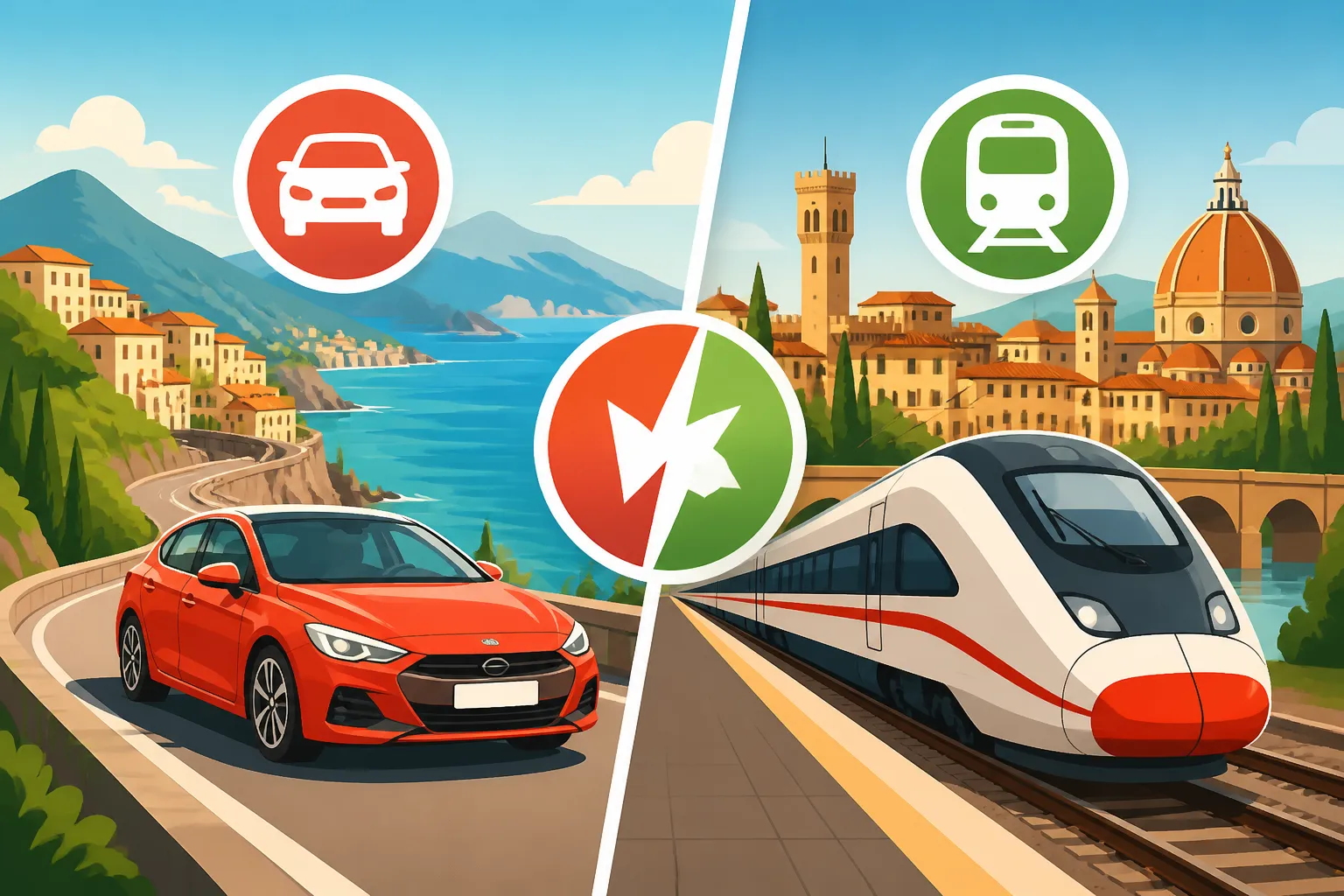
The pattern is consistent. Rail dominates wherever your days are spent in big cities linked by high-speed lines. The car dominates wherever your days are spent between towns rather than in them. And the hybrid wins for the many travellers who want both.
A Pre-Booking Checklist
Before you pay for anything, run through these steps. They take about an hour and have saved my readers a great deal of money and frustration.
- Write down your full itinerary, including where you sleep each night and where you arrive and depart.
- Count every traveller and note children’s ages for rail fare purposes.
- Mark each day as a city day or a countryside day.
- Price the rail legs for your city days using Omio, comparing both high-speed operators on your actual dates.
- Price a car only for your countryside days, with a same-location pickup and return wherever possible.
- Add insurance, fuel, tolls, parking and extras to the car quote using the tables above as a guide to which lines to include.
- Check whether your licence needs an International Driving Permit.
- Identify every ZTL near your accommodation and pickup point, and ask your hotel how to approach by car if you are driving.
- Check for announced transport strikes during your travel dates.
- Compare the full totals, not the headline prices, and book the cheaper or calmer option for each segment.
My Honest Recommendation
If you take one thing from this guide, let it be this: stop comparing a car’s daily rate against a single train ticket. Rebuild both into a total trip cost for your specific route and group, and the right answer usually becomes obvious. For the classic city circuit, that answer is rail. For the deep countryside, it is a car. For most real trips, it is a smart mix of the two.
When it comes to the rail portion, my habit after years here is to begin every search on Omio. Seeing Trenitalia and Italo together, with bus alternatives where they exist, is the fastest way I know to find the departure that fits both the budget and the day. Search your first leg there tonight, while the early fares are still available, and build the rest of your plan around it. For deeper background on the two operators themselves, see Trenitalia vs Italo: Fares, Loyalty, and Which Route Each One Serves.
Disclaimer
This article is for general informational purposes only and does not constitute professional advice. Laws, prices and regulations vary by location and change over time. Consult a qualified professional for guidance on your specific situation.