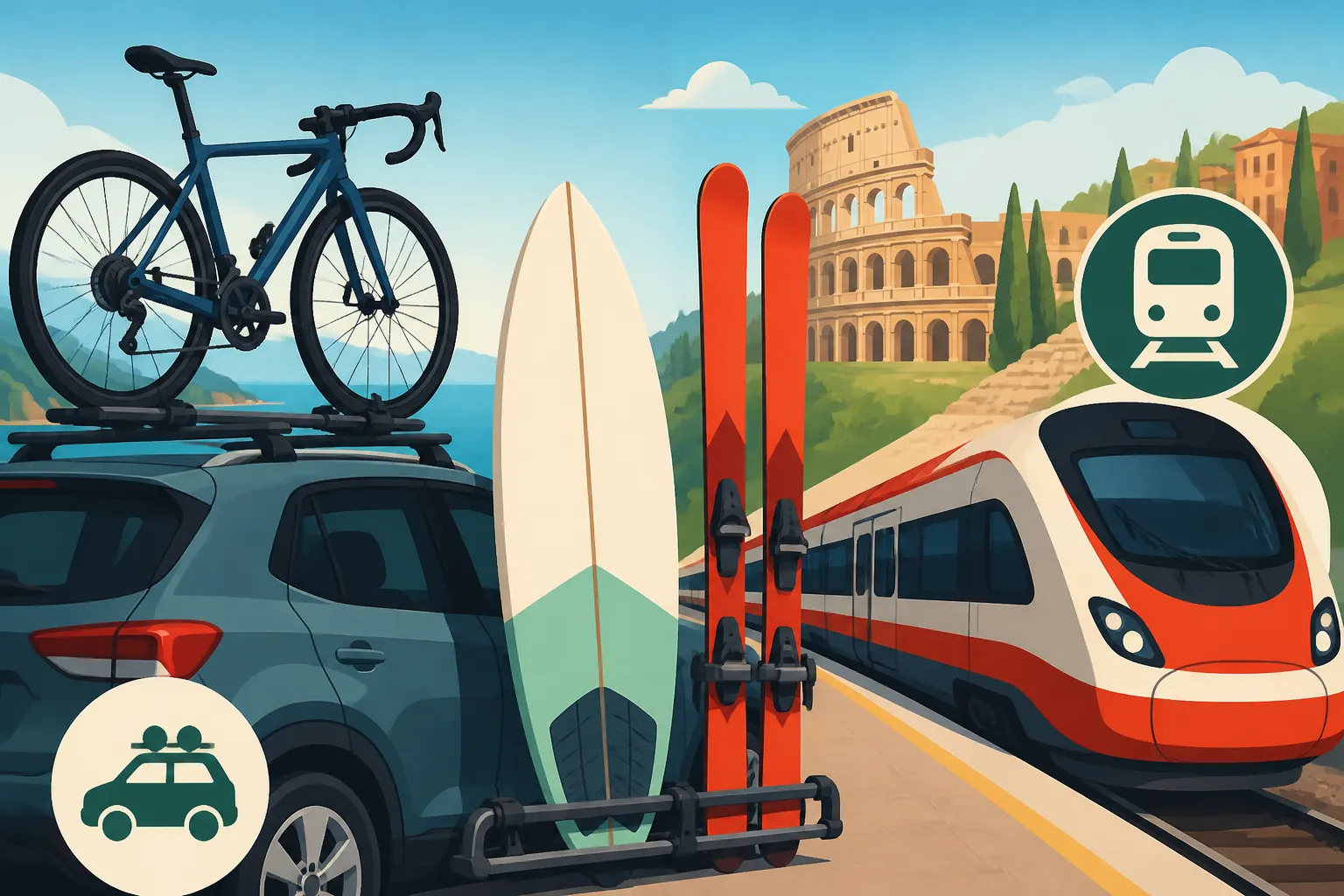
Travelling With a Bike, Surfboard, or Skis in Italy: Transport Rules
Ah, the romance of Italy! Picture this: you've got your trusty mountain bike ready to conquer the Dolomites, your surfboard longing for the Mediterranean waves, or your skis poised for the powdery slopes of the Alps. Sounds idyllic, right? Then reality hits. How on earth do you actually get your oversized gear from point A to point B in Italy without breaking the bank, or worse, your beloved equipment? It's a common expat headache, trust me. This isn't like hopping on a train in some more 'organized' countries; Italy has its own charming, yet utterly bewildering, set of rules. This guide is here to untangle that mess and help you transport your sports gear smoothly across the peninsula.
Disclosure: This post may contain affiliate links. We may earn a commission at no extra cost to you if you make a purchase through these links. Read full disclosure.
The Italian Public Transport Landscape: Not Always Equipment-Friendly
Navigating Italy's public transport system with anything larger than a carry-on can feel like an Olympic sport in itself. Add a bike, a surfboard, or a pair of skis into the mix, and you're suddenly facing a bureaucratic labyrinth. Each mode of transport, and sometimes even each individual company, has its own quirky rules, fees, and restrictions. It’s enough to make you want to just stay home, but don't despair; with a bit of planning and the right tools, it's absolutely doable.
Trains: A Mixed Bag of Rules and Realities
Italy's extensive rail network, primarily run by Trenitalia and the high-speed Italo, is often the most appealing option for intercity travel. However, their policies on bulky sports equipment are, shall we say, nuanced.
For bikes, the rules typically distinguish between assembled and disassembled bikes. On regional trains (marked as Regionale or Regionale Veloce), you might be able to bring a fully assembled bicycle, often in a designated carriage or area, usually for a small additional fee or by purchasing a special "bike ticket" (around €3.50 for 24 hours). This is usually indicated by a bike symbol on the train schedule or carriage itself. The catch? These spaces are limited, first-come, first-served, and sometimes non-existent. Trying to force a bike into a crowded carriage is a surefire way to earn some sguardi (stares) and a scolding from a conductor.
High-speed trains like Frecciarossa, Frecciargento, Frecciabianca, and Italo are a different beast entirely. On these, fully assembled bikes are generally not allowed. Your bike must be disassembled and packed into a bike bag. The dimensions are usually restricted to something like 80x110x40 cm (LxHxW), which essentially means a compact travel bag. Exceed these dimensions and you risk being denied boarding or charged a hefty fee. For those wanting to travel long distances, learning how to quickly pack your bike is a critical skill. Italo's policy is similar, with strict luggage size limits for all passengers, making it tough for anything beyond a highly compact bike bag.
When it comes to surfboards and skis, the situation is even less explicitly defined. They generally fall under the "special luggage" category. If they fit within the standard luggage dimensions and don't inconvenience other passengers, you might get away with it on regional trains. On high-speed services, they absolutely must fit within the specified dimensions for luggage (often 80x110x40 cm per piece for Trenitalia, slightly different for Italo depending on your ticket class) and be properly bagged. A surfboard is particularly challenging due to its length. A longboard is almost certainly out, but a shorter board in a compact bag might pass if you’re lucky and the train isn't packed. Ski bags are usually easier as they are narrower, but again, check those length restrictions. I’ve seen people manage ski bags on high-speed trains, but they often have to stack them vertically in the luggage areas near the doors. Booking your tickets and knowing the specific rules for your route is paramount, and a platform like Omio can actually show you some of these details when you're comparing options.
For more in-depth information on navigating the rail system, you might want to read our comprehensive guide on High-Speed Trains in Italy: Trenitalia, Italo, Routes, and Savings or Regional Trains in Italy: How to Use Them and Save.
Buses: Local vs. Long-Distance Limitations
Buses in Italy offer another layer of complexity. For local city buses (like ATAC in Rome or ATM in Milan), bringing large sports equipment is generally a no-go, especially during peak hours. Some cities do have specific rules for foldable bikes (often requiring them to be folded), but a full-sized bike, surfboard, or ski set is usually prohibited inside the passenger compartment due to safety and space constraints.
Intercity and long-distance buses, such as those operated by FlixBus, are a slightly different story. They typically have a dedicated luggage compartment under the bus, making them seem more accommodating. However, even here, there are strict size and weight limits. FlixBus, for example, allows one standard piece of luggage and one carry-on for free. Anything extra or oversized, like a bike or a surfboard, usually incurs an additional fee and requires advance booking. You'll often need to declare it during the booking process, specifying the dimensions. For bikes, they almost always require it to be disassembled and packed in a bike bag. Surfboards and skis usually fall into the "special luggage" category, and again, their dimensions must be declared.
The key takeaway for buses is that you must check the specific operator's policy before you book. What one regional bus company in Umbria allows, a different one in Sicily might strictly prohibit. The wonderful thing about a booking platform like Omio is that it often integrates these specific luggage policies into the search results, saving you the headache of trawling through multiple operator websites. You might also find our guide on Intercity Buses in Italy: FlixBus and Regional Networks helpful for planning.
Ferries and Boats: Often More Accommodating
When traveling to Italy's islands (Sicily, Sardinia, Elba, the Aeolian Islands, etc.) or across one of its beautiful lakes (Como, Garda, Maggiore), ferries and boats often prove to be the most relaxed option for sports equipment. Most ferry companies are accustomed to carrying vehicles, and by extension, extra-large luggage.
For bikes, it's generally quite straightforward. You purchase a passenger ticket and a separate ticket for your bicycle, which is typically stored on the vehicle deck alongside cars. There's usually no need to disassemble it, though securing it properly is your responsibility. This makes island cycling holidays much more feasible.
Surfboards and skis also tend to fare well on ferries. As long as they are properly bagged and don't pose a safety hazard, they can usually be brought on board as oversized luggage, sometimes for a small additional fee, similar to a bike. The sheer size of the ferry allows for more flexibility than a cramped train or bus. Always check with the specific ferry operator (e.g., Tirrenia, Moby Lines, Liberty Lines for Sicily/Sardinia, or local lake navigation companies) if you have particularly unusual or large equipment, but in general, this is often the least stressful option.
Essential Gear Considerations: Packing Smart for Italian Travel
When you're trying to lug your gear across Italy, how you pack it can make or break your journey. Italian transport staff often prioritize space and safety, and a well-packed item is far less likely to cause issues than something unwieldy and unprotected.
Bikes: Disassembly and Proper Bagging
If you're planning to use high-speed trains or intercity buses, disassembling your bike is non-negotiable. This means taking off the wheels, pedals, and handlebars, and possibly even removing the seat post. A good, padded bike travel bag is your best friend here. Not only does it protect your bike from bumps and scratches, but it also helps compress it into the required dimensions. Look for bags that specifically state they meet airline or train oversized luggage requirements, typically soft cases or hybrid bags that offer a balance of protection and collapsibility.
A useful trick I picked up: before your trip, practice disassembling and reassembling your bike several times. Time yourself. You don't want to be fumbling with tools and greasy parts on a busy Italian platform, especially when your train is about to depart! Also, remember to pack a small toolkit, a mini pump, and any spare parts you might need for reassembly at your destination.
Surfboards: Protecting Your Board and Understanding Size Limits
Surfboards are tricky because of their length. For train or bus travel, smaller boards (e.g., shortboards, fish, some funboards) stand a better chance than longboards. A sturdy, padded board bag is essential. Always remove the fins, and if possible, use foam or bubble wrap to protect the nose and tail. Some travelers even cut an old yoga mat to size and wrap it around their board for extra padding.
Be acutely aware of the dimension limits imposed by transport companies. If a company specifies a maximum length of, say, 120 cm for "special luggage," a 6-foot (180 cm) surfboard simply won't be allowed, no matter how well it's packed. In these cases, your only options might be a rental car or specialized courier services. This is where planning ahead and checking explicit rules on a platform like Omio becomes vital to avoid nasty surprises.
Skis and Snowboards: Covers, Boots, and Carriages
Skiers and snowboarders often have an easier time because ski bags are generally designed to be long and relatively narrow, which fits better into luggage compartments than a wide surfboard. A good, padded ski bag that can hold both skis/board and poles is a must. If you have separate boot bags, these usually count as another piece of standard luggage.
On trains and buses, ski bags typically go into the main luggage areas, either overhead (if short enough and light enough) or in the dedicated luggage racks near the doors. On regional trains to mountain areas, you might find specific ski racks, but don't count on it. For high-speed trains, as long as your ski bag fits within the length and weight limits, it's usually acceptable, although again, finding an ideal spot can be a squeeze. Arriving early to board your train or bus will give you an advantage in securing space for your equipment.
Navigating the System: Booking, Costs, and Local Insights
This is where the rubber meets the road, or rather, where your bike hits the tracks. Italy's transport system can be wonderfully efficient but also utterly perplexing. Getting it right with bulky gear requires foresight and, frankly, a bit of strategic thinking.
Booking Ahead: The Key to Stress-Free Travel (Omio to the Rescue!)
Listen, the best piece of advice I can give you is this: book everything in advance, especially when traveling with oversized equipment. Don't show up at the train station hoping to buy a ticket for you and your surfboard five minutes before departure. You'll be met with confusion, frustration, and very likely, a "no."
This is precisely where Omio shines as an absolute lifesaver for expats and tourists in Italy. Instead of juggling multiple websites, trying to decipher Italian policies for Trenitalia, Italo, and various bus companies, Omio brings it all together in one place. You can search for train, bus, and even flight options, compare prices, and most importantly, often see the specific luggage policies or options for adding special baggage right there in the search results.
For instance, when searching on Omio, you can select your origin and destination, and then, crucially, often toggle options for "bicycle" or "oversized luggage" if the operator supports it. This immediately filters your results to show you services that might accommodate your gear, saving you hours of frantic searching and translating. It demystifies the whole process. Omio essentially cuts through the typical Italian bureaucracy, presenting you with clear, actionable transport solutions. It helps you understand if a specific train service allows bikes, what the extra cost is, and often, provides direct links to operator-specific rules. It really makes what could be a nightmare into a manageable task.
Understanding Hidden Costs and Local Exceptions
Be prepared for potential extra costs. While a small bike ticket on a regional train might be a few euros, larger items on intercity buses or high-speed trains could incur fees anywhere from €10 to €30 per item. Always factor this into your budget. Sometimes, the cost of the "special luggage" ticket can almost rival your own ticket!
Local exceptions are another thing to watch out for. What's allowed in Lombardy might be viewed differently in Puglia. For example, some local train lines in popular cycling regions might be more lenient, or specific ski resort buses might have dedicated compartments for skis during winter. However, these are typically regional services, not the major intercity routes. If you're traveling within a specific region with your gear, it's always worth a quick web search (or a direct call, if your Italian is up to it!) to the local transport authority for their most current and precise rules.
Practical Tips from an Expat: What to Expect
Having done this dance more times than I care to admit, here are a few things I've learned:
- Arrive Early: This is crucial. If your bike/surfboard/skis are taking up valuable space, you'll want to be among the first to board to secure a spot in the luggage area. If the train is already full, you might struggle to fit your gear.
- Be Polite and Prepared: A friendly smile and a few Italian phrases (even "Scusi, posso mettere qui la bicicletta/tavola da surf/gli sci?" – "Excuse me, can I put the bike/surfboard/skis here?") can go a long way. Have your special luggage ticket or proof of booking ready.
- Flexibility is Your Friend: Sometimes, despite all your planning, things go awry. A train might be unexpectedly crowded, a conductor might interpret rules differently, or the luggage compartment might be full. Have a backup plan in mind, even if it's just to wait for the next train or bus.
- Protect Your Gear (and the Train!): Make sure your equipment is securely packed and won't roll around or damage the train's interior or other passengers' belongings. I always throw an extra strap or bungee cord in my bag for this very reason.
- Consider Off-Peak Travel: Traveling mid-week or during non-commute hours significantly increases your chances of finding space and having a less stressful journey.
Don't forget that navigating Italy requires a basic grasp of Italian Language and Everyday Communication for Visitors, and understanding Italian Customs, Etiquette, and Social Life will always help smooth interactions.
| Transport Type | Bike (Disassembled/Bagged) | Bike (Assembled) | Surfboard (Bagged) | Skis/Snowboard (Bagged) | General Policy & Notes | Recommended Booking Method |
|---|---|---|---|---|---|---|
| High-Speed Trains (Trenitalia, Italo) | YES (Strict dimensions, fee often applies) | NO | NO (unless very short and within strict dimensions) | YES (Strict dimensions, fits better than surfboard) | Must fit in specified dimensions (e.g., 80x110x40cm), usually counts as standard luggage. | Omio (check specific rules & add luggage during booking) |
| Regional Trains (Trenitalia) | YES (Within luggage limits, may need bike ticket) | YES (Specific carriages/fee may apply, limited space) | SOMETIMES (If within luggage limits and not too long) | YES (Fits well in luggage areas) | Varies by region & train type; bike space is limited and first-come. | Omio, Trenitalia website |
| Intercity Buses (e.g., FlixBus) | YES (Must be disassembled/bagged, extra fee, book in advance) | NO | YES (Must be bagged, extra fee, strict length limit, book in advance) | YES (Must be bagged, extra fee, book in advance) | Strict luggage dimensions & weight. Must declare and pay for oversized items. | Omio (check specific rules & add luggage during booking) |
| Local City Buses/Trams | NO (Generally) | NO | NO | NO | Not designed for large items; only small folded bikes might be allowed off-peak. | N/A |
| Ferries (to Islands/Lakes) | YES (Dedicated bike ticket, often stored on vehicle deck) | YES (Dedicated bike ticket, often stored on vehicle deck) | YES (May incur small fee, stored on vehicle deck) | YES (May incur small fee, stored on vehicle deck) | Most accommodating for all types of oversized gear. Book ahead for peace of mind. | Omio (for some routes), individual ferry operator websites |
| Rental Car | YES (Dependent on car size, roof rack rental) | YES (Dependent on car size, roof rack rental) | YES (Dependent on car size, roof rack rental) | YES (Dependent on car size, roof rack rental) | Most flexibility, but consider ZTLs, parking, and cost. | Car rental websites (e.g., Europcar, Hertz) |
Alternative Transport Options: When Public Transport Just Won't Do
Sometimes, the thought of wrestling your gear onto a train or bus just feels too overwhelming, or perhaps your equipment is simply too large for public transport rules. In these cases, it's good to know you have alternatives.
Car Rental and Car Sharing: Freedom with a Price Tag
Renting a car offers unparalleled flexibility, especially if you're traveling to remote areas not well-served by public transport, or if you simply have too much gear to realistically manage on a train. Most major rental companies like Europcar, Hertz, or Avis operate throughout Italy. You can choose a car large enough to fit your equipment, and many companies offer roof racks or ski boxes as extras, though these come with additional costs and often require advance booking.
The main advantages are obvious: you control your schedule, you can stop wherever you like, and you don't have to worry about strict luggage dimensions (within reason, of course). However, there are significant downsides to consider. Italy's cities have Zona a Traffico Limitato (ZTL), restricted driving zones where only authorized vehicles can enter. Violating a ZTL means a hefty fine, often received months later, and these zones can be confusing for foreigners. Parking in Italian cities can also be a nightmare and expensive. Then there's the cost of rental, fuel (which is pricey in Italy), tolls, and insurance. For short trips or single destinations, it might be worth it, but for a multi-city tour, it quickly adds up. Our article on Renting a Car in Italy: ZTLs, Insurance, and Driving Tips offers great advice, and you should definitely check out What Is a ZTL in Italy and How to Avoid Fines before you even think about driving in a city.
Car-sharing services (like Enjoy or Share Now) are available in major cities, but these are generally not suitable for transporting large sports equipment, as the cars are typically small city models and often need to be left within specific city limits.
Courier Services: Shipping Your Gear Directly
If you're planning a longer stay in one location, or if you're particularly worried about the logistics of self-transporting, a courier service could be a viable option. Companies like UPS, DHL, or even specialized sports equipment shippers can transport your bike, surfboard, or skis directly to your accommodation.
This removes all the stress of public transport, but it comes at a higher cost and requires careful planning regarding pickup and delivery times. You'll need to ensure your gear is professionally packed to withstand transit, as well as coordinating with your accommodation to receive the package. While less common for short trips, it's a solid solution for a dedicated cycling or surfing holiday where you'll be based in one spot for an extended period.
Ultimately, traveling with your prized sports equipment in Italy requires a good dose of patience, a little bit of Italian savoir-faire, and smart planning. Using a tool like Omio to demystify the booking process across different transport providers can truly be your secret weapon, turning potential transport headaches into smooth journeys.
Disclaimer
The information provided in this guide is for general informational purposes only and is subject to change. Transport rules and regulations in Italy, especially concerning luggage and oversized items, can vary by operator, region, and may be updated without prior notice. Always verify the most current policies directly with the specific transport provider (train company, bus company, ferry operator) or through your chosen booking platform like Omio before making travel arrangements.