When to Go to the ER vs Urgent Care in Italy
Navigating medical emergencies in a foreign country can be overwhelming. This guide clarifies the differences between the Italian Pronto Soccorso (ER) and the Guardia Medica (Urgent Care), explaining triage codes, costs, and exactly where to go for various medical issues.
Disclosure: This post may contain affiliate links. We may earn a commission at no extra cost to you if you make a purchase through these links. Read full disclosure.
Introduction
The Italian medical landscape provides two primary pathways for acute care: the Pronto Soccorso (Emergency Room) and the Guardia Medica (now officially called Continuità Assistenziale, effectively acting as Urgent Care). Understanding the “gatekeeping” philosophy of Italian medicine is essential. The system is designed to prioritize critical trauma and life-threatening conditions at the hospital level, while shifting non-emergency issues to community-based services.
For an expat, the challenge lies in the terminology and the triage protocols. Italy uses a sophisticated color-coding system to determine who gets seen first, and if you arrive at a hospital with a minor issue, you will be placed at the very bottom of a list that can span twelve hours or more. Conversely, for minor but urgent needs—like a high fever, a severe sore throat, or a prescription that cannot wait until Monday—the Guardia Medica offers a much more efficient, localized solution.
This comprehensive guide is designed to help you make the right call when you are feeling unwell. We will explore the specific functions of the Pronto Soccorso, explain the crucial role of the Guardia Medica, break down the triage codes used in Italian hospitals, and detail the costs associated with each service. By the end of this article, you will know exactly how to navigate the Italian emergency infrastructure with confidence, ensuring you receive the appropriate level of care while respecting the local medical system.
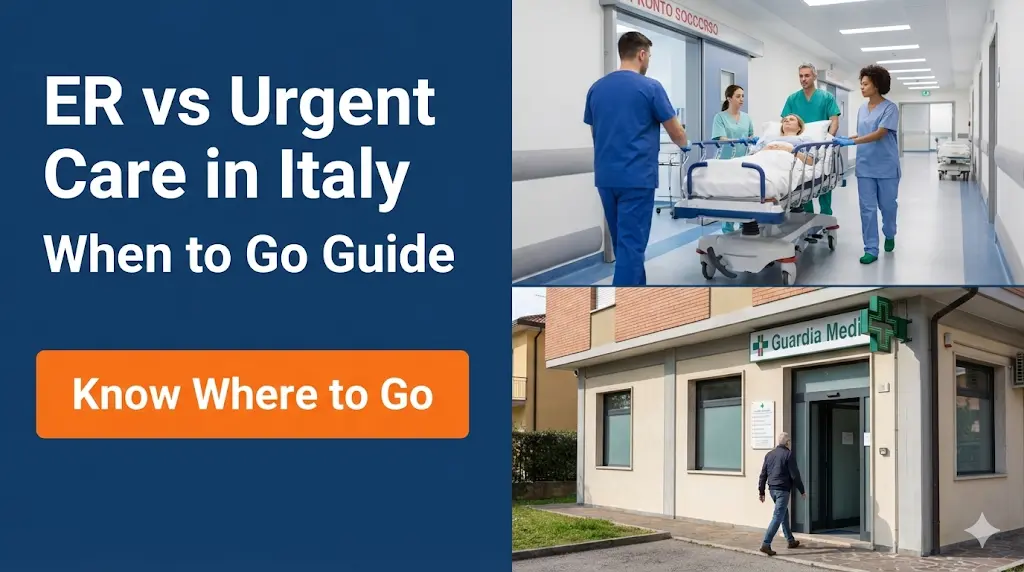
The Pronto Soccorso: Italy’s Emergency Room
The Pronto Soccorso (literally “Ready Help”) is the emergency department found in public hospitals throughout Italy. It is a high-intensity environment equipped to handle the most severe medical crises imaginable, from major road accidents and cardiac arrests to strokes and severe respiratory failure.
In Italy, the ER is not intended for routine care or minor illnesses. It is the apex of the emergency system. One of the most important things to realize as an expat is that public hospitals handle almost all emergency care; private clinics generally do not have the trauma facilities or 24/7 specialized surgical teams required for life-saving interventions. If you are in a genuine life-or-death situation, the public Pronto Soccorso is the only place you should be.
When the ER is the Correct Choice
You should proceed to the Pronto Soccorso—or call an ambulance by dialing Emergency Medical Numbers in Italy (112, 118, 1500)—if you or someone with you experiences:
- Chest Pain: Especially if it is crushing, radiating to the arm or jaw, or accompanied by shortness of breath.
- Difficulty Breathing: Severe asthma attacks, allergic reactions causing throat swelling (anaphylaxis), or sudden gasping for air.
- Neurological Changes: Sudden weakness on one side of the body, facial drooping, slurred speech, or intense, “thunderclap” headaches.
- Major Trauma: Deep lacerations that won’t stop bleeding, suspected broken bones with visible deformity, or severe burns.
- Loss of Consciousness: Any instance where the patient has fainted or is unresponsive.
- Severe Psychiatric Crisis: Situations where an individual is a danger to themselves or others.
If your situation involves a non-life-threatening medical need, you might find more appropriate care elsewhere. For example, if you are looking for long-term health management rather than emergency intervention, you should start by Registering with an Italian Family Doctor (Medico di Base).
Understanding the Triage System (Codici di Priorità)
When you walk into a Pronto Soccorso, you do not see a doctor immediately. You first encounter a specialized triage nurse. This nurse’s sole job is to assess your clinical urgency and assign you a priority code. This is a point of significant culture shock for many expats: Italy does not operate on a first-come, first-served basis.
The color-coding system ensures that a person having a heart attack who arrives at 10:00 AM is seen before someone with a sprained ankle who arrived at 8:00 AM. In recent years, Italy has transitioned from a four-color system to a more nuanced five-level numerical and color system, though many people still refer to the classic colors.
The Five Levels of Triage
| Code Number | Color | Urgency Level | Description |
| 1 | Red (Rosso) | Immediate | Life-threatening. The patient is in critical condition and receives instant care. |
| 2 | Orange (Arancione) | High | Potentially life-threatening. The patient is stable but at high risk of rapid deterioration. |
| 3 | Blue (Azzurro) | Deferrable | Stable condition but requiring significant diagnostic resources and specialist attention. |
| 4 | Green (Verde) | Minor | Minor urgency. Condition is stable and can wait without risk to health. |
| 5 | White (Bianco) | Non-Urgent | Minimal clinical relevance. These issues should ideally be handled by a GP. |
If you are assigned a White Code or a Green Code, prepare for a long stay. In busy metropolitan hospitals in Rome or Milan, a white code patient may wait 8 to 12 hours. Furthermore, while the Servizio Sanitario Nazionale is largely free, many regions charge a co-payment (ticket) of around €25 to €50 for white code visits to deter the misuse of the ER for minor ailments.
The Guardia Medica: Italy’s Urgent Care Alternative
If your medical issue is urgent but not an emergency, and it occurs during the night or on a weekend, the Pronto Soccorso is usually the wrong choice. Instead, you should utilize the Guardia Medica (officially Continuità Assistenziale).
The Guardia Medica is a state-run, out-of-hours medical service that fills the gap when your regular Medico di Base (General Practitioner) is not working. It is essentially the Italian version of an Urgent Care center, but with a unique twist: they often perform house calls.
When to Use the Guardia Medica
The Guardia Medica is the appropriate resource for:
- High fevers that aren’t responding to over-the-counter medicine.
- Severe flu symptoms, coughs, or ear infections.
- Minor rashes or allergic reactions (not involving breathing difficulty).
- Vomiting or diarrhea that isn’t causing severe dehydration.
- Urgent prescription refills for chronic medications (e.g., you ran out of blood pressure meds on a Saturday).
- Issuing medical certificates for work if you fall ill over the weekend.
How to Access the Guardia Medica
Unlike a walk-in clinic in the US, you generally start by calling the local Guardia Medica phone number for your city or district. You can find these numbers on the website of your local ASL (Azienda Sanitaria Locale).
When you call, a doctor will perform a phone triage. They may:
- Give Advice: Tell you how to manage the symptoms at home.
- Invite You to the Clinic: Provide an address for you to come in for a physical examination.
- Perform a House Call: In many cases, if you are too ill or frail to travel, the doctor will actually come to your home to examine you.
For residents and students, this service is usually free, though non-residents (including tourists) may be charged a small fee (typically €15 for a clinic visit and €25-€30 for a house call). If your medical needs are specifically related to vision, you may want to check Eye Care in Italy: Optometrists and Ophthalmologists for specialized providers.
Comparing ER vs. Urgent Care (Guardia Medica)
To help you decide where to go, consider this comparison table based on common medical scenarios encountered by expats.
| Symptom / Situation | Go to Pronto Soccorso (ER) | Use Guardia Medica (Urgent Care) |
| Fever | Only if accompanied by seizures, confusion, or stiff neck. | For standard high fevers and flu symptoms. |
| Pain | Chest pain, sudden severe abdominal pain, or traumatic injury. | Mild back pain, toothache, or minor muscle strain. |
| Cuts / Wounds | Deep wounds requiring many stitches or heavy bleeding. | Minor cuts or scrapes requiring simple dressing or advice. |
| Breathing | Gasps, wheezing, or allergic swelling. | Standard cough or mild congestion. |
| Prescriptions | Never for standard refills. | Yes, for urgent bridge prescriptions of essential meds. |
| Waiting Time | 0 to 12 hours (depending on triage code). | Usually much faster (minutes to 2 hours). |
Specialized Care: Pediatric and Obstetric Emergencies
If you are dealing with a medical issue involving a child or a pregnant woman, the landscape changes slightly. Italy often has specialized emergency rooms to provide more targeted care.
Pediatric ER (Pronto Soccorso Pediatrico)
Children under 14 should ideally be taken to a Pronto Soccorso Pediatrico. Many large general hospitals have a separate entrance or wing for children. There are also dedicated children’s hospitals, such as Bambino Gesù in Rome or Meyer in Florence. These facilities are staffed by pediatricians and pediatric nurses who are experts in dealing with children’s physiological and emotional needs.
Obstetric ER (Pronto Soccorso Ostetrico-Ginecologico)
Pregnant women experiencing complications (like sudden pain, bleeding, or decreased fetal movement) or those who have gone into labor should head to the specialized obstetric/gynecological emergency department. This is often a separate triage area within a large public hospital. This ensures you are seen by an OB-GYN and a midwife immediately rather than waiting in the general trauma pool.
Handling Language Barriers in Emergency Situations
One of the greatest fears for an expat is being unable to communicate symptoms during a crisis. While many Italian doctors speak some English (particularly in larger cities), nursing and administrative staff may not.
Strategies for Communication
- Use the “Where Are U” App: This app is linked to the 112 emergency system. It allows you to call for help and automatically sends your GPS location to the dispatcher. It even has a “silent call” and text-based chat function for those who cannot speak.
- Medical ID on Your Phone: Set up the Medical ID feature on your smartphone (iPhone or Android). Include your blood type, chronic conditions, and allergies. This can be accessed by medical staff even if your phone is locked.
- Basic Vocabulary: Learn the Italian words for your chronic conditions.
- Senza respiro (Out of breath)
- Dolore al petto (Chest pain)
- Allergico a… (Allergic to…)
- Incinta (Pregnant)
- Diabetico (Diabetic)
- Translation Apps: While not perfect for complex medical debates, apps like DeepL or Google Translate are incredibly helpful for communicating simple symptoms to a triage nurse.
Cost and Insurance Considerations
The financial aspect of emergency care in Italy depends heavily on your residency status and the urgency of your condition.
Residents (Enrolled in SSN)
If you are officially registered with the SSN and have your Tessera Sanitaria (Health Card), the Pronto Soccorso is essentially free for all urgent codes (Red, Orange, Blue, Green). You will only pay the ticket co-pay if you are assigned a White Code (non-urgent). The Guardia Medica is also generally free for residents.
EU Citizens (EHIC Holders)
If you are an EU citizen visiting Italy, your European Health Insurance Card (EHIC) grants you access to emergency care under the same terms as Italian residents. You must present the physical card or a digital version to the hospital administration.
Non-EU Tourists and Unregistered Expats
If you are not yet registered with the SSN, you will likely be asked for your insurance details or a form of payment. Emergency life-saving care is always provided first, regardless of your ability to pay. However, the hospital will bill you later. A standard ER visit for a non-resident can cost between €150 and €800, depending on the tests performed (CT scans, blood work, etc.). This is why having private travel or expat insurance is non-negotiable.
What to Bring to the Hospital or Clinic
Whether you are going to the ER or the Guardia Medica, having the right documentation will significantly speed up the administrative side of your visit.
- Identification: Your passport or Italian Carta d’Identità.
- Health Card: Your Tessera Sanitaria (if resident) or EHIC (if EU citizen).
- Medication List: A physical list of all medications you are currently taking, including dosages.
- Medical History: A brief summary of past surgeries, chronic illnesses, or known allergies.
- Insurance Info: A copy of your private health insurance certificate and the 24/7 emergency contact number for your provider.
- Phone Charger: In the event of a long wait or admission, you will need to keep your lines of communication open.
Conclusion
Navigating the choice between the Pronto Soccorso and the Guardia Medica is a vital skill for any expat living in Italy. The system is highly effective, but it demands that patients act as responsible partners by choosing the correct level of care.
By reserving the Pronto Soccorso for genuine, life-threatening emergencies and utilizing the Guardia Medica for minor acute illnesses, you ensure that you receive faster treatment and avoid the financial penalties associated with misusing the ER. Remember the triage color codes: unless you are “Red” or “Orange,” you are in for a wait. Prepare your documents, keep an emergency app on your phone, and take comfort in knowing that Italy’s dedicated medical professionals are some of the best in the world, ready to help you whether it’s a midnight fever or a midday crisis.
References
Primary sources (official)
- Ministero della Salute (Ministry of Health): Official guidelines on ER triage protocols and the role of Continuità Assistenziale. https://www.salute.gov.it
- Agenzia Nazionale per i Servizi Sanitari Regionali (AGENAS): Reports on hospital performance and the implementation of the five-level triage system. https://www.agenas.gov.it
Other helpful sources
- Expatica Italy: Practical guides for foreigners on navigating the Italian healthcare system and emergency services. https://www.expatica.com/it/healthcare/
- Doctors in Italy: A resource for finding English-speaking medical assistance and understanding local patient rights. https://www.doctorsinitaly.com
Disclaimer
The information provided in this article is for educational and informational purposes only and does not constitute official medical, legal, or financial advice. Healthcare protocols, triage codes, and costs in Italy are subject to change by regional and national health authorities. In the event of a medical emergency, always dial 112 or 118 immediately, or seek assistance from trained medical professionals at the nearest hospital or clinic. Ensure you possess appropriate health coverage or travel insurance before seeking medical treatment.