Blood Donation: How and Where in Italy
Learn how to contribute to Italy’s life-saving blood supply. This comprehensive guide covers eligibility requirements for expats, the donation process, where to find centers through organizations like AVIS, and the unique legal benefits, such as a mandatory paid day off work.
Disclosure: This post may contain affiliate links. We may earn a commission at no extra cost to you if you make a purchase through these links. Read full disclosure.
Introduction
In Italy, blood donation is managed by the Centro Nazionale Sangue (National Blood Center) under the auspices of the Ministry of Health. Unlike some countries where blood collection is centralized entirely within hospitals, Italy relies heavily on massive, highly organized volunteer associations. These organizations, such as AVIS (Associazione Volontari Italiani Sangue), coordinate with the public health system to ensure a steady supply of blood and plasma for surgeries, emergency rooms, and the treatment of chronic blood disorders.
For the expatriate community, participating in this system offers more than just a sense of altruistic fulfillment. It provides a unique window into the Italian healthcare philosophy, which prioritizes social solidarity and preventative wellness. Furthermore, Italy has some of the most progressive labor laws in the world regarding donors, including a legally mandated paid day off from work for those who donate through the public system.
This extensive guide is designed to demystify the blood donation process in Italy for foreigners. We will explore the rigorous eligibility requirements, detail the step-by-step procedure from the initial health screening to the post-donation espresso, and provide actionable advice on how to locate donation centers in your specific region. We will also discuss the different types of donations available, such as whole blood and apheresis, and explain the legal rights you hold as a donor in the Italian workplace. By the end of this article, you will have the knowledge and confidence to roll up your sleeve and contribute to the vital “gift of life” in your adopted country.
The Importance of Voluntary Blood Donation in Italy
Italy’s approach to blood donation is rooted in the principle of “free, voluntary, anonymous, and non-remunerated” contribution. The state views blood as a public resource that cannot be bought or sold. This ethical stance ensures a high level of safety for the blood supply, as donors are motivated by altruism rather than financial gain, leading to more honest disclosures during the health screening process.
The demand for blood in Italy is constant and increasing. With an aging population and a high volume of complex surgical procedures—ranging from organ transplants to advanced oncology treatments—the Servizio Sanitario Nazionale (SSN) requires approximately 8,000 units of blood every single day. While Italy is largely self-sufficient in whole blood, there is a persistent need for plasma, which is used to produce life-saving medicinal products for patients with rare diseases and immune deficiencies.
For expats, joining the ranks of Italian donors is a powerful act of “social citizenship.” It demonstrates a commitment to the well-being of your neighbors and helps alleviate the seasonal shortages that often occur during the winter flu season or the peak summer holiday months. If you are still in the early stages of settling in, you may want to review our guide on Settling In Italy: Daily Life Tips for Expats to see how community involvement can speed up your integration.
Eligibility Requirements for Expats and Foreigners
To protect both the donor and the recipient, Italy maintains strict eligibility criteria. As a foreigner, your nationality is not a barrier, but your residency status and health history are carefully scrutinized.
Residency and Documentation
To donate blood in Italy, you must be a legal resident. When you arrive at a donation center, you will be required to present:
- A valid identity document (Passport or Italian Carta d’Identità).
- Your Italian tax code (Codice Fiscale).
- Your Italian health card (Tessera Sanitaria).
The requirement for the health card is essential because your donation history and blood test results are linked to your national health profile. If you have not yet secured these documents, please consult our guide on Obtaining the Italian Health Card (Tessera Sanitaria) to complete your medical registration.
Basic Health Criteria
The standard physical requirements for donors in Italy are as follows:
- Age: Between 18 and 65 years old. (First-time donors over 60 are subject to doctor approval).
- Weight: Minimum of 50 kilograms (approx. 110 lbs).
- Heart Rate: Between 50 and 100 beats per minute.
- Blood Pressure: Systolic between 110 and 180 mmHg; Diastolic between 60 and 100 mmHg.
- Hemoglobin Levels: Minimum 13.5 g/dL for men and 12.5 g/dL for women.
Language Proficiency
A crucial requirement for expats is the ability to communicate effectively in Italian or to bring a trusted translator. During the donation process, you must fill out a detailed medical questionnaire and undergo a private interview with a doctor. You must be able to understand the questions regarding your sexual history, travel history, and medical background to provide “informed consent.” If the doctor feels there is a significant language barrier that prevents a safe health assessment, they may defer you until you can be accompanied by an interpreter. You can find resources for this in our guide on Using Medical Translation and Interpretation Services.
Common Reasons for Deferral in Italy
Italy adheres to rigorous European standards regarding blood safety. Certain lifestyle factors or recent events can lead to a temporary or permanent deferral (esclusione).
Temporary Deferrals
- Travel: If you have recently visited areas with a high risk of tropical diseases (like Malaria, West Nile Virus, or Dengue), you will be deferred for a period ranging from 28 days to 6 months.
- Tattoos and Piercings: There is a mandatory 4-month waiting period after getting a new tattoo, piercing, or even permanent makeup to rule out bloodborne infections.
- Medication: Use of antibiotics usually requires a 15-day wait after the last dose. Taking aspirin or anti-inflammatories may defer you for 5 to 7 days for specific types of donations (like platelets).
- Pregnancy and Childbirth: Women are deferred during pregnancy and for 6 months to 1 year following childbirth or the end of breastfeeding.
- Dental Work: Minor procedures like cleanings require a 48-hour wait, while extractions or implants require a 1-week deferral. If you need dental work before donating, see Dental Care in Italy: Costs and Insurance Coverage.
Permanent Deferrals
- History of viral hepatitis (B or C).
- HIV/AIDS or being in a high-risk group for bloodborne pathogens.
- History of certain autoimmune diseases or malignancies.
- History of using intravenous drugs.
- A specific deferral exists for those who resided in the United Kingdom for more than 6 months between 1980 and 1996 due to “Mad Cow Disease” (vCJD) risks, though these rules are periodically reviewed by the Ministry of Health.
Where to Donate: AVIS and the Italian Blood Network
In Italy, you generally do not just walk into a random hospital to give blood. Most donations are organized through four major recognized associations that work in partnership with the state.
1. AVIS (Associazione Volontari Italiani Sangue)
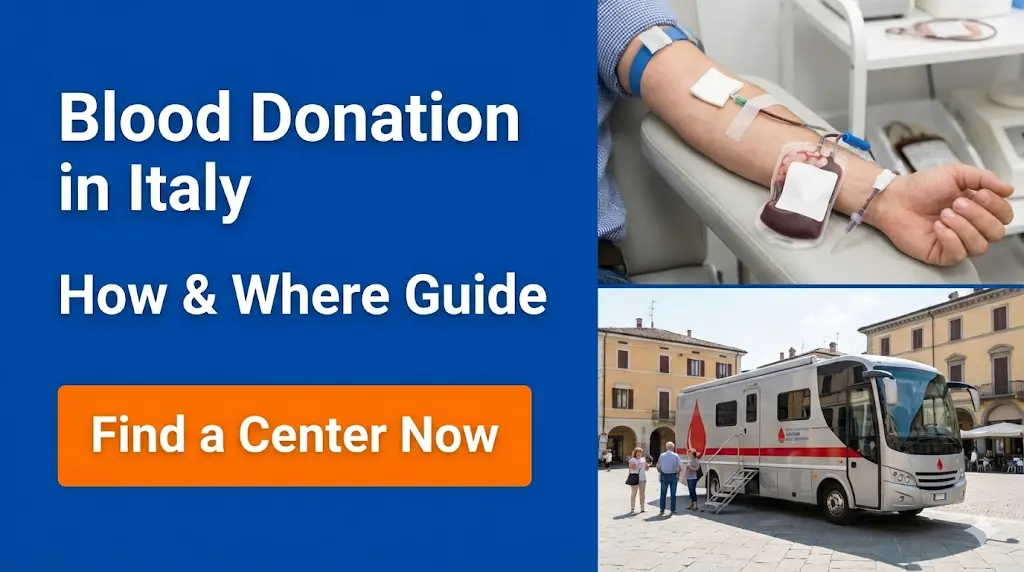
AVIS is the largest and most prominent organization, with over 3,000 branches across Italy. It is a non-profit that manages the recruitment and scheduling of donors. Most expats will find an AVIS office in their town or neighborhood. AVIS organizes both “mobile” collection days (using specialized blood buses) and fixed appointments at hospital transfusion centers.
2. FIDAS (Federazione Italiana Associazioni Donatori di Sangue)
FIDAS is a federation of various local donor associations. They operate similarly to AVIS and have a strong presence in many northern and central regions.
3. FRATRES
FRATRES is a national organization often associated with Catholic volunteer groups, focusing on the spiritual and civic value of donation.
4. CRI (Croce Rossa Italiana)
The Italian Red Cross also manages blood donation programs, particularly in major metropolitan areas.
How to Find Your Local Center
The easiest way to find a donation point is to visit the AVIS website and use their “Dove Donare” (Where to Donate) tool. You can enter your city or postal code to find the nearest headquarters. Alternatively, you can search for the “Servizio Trasfusionale” (Transfusion Service) of your local public hospital (Ospedale).
Step-by-Step Guide to the Donation Process
The donation process in Italy is thorough and designed to ensure you feel supported throughout. Here is what to expect on your first visit.
Step 1: Booking and Preparation
In most regions, you must book an appointment in advance. This prevents long wait times and allows the center to manage blood types according to current hospital needs.
- The Night Before: Eat a healthy meal, avoid alcohol, and get a good night’s sleep.
- Morning of Donation: Unlike a standard blood test for a check-up, you should not arrive on an entirely empty stomach. You should have a light breakfast (coffee, tea, juice, and a few dry biscuits or a slice of toast). Avoid milk, cream, or fatty pastries (like cornetti) as fats in the blood can interfere with certain laboratory tests.
Step 2: Registration and Questionnaire
Upon arrival, you will present your ID and health card. You will be given a lengthy questionnaire (questionario anamnestico) covering your medical history, recent travels, and lifestyle. This form is a legal document, and you must answer truthfully.
Step 3: The Medical Interview and Mini-Physical
You will meet privately with a transfusion doctor. They will:
- Review your questionnaire.
- Measure your blood pressure and heart rate.
- Perform a finger-prick test to check your hemoglobin levels.
- Discuss any concerns you have.
On your first visit, the doctor will often perform a “pre-donation” screening (predonazione). This means they may take several vials of blood for comprehensive testing but will not perform the full donation until the results come back clear (usually within a few days).
Step 4: The Donation
Once cleared, you will be led to a comfortable reclining chair.
- Whole Blood (Sangue Intero): This is the most common type. It takes about 8 to 12 minutes to collect approximately 450ml of blood.
- Plasma or Platelets (Aferesi): Using a specialized machine, only plasma or platelets are collected, and your red blood cells are returned to you. This process takes longer (35 to 50 minutes) but allows you to donate more frequently and is less physically demanding on your iron stores.
Step 5: Post-Donation Recovery and the “Ristoro”
After the needle is removed, you will be asked to remain reclined for a few minutes. You then head to the refreshment area (sala ristoro). In Italy, this is a cherished ritual. You will be provided with water, juice, coffee, and a variety of snacks (sandwiches, cookies, or fruit). It is essential to stay for at least 15-20 minutes to ensure you don’t feel faint.
Blood Donation Frequency and Types
| Donation Type | Volume | Duration | Frequency (Men) | Frequency (Women) |
| Whole Blood | 450ml | 10 min | Every 90 days | Every 180 days (childbearing age) |
| Plasma (Plasmapheresis) | 600-700ml | 40 min | Every 14 days | Every 14 days |
| Platelets (Piastrinoferesi) | Variable | 50 min | Max 6 times/year | Max 6 times/year |
| Multicomponent | Variable | 50 min | Every 90 days | Every 90 days |
Note: Women of childbearing age are limited to two whole blood donations per year to protect their iron levels.
The Unique Italian Benefit: The Paid Day Off
One of the most surprising and beneficial aspects of donating blood in Italy is the legal protection provided by Law 219 of 2005.
If you are a legally employed worker (with a contratto di lavoro), you are entitled to a full 24-hour paid leave on the day you donate blood or blood components. This is not a “gift” from your employer; the Italian state (via INPS) reimburses your employer for your salary on that day.
How to Claim Your Leave
- Inform your employer: It is polite to give at least a few days’ notice of your intent to donate.
- Request a certificate: After your donation, the transfusion center will provide you with a signed certificate of justification (giustificativo).
- Submit to HR: You provide this certificate to your employer, and you are credited for a full day of work without any deduction from your vacation or sick leave balance.
This law reflects Italy’s commitment to encouraging donation by ensuring that no citizen or resident suffers a financial loss for their contribution to the public health system.
Free Medical Check-Ups for Regular Donors
Another significant advantage of becoming a regular donor in Italy is the continuous health monitoring you receive. Every time you donate, your blood is screened for:
- HIV, Hepatitis B and C, and Syphilis.
- Complete Blood Count (CBC).
- Liver enzyme levels (ALT).
- Cholesterol and triglyceride levels.
- Blood sugar (glucose).
- Creatinine (kidney function).
- Iron levels (Ferritin).
Useful Italian Vocabulary for Donors
To help you navigate your first visit, here are the most common terms you will hear:
- Donatore / Donatrice: Male/Female donor.
- Gruppo Sanguigno: Blood type (e.g., A positivo, Zero negativo).
- Trasfusione: Transfusion.
- Tampone: Swab (often used for the cleaning of the arm).
- Ago: Needle.
- Svenire / Capogiro: To faint / Dizziness.
- Idratarsi: To hydrate.
- Idoneo / Non idoneo: Eligible / Ineligible.
- Sospensione: Deferral.
Donating During Holidays and Emergencies
Italy often faces blood shortages during the month of August (when the entire country goes on vacation) and during the Christmas period. During these times, AVIS and other organizations send out urgent “Appelli” (appeals) via SMS or social media.
If there is a national emergency, such as a major earthquake or a multi-vehicle accident, the transfusion centers may open for extended hours. However, health authorities always remind the public that it is the “constant” donor who saves lives, rather than the “emergency” donor. Blood has a shelf life (42 days for red cells, only 5 days for platelets), so a steady stream of regular appointments is much more valuable than a sudden surge of donors during a crisis.
Conclusion
Participating in blood donation programs in Italy is a rewarding way to give back to a country that has welcomed you. It is a process governed by safety, medical excellence, and a deep sense of community. By becoming a donor, you not only provide a life-saving resource for the Servizio Sanitario Nazionale but also gain access to regular free health screenings and benefit from Italy’s generous labor protections.
Whether you choose to join AVIS or coordinate directly with your local hospital, you are joining a network of millions of volunteers who believe in the power of solidarity. So, check your residency documents, brush up on your Italian medical terms, and book your first appointment. Your donation might just be the miracle someone else is waiting for.
References
Primary sources (official)
- Centro Nazionale Sangue (National Blood Center): The official government body overseeing blood collection and transfusion protocols in Italy. https://www.centronazionalesangue.it/
- Ministero della Salute (Ministry of Health): Provides the legal framework for donation eligibility and donor rights under Italian law. https://www.salute.gov.it/
Other helpful sources
- Associazione FRATRES: A national donor organization providing resources on the ethics and practice of blood donation. https://www.fratres.it/
- FIDAS (Federazione Italiana Associazioni Donatori di Sangue): A major federation for regional donor groups with extensive educational materials. https://fidas.it/
Disclaimer
The information provided in this article is for educational and informational purposes only and does not constitute medical or legal advice. Eligibility criteria for blood donation in Italy are subject to change based on national health directives and regional regulations. Always consult with a licensed physician at an official transfusion center (Centro Trasfusionale) to determine your fitness for donation. If you have recently traveled or have a pre-existing medical condition, disclosure to the medical staff is mandatory for the safety of the blood supply.