How to Dress for Churches and Religious Sites in Italy
There is nothing more heartbreaking than standing in a long queue under the Roman sun for an hour at St. Peter’s Basilica, only to be turned away at the threshold because your shoulders are visible or your shorts are an inch too short. This guide breaks down the strict, often non-negotiable dress codes for Italy’s sacred spaces, helping you navigate the delicate balance between the sweltering Mediterranean heat and the deep-seated cultural expectations of religious respect.
Disclosure: This post may contain affiliate links. We may earn a commission at no extra cost to you if you make a purchase through these links. Read full disclosure.
The Cultural Weight of Italian Church Etiquette
When you enter a church in Italy, you aren't just entering a museum or an architectural landmark; you are stepping into a living house of worship that holds immense weight in the local community. Even if you aren't religious yourself, the "gatekeepers"—usually volunteers or security guards—view your attire as a direct reflection of your respect for their culture and heritage. This is a primary example of the concept of Dress Codes and Bella Figura in Italy, where making a good impression through your appearance is considered a social duty. In smaller towns, you might find that the rules are less about a formal security check and more about the watchful eyes of the local nonne (grandmothers) who frequent the pews.
In major tourist hubs like Rome, Florence, and Venice, the rules are strictly enforced by staff members who will literally block your path if you don't meet the criteria. This is particularly true for the big-ticket items like the Duomo in Florence or St. Mark’s in Venice. If you are using Omio to book your high-speed trains between these cities, you’ll likely be visiting several major basilicas in a single week. Each one has its own level of scrutiny, but the "Big Three" (Rome, Florence, Venice) are the most uncompromising. Understanding Italian Customs, Etiquette, and Social Life will help you realize that these rules aren't meant to be exclusionary, but rather to maintain a sense of sanctity in spaces that are often overrun by thousands of visitors daily.
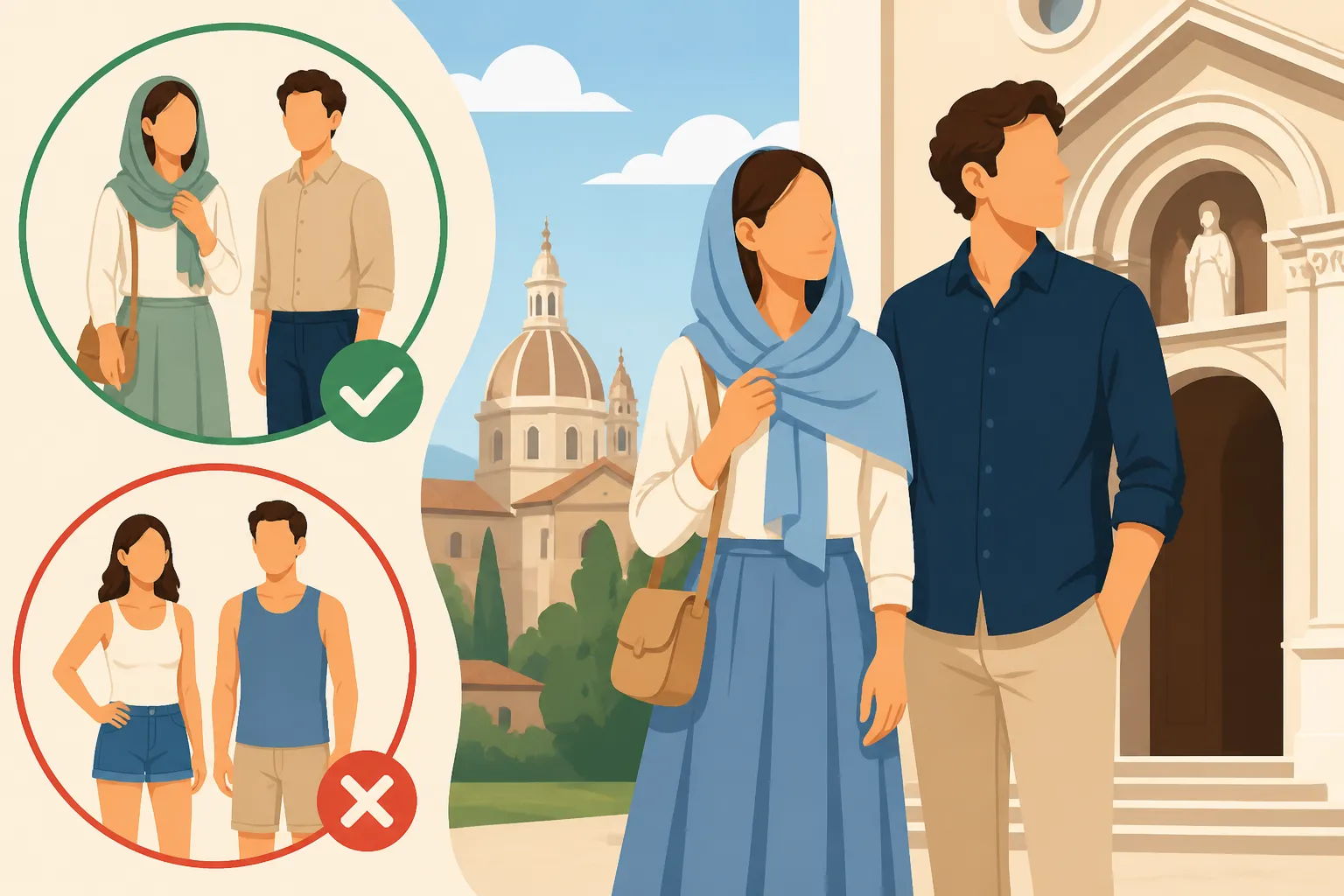
The general rule of thumb is "shoulders and knees." This applies to everyone, regardless of gender or age. It sounds simple, but in the peak of July, when the humidity is thick, it becomes a logistical challenge. You want to stay cool while wandering the streets, yet you need to be "covered" the moment you cross the threshold of a church. This guide is designed to help you avoid the common pitfalls and the last-minute stress of being denied entry to the very sites you traveled thousands of miles to see.
Seasonal Strategies for Staying Cool and Respectful
The Italian summer is famous for its beauty, but it is equally notorious for its heat. Many travelers make the mistake of dressing for a beach day when they are actually planning a day of intensive sightseeing. To avoid being turned away, you need a wardrobe that is modular. One of the most effective strategies I’ve learned as an expat is the "Scarf Technique." For women, carrying a lightweight linen or silk scarf in your bag is a lifesaver. You can wear your sleeveless sundress or tank top while walking through the Piazza della Signoria, but the moment you approach a church, you simply wrap the scarf around your shoulders.
Men often struggle more with the "no shorts" rule. While some more "relaxed" churches might allow shorts that hit exactly at the knee, many of the major basilicas demand trousers or zip-off travel pants. If you are planning a trip through the Rome, Florence, and Venice: Italy's Great Cities Explorer's Guide, you will notice that the heat index can make heavy denim feel like a personal sauna. Opt for breathable fabrics like linen or lightweight chinos. Avoid athletic wear or "short shorts," as these are almost always a reason for rejection. If you've booked a guided tour through GetYourGuide, your guide will often remind you of this, but it’s better to be prepared before you leave your hotel.
Children are sometimes given a bit more leeway, but once a child looks like a "young adult" (usually around age 12), they are held to the same standards as everyone else. It is always safer to have them in bermuda shorts that reach the knee and t-shirts rather than tank tops. When you are Acclimatizing to Italian Climate: Heat, Humidity, and Health, you’ll find that wearing loose-fitting, natural fibers actually keeps you cooler than baring your skin to the direct sun, so the church dress code can actually work in your favor if you choose the right materials.
Your Religious Site Clothing Checklist
To ensure you never get rejected at the door, it helps to categorize your clothing into "Safe," "Risky," and "Prohibited." Italian security guards at major sites are trained to spot infractions quickly, and they rarely accept excuses. Even if you see a few people "sneaking in" with prohibited items, don't count on being the exception. The "risky" category is where most tourists get caught; what looks like a knee-length skirt to you might look too short to a guard if it rides up when you walk.
| Clothing Item | Category | Advice for Expats and Tourists |
|---|---|---|
| T-shirts | Safe | Ensure the neckline isn't too low and sleeves cover the deltoid. |
| Linen Trousers | Safe | The gold standard for Italian summer; breathable and respectful. |
| Maxi Dresses | Safe | Perfect for women; covers everything while staying breezy. |
| Bermuda Shorts | Risky | Must clearly cover the knee. If they are "at" the knee, you might be denied. |
| Capris / Culottes | Safe | A great middle-ground for women who don't want full trousers. |
| Tank Tops | Prohibited | Shoulders must be covered. Carrying a shawl is the only workaround. |
| Mini Skirts | Prohibited | Anything above the knee is a high-risk for rejection. |
| Hats | Prohibited | Men must remove hats upon entry; women can usually keep fashion hats on. |
| Flip-Flops | Risky | While not strictly banned, they are seen as "beachwear" and frowned upon. |
| Crop Tops | Prohibited | Any midriff showing is a guaranteed "no" from security. |
When you are Shopping in Italy: Markets, Boutiques, and Outlets, look for "Pantaloni di lino" (linen pants) or light cardigans. These items are staples of the Italian wardrobe for a reason. They allow for air circulation while maintaining that all-important Bella Figura. If you are staying at a central hotel booked through Booking.com, you might even have time to head back and change, but it's much better to be "church-ready" from the moment you step out for your morning espresso.
Emergency Solutions and Practical Tips
We have all been there: you’re walking down a beautiful side street in Trastevere, you see a stunning 12th-century church you didn't plan to visit, and you realize you’re wearing a sleeveless top with no backup. In these moments, you have a few options, but some are better than others. Many of the most famous churches, like the Pantheon or the Vatican, have street vendors nearby selling "emergency kits." These usually consist of a cheap, disposable paper or plastic poncho or a low-quality synthetic scarf. They are overpriced and uncomfortable, but they will get you through the door.
A better solution is to always keep a "church kit" in your daypack. For my family, this includes a large pashmina for me and a pair of lightweight "emergency" leggings for my daughter if she’s wearing a shorter skirt. For men, if you are wearing shorts and desperately want to go inside, some churches used to provide "sarongs" or paper skirts, but this practice has largely disappeared post-pandemic for hygiene reasons. It is now your responsibility to be prepared. If you are trying to How to Skip the Lines at the Colosseum and Vatican, remember that your "skip the line" ticket doesn't bypass the dress code check. You will still go through security, and they will still check your outfit.
Finally, keep in mind that the dress code also extends to your behavior. Even if you are perfectly dressed, carrying loud conversations or taking photos with flash in restricted areas can get you escorted out. It is all part of the same ecosystem of respect. Whether you are using Italian Greetings and Etiquette: Kissing on the Cheek in a social setting or whispering in a side chapel, the goal is to blend in rather than stand out as a "typical" tourist. By following these dressing guidelines, you transition from being a mere observer to a respectful guest in some of the most beautiful and sacred spaces on earth.
Always check the specific website of a cathedral if you are unsure, as some private chapels or specific pilgrimage sites might have even more stringent rules, such as requiring women to wear headcoverings (though this is extremely rare nowadays). Generally, the "shoulders and knees" rule will serve you well from the tip of the Alps down to the coast of Sicily. If you are ever in doubt, just look at how the locals are dressed. Even in the heat, you will rarely see an Italian adult in a church wearing anything they would wear to the gym or the beach.
Disclaimer
The information provided in this guide is for educational and informational purposes only. While we strive to provide the most up-to-date advice on Italian dress codes and cultural expectations, rules can change at the discretion of individual church authorities or local municipalities. Always follow the instructions of on-site security and staff. We are not responsible for any denial of entry or travel disruptions resulting from personal wardrobe choices.