How to Say Please, Thank You, and Sorry in Italian
Most visitors arrive in Italy and quickly realize that "Ciao" only gets them so far. The real barrier isn't just the complex grammar; it is the social friction that occurs when you cannot politely ask for a coffee or apologize for bumping someone on a crowded bus. This guide solves that by teaching you the essential politeness markers—Please, Thank You, and Sorry—so you can navigate Italy with grace and genuine connection.
Disclosure: This post may contain affiliate links. We may earn a commission at no extra cost to you if you make a purchase through these links. Read full disclosure.
Mastering the Nuances of Please in Italian
In Italian culture, politeness is not just a linguistic requirement; it is part of "bella figura," the art of making a good impression. When you use the word for please, you are signaling to the person across from you that you respect the social order. The most common way to say please is "per favore," but as any veteran expat will tell you, the context in which you use it changes how you are perceived.
"Per favore" is your all-purpose tool. Whether you are ordering a panino or asking someone to move their luggage on a train booked via Omio, this phrase works across all social strata. However, you might also hear "per piacere." While they are largely interchangeable, "per piacere" can sometimes feel a bit more personal or urgent. If you are struggling with a heavy suitcase and need a hand, "per piacere" might just pull at the heartstrings a bit more than the standard version.
Another high-level way to express "please" without actually saying the word is through your verb choices. Instead of saying "Voglio un caffè" (I want a coffee), which sounds demanding and abrasive, you should use "Vorrei un caffè" (I would like a coffee). Adding "per favore" to the end of a "vorrei" sentence is the gold standard of Ordering Food and Drinks in Italian: A Practical Phrasebook. It transforms you from a demanding tourist into a sophisticated guest.
In very formal settings—perhaps you are dealing with a government official or a high-end hotel concierge—you might encounter the word "cortesia." Using the phrase "per cortesia" is like adding a tuxedo to your sentence. It is extremely polite and slightly old-fashioned, but in the right environment, it works wonders. Using these variations shows that you have moved beyond the basics found in a Survival Italian for Travelers: Key Phrases to Learn First list and are actually engaging with the local culture.
Beyond Grazie: The Art of Expressing Gratitude
Everyone knows "grazie," but few tourists understand how to use it with the rhythmic flair of a local. The pronunciation is the first hurdle; remember that the "e" at the end is pronounced (graht-zee-eh), not "graht-zee." Once you have the sound down, you need to understand the tiers of gratitude. For a simple transaction, like receiving change at a tobacco shop, a short "grazie" is sufficient.
If someone has gone out of their way for you—perhaps a tour guide you found through GetYourGuide who shared an incredible secret history of a Roman alley—you want something stronger. "Grazie mille" (a thousand thanks) is the standard upgrade. You can also say "mille grazie," which carries the same weight. If you want to sound even more sincere, "molte grazie" or "grazie di cuore" (thanks from the heart) are beautiful ways to show deep appreciation.
Equally important is knowing how to respond when someone thanks you. The standard response is "prego." However, "prego" is a linguistic Swiss Army knife. It means "you’re welcome," but it also means "please, after you," or "how can I help you?" when you walk into a shop. If you are at a dinner party and someone thanks you for a gift, you might say "di nulla" or "di niente" (it’s nothing). These phrases are less formal than "prego" and suggest that the favor was no trouble at all.
Understanding these responses is a core part of Italian Social Customs: Greetings, Gestures, and Personal Space. If you simply stay silent after someone says "grazie," it can be interpreted as coldness. Even a quick nod and a "prego" maintains the social harmony. In a restaurant, after the waiter clears your plates, a "grazie" followed by his "prego" is the standard punctuation of a meal. For more on the flow of dining, check out our guide on Restaurant Etiquette in Italy: Coperto, Courses, and the Bill.
| English Phrase | Italian Translation | Social Context |
|---|---|---|
| Please (Standard) | Per favore | Use in almost any situation |
| Please (Formal/Polite) | Per cortesia | Use with officials or in high-end service |
| Thank you | Grazie | The essential daily thanks |
| Thank you very much | Grazie mille | Use when someone is genuinely helpful |
| You're welcome | Prego | The standard response to thanks |
| Excuse me (to get attention) | Scusi | Formal; use with strangers |
| Excuse me (to pass by) | Permesso | Specifically for moving through a crowd |
| I'm sorry (regret) | Mi dispiace | For emotional or sincere apologies |
Navigating Apologies and the Difference Between Sorry and Excuse Me
One of the most confusing aspects of Italian for English speakers is that we use the word "sorry" for everything—from bumping into a stranger to losing a loved one. Italian is much more specific. If you need to get someone’s attention or apologize for a minor, accidental physical transgression, you use "scusa" or "scusi."
The distinction between "scusa" and "scusi" is your first major lesson in the formal (Lei) and informal (tu) registers. If you are talking to a child or a close friend, use "scusa." For everyone else—the waiter, the shopkeeper, the person you bumped into on the street—use "scusi." It is always better to be too formal than too casual in Italy. If you arrive at your apartment booked through Booking.com and realize you are an hour late for check-in, starting your conversation with "Scusi per il ritardo" (Excuse me/sorry for the delay) immediately softens the mood of a frustrated host.
Then there is "permesso." This is a vital word that many tourists overlook. If you are trying to move through a crowded group of people, do not say "scusi." Say "permesso." It literally means "with your permission." It is the polite way to ask people to make a physical path for you. Using it shows you understand Italian Customs, Etiquette, and Social Life better than the average traveler.
Finally, there is "mi dispiace." This is used for true regret or empathy. If you break something, if you have to decline an invitation, or if you are expressing sympathy for someone’s bad news, "mi dispiace" is the correct choice. Using "scusi" in these moments would feel shallow. "Mi dispiace" carries weight; it tells the other person that you feel the weight of the situation. This level of emotional intelligence is essential for Staying Safe in Italy: Common-Sense Tips for Travelers, as it helps de-escalate potential misunderstandings.
Cultural Context and Non-Verbal Politeness
In Italy, words are only half the conversation. To truly master "please," "thank you," and "sorry," you must understand the non-verbal cues that accompany them. A "grazie" delivered with eye contact and a slight smile is worth ten muttered "grazie mille"s. Italians value presence and eye contact; looking at your phone while thanking someone is often seen as dismissive.
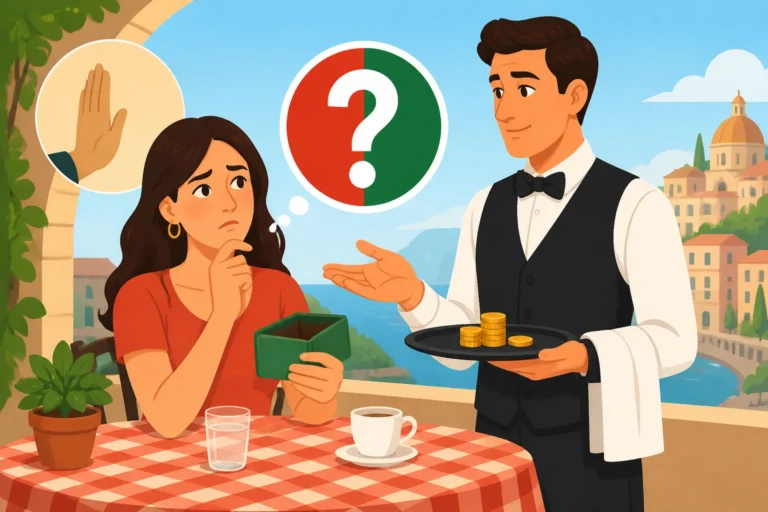
The hand gestures that Italy is famous for also play a role in politeness. A slight raise of the hand with the palm facing out can act as a silent "scusi" when you are driving or walking. A gentle touch on the shoulder (among people who have already established some rapport) can emphasize a "mi dispiace." However, as a visitor, it is usually best to keep your gestures subtle until you have observed the local rhythms.
The concept of time also plays into politeness. Apologizing for being five minutes late is often unnecessary in a social context, but being "gentile" (kind/polite) involves a certain level of patience. If a shopkeeper is chatting with a regular while you wait to pay, interrupting with a "scusi" might be seen as rude. Wait for a natural break, then use your "scusi" to signal you are ready. This patience is a key element of the Coffee Culture in Italy: How to Order Like a Local, where the interaction is often as important as the caffeine.
By weaving these phrases into your daily life, you stop being a spectator and start being a participant. Italians are incredibly forgiving of grammatical errors, but they are very sensitive to a lack of courtesy. If you lead with kindness and a well-placed "per favore," you will find that doors—both literal and social—open much more easily for you across the peninsula.
Disclaimer
The information provided in this guide is for educational and informational purposes only. While every effort has been made to ensure the accuracy of the translations and cultural advice, regional dialects and social norms in Italy can vary significantly. Language is an evolving tool, and personal experiences may differ based on specific locations and social contexts. Always observe local behavior and adapt your communication accordingly.