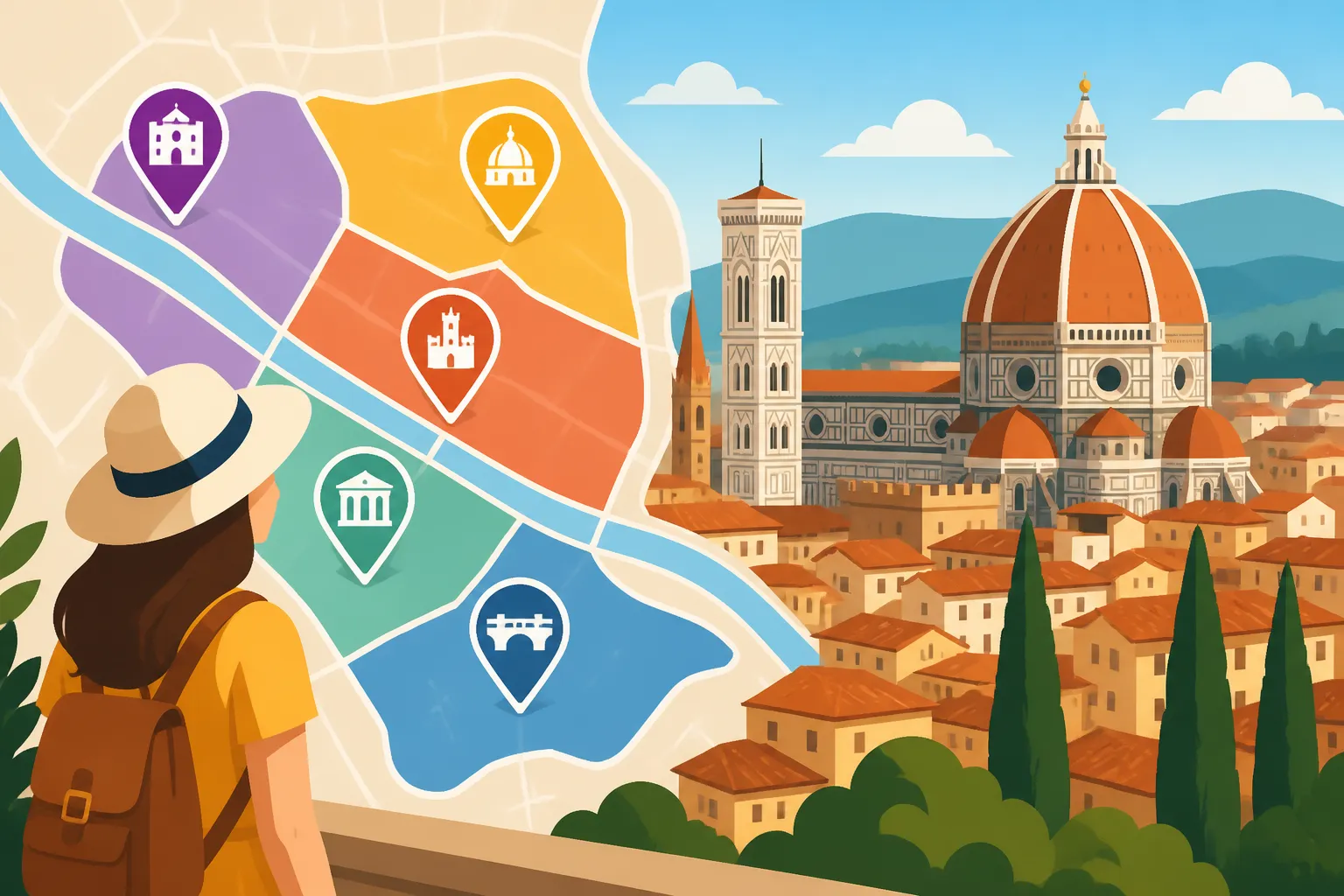
What’s the Best Area to Stay in Florence?
Your train pulls into Santa Maria Novella and you realise the “central” apartment you booked sits above a bar that stays loud past midnight. Or it’s a long, sweaty walk from everything you came to see. Florence is small, but each neighborhood feels very different. This guide compares the main areas and explains who each one suits, so you can book a base you won’t regret.
Disclosure: This post may contain affiliate links. We may earn a commission at no extra cost to you if you make a purchase through these links. Read full disclosure.
How Florence Is Laid Out and Why Your Base Matters
Florence is often called walkable, and that’s true. But “walkable” means one thing in a cool April morning and something else when you’re dragging a suitcase over uneven stone in August. Where you sleep shapes your whole trip. It decides how early you can reach the Uffizi before the tour groups, whether you nap in the afternoon heat, and how you feel walking home after a long dinner.
The Compact Centre and the River Divide
Historic Florence sits mostly on the north bank of the Arno. The Duomo, Piazza della Signoria, the Uffizi, the San Lorenzo market streets and Santa Croce are all on that side. Cross the Ponte Vecchio, Ponte Santa Trinita or Ponte alle Grazie and you’re in the Oltrarno, which literally means “beyond the Arno.” This is the area around Palazzo Pitti, the Boboli Gardens, Piazza Santo Spirito and the artisan workshops of San Frediano.
The north bank holds the big monuments and the crowds. The south bank feels more lived-in, with fewer souvenir shops and more neighborhood trattorias, though the Oltrarno has become popular too. Neither bank is far from the other. You can cross the city centre on foot in well under an hour. What changes is the atmosphere outside your front door at seven in the morning and at eleven at night.
The main rail hub, Firenze Santa Maria Novella, sits at the northwest edge of the historic centre. That matters if you’re arriving by high-speed train from Rome, Milan or Venice. Many travellers compare Trenitalia and Italo schedules on Omio before they pick a hotel, because a base near the station saves a lot of effort on arrival and departure days. The tram also links Santa Maria Novella with Florence’s Peretola airport, which makes the station area handy if you’re flying in.
What First-Timers Usually Get Wrong
The most common mistake is booking on the word “central” alone. Almost every listing in Florence calls itself central, and technically most of them are. The real questions are different. Is the street quiet? Is the building fourth floor with no lift? Does the window face a piazza where buskers play until late?
The second mistake is renting a car and booking a hotel inside the historic centre. Most of the old city is a ZTL, a limited traffic zone watched by cameras. Driving in without authorisation can lead to fines that arrive months later. If you’re picking up a car for a Tuscany road trip, read What Is a ZTL in Italy and How to Avoid Fines before you choose a base. Then think about collecting the car on your way out of town rather than keeping it during your city days.
The third mistake is overestimating how much ground you’ll cover. If you’re staying only two nights, being close to the sights matters far more than charm. If you’re staying a week, a quieter area with a local food market and a bakery you’ll come to love is worth a slightly longer walk. Our guide How Many Days Do You Need in Florence? can help you plan your time before you weigh up neighborhoods.
Florence Neighborhoods Compared for Every Kind of Trip
Below is a closer look at the areas visitors book most often. For an even more detailed street-level breakdown, see Where to Stay in Florence: Duomo, Oltrarno, Santa Croce, and San Frediano.
Duomo and Centro Storico
This is the postcard Florence. You can step out for an espresso and see Brunelleschi’s dome rising over the rooftops. Everything major is close: Giotto’s bell tower, the Baptistery, Piazza della Signoria and the Uffizi. If this is your first trip and you have limited days, the convenience here is hard to beat.
The trade-off is real, though. The streets around the cathedral are packed from mid-morning until evening, especially in spring and summer. Restaurants on the main squares often aim at passing tourists rather than repeat locals. Street noise carries through old windows. Prices for rooms here also tend to sit at the higher end for the comfort level you get, because you’re paying for location.
A good compromise is to stay on a side street a few minutes from the Duomo rather than on the piazza itself. Streets towards Via dei Servi or Borgo degli Albizi keep you close to everything but are often calmer at night. If you’re planning an early Uffizi entry, staying here or near Piazza della Signoria lets you walk over before the lines build. Our guide How to Get Into the Uffizi Without Long Queues explains how to time that well.
Santa Maria Novella and San Lorenzo
The area around the station and the Basilica of Santa Maria Novella is the practical choice. You can roll your suitcase off the train and reach your hotel quickly. Day trips are easy, whether you’re heading to Pisa, Lucca, Siena or Bologna. For anyone planning several excursions, this convenience adds up fast. Ideas for those outings are in Best Day Trips From Florence Without a Car.
The streets right next to the station can feel busy, a bit gritty, and less charming than the rest of the centre. Walk a few minutes towards Piazza Santa Maria Novella itself and things improve noticeably. The square is open and pleasant, with the striking marble facade of the basilica on one side.
San Lorenzo sits just east of the station, around the Medici Chapels and the Mercato Centrale. The ground floor of the market sells fresh produce, cheese and meat. The upper floor is a busy food hall that works well for a casual dinner. The outdoor leather stalls nearby are crowded and loud by day but go quiet in the evening. Many travellers like San Lorenzo because it feels central without being as polished, or as expensive, as the Duomo blocks. It also tends to have more budget hotels and guesthouses.
Santa Croce and Sant’Ambrogio
East of Piazza della Signoria, Santa Croce centres on the great Franciscan basilica where Michelangelo, Galileo and Machiavelli are buried. The area mixes university students, long-time residents and visitors. In the evening it has lively bars and gelato shops, so it suits travellers who want some nightlife without the heavier late-night scene around certain squares.
Go a little further east and you reach Sant’Ambrogio, one of the most local-feeling corners of the historic centre. The Mercato di Sant’Ambrogio is a working neighborhood market where Florentines buy their vegetables. Cafes and small trattorias around it are aimed at people who live nearby. For travellers staying a week or longer, this is often the sweet spot. You’re still within easy walking distance of the Duomo, but you can live a little like a resident.
Before booking in Santa Croce, check whether your room faces a busy piazza or bar street. Piazza Santa Croce hosts events, and some streets nearby can be noisy on weekend nights. Asking for a courtyard-facing room is often the simplest fix.
Oltrarno: Santo Spirito, San Frediano and San Niccolò
Cross the river and Florence slows down a little. Around Piazza Santo Spirito you’ll find a square with a market some mornings, a Brunelleschi church with a plain facade, and outdoor tables that fill up at aperitivo time. San Frediano, further west, is known for artisan workshops, craft beer spots and neighborhood restaurants. San Niccolò, to the east below Piazzale Michelangelo, is a small, pretty pocket with a village feel and a steep walk up to some of the best views of the city.
The Oltrarno suits repeat visitors, couples, food lovers and anyone who wants evenings that feel less like a museum. You’re close to Palazzo Pitti and the Boboli Gardens, and most of the major sights on the north bank are only a bridge away.
There are a few caveats. Piazza Santo Spirito can be loud late at night, especially in warm months, so choose a street a short distance from the square if you’re a light sleeper. The walk from Santa Maria Novella station is manageable, but it’s longer, and the cobblestones are hard on small suitcase wheels. A taxi from the station rank is often worth it on arrival day. Families looking at the Oltrarno for more space should also see Where to Stay in Florence for Families and Longer Stays.
Just Outside the Centre: Campo di Marte and Fiesole
Campo di Marte is a residential area northeast of the old city, home to the football stadium and its own railway station. Accommodation here often gives you more space for your money, and some places come with parking. That’s useful if you’re driving, since you stay outside the ZTL. The downside is a longer walk or a bus ride into the centre, and evenings here feel suburban rather than romantic.
Fiesole sits on the hills above Florence, reached by city bus or taxi. It has Roman ruins, a peaceful main square and wide views over the Arno valley. Staying up here suits travellers who want cooler summer evenings and quiet nights, and who don’t mind building their days around the bus. It’s not ideal if you want to stay out late in the city.
| Area | Best For | Main Strength | Main Drawback | Noise Level at Night |
|---|---|---|---|---|
| Duomo and Centro Storico | Short first trips | Steps from the major sights | Crowds and tourist-focused dining | Moderate to high on main streets |
| Santa Maria Novella | Day trips and train arrivals | Fast station and airport tram access | Station streets feel less charming | Moderate |
| San Lorenzo | Budget-minded first-timers | Mercato Centrale and central location | Busy market stalls by day | Moderate |
| Santa Croce | Social travellers | Bars, gelato and lively evenings | Some loud piazzas at weekends | Moderate to high |
| Sant’Ambrogio | Longer stays | Local market and neighborhood feel | Slightly further from the station | Low to moderate |
| Oltrarno | Repeat visitors and food lovers | Artisan streets and relaxed evenings | Santo Spirito can be loud late | Varies by street |
| San Niccolò | Couples wanting calm | Village feel below Piazzale Michelangelo | Hilly and smaller choice of stays | Low |
| Campo di Marte | Drivers and value seekers | More space and outside the ZTL | Bus or long walk to the centre | Low |
| Fiesole | Quiet and cooler summer nights | Hilltop views and calm | Depends on bus or taxi | Very low |
Choosing Your Base Step by Step
When I help friends plan a Florence trip, I walk them through the same short process. It takes the guesswork out of the decision.
- Count your nights. Two nights or fewer usually points to the Duomo, Santa Maria Novella or San Lorenzo. Five or more opens up Sant’Ambrogio, the Oltrarno or San Niccolò.
- List your day trips. If you’re heading to Siena, Pisa or Lucca by train or bus, staying near the station saves time each morning. Our guide How to Take a Day Trip to Siena From Florence is a good example of how a station-area base pays off.
- Decide how you arrive. Coming by high-speed train or the airport tram favours the station side. Arriving by car favours Campo di Marte or a hotel with confirmed parking and clear ZTL instructions.
- Be honest about sleep. Light sleepers should ask for a courtyard room or skip addresses right on Piazza Santo Spirito, Piazza Santa Croce or bar-heavy streets.
- Check stairs and luggage. Many historic buildings have narrow stairwells and no lift. If anyone in your group has mobility needs or heavy bags, make a lift a must-have filter.
- Look at the map, not the label. On Booking.com, the map view lets you see exactly where a property sits relative to the Duomo, the station and the river. Don’t rely on the word “central” in the title.
- Book tours around your base. If you’re joining a guided Uffizi visit or a Chianti wine trip through GetYourGuide, note the meeting point before you book a room. Some excursions leave from near the station, which might tip the balance.
- Read recent reviews for the specifics. Search for words like noise, stairs, air conditioning and check-in. These tell you more than the overall score.
If you’re still undecided after this, a reliable default for a first visit is a quiet side street between the Duomo and Santa Croce, or near Santa Maria Novella if you’re doing lots of day trips. To shape what you’ll actually do once you arrive, see Florence for First-Time Visitors: What to See and Skip.
Practical Booking Checks Before You Commit
Even in the right neighborhood, a few small details can make or break your stay. These are the issues that catch people out most often in Florence.
Air Conditioning, Heating and Windows
Florence sits in a river valley surrounded by hills. Summers can be intensely hot, and the stone buildings hold that heat. Don’t assume every room has air conditioning, even in a hotel. Some historic apartments rely on fans. In winter, older buildings can feel cold, and heating may run on set hours. Before you book, read Air Conditioning and Heating in Italian Accommodation: What to Verify, and message the host directly if the listing is vague.
Windows matter too. Many Florentine buildings have heavy wooden shutters that block light and some noise. A room facing an inner courtyard is usually quieter than one over the street. It’s always worth asking which way your room faces.
Check-In Times, Registration and the Tourist Tax
Many smaller guesthouses and apartments don’t have a 24-hour reception. If your train or flight arrives late, confirm the check-in arrangements in writing ahead of time. Some hosts meet you in person, while others use key boxes or codes. Late arrival fees are common with self-catering apartments, so ask about them upfront.
Italian accommodation must register guests with the authorities, so you’ll be asked for your passport or ID at check-in. This is a standard legal requirement, not a sign that something is wrong. Florence also charges a city tourist tax per person per night. It’s usually collected at the property rather than included in the online price. Rates depend on the type and category of accommodation. For how it works, see Italy’s Tourist Tax by City: Tassa di Soggiorno and What You Pay, and check the property’s own terms for the exact amount.
Short-Term Rentals Versus Hotels
Apartments in Florence can be wonderful, especially for families or longer stays where a kitchen and washing machine make life easier. Hotels and guesthouses, on the other hand, usually handle luggage storage, late arrivals and problems more smoothly. Florence has tightened its rules on short-term rentals in the historic centre. When you book an apartment, check that the listing shows its official identification code and that the host answers questions clearly.
If you’re thinking of a longer stay, or you’re curious about living there rather than visiting, Living in Florence and Bologna: A Practical Comparison gives a resident’s view of the city’s neighborhoods. It can help you see past the tourist layer.
Getting Around Once You’re Settled
Once you’ve found your base, you’ll walk almost everywhere. Comfortable shoes with decent grip are essential, because the stone paving gets slippery in rain. Taxis in Florence usually work from official ranks or by phone rather than being hailed on the street, so note the nearest rank to your accommodation. For trips out of the city, regional trains and buses are easy to use from Santa Maria Novella. Trips to Pisa and Lucca are covered in Florence to Pisa and Lucca: Regional Ticketing Explained.
The best area to stay in Florence is the one that matches how you actually travel. Pick the Duomo for short, sight-packed trips, Santa Maria Novella for day trips, Santa Croce for lively evenings, Sant’Ambrogio for local life, and the Oltrarno for slower, food-focused days. Check the details above before you pay, and you’ll spend your trip enjoying the city rather than working around your hotel.
Disclaimer
This article is for general informational purposes only and does not constitute professional advice. Laws, prices and regulations vary by location and change over time. Consult a qualified professional for guidance on your specific situation.