Water Usage and Drought Policies in Italy
Expats moving to Italy are often shocked by sudden summer water shutoffs and confusing municipal drought ordinances. I remember turning on my shower during my first July in Tuscany, only to be greeted by a hollow hiss of air instead of water. This guide breaks down Italy’s regional water usage rules, drought restrictions, and how to keep your household running legally.
Disclosure: This post may contain affiliate links. We may earn a commission at no extra cost to you if you make a purchase through these links. Read full disclosure.
The Reality of Italian Summer Droughts
When you picture Italy, you likely imagine the endless free-flowing nasoni (public water fountains) of Rome or the pristine lakes of the north. However, the reality of Italy’s water infrastructure is far more fragile. In recent years, severe summer droughts have become the new normal, radically altering how residents consume water from June through September.
Regional Differences in Water Scarcity
The water crisis in Italy is not uniform; it strikes different regions in vastly different ways. Historically, the deep south and the islands—particularly Sicily, Sardinia, and Puglia—have struggled with chronic water scarcity. In these regions, summer water rationing is a cultural norm that locals have adapted to for decades. The infrastructure is often antiquated, leading to massive leakage in the municipal pipes before the water ever reaches your home.
More recently, the crisis has moved drastically northward. The Po Valley, Italy’s agricultural heartland, relies heavily on winter snowfall in the Alps to feed its rivers and aquifers during the summer. With changing climate patterns, northern powerhouses like Milan, Turin, and the Emilia-Romagna region are now facing the same aggressive water rationing historically reserved for the Mediterranean south. If you are an expat exploring Italy’s new digital residency pilot for expats and planning to work remotely from a picturesque rural village, you must understand that picturesque often means disconnected from reliable, uninterrupted utility grids.
Understanding Municipal Decrees
The most frustrating aspect of Italian drought management for foreigners is that the rules are hyper-localized. There is no single, nationwide mandate telling you when you can or cannot water your garden. Instead, water restrictions are governed by an ordinanza sindacale (a mayor’s decree).
When local reservoirs dip below a certain threshold, the mayor of your specific comune (municipality) will issue an official ordinance. This document dictates exactly what constitutes “essential” versus “non-essential” water use. These ordinances are usually published in dense, bureaucratic Italian on the town hall’s website and occasionally taped to the front doors of condominium buildings. Missing this notice is not an excuse for breaking the rules. If you are anxiously tracking the Timelines for picking up your permesso di soggiorno in Italy, you must bring that same level of vigilance to checking your local municipal portal every week during the summer months to ensure you are legally compliant with neighborhood water limits.
Managing Your Household Water Supply
Surviving an Italian summer requires modifying your daily household routines. Expecting 24/7 high-pressure municipal water in certain regions is a recipe for extreme frustration.
Navigating Condominium Water Tanks
If you rent an apartment in central or southern Italy, you will likely encounter an autoclave. Because municipal water pressure drops significantly during peak summer hours—or is shut off entirely overnight by the city to conserve reservoir levels—buildings rely on these private water reserve tanks.
An autoclave is essentially a massive water tank, usually located on the roof, in the basement, or even tucked onto a balcony, equipped with an electric pump. During the hours when the city water is flowing, it fills the tank. When you turn on your shower, the pump pulls from this reserve tank rather than the dry municipal pipes. Maintaining this system is crucial. If the pump breaks, you have no water, regardless of what the city is doing.
When you first arrive, securing an apartment with a reliable, functioning autoclave is your best defense against summer shutoffs. I highly recommend using Spotahome for your initial bridge housing. Because Spotahome vets its mid-term rental properties, you can secure a functional apartment and actually test the local water infrastructure for a few months before committing to a rigid four-year lease. Booking a transitional apartment via Spotahome gives you the peace of mind to focus on your administrative relocation tasks rather than fighting a landlord over a broken water pump on day one.
Combating Hard Water and Infrastructure Quirks
Drought is only half the battle; the actual quality of the water is the other. The vast majority of tap water in Italy is perfectly safe to drink, but it is notoriously rich in minerals. This hard water, known locally as calcare (limescale), is the absolute bane of Italian households.
Calcare will aggressively destroy your coffee maker, clog your showerhead, and calcify your washing machine’s heating element within months if you do not actively fight it. You will constantly need to use anti-limescale products (like Calgon) in your appliances. If you want to drink tap water without the heavy mineral taste, you will need reliable filtration.
Navigating a rural Italian hardware store to find specific plumbing fixtures when you barely speak the language is exhausting. I quickly learned to rely on Amazon Italy for my water management needs. You can buy bulk water filter pitchers, replacement cartridges, and heavy-duty emergency water storage jugs through Amazon Italy and have them delivered directly to a local automated locker. Furthermore, swapping out your landlord’s ancient bathroom fixtures for low-flow, anti-scale showerheads via Amazon Italy not only saves you from the calcare buildup but drastically reduces your overall water consumption, keeping your utility bills low. Budgeting for these hidden domestic costs is vital when compiling the Acceptable financial proof for Italy self-employment visa, as the daily maintenance of an Italian household requires constant minor investments.
Penalties, Restrictions, and Staying Compliant
The Italian government takes drought ordinances incredibly seriously. These are not polite suggestions; they are legally binding mandates enforced by the Polizia Locale (local municipal police).
Common Drought Fines for Expats
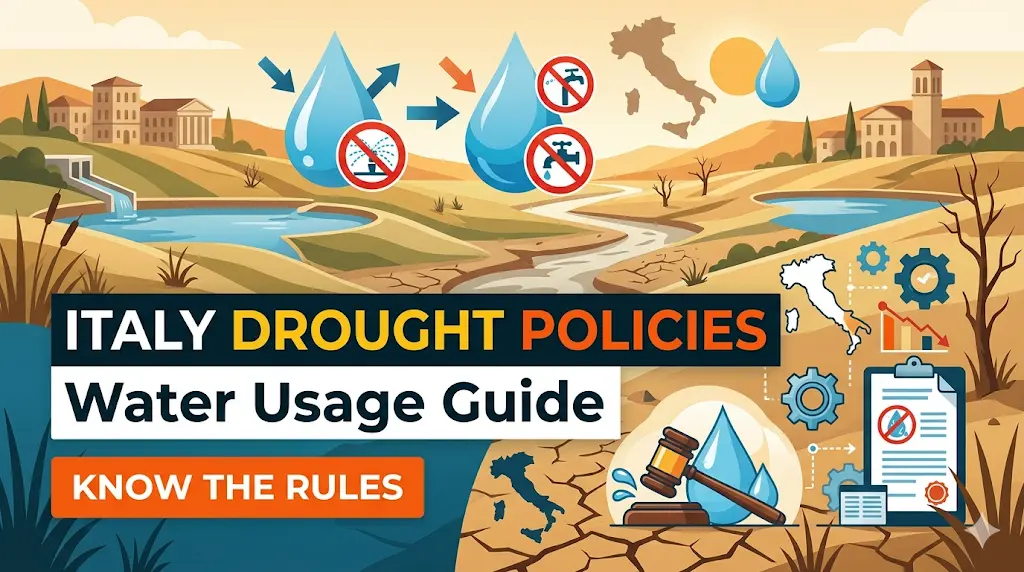
When an ordinanza sindacale is enacted, it specifically targets “improprio” (improper) water usage. The exact restrictions vary by town, but they universally prohibit the use of drinking water (acqua potabile) for anything other than domestic, personal hygiene, and sanitary purposes.
If you are caught violating these rules, the fines typically range from 25 to 500 euros per infraction. The most common violations that trap unaware expats include:
- Washing your car: Washing a private vehicle in your driveway using a hose connected to the municipal water supply is strictly forbidden during a drought alert. You must use commercial car washes, which recycle their water.
- Watering the garden during the day: Most ordinances completely ban watering lawns and gardens. If they do allow it, it is usually restricted to the dead of night (e.g., between 11:00 PM and 5:00 AM) to prevent rapid evaporation.
- Filling swimming pools: Filling private inflatable or structural pools with municipal tap water is heavily penalized.
- Hosing down patios: Using a hose to clean a terrace, balcony, or sidewalk is considered a massive waste of potable water and will result in an immediate fine if a neighbor reports you.
Understanding your civic duties is part of integrating into the culture. If you are supporting a family under the Conditions for working while on Italy Family Reunification Visa, ensuring your entire household understands these rules prevents costly fines that could strain a single-income budget.
| Drought Severity Level | Typical Trigger | Common Municipal Restrictions |
| Code Yellow (Pre-Alert) | Below average spring rainfall | Voluntary reduction in usage, advisories on showering vs. bathing. |
| Code Orange (Alert) | Dropping reservoir levels | Ban on washing private cars, filling swimming pools, watering lawns during the day. |
| Code Red (Emergency) | Critical depletion of aquifers | Complete ban on non-essential use; nightly water shutoffs (e.g., 10 PM to 6 AM). |
Proactive Water Management
To avoid waking up with a dry tap or a massive fine, you must stay aggressively informed. The biggest hurdle is that municipal websites are notoriously archaic and entirely in Italian. When a water main breaks or a rolling shutoff is scheduled, the town hall will often post a rapid alert on their social media pages or website.
If you have just moved into a new apartment, your home Wi-Fi might take weeks to activate. Waiting for a router while a drought emergency unfolds is a recipe for disaster. Using an Airalo eSIM completely bypasses this vulnerability. By downloading an eSIM from Airalo before your flight lands, you guarantee immediate, high-speed mobile data the second you walk into your new home. Having Airalo data means you can instantly translate the complicated PDF ordinances posted on the comune website, ensuring you know exactly when the water will be turned off and what you are legally allowed to do.
Furthermore, maintaining a clean administrative profile with the municipality ensures you actually receive official notices. If you relocate to a new apartment, executing the precise steps in How to change your address with the Questura in Italy ensures your legal residency matches your physical location. If you fail to update your address, you will not receive official notices regarding local utility rationing, placing you at a severe disadvantage. The state views compliance holistically; the Consequences of losing your permesso di soggiorno card or letting your legal status lapse can completely paralyze your ability to set up utility contracts in your own name, leaving you entirely dependent on a potentially absent landlord during a severe water crisis.
Even if you navigate the complexities of the Italian visa policy for dual nationals and hold an Italian passport, you are not immune to the localized realities of the country’s aging infrastructure. Prepare a robust Checklist: All You Need Before Moving to Italy that includes planning for domestic water storage, secure a bridge apartment to test the neighborhood’s grid, and learn to embrace the shorter, more efficient showers that define an authentic Italian summer.
References
Primary sources (official)
- Ministero dell’Ambiente e della Sicurezza Energetica (Ministry of Environment and Energy Security): https://www.mase.gov.it/
- ARERA (Italian Regulatory Authority for Energy, Networks and Environment): https://www.arera.it/en/
Other helpful sources
- ISTAT (Italian National Institute of Statistics – Water Resources Data): https://www.istat.it/
- Utilitalia (Federation of Environmental and Energy Utilities): https://www.utilitalia.it/
Disclaimer
The information provided in this article is for general informational purposes only and does not constitute official legal, municipal, or environmental advice. Italian drought policies, water rationing schedules, and municipal fines for improper water usage (ordinanze sindacali) are highly localized and subject to sudden changes depending on regional reservoir levels. Always verify current water restrictions directly with your local town hall (Comune) or your regional water utility provider to ensure strict compliance with local laws.