Italian Language and Everyday Communication for Visitors
Standing in a crowded Roman piazza, you quickly realize the five phrases you learned on the plane aren't helping you find the correct platform or explain a food allergy. I remember my first month in Florence, sweating through my shirt because I couldn't figure out how to ask for a stamp at the Post Office. This guide solves your communication anxiety by providing the real-world linguistic tools and cultural cues you actually need for a smooth trip.
Disclosure: This post may contain affiliate links. We may earn a commission at no extra cost to you if you make a purchase through these links. Read full disclosure.
The Survival Italian Toolkit
Greetings and the Art of Politeness
When you first arrive in Italy, the instinct is often to lead with "Ciao." However, one of the first things I learned the hard way is that "Ciao" is quite informal. It is reserved for friends, family, and people you already know well. If you walk into a boutique or a family-run trattoria and shout "Ciao!" to the elderly owner, you might receive a polite nod, but you haven't started off on the right foot regarding Italian Customs, Etiquette, and Social Life. Instead, your best friends are "Buongiorno" (Good morning) and "Buonasera" (Good evening). The transition from one to the other usually happens right after lunch, around 1:00 PM or 2:00 PM.
Politeness in Italy is also about using the formal "Lei" instead of the informal "Tu." While you don't need to master complex grammar, simply adding "Per favore" (please) and "Grazie" (thank you) to everything will open doors. I’ve seen tourists get frustrated because they feel ignored at a counter, but often it’s because they didn't offer a "Buongiorno" before launching into a request. In Italy, the social greeting is the "key" that unlocks the service. If you are struggling with a specific interaction, remember that showing effort counts for double. Even a butchered "Scusi, non parlo bene l'italiano" (Excuse me, I don't speak Italian well) will usually result in the local switching to English or using slow, clear gestures to help you.
Furthermore, don't forget the importance of "Prego." You will hear this word constantly. It means "You're welcome," but it also means "Please, come in," "How can I help you?" or "After you." If a waiter gestures to a table and says "Prego," he is inviting you to sit. If you say "Grazie" and they respond with "Prego," they are being polite. It is the multi-tool of the Italian language. Understanding the context of this one word will make you feel significantly more "in the know" as you navigate daily interactions.
Navigating the Bar and Restaurant
The Italian "bar" is not a place for late-night cocktails—well, it can be, but primarily it is the hub for coffee and breakfast. Communication here is fast-paced and follows a specific rhythm. In many busy city centers, you are expected to pay at the "cassa" (cashier) first, then take your "scontrino" (receipt) to the counter. I remember standing at the bar in Milan for ten minutes wondering why the barista was ignoring me, only to realize I was supposed to wave my receipt at him like a flag. If you want to fit in, learn How to Order Coffee in Italy Like a Local and remember that a "latte" is just a glass of milk. If you want coffee with milk, you need a "caffè latte" or a "cappuccino."
When it comes to lunch and dinner, the language changes. You will often be asked "Siete in quanti?" (How many are you?). You can respond with numbers on your fingers, but saying "Tavolo per due, per favore" sounds much smoother. Once seated, you'll encounter the "coperto," which is a small cover charge. Don't mistake this for a tip or a scam; it's a standard fee for bread and table service. If you are looking for a truly local experience, you should focus on How to Find Authentic Restaurants in Italy (Not Tourist Traps) where the menu might only be in Italian. In these cases, knowing "carne" (meat), "pesce" (fish), and "verdure" (vegetables) is essential.
Water is another communication hurdle. It is never free and rarely served from the tap. You will be asked "Naturale o frizzante?" (Still or sparkling?). If you just say "Acqua," the waiter will wait for the clarification. Also, be prepared for the bill ritual. In Italy, it is considered rude for a waiter to bring the bill before you ask for it—they don't want to rush you. You must catch their eye and say, "Il conto, per favore." This is a core part of the Italian Food Culture: Eating Well as a Visitor experience, where meals are meant to be lingered over, not processed like an assembly line.
Asking for Help and Directions
Asking for directions in Italy is less about GPS coordinates and more about local landmarks. If you ask "Dov'è la piazza?" you might get a response like "Sempre dritto" (Straight ahead) or "Gira a destra" (Turn right). I’ve spent countless hours wandering the backstreets of Venice because I misunderstood "dietro" (behind) for "dentro" (inside). It is helpful to have the name of your destination written down or pulled up on your phone. If you are using public transit, knowing the difference between "Binario" (Platform) and "Uscita" (Exit) will save you from missing your train.
If you find yourself truly lost, look for a "Tabacchi"—these are shops marked with a large "T" sign. They are the unofficial information centers of Italian life. Here you can buy bus tickets, stamps, and phone credit. The people working there are used to quick, transactional Italian, so it's a great place to practice your "Vorrei un biglietto per l'autobus" (I would like a bus ticket). If you are traveling between cities, you might use services like Omio to compare routes, but you will still need to communicate with local staff when things like strikes or delays happen.
In the event of a more serious issue, such as a wrong turn into a restricted traffic zone, you should be aware of What Is a ZTL in Italy and How to Avoid Fines. Communicating with a traffic officer or a rental agency requires a different level of vocabulary. "Ho fatto un errore" (I made a mistake) goes a long way. Most Italians are incredibly sympathetic to tourists who are clearly trying to follow the rules but got tripped up by the confusing signage. A little humility and a few keywords can often de-escalate a stressful situation.
Non-Verbal Communication: The Italian Secret Language
Mastering the Hand Gestures
You’ve seen the memes, but the reality of Italian hand gestures is a sophisticated linguistic layer that exists alongside spoken words. It is not just about waving hands; it is about emphasis, emotion, and sometimes, entire sentences. The most famous is the "pinecone hand," where fingers are bunched together and moved up and down. This usually means "What are you talking about?" or "What do you want?". I remember using this accidentally when I was just trying to describe a piece of fruit, and the vendor thought I was questioning his prices! Use it sparingly and only when you are genuinely confused.
Another essential gesture is the "chin flick," where you brush the back of your fingers forward from under your chin. This essentially means "I don't care" or "It doesn't matter to me." It’s a bit dismissive, so be careful using it in formal settings. Conversely, if you want to show that something is delicious, you press your index finger into your cheek and rotate it. This is a silent compliment to the chef that transcends any language barrier. It’s particularly effective in small family-run places where the grandmother is watching you eat from the kitchen door.
Gestures also help with scale and quantity. Rubbing your thumb against your index and middle fingers signifies "expensive" or "money." Tapping the side of your nose means "watch out" or "someone is being clever." When you combine these with basic Italian, you become much more expressive. It allows you to communicate the feeling of your message even if you can't find the exact adjective. Observe locals in a piazza; they are essentially performing a dance that provides a subtext to every conversation.
Eye Contact and Personal Space
Communication in Italy is "high-contact." This means that the bubble of personal space is much smaller than in many English-speaking countries. If you are talking to someone, they will stand closer to you than you might be used to. Retreating can be seen as cold or unfriendly. Eye contact is also vital. In Italy, looking someone in the eye when you say "Salute" (Cheers) or "Buongiorno" is a sign of respect and honesty. If you look at the floor, you might appear suspicious or bored.
Physical touch is also more common. A light touch on the arm during a conversation is a way of establishing a connection. However, as a visitor, you should follow the local's lead. You’ll notice that men often hug or walk arm-in-arm, and women frequently kiss both cheeks when greeting. For a first-time visitor, a firm handshake is always appropriate, but don't be surprised if the interaction quickly becomes more "physical." Understanding these boundaries is a major part of Italian Customs, Etiquette, and Social Life.
In crowded places like the Rome Metro, the "push" is common and not usually intended to be aggressive. It's just part of the flow of life. If you need to get past someone, say "Permesso" (Permission). This is much more effective than "Scusa." "Permesso" is specifically used when you are moving through a space or entering a room, whereas "Scusa" is for when you've already stepped on someone’s toe. Using the right word in the right space shows you understand the social choreography of the country.
Reading the Room (The Bella Figura)
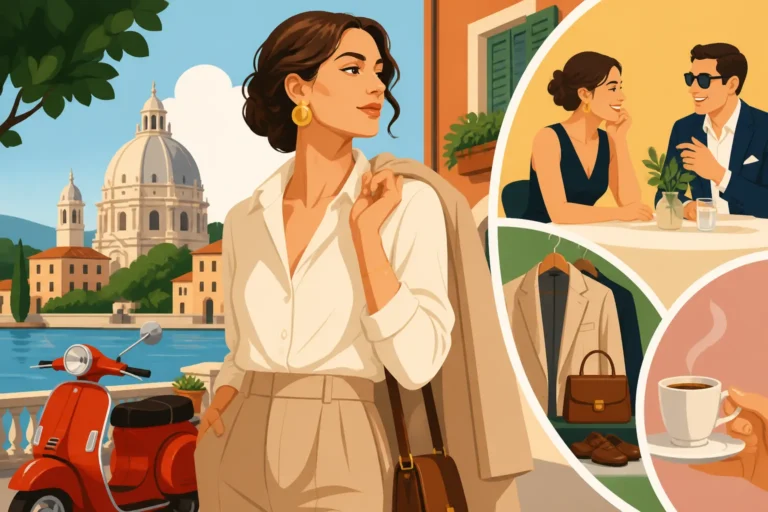
The concept of "Bella Figura" (Beautiful Figure) is the guiding principle of Italian social communication. It isn't just about dressing well; it’s about presenting yourself with dignity, grace, and politeness. This affects how you communicate because it dictates the level of decorum expected in public. For instance, raising your voice in a heated argument or getting visibly drunk in a piazza is considered "Brutta Figura" (Bad Figure). If you remain calm and polite, even when you are frustrated with a late train, you are more likely to get help.
Communication also involves how you dress for certain environments. If you try to enter a cathedral in a tank top and shorts, you are "communicating" a lack of respect for the culture. Often, the staff won't even speak to you; they will simply point to the exit. Dressing appropriately is a non-verbal way of saying "I value your traditions." I always keep a light scarf in my bag to cover my shoulders, which has saved me from many awkward "No" encounters at church entrances.
Finally, understand the rhythm of the day. From roughly 12:30 PM to 4:00 PM, many shops close for "riposo" (rest). Trying to bang on a door or calling a business during these hours is seen as a breach of social etiquette. They aren't being lazy; they are prioritizing family and food. Respecting this silence is a form of communication in itself. It says that you are an observer who understands that Italy does not revolve around the 24/7 convenience culture of the US or UK.
Practical Communication for Transit and Travel
Buying Tickets and Validating Machines
One of the most stressful communication moments for visitors is the train station. While apps like Omio are fantastic for booking High-Speed Trains in Italy: Trenitalia, Italo, Routes, and Savings, you will still find yourself standing in front of a self-service machine or a ticket window ("biglietteria"). If the machine is broken—a common occurrence—you’ll need to approach the counter. Start with "Vorrei un biglietto per…" and have your destination ready. Be aware that many smaller stations have limited English-speaking staff, so keep it simple.
The biggest "gotcha" in Italian transit isn't the ticket itself, but the validation. If you have a regional paper ticket, you must validate it in the small green or yellow machines ("obliteratrice") on the platform before boarding. If you don't, you are communicating to the ticket inspector that you are trying to ride for free. I've seen tourists try to explain their way out of a 50-euro fine using English, but the inspectors are often unmoved. The silent act of punching your ticket is the most important "word" you will use on the train.
For city buses and trams, you usually cannot buy tickets on board. You need to find a "Tabacchi" or a newsstand ("Edicola"). If you board without a ticket and try to buy one from the driver, they will likely just shrug or ignore you. In Rome or Milan, many people now use contactless "Tap & Go" systems. If you use this, keep your card handy; if an inspector comes by, you just tap your card on their handheld reader. It’s a silent, efficient way to prove you’ve paid.
Checking into Accommodations
When you book your stay through Booking.com, you have the advantage of an integrated messaging system. Use this! I always send a message in a mix of English and basic Italian: "Arriveremo alle ore 15:00. Grazie!" (We will arrive at 3:00 PM. Thank you!). This sets a professional and polite tone before you even arrive. When you show up at a B&B or a small hotel, the check-in process is a formal exchange. You will be asked for your "Documenti" (Passports). This is a legal requirement for the "Alloggiati Web" police reporting system, so don't be alarmed when they take your passport to the back room for a few minutes.
Communicating about room issues requires a balance of "Bella Figura" and firmness. If the air conditioning isn't working, don't start with a complaint. Start with "Scusi, c'è un problema con l'aria condizionata." (Excuse me, there is a problem with the air conditioning). In Italy, solving problems often involves a bit of "chiacchiera" (small talk). If you are friendly with the host, they will go out of their way to fix things. If you are demanding and loud, things might "take a few days" to get repaired.
You should also ask about the "tassa di soggiorno" (tourist tax). This is often paid in cash upon arrival or departure and is not included in the online booking price. Asking "Dobbiamo pagare la tassa di soggiorno?" shows you are an experienced traveler. Also, confirm the breakfast times ("A che ora è la colazione?") and the checkout time ("A che ora è il check-out?"). These small clarifications prevent any awkwardness on your final morning.
Booking Tours and Sightseeing
For major attractions like the Vatican or the Uffizi, you’ll likely use GetYourGuide to skip the lines. However, once you meet your guide, communication remains key. Most guides speak excellent English, but if you are in a large group, stay close and use "Scusi?" if you miss a detail. If you are doing a "free" walking tour, remember that communication includes the tip at the end. While tipping is not mandatory in restaurants, for a guided tour, a tip of 5-10 euros per person is a standard way of saying "You did a great job."
When visiting sites independently, you might encounter "No entry" signs like "Vietato l'ingresso." Respect these. If you want to take a photo but aren't sure if it's allowed, catch the eye of a guard and point to your camera while saying "Si può?". A simple nod or a "No, mi dispiace" (No, I'm sorry) will give you the answer. It’s always better to ask permission than to be yelled at in front of a crowd of tourists.
Communication at popular landmarks also involves managing street vendors. You will be approached by people selling water, selfie sticks, or "skip-the-line" tickets. A firm "No, grazie" while maintaining your walking pace is the best way to handle this. If you hesitate or engage in conversation, they will take it as an invitation to keep selling. In the world of Italian tourism, "No" is a complete sentence and should be delivered with a polite but final tone.
| English Phrase | Italian Equivalent | When to Use It |
|---|---|---|
| Good morning / Good evening | Buongiorno / Buonasera | Entering any shop, restaurant, or greeting a stranger. |
| Please / Thank you | Per favore / Grazie | Essential for every single interaction. |
| Excuse me (to get attention) | Scusi | To catch a waiter's eye or ask a stranger for help. |
| Excuse me (to pass through) | Permesso | When moving through a crowd or entering a room. |
| The bill, please | Il conto, per favore | At the end of a meal (never brought automatically). |
| I don't speak Italian | Non parlo italiano | To signal you need to switch to English or gestures. |
| Still / Sparkling water | Naturale / Frizzante | When ordering water at a restaurant. |
| Where is…? | Dov'è…? | Searching for a bathroom, platform, or landmark. |
Dealing with Bureaucracy and Services
Post Offices and Tabacchi
The Italian Post Office ("Poste Italiane") is a legendary place of wait times and confusion. If you need to send a postcard or a package, you must first take a ticket from a kiosk. The kiosk will have various buttons; for a simple stamp, look for "Corrispondenza." I once waited forty minutes in the wrong line because I didn't realize there were separate categories for "pensioners" and "general mail." If in doubt, point to your postcard and ask the person at the door, "Quale pulsante?" (Which button?).
A "Tabacchi" is much easier to navigate. Besides cigarettes, they sell "bolli" (stamps) and "biglietti" (tickets). If you need to top up a local SIM card, you can do it here by saying "Ricarica" and giving them your phone number. These shops are usually family-run and very efficient. They are the heartbeat of the neighborhood. If you are staying in an Airbnb for a week, becoming a "regular" at the local Tabacchi by saying "Buongiorno" every morning is a great way to feel like part of the community.
You might also see "Edicola" (newsstands). These are great for maps and local magazines. Even if you don't read Italian, buying a local paper can be a fun way to practice. The interaction is simple: point to the item, pay the price shown on the cover, and say "Grazie, arrivederci." These small, successful exchanges build your confidence for more complex tasks like Registering With Your Local ASL in Italy: A Practical Guide if you ever decide to stay longer.
Pharmacies and Medical Needs
Italian pharmacies ("Farmacia") are marked by a glowing green cross. They are not like US drugstores; they are clinical environments where the pharmacist is a highly trained professional who can give medical advice. If you have a minor ailment like a cold or a headache, you don't need to go to a doctor. You can go to the Farmacia and explain your symptoms. Use simple words: "Dolore" (Pain), "Tosse" (Cough), "Febbre" (Fever).
The pharmacist will often recommend a "sopra il bancone" (over-the-counter) medication. If you have a specific brand from home, show them the active ingredient (e.g., Ibuprofen or Paracetamol), as the brand names will be different. If you find yourself in a situation where you need more urgent help, you should know Emergency Medical Numbers in Italy (112, 118, 1500). Calling 112 is the standard for any emergency. If you don't speak Italian, stay calm and say "English, please." They will usually transfer you to an English-speaking operator.
For late-night needs, you’ll need to find a "Farmacia di turno" (on-duty pharmacy). Each pharmacy has a sign in the window listing which local shop is open after hours. This is a vital piece of information because most pharmacies close at 7:30 PM. Communicating with an on-duty pharmacist at 2:00 AM through a small window in the door can be intimidating, but stay polite and state your need clearly. They are there to help, and their English is often better than you’d expect.
The Digital Barrier (SPID and Online Booking)
Italy is rapidly digitizing, but it can be a barrier for visitors. Many services now require "SPID" (a digital identity system), which tourists cannot get. However, you will encounter the "CUP" system for booking medical appointments or regional sites. For most visitors, the communication happens through third-party websites. If a site looks like it requires an Italian tax code ("Codice Fiscale") to book a ticket, try entering your passport number or looking for a "Foreign Resident" checkbox.
Many museums and trains now use QR codes for tickets. Ensure your phone is charged! Communicating with a ticket controller with a dead phone is a nightmare. I always carry a printed backup of my Omio or Booking.com confirmations. It's a non-verbal "safety net" that saves a lot of stress. If a digital scanner isn't working, simply show the printed paper and say "Non funziona" (It doesn't work). The staff will usually just wave you through or manually enter the code.
For dinner reservations, many restaurants now use apps like TheFork or their own websites. This is a blessing if you are nervous about speaking on the phone. However, if you have to call, be prepared for a very fast "Pronto!" (Ready/Hello). State your name, the number of people, and the time. "Prenotazione per Rossi, due persone, alle otto" (Reservation for Rossi, two people, at eight). If they say "Tutto esaurito," it means they are fully booked. Don't argue; just say "Grazie lo stesso" (Thanks anyway) and try the next place.
Cultural Nuances and Social Etiquette
The Tipping Debate
One of the most frequent questions I get is, "Do I tip in Italy?". The short answer is: you don't have to, and it’s not expected in the way it is in North America. Waiters are paid a living wage, and the "coperto" covers the service basics. However, if you've had an exceptional experience, leaving a few euros on the table is a nice gesture. This is a silent way of communicating "I really enjoyed this." For a deeper dive, check out Tipping in Italy: When, Where, and How Much.
In coffee bars, you might see a small jar for "mance" (tips). People often leave their 10 or 20-cent change there. It’s not about the money; it’s about the acknowledgment. If you are paying for a 1.20 euro coffee with a 2-euro coin, saying "Tenga pure il resto" (Keep the change) is a very "local" thing to do. It communicates that you aren't just a tourist, but someone who understands the local flow.
In taxis, it's common to round up to the nearest euro. If the fare is 14.20 euros, give them 15 and say "Va bene così" (It's fine like this). This simplifies the interaction and avoids the awkwardness of fumbling for small coins in the backseat. Remember, communication about money in Italy should always be discreet. Don't make a big show of tipping; just leave it or mention it quietly.
Dining Times and Expectations
Communication about food in Italy is also about timing. Italians eat late. Lunch is at 1:00 PM, and dinner rarely starts before 8:00 PM. If you show up at a restaurant at 6:30 PM, the doors might be locked, or the staff will be eating their own meal. This isn't a lack of service; it’s a cultural boundary. If you are hungry early, look for an "Aperitivo." This is the time between 6:00 PM and 8:00 PM when you buy a drink and get some small snacks.
During a meal, the waiter will not check on you every five minutes. In some cultures, this is seen as bad service, but in Italy, it's the opposite. The waiter is communicating respect for your privacy and your conversation. If you need something, you have to be proactive. Raise your hand slightly or catch their eye. Don't shout "Cameriere!". A simple "Scusi" as they walk by is the way to go.
Also, be prepared for the "No" when it comes to food modifications. If you ask for a cappuccino after a heavy dinner, the waiter might actually say "No" or give you a look of genuine concern. This is because Italians believe milk after a meal ruins digestion. They aren't trying to be difficult; they are communicating their cultural belief in food harmony. If you insist, they will serve it, but you have definitely made a "Brutta Figura."
Shopping and Market Interactions
Shopping in Italy ranges from the high-end boutiques of Via Montenapoleone to the chaotic local markets. In a boutique, the interaction is very formal. Wait to be greeted before you start touching the clothes. Say "Sto solo guardando, grazie" if you are just looking. If you want to try something on, point to the item and ask "Posso provare?". The salesperson will then lead you to the "camerino" (fitting room).
In local food markets, the rules are different. Most importantly: Do not touch the produce. This is the number one mistake tourists make. You point to what you want, and the vendor picks it for you. You say "Mezzo chilo di pomodori, per favore" (Half a kilo of tomatoes, please). This is a health and safety thing, but also a matter of respect for the vendor’s goods. If you start squeezing the peaches, you will be scolded quite loudly.
Market communication is also about "quanto costa?" (how much does it cost?). While prices are usually marked, in some flea markets, you can "contrattare" (haggle) a little. However, don't do this for food or in regular shops. Haggle only if you are buying multiple items or if the item is clearly an antique/second-hand. Use phrases like "È un po' caro" (It's a bit expensive) and see if they budge. If they don't, pay the price or walk away with a polite "No, grazie."
Regional Differences in Dialects and Accents
North vs. South Communication Styles
As you move from Milan to Naples, you’ll notice the language changes. In the North, Italian is often spoken more clearly and at a slightly slower pace, with a focus on formal politeness. In the South, the language is faster, more melodic, and heavily accented. You might find that the "Buongiorno" in Naples sounds more like "Bongiorn'" with the final vowel cut off. This is part of the charm of the country, but it can be challenging for your ears.
The South is also much more "extroverted" in its communication. People will strike up conversations with you at a bus stop or in a shop. In the North, people tend to be more "riservato" (reserved). I’ve found that in Rome, the language is a mix—blunt, funny, and very direct. If a Roman waiter is "rude" to you, he’s probably just being Roman. Don't take it personally; it's just the local dialect of social interaction.
Understanding these regional vibes helps you adjust your own communication. In Venice, things are quiet and formal. In Palermo, they are loud and passionate. If you try to use your formal Milanese-style Italian in a Sicilian market, you might sound a bit stiff. Don't be afraid to mimic the local intonation a little bit; it shows you are tuned into the local frequency.
Common Dialect Words for Travelers
While everyone speaks standard Italian, you will hear dialect words everywhere. In Tuscany, they have a "gorgia toscana," where the letter 'c' is pronounced like an 'h'. So "Coca-Cola" sounds like "Hoha-Hola." It’s a famous linguistic quirk. In Rome, you’ll hear "Aò!" as a way of saying "Hey!". It’s very informal and you shouldn't use it, but knowing what it means helps you understand the environment.
In Naples, the word "Guaglió" is used for "young man" or "hey you." In the North, you might hear "Ué" as a greeting. These aren't words you’ll find in a textbook, but they are the "background noise" of Italy. If you hear someone say "Basta!" they mean "Enough!" or "Stop!". It’s a very useful word to know if a street vendor is being too persistent or if someone is trying to give you too much food.
Regional food words are the most important dialects for you. In Genoa, "pesto" is king. In Rome, you need to know "Guanciale." If you go to a bakery in Puglia, you ask for "Focaccia Barese." Using these regional terms communicates that you have done your homework and respect the local culinary heritage. It often leads to a better quality of food because the vendor knows you aren't just looking for "spaghetti bolognese."
Adapting Your Listening Ear
The biggest challenge isn't speaking Italian; it's understanding it when it's spoken back to you at 100 miles per hour. When an Italian realizes you speak a little of their language, they often forget you aren't fluent and launch into a long explanation. Don't panic. Listen for keywords. If you are asking for the bathroom and they say a long sentence ending in "destra," you know to go right.
If you are totally lost, use "Può ripetere più lentamente, per favore?" (Can you repeat more slowly, please?). This is the most powerful phrase in your arsenal. Most Italians are happy to slow down if they know you are genuinely trying. Also, pay attention to their hands—they are often "drawing" the instructions in the air for you.
Finally, remember that the "melody" of the sentence tells you a lot. A rising tone at the end is a question. A sharp, staccato tone is often a warning or an instruction. You can often understand the intent of a person without knowing a single word they said. Trust your instincts. If someone looks concerned and is pointing at your backpack, they are likely trying to warn you about Avoiding Pickpockets in Italy's Tourist Areas.
Emergency Situations and Essential Phrases
Medical Emergencies
If you find yourself in a medical crisis, the first word you need is "Aiuto!" (Help!). If you are in a public place and someone collapses, shout "Chiamate un'ambulanza!" (Call an ambulance!). As mentioned before, 112 is your go-to number. If you are at a hospital ("Pronto Soccorso"), the triage system uses colors. Red is immediate, yellow is urgent, and green/white is non-urgent. Communicating your symptoms accurately is vital.
If you have a chronic condition, have it written down in Italian on a card in your wallet. For example, "Sono diabetico" (I am diabetic) or "Sono allergico alle arachidi" (I am allergic to peanuts). This is a silent form of communication that can save your life if you are unable to speak. For more details on the system, read Emergency Medical Services in Italy: 112 and Hospitals.
In less dire situations, such as a sprained ankle, you might go to a "Guardia Medica." This is an after-hours doctor service for non-emergencies. You will need to explain what happened: "Sono caduto" (I fell). Be prepared to wait, as these clinics are often busy. However, the service is usually excellent and often free or very low cost for tourists.
Reporting Lost Items
Losing a passport or a wallet is a nightmare, but the communication process is straightforward. You need to go to the "Polizia" or "Carabinieri" to file a "denuncia" (report). You will say "Ho perso il mio portafoglio" (I lost my wallet) or "Mi hanno rubato la borsa" (My bag was stolen). This report is essential for insurance purposes and for getting a replacement passport from your embassy.
The officers might not speak much English, so have your details ready: where it happened, what was inside, and your local address. If you have a photo of your lost passport on your phone, show it to them. It speeds up the process significantly. Stay calm and patient; the bureaucracy can be slow, but the "denuncia" is a vital legal document.
If you lose something on a train, look for the "Oggetti Smarriti" (Lost Property) office at the main station (like Roma Termini or Milano Centrale). You’ll need to describe the item: "Uno zaino nero" (A black backpack). Often, items do turn up, but the process of reclaiming them involves a bit of paperwork and a small fee.
Getting Help in English (When All Else Fails)
If you are in a situation where you simply cannot communicate and the stakes are high, look for younger people. Most Italians under the age of 30 have studied English in school and are often eager to practice. You can ask "Parla inglese?" (Do you speak English?). If they look hesitant, they might still understand more than they can say.
In major tourist hubs, there are "Tourist Information" kiosks. The staff here are multilingual and can help with everything from booking a hotel to finding a lost dog. They are a great resource if you are feeling overwhelmed by the language barrier. Also, your hotel concierge is a professional communicator. If you need to make a complex phone call to a local business, ask them to do it for you.
Finally, use technology. Google Translate’s "conversation mode" or the camera feature that translates signs in real-time is a lifesaver. It’s not perfect, but it bridges the gap. Just don't rely on it entirely; the effort of trying to speak the language yourself is what will truly enrich your travel experience and win you the respect of the locals.
Disclaimer
The information provided in this guide is for general informational purposes only and does not constitute legal, medical, or professional advice. While we strive to provide accurate and up-to-date information, Italian laws, travel regulations, and service availability can change frequently. Always consult official government websites or local authorities for the most current information regarding visas, health requirements, and safety protocols. The author and publisher are not responsible for any issues or losses incurred while traveling in Italy based on the suggestions in this article.