Italian Wine Regions: A Beginner’s Guide
You’ve finally made it to an enoteca in Florence, and the wine list is a wall of unfamiliar names. Is Montepulciano a grape or a town? Why does every bottle mention DOC? Which one goes with the wild boar? This guide covers Italy’s main wine regions, the label system, which grapes come from where, and how to plan tastings without stress.
Disclosure: This post may contain affiliate links. We may earn a commission at no extra cost to you if you make a purchase through these links. Read full disclosure.
Why Italian Wine Feels So Confusing at First
If Italian wine has ever made you feel out of your depth, the problem isn’t you. I spent my first year in Italy ordering “the red one, the house one, thank you,” because I didn’t want to look foolish in front of a waiter who’d clearly been drinking Barbera since he was twelve. The system really is complicated. Italy grows hundreds of native grape varieties, and almost every province has its own traditions, rules, and pride.
The good news is that you don’t need to memorise all of it. A few patterns cover most of what you’ll see on wine lists and supermarket shelves. Once those make sense, you’ll find yourself reading labels with confidence instead of grabbing whatever has the nicest drawing on it.
Grapes, Places, and Names That Don’t Match
Many New World wines are labelled by grape: Merlot, Chardonnay, Cabernet. Most Italian wines are labelled by place. Barolo is a village and an area in Piedmont, and the grape inside the bottle is Nebbiolo. Chianti is a territory in Tuscany, and the main grape is Sangiovese. Soave is a town in the Veneto, and the wine is mostly made from Garganega.
Then Italy adds a twist. Some names combine grape and place, such as Barbera d’Asti, which is Barbera grapes from around Asti. Others look like they follow the same pattern but don’t. The classic trap is Vino Nobile di Montepulciano, a Tuscan wine made mainly from Sangiovese in the town of Montepulciano. Montepulciano d’Abruzzo, on the other hand, is made from the Montepulciano grape in the Abruzzo region. The same word means a town in one bottle and a grape in the other.
Picture this: you’re at dinner in Rome and you order “a Montepulciano” because you loved one in Siena. The bottle that arrives is softer, darker, and very different. You haven’t misremembered anything. You’ve just met the most famous naming quirk in Italian wine. Waiters see this all the time, so it’s fine to ask which one they mean.
Reading the Label: DOCG, DOC, IGT, and Vino da Tavola
Italy sorts its wines into a quality pyramid based on how strictly production is regulated. Each tier tells you something about where the wine comes from and what rules the winemaker followed. It doesn’t guarantee you’ll like it.
| Label Tier | What It Means | What to Expect as a Beginner |
|---|---|---|
| DOCG | Denominazione di Origine Controllata e Garantita, the strictest tier, with tight rules on area, grapes, and production | Famous names such as Barolo, Brunello di Montalcino, Chianti Classico; usually a neck strip on the bottle |
| DOC | Denominazione di Origine Controllata, a defined area with set production rules | The bulk of reliable regional wines, often excellent value |
| IGT | Indicazione Geografica Tipica, a broader regional label with more freedom on grapes and style | Includes everyday wines and also some prestigious experimental bottles, such as many Super Tuscans |
| Vino da Tavola or Vino | Basic wine with minimal geographic claims | House carafes and simple bottles; sometimes charming, sometimes forgettable |
Many beginners assume IGT means lesser quality. Some of the most sought-after Tuscan reds have carried IGT labels simply because their winemakers wanted to use grapes, such as Cabernet Sauvignon or Merlot, that the stricter rules didn’t allow. Read the tier as information about the rules, not as a score.
Other label words worth knowing: “Classico” refers to the historic heart of a zone, as in Chianti Classico or Soave Classico. “Superiore” usually means stricter requirements, such as more ageing or riper grapes. “Riserva” means the wine was aged longer before release. You’ll also see “rosso” for red, “bianco” for white, “secco” for dry, “dolce” for sweet, and “frizzante” or “spumante” for lightly or fully sparkling.
A Simple Mental Map: North, Centre, South
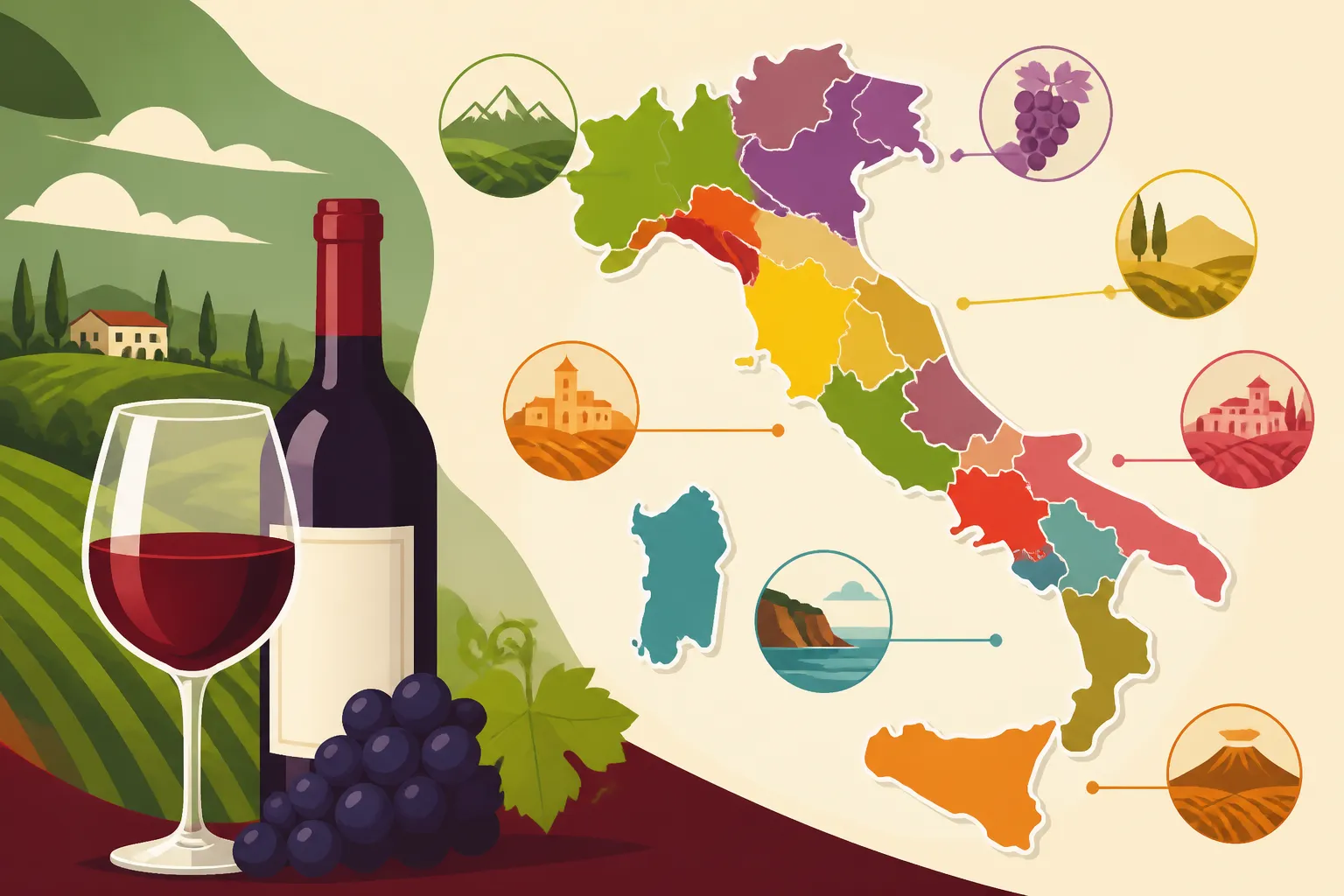
The easiest way to organise Italian wine in your head is by climate. The cooler, Alpine-influenced north is known for structured reds, aromatic whites, and quality sparkling wine. The hilly centre is Sangiovese country, with Tuscany at its core and a ring of underrated neighbours around it. The hot south and the islands produce bold, sun-drenched reds and, more and more, fresh whites grown on volcanic soils.
If you want the broader cultural side, including how wine sits alongside the espresso bar and the evening spritz, see Italian Wine, Coffee, and Aperitivo Culture. Below, we’ll go region by region.
Northern Italy’s Wine Regions
Northern Italy rewards curious drinkers. The landscapes run from the fog-wrapped hills of Piedmont to the vineyards stacked beneath the Dolomites, and the wines are just as varied. It’s also the easiest part of the country for wine tourism without a car, because rail connections are strong.
Piedmont: Nebbiolo Country
Piedmont, in the northwest, is where serious Italian wine lovers end up. Its best-known wines, Barolo and Barbaresco, both come from the Nebbiolo grape grown in the Langhe hills around the town of Alba. Nebbiolo has a pale colour that surprises first-timers, but it carries firm tannins and aromas often described as roses, tar, and cherries. These wines are built to age, and young bottles can feel grippy.
You don’t have to start with Barolo. Piedmont’s everyday wines are where many locals actually live. Barbera is juicy, bright, and food-friendly. Dolcetto is softer and meant to be drunk young. For whites, look for Arneis from the Roero hills and Gavi from the southeast of the region. Moscato d’Asti is a lightly sparkling, gently sweet wine that’s lovely with fruit desserts or on a hot afternoon.
Autumn here is magical and busy. The grape harvest overlaps with the white truffle season, and Alba’s truffle fair draws crowds. If you’re planning around that period, read Truffle and Harvest Season in Piedmont: Booking Around Alba’s Calendar before you commit to dates. For a fuller picture of the region, Piedmont: Wine, Truffles, and the Langhe covers villages, food, and scenery.
Veneto and Friuli: Prosecco, Amarone, and Crisp Whites
The Veneto makes more wine than almost any other Italian region, and it’s surprisingly diverse. Prosecco, made mainly from the Glera grape, comes from the hills between Conegliano and Valdobbiadene, where the steep slopes produce the most respected versions. Look for “Conegliano Valdobbiadene” on the label if you want something more interesting than the average party bottle.
West of Venice, around Verona, is Valpolicella. Its everyday reds are light and cherry-scented, mostly from the Corvina grape. The region’s star is Amarone della Valpolicella, made from grapes dried for months before fermentation. The result is rich, powerful, and warming, a wine for winter evenings and aged cheeses. Ripasso sits in between, made by passing young Valpolicella over the leftover skins from Amarone.
Further east, Friuli Venezia Giulia is known for some of Italy’s best whites. Friulano, Ribolla Gialla, and Pinot Grigio from the Collio and Colli Orientali hills are far more textured than the watery versions sold abroad. Friuli is also a stronghold of “orange wine,” white grapes fermented with their skins for an amber colour and a slightly tannic bite.
Trentino-Alto Adige and Lombardy: Mountain Wines and Franciacorta
Alto Adige, also called South Tyrol, feels like a different country, and partly it is. German is widely spoken, labels are often bilingual, and the wines are crisp and precise. Gewürztraminer takes its name from the village of Tramin here. Local reds include light, easy Schiava and dark, earthy Lagrein. Trentino, just south, is known for Trento DOC sparkling wine made by the traditional method.
Lombardy’s headline wine is Franciacorta, a traditional-method sparkling wine from the hills near Lake Iseo. It’s Italy’s main answer to Champagne, and you can combine a cellar visit with a lakeside lunch. In the far north, the Valtellina valley grows Nebbiolo, called Chiavennasca locally, on terraces carved into steep mountainsides. It’s a quieter, more alpine take on the grape than Barolo.
Central Italy’s Wine Regions
Central Italy is where most visitors take their first proper wine trip, and for good reason. The scenery is the postcard version of Italy, the food is built to go with the wine, and the main towns sit within reach of Florence, Siena, and Rome.
Tuscany: Sangiovese in Many Accents
Sangiovese is Tuscany’s backbone, and the fun of the region is tasting how differently it comes across from place to place. Chianti Classico, the historic zone between Florence and Siena, is marked by a black rooster on the bottle neck. It tends to be savoury, with sour cherry and herbs. The wider Chianti area, including sub-zones like Chianti Rufina, covers a larger territory and a broader range of styles.
South of Siena, Brunello di Montalcino is Sangiovese at its most structured and long-lived, while Rosso di Montalcino is the younger, earlier-released sibling and a good way to taste the town’s style for less. Vino Nobile di Montepulciano comes from the hilltop town of the same name and sits between the two in weight. On the coast, Bolgheri is home to the Super Tuscans, blends often based on Cabernet Sauvignon and Merlot, which brought international attention to the area. For a white, try Vernaccia di San Gimignano, a crisp, slightly bitter wine from one of Tuscany’s famous tower towns.
A typical beginner scenario: you base yourself in Florence and want one wine day. Chianti Classico is the obvious pick, since regional buses run into towns like Greve in Chianti. If you’d rather sleep among the vines, Where to Stay in Tuscany: Choosing a Base for Wine Country or the Coast walks through the trade-offs between towns, farmhouses, and coastal bases. Many agriturismi are working wine estates, and Booking.com lets you filter rural stays and read guest reviews about whether a tasting is actually offered on site.
Umbria, Marche, and Abruzzo: The Underrated Neighbours
Many people drive through Umbria on the way to somewhere else and never realise how good its wines are. Sagrantino di Montefalco is one of Italy’s most tannic reds, dense and dark, and best with grilled meats. Orvieto, near the dramatic cliff-top town of the same name, is a gentle, approachable white. Umbria’s wineries tend to be quieter than Tuscany’s, which can make visits more personal.
Over on the Adriatic side, Le Marche produces Verdicchio, a white that ranges from fresh and lemony to rich and age-worthy. It’s perfect with the region’s seafood. Further south, Abruzzo is the home of Montepulciano d’Abruzzo, a generous, plummy red that often costs less than wines of similar quality from better-known regions. Trebbiano d’Abruzzo is its white partner, and Cerasuolo d’Abruzzo is a deep-coloured rosé that locals drink happily all summer.
Emilia-Romagna: Lambrusco and the Food Valley
Emilia-Romagna is famous for Parmigiano Reggiano, prosciutto di Parma, and traditional balsamic vinegar, so it makes sense that its signature wine is built for rich food. Lambrusco, a sparkling red from around Modena and Reggio Emilia, has a reputation abroad for being sweet and cheap. The good dry versions are a revelation: purple, foamy, and refreshing alongside a plate of cured meats. The same logic of local wine for local dishes runs through Italian Regional Cuisine: How Food Changes Across Italy.
In the Romagna half of the region, closer to the Adriatic, Sangiovese di Romagna is a rustic, honest red, and Albana is a white with real character. These are everyday wines in the best sense, and you’ll find them by the carafe in trattorias across Bologna.
Southern Italy and the Islands
For years, southern wine was dismissed as bulk wine for blending. That reputation is well out of date. The south now produces some of Italy’s most exciting bottles, often from ancient native grapes grown on volcanic or sun-baked soils, and often at friendlier prices than their northern counterparts.
Campania and Basilicata: Volcanic Reds and Mineral Whites
Campania, the region around Naples, has a wine history going back to Roman times. Its great red grape is Aglianico, which produces Taurasi, a powerful, long-lived wine sometimes called the Barolo of the south. Its whites are among Italy’s finest: Fiano di Avellino is round and nutty, and Greco di Tufo is fresher and more mineral. Near Vesuvius, Lacryma Christi wines grow on volcanic slopes overlooking the bay.
Neighbouring Basilicata is best known for Aglianico del Vulture, grown on the slopes of an extinct volcano. Basilicata is less visited than Campania, so a winery trip here feels like a real discovery, and it pairs well with a stop in Matera.
Puglia: Primitivo and Negroamaro
Puglia, the heel of Italy’s boot, is warm, flat in many places, and full of vines. Primitivo, genetically related to the grape Americans know as Zinfandel, makes ripe, jammy reds, especially around Manduria. Further south in the Salento peninsula, Negroamaro produces darker, slightly bitter reds and some excellent rosés, which locals drink cold with seafood in summer.
Puglia’s wine scene is relaxed and welcoming. Many masserie, fortified farmhouses turned into guesthouses, make or source local wine, and dinners often feature bottles from producers just down the road.
Sicily and Sardinia: Island Wines With Their Own Identity
Sicily is a wine continent in itself. Nero d’Avola is the island’s best-known red, full and fruity. The hottest story, though, is Mount Etna, where vines grow on black volcanic soil at high altitude. Etna Rosso, made mainly from Nerello Mascalese, is elegant and perfumed, while Etna Bianco from Carricante is bright and saline. In the far west, Marsala is a fortified wine with a long trading history that’s worth tasting properly rather than only meeting it in a cooking sauce. To fit wine into a wider trip, Sicily for Travelers: Cities, Coast, and Volcanoes covers the island’s main bases.
Sardinia’s signature red is Cannonau, the same grape family as Grenache, and locals will happily tell you about the island’s long-lived villagers who drink it daily. In the northeast, Vermentino di Gallura is a crisp, herbal white that tastes exactly like a Sardinian beach holiday should.
Choosing Your First Wine Region to Visit
Now for the practical question: where should you actually go? Your answer depends on what kind of trip you want, whether you’ll drive, and when you’re travelling.
Matching a Region to Your Travel Style
| Region | Signature Wines | Best For | Car-Free Access |
|---|---|---|---|
| Piedmont, Langhe | Barolo, Barbaresco, Barbera, Moscato d’Asti | Serious wine lovers, foodies, autumn travellers | Possible via Turin and Alba, but limited between villages |
| Veneto, Valpolicella and Prosecco Hills | Amarone, Valpolicella, Prosecco, Soave | Combining wine with Venice or Verona | Good from Verona and Venice by train and bus |
| Lombardy, Franciacorta | Franciacorta sparkling wine | Lake trips, sparkling wine fans | Reasonable via Brescia and the lake line |
| Tuscany, Chianti and Montalcino | Chianti Classico, Brunello, Vino Nobile | First-timers, classic scenery, romantic trips | Buses from Florence and Siena, slower to remote estates |
| Umbria | Sagrantino, Orvieto | Quieter visits, mixing wine with hill towns | Orvieto is easy by train; Montefalco needs planning |
| Campania | Taurasi, Fiano, Greco di Tufo | Pairing wine with Naples and the coast | Inland wine zones are hard without a car |
| Sicily, Etna | Etna Rosso, Etna Bianco, Nero d’Avola | Adventurous drinkers, volcano lovers | Circumetnea railway and tours from Catania |
If this is your first wine trip and you want a gentle introduction, Tuscany or the Veneto is usually the easiest call. If you already love wine and want depth, Piedmont is hard to beat. If you’d like something that feels undiscovered, try Umbria, Abruzzo, or Etna.
Getting There Without Driving
Let me say this plainly, because it matters more than any tasting tip. Italy’s drink-driving limits are low and stricter still for newly licensed drivers, and police checks on country roads near wine zones happen. Several tastings in one day add up, even with small pours. Many expats I know have learnt to treat a wine day as either a designated-driver day or a no-car day.
Public transport covers more than you might expect. Trains reach Alba, Conegliano, Verona, Orvieto, and the Franciacorta area, and regional buses link Florence and Siena to Chianti and Montalcino. To compare train and coach options on the same screen, Omio is useful for seeing journey times and connections between a city base and a wine town, though for small local buses you’ll often need to check the regional operator’s own timetable. If you’re set on driving, read Renting a Car in Italy: ZTLs, Insurance, and Driving Tips first, because historic town centres often have restricted traffic zones that catch out visitors.
The simplest alternative is a guided tour with transport included. Platforms such as GetYourGuide list small-group wine tours from Florence, Verona, Alba, and Catania, so someone else handles the driving, the appointments, and the translations. Check the itinerary to see how many wineries are included, whether lunch is part of it, and how big the group is. Prices vary a lot by region and season, so compare on the platform itself.
Cycling is another lovely option in gentler areas. How to Plan a Cycling Trip in Tuscany covers routes and bike rentals, with one caveat: Tuscan hills are steeper than they look in photos, and wine and hills don’t mix well. Many people choose e-bikes for this reason.
Seasons and Timing
Spring brings green vineyards, mild weather, and wineries that have time to chat. Summer is hot, especially in the south, and many producers are busy in the vineyards, but evening events and outdoor tastings can be wonderful. Autumn is harvest season, called the vendemmia. It’s atmospheric, but some small wineries are too busy to host visitors, while others welcome people to watch. Winter is quiet, cellars are calm, and you may get a producer’s full attention, though some smaller estates close.
For Tuscany specifically, What’s the Best Month to Visit Tuscany? goes into weather, crowds, and events month by month. Wherever you go, avoid assuming a winery is open on a Sunday or during August holidays without checking first.
How to Taste Like a Local Without Feeling Lost
The wine is the easy part. What makes beginners nervous is the social side: booking, knowing what to say, and understanding what’s expected. I still remember turning up unannounced at a family winery in the Langhe and being politely but firmly turned away because the owner was out in the vineyard. Learn from my mistake.
Booking a Winery Visit Step by Step
Most Italian wineries, especially small family producers, expect an appointment. Unlike tasting rooms in some other countries, the person pouring your wine may also be the person who made it, so walk-ins can be genuinely inconvenient.
- Choose two or three wineries in the same area rather than spreading out across a region. Two tastings a day is plenty for most people, and three is the realistic maximum.
- Check each winery’s own website or contact page for visit information. Look for words like “visite,” “degustazioni,” or “prenota” for booking.
- Send an email or message a few days to a couple of weeks ahead, with your preferred date, time, group size, and language. Writing in simple English is fine, and adding a short Italian greeting is a nice touch.
- Ask what’s included: a cellar tour, how many wines you’ll taste, whether food is served, and whether there’s a tasting fee. Fees are common and vary widely, so confirm rather than assume.
- Plan your transport and confirm the exact address. Rural wineries can be hard to find, and map pins sometimes point to the wrong building.
- Arrive on time, eat a proper breakfast, and bring water.
- At the end, buying a bottle or two is a friendly gesture, especially at smaller estates, though it’s rarely mandatory. Ask about shipping if you can’t carry bottles home.
For more detail on etiquette during the visit itself, How to Visit a Winery (Cantina) in Italy covers what happens in the cellar, how to behave, and how to ask good questions. If you’re heading to Piedmont, How to Explore the Langhe Wine Region in Piedmont includes village-by-village tips.
Ordering Wine in Restaurants and Enoteche
You don’t need to visit a winery to learn. An enoteca, or wine bar and shop, is often the best classroom, because staff usually love talking about local bottles and many pour by the glass. Ask for “un calice di vino rosso locale,” a glass of local red, and let them choose. For the difference between enoteche, cantine, and tasting rooms, see Wine Tasting in Italy: Cantine and Enoteche.
In restaurants, the house wine, “vino della casa,” is often perfectly good and comes by the quarter, half, or full litre carafe. In wine regions, it’s usually made nearby. If you want a bottle but feel lost, tell the waiter what you’re eating and what you usually like, such as “light,” “dry,” or “not too strong,” and ask for a local suggestion. Choosing a wine from the same area as the food is a reliable rule that Italians follow almost by instinct.
If the language barrier is what really worries you, How to Try Italian Wine Without Knowing the Language has phrases and strategies for ordering with confidence. A few words go a long way: “secco” for dry, “leggero” for light, “corposo” for full-bodied, and “frizzante” for lightly sparkling.
Mistakes Beginners Make and How to Avoid Them
The most common mistake is trying to see too much. People plan four wineries across two regions in a single day and end up rushed, tired, and unable to remember anything they tasted. Slow down. One region and two producers will teach you more than a frantic tour.
The second is judging Italian wine without food. Many Italian reds are high in acidity and tannin because they’re made to go with olive oil, tomato, cheese, and meat. A Chianti that tastes sharp on its own can suddenly make sense next to a plate of pici with ragù. If a wine puzzles you, try it again with dinner.
The third is ignoring the cheaper tiers. You don’t need Barolo or Brunello to have a great experience. Langhe Nebbiolo, Rosso di Montalcino, Valpolicella Classico, or a good Montepulciano d’Abruzzo will give you the character of the place at a gentler price. Many locals drink these far more often than the famous names.
Finally, don’t be embarrassed to spit or pour away part of a tasting. At wineries, a spittoon is normal and professional, and no one will think you’re rude. It’s how you stay sharp enough to enjoy the last wine as much as the first, and safe enough to get back to your bed.
Disclaimer
This article is for general informational purposes only and does not constitute professional advice. Laws, prices and regulations vary by location and change over time. Consult a qualified professional for guidance on your specific situation.