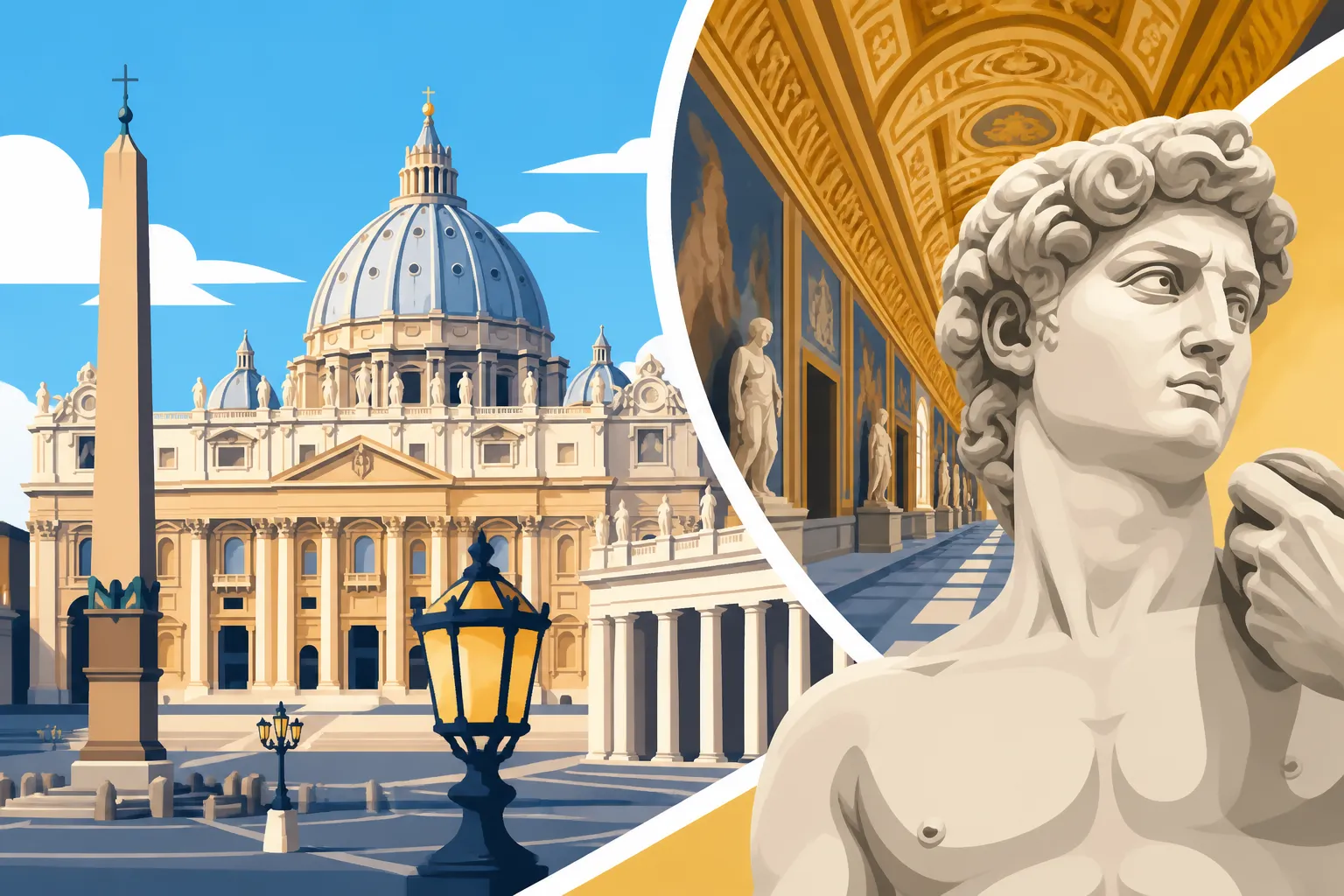
Visiting the Vatican: St. Peter’s and the Museums
Most first-time visitors to the Vatican make the same mistakes. They arrive at noon in August with bare shoulders and no ticket, then spend hours in a queue on Viale Vaticano. Some never make it past the guard at St. Peter’s. This guide covers how to plan both the Vatican Museums and St. Peter’s Basilica so the visit is memorable rather than miserable.
Disclosure: This post may contain affiliate links. We may earn a commission at no extra cost to you if you make a purchase through these links. Read full disclosure.
Understanding the Vatican Before You Go
The Vatican confuses people because it isn’t one attraction. It is a sovereign state, the smallest in the world, sitting inside Rome. For a visitor it splits into two separate experiences that most guidebooks blur together. Get this distinction clear first and every other decision becomes easier.
St. Peter’s Basilica and the Vatican Museums Are Two Different Visits
St. Peter’s Basilica is a working church, the spiritual centre of the Catholic world. General entry to the basilica is free. You reach it through St. Peter’s Square and a security checkpoint under Bernini’s colonnade. The Vatican Museums are a separate institution with a separate entrance about a fifteen-minute walk away, along the Vatican walls on Viale Vaticano. They need a paid ticket, and the Sistine Chapel sits at the very end of the route.
The two sites don’t share a queue, a ticket or a front door. On my first visit years ago I queued for the basilica believing I’d walk through to the Sistine Chapel. Nobody had told me otherwise. Forty minutes later a very patient Swiss Guard pointed me back out across the square. You can visit one without the other, and plenty of people do. Doing both in a single day is possible, but it is a long day on hard marble floors.
A passage connecting the Sistine Chapel to the basilica is sometimes open to guided groups. It saves the long walk back around the walls. Treat it as a pleasant bonus if your tour uses it, not something to build a plan around. Access depends on the day, the group and decisions made inside the Vatican that nobody announces in advance.
How Much Time You Actually Need
People underestimate the museums badly. The collection covers miles of galleries, and the official route funnels you through a fixed sequence of rooms before you reach the Sistine Chapel. A focused visit hitting only the major highlights takes around three hours. A relaxed visit that includes the Pinacoteca, the Egyptian and Etruscan collections and a coffee break can stretch to five or six.
The basilica is quicker but still deserves time. Allow an hour inside the church itself. Add another hour or more if you climb the dome, and longer again if you visit the papal tombs in the grottoes below. Then add the security queue, which can be anything from five minutes to well over an hour depending on the season and time of day.
My honest advice is to split them across two mornings if your Rome itinerary allows. Museum fatigue is real. By the time you’ve walked the Gallery of Maps and the Raphael Rooms, your brain struggles to take in the Sistine Chapel ceiling. If you’re still working out how long to stay in the city overall, How Many Days Do You Need in Rome? can help you decide whether a dedicated Vatican day fits.
Where the Vatican Sits in Relation to the Rest of Rome
The Vatican lies on the west bank of the Tiber, next to the Prati district and the Borgo, the old streets running up to St. Peter’s Square. It isn’t near the Colosseum or the Forum, and walking between them takes the better part of an hour. That shapes your logistics more than people expect. Booking the Colosseum in the morning and the Vatican Museums straight after lunch is a recipe for a sprint across the city.
The nearest metro stop for the museums is Ottaviano on Line A. Cipro, one stop further along, is also close to the museum entrance. For St. Peter’s Square, Ottaviano works, or you can walk from Piazza Risorgimento. If the network is new to you, How to Use the Rome Metro as a First-Time Visitor covers ticketing and validation. Many buses also stop around Piazza Risorgimento and along Via della Conciliazione.
For first-timers still getting their bearings, Rome for First-Time Visitors: Neighborhoods and Highlights gives a good picture of how the Vatican relates to the centro storico, Trastevere and the other areas you’ll be moving between.
Booking Tickets for the Vatican Museums
This is where most of the stress happens, and where a little planning saves the most time. The ticketing system punishes the unprepared. It rewards anyone who books ahead and thinks carefully about timing.
Booking Directly Through the Official Vatican Museums Website
The official Vatican Museums website sells timed-entry tickets for specific dates and slots. A timed ticket means you join a much shorter line for pre-booked visitors instead of the walk-up queue that can snake along the wall in high season. Official tickets carry a small booking fee on top of the base admission, and buying direct is generally the most economical option.
The catch is availability. In spring, summer and around major religious holidays, popular morning slots sell out well in advance. Some travellers log on a week before their trip and find nothing left except late-afternoon entries. Book as soon as your Rome dates are fixed. Check that the name on the booking matches the ID you’ll carry, and bring a charged phone or a printout of the confirmation.
Read the fine print on the official site. Reduced tickets for children, students and some other groups exist. The eligibility rules are specific and usually need proof at the entrance. A student card from a home university isn’t automatically accepted, so check the current conditions before you rely on a discount.
Guided Tours, Early Access and Reseller Platforms
When official slots are gone, or when you want someone to explain what you’re looking at, guided tours fill the gap. Platforms such as GetYourGuide list a wide range of Vatican options. These include small-group tours, private guides, and early-entry tours that get you in before general opening. Prices vary a lot depending on group size, duration and access, so compare inclusions carefully on each listing rather than assuming they’re all the same product.
Early-access tours are the closest thing to a secret weapon. Walking through the Raphael Rooms or the Sistine Chapel while they are relatively quiet is a completely different experience from shuffling through at peak hour. Check exactly what “early” means on any listing. Some get you in before the doors open to the public; others simply start at the first general slot. The listing should say which.
Be cautious with anyone selling “skip the line” tickets on the street near Ottaviano or along Viale Vaticano. Some are legitimate tour company representatives, but the pitch often overstates what’s on offer, and the price is rarely competitive. Book in advance from a source you can verify. For a deeper comparison of queue-beating strategies, see How to Skip the Lines at the Colosseum and Vatican.
Comparing Your Entry Options
The table below summarises the main ways to visit, so you can weigh cost against comfort and flexibility.
| Option | What You Get | Best For | Main Drawback |
|---|---|---|---|
| Official timed ticket, booked online | Entry at a chosen slot, shorter pre-booked queue | Independent travellers who plan ahead | Popular slots sell out early in high season |
| Walk-up ticket on the day | Entry after queuing at the ticket office | Off-season visits with flexible plans | Very long waits are common at busy times |
| Small-group guided tour | Timed entry plus a guide explaining the highlights | First-timers who want context | Fixed pace and route |
| Early-access tour | Entry before or at the very start of the day | Photographers and crowd-averse visitors | Very early start, higher cost than standard tickets |
| Private guide | Tailored route and pace | Families, mobility needs, art lovers | Highest cost |
| St. Peter’s Basilica only | Free entry to the church after security | Travellers short on time or budget | No access to the museums or Sistine Chapel |
The Sunday and Holiday Question
The museums are generally closed on Sundays. The exception is occasional free-entry days, and these draw some of the largest crowds of the year. Free entry sounds tempting, but the queues often stretch for hours and the galleries are packed shoulder to shoulder. Unless your budget is very tight, I’d skip it.
The museums also close on several Catholic feast days that don’t line up with Italian public holidays, so always check the official calendar for your dates. If your only free day in Rome is a Sunday, How to Visit the Vatican on a Sunday explains what you can still do. Mass in the basilica and the papal Angelus blessing in the square are both options.
Navigating the Vatican Museums Like a Seasoned Visitor
Once you’re through security and past the turnstiles, the scale of the place hits you. A little strategy helps you see what matters most without burning out halfway.
The Route From the Entrance to the Sistine Chapel
The museums follow a broadly one-way route that ends at the Sistine Chapel, and the signage pushes you steadily towards it. On the way you’ll pass through the Pio-Clementino Museum, home to the Laocoön and the Apollo Belvedere. Then come the Gallery of the Candelabra, the Gallery of Tapestries and the Gallery of Maps, with its painted ceiling and huge topographical frescoes of the Italian regions. After those are the Raphael Rooms, including the School of Athens.
Many people race past the Pinacoteca, the picture gallery, because it sits slightly off the main flow near the start. That’s a shame. It holds works by Raphael, Leonardo and Caravaggio in rooms that are often calmer than the main corridors. If you have energy early on, go there first, before the crowds and your own fatigue build. The Cortile della Pigna, the courtyard with the giant bronze pine cone, is also a good spot to sit and regroup.
For a room-by-room walk through the highlights, How to Visit the Vatican Museums and Sistine Chapel goes deeper into the route. If you’re building a wider art itinerary across the country, Italy’s Great Museums: Uffizi, Vatican, and Beyond puts the Vatican collection in context alongside Florence and other cities.
Rules Inside the Sistine Chapel
The Sistine Chapel is a consecrated space, and the rules are enforced. Photography and filming are not allowed inside, and guards will tell you to put your phone away. Silence is expected. You’ll hear regular calls of “silenzio” and “no photo” over the murmuring of the crowd. Guided tours can’t give commentary inside the chapel, which is why good guides brief their groups beforehand using boards in the courtyards.
Find a spot along the side benches if you can, and give yourself at least fifteen or twenty minutes. Look up at the ceiling in sections rather than trying to take it all in at once. Start with the Creation of Adam near the centre, then work outward to the prophets and sibyls. Turn round to face the Last Judgement on the altar wall last; it’s powerful once your eyes have adjusted. A small pair of binoculars or a zoomed-in phone view before you enter makes the details easier to follow.
People sometimes feel a little let down because the chapel is smaller and more crowded than they imagined. The trick is to give it time. Don’t treat it as the box you tick on the way to the exit. Stand still, let the crowd move around you, and look up for longer than feels natural.
Pacing Yourself and Practical Comforts
The museums are physically demanding. You’ll walk a long way on hard floors, often slowly, in rooms that can get very warm in summer. Wear comfortable shoes you’ve already broken in, and bring a refillable water bottle; there are fountains and cafés inside. Large bags, umbrellas and some other items may need to go to the cloakroom, so travel light.
There’s a cafeteria and a pizzeria inside, plus a café in the Cortile della Pigna. They aren’t gourmet, but a mid-visit break genuinely restores your focus. The Prati district just outside has plenty of better places for lunch afterwards, along Via Cola di Rienzo and the side streets around Piazza Risorgimento.
When you leave, many visitors exit via the elegant double-spiral staircase near the museum exit, a favourite for photographs. Be aware that the exit drops you back onto Viale Vaticano, so the walk round to St. Peter’s Square still lies ahead unless you took a group passage.
Visiting St. Peter’s Basilica
The basilica is the emotional heart of any Vatican visit. Even travellers who aren’t religious tend to describe it as overwhelming, in the best sense.
Getting Through Security and the Dress Code
All visitors to the basilica go through airport-style security under the colonnade on the right side of St. Peter’s Square, if you’re facing the church. The queue moves faster than it looks, but at peak times it can still take a long while. Early morning, soon after opening, is usually the calmest. Late afternoon can also be manageable outside the busiest months.
The dress code is the single biggest reason people get turned away. Shoulders and knees should be covered. That means no tank tops, no short shorts and no very short skirts, for men and women alike. Staff at the entrance enforce this firmly, even in the heat of July. A light scarf or shawl over the shoulders and lightweight trousers or a long skirt solve the problem easily. Some vendors sell paper shawls nearby, but don’t rely on that.
For more detail on what’s acceptable, How to Dress to Enter St. Peter’s Basilica covers specifics. The broader etiquette, such as keeping voices low and not walking in front of worshippers, is explained in Visiting Italian Churches Respectfully as a Traveler.
What to See Inside the Basilica
Just inside, to the right, is Michelangelo’s Pietà, which he carved as a young man. It sits behind protective glass, and crowds gather here, so be patient and work your way to the front. Many people find it the most moving work in the whole Vatican: Mary holding the body of Christ, rendered in marble with astonishing softness.
Walk up the nave towards the high altar and Bernini’s bronze baldacchino rises above the spot believed to sit over the tomb of St. Peter. Beyond it, at the far end of the apse, is the Cathedra Petri, Bernini’s gilded monument around the Chair of St. Peter. Along the way look out for the bronze statue of St. Peter, its foot worn smooth by centuries of pilgrims touching and kissing it. Look up too at the mosaics, which are so finely made that most visitors assume they are paintings.
Parts of the basilica are reserved for prayer, including the Blessed Sacrament chapel. Visitors who want to pray can enter, but sightseeing isn’t appropriate there. Below the main floor, the Vatican Grottoes hold the tombs of many popes. The entrance and exit for the grottoes can change, so follow the signage on the day.
Climbing the Dome
The climb up Michelangelo’s dome is one of the best experiences in Rome. It’s also one of the most physically demanding. The entrance to the climb is usually to the right of the basilica, separate from the main entry, and it needs its own ticket. A lift option takes you part of the way, cutting out a good chunk of the stairs. Either way you’ll still face a long climb on foot, and the final stretch becomes narrow, steep and slanted as the passage follows the curve of the dome.
The reward is twofold. Partway up you step onto an interior walkway that circles the inside of the dome. From there you look straight down into the basilica and close up at the mosaics. At the top, an outdoor terrace gives a panoramic view over St. Peter’s Square, the Vatican Gardens and the whole of Rome. On a clear morning you can trace the Tiber all the way through the city.
The climb is not suitable for anyone with heart problems, serious mobility issues or claustrophobia. The upper passages are tight, and once you’re committed it’s hard to turn back. Go early in the day when the queue is short and the temperature is lower. Carry nothing bulky.
Papal Events, Special Tours and Timing Your Visit
The Vatican has a rhythm of its own, shaped by the liturgical calendar and the Pope’s schedule. Plan around it and you’ll catch something special. Ignore it and you may find the basilica closed when you arrive.
Papal Audiences and the Angelus
The Pope usually holds a general audience on Wednesday mornings, either in St. Peter’s Square or, in colder months, inside the Paul VI Audience Hall. Tickets for the audience itself are free and issued through the Prefecture of the Papal Household. Many people also request them through their parish or national pilgrim offices. Be wary of anyone trying to sell you audience tickets.
On Wednesday mornings the basilica may be closed or partially closed until the audience ends, so a Wednesday is not the day to plan a quiet early visit. On Sundays, when the Pope is in Rome, he usually leads the Angelus prayer from a window overlooking the square at midday. It’s a short, open event, and the atmosphere in the square is lovely even if you aren’t Catholic. How to Attend a Papal Audience at the Vatican explains the ticket request process step by step.
The Scavi Tour and the Vatican Gardens
The Scavi tour takes small groups beneath the basilica into the ancient necropolis believed to contain the tomb of St. Peter. It’s one of the most extraordinary experiences in Rome. You walk through Roman-era streets of tombs that were buried when Constantine built the first basilica. Bookings go through the Excavations Office, groups are kept small, and places are limited. Request as far ahead as you can and give flexible dates. The office applies its own entry conditions, including age restrictions, so read them before you apply.
The Vatican Gardens can be visited on guided tours booked through the Vatican Museums, often combined with museum entry. They’re a peaceful contrast to the crowded galleries, with fountains, grottoes and views of the dome from angles most visitors never see. Group sizes and schedules vary, so check the official options when you book.
Choosing the Right Day and Season
The table below gives a general sense of how different days behave. Crowds always depend on the season and on special events.
| Day | Vatican Museums | St. Peter’s Basilica | Notes |
|---|---|---|---|
| Monday | Often very busy | Usually open normally | Many other Rome museums close on Mondays, pushing crowds here |
| Tuesday and Thursday | Generally calmer | Usually open normally | Often the best all-round choice |
| Wednesday | Can be quieter in the morning | Often restricted during the papal audience | Good for the museums, poor for an early basilica visit |
| Friday and Saturday | Busy, especially in high season | Busy | Book timed slots well ahead |
| Sunday | Generally closed except special days | Open, with Masses and the Angelus | Ideal for the square and the basilica, not the museums |
Season matters as much as the day of the week. Spring and early autumn bring pleasant weather and heavy crowds. Summer brings heat, long queues and very warm galleries. Late autumn and winter, outside Christmas and New Year, are the quietest. Easter and Holy Week are a special case: the Vatican hosts major ceremonies, accommodation fills up, and some areas close for liturgies. If your trip falls then, read Easter and Holy Week in Italy: Which Cities Sell Out and When before you book anything.
Getting There, Staying Nearby and Staying Safe
A good Vatican day starts long before you reach the entrance. Where you sleep, how you arrive in Rome and how you protect your belongings all shape the experience.
Arriving in Rome and Reaching the Vatican
Most visitors fly into Fiumicino or Ciampino, or arrive by high-speed train at Roma Termini from Florence, Naples, Venice or Milan. If you’re combining Rome with other Italian cities, a booking platform such as Omio lets you compare trains and coaches between cities on one screen. That’s handy when you’re juggling Trenitalia, Italo and bus options and want to see journey times side by side. For airport arrivals specifically, Rome Fiumicino Transfers: Leonardo Express, Regionale, and Bus Compared covers the main routes into the city.
From Termini, take Metro Line A towards Battistini and get off at Ottaviano for the museums and the square. The journey is short, but trains get very crowded at rush hour. Taxis from the centre are another option, especially if you’re travelling with young children or anyone with limited mobility. Tell the driver whether you want the museum entrance on Viale Vaticano or St. Peter’s Square, because they’re not the same drop-off point.
Walking is also a pleasure if you’re staying in the centro storico. Cross the Tiber at Ponte Sant’Angelo, pass Castel Sant’Angelo, and walk up Via della Conciliazione. The dome grows larger with every step, and it makes a memorable approach on a first visit.
Choosing a Base Near the Vatican
Staying in Prati or the Borgo puts you within walking distance of both the museums and the basilica. That makes early-morning entries far easier. Prati is a calm, residential, grid-patterned district with good restaurants, solid transport links and a less touristy feel than the historic centre. The Borgo is closer still to St. Peter’s, with narrow streets and a pilgrim-town atmosphere.
Platforms like Booking.com make it easy to filter by neighbourhood and check walking distance to Ottaviano or St. Peter’s Square before you commit. That’s useful if you’ve booked an early-access tour and don’t want to cross the city in the dark. Read recent reviews on noise, air conditioning and lifts, which vary enormously between Roman buildings.
The trade-off is that Prati is quieter in the evenings and further from the Pantheon, Piazza Navona and Trastevere nightlife. For a full comparison of the neighbourhoods, see Where to Stay in Rome: Centro Storico, Trastevere, Monti, and Prati.
Protecting Yourself From Pickpockets and Scams
The crowds around the Vatican attract pickpockets, especially on Metro Line A, on the buses into Piazza Risorgimento and in the dense queues outside the museums. Keep your phone and wallet in a front pocket or a zipped bag worn across your body. Be extra alert when you’re squeezed together at security or in the Sistine Chapel. Avoiding Pickpockets in Italy’s Tourist Areas covers the most common tactics and how to spot them.
The other recurring nuisance is touts. Along Viale Vaticano and around the square, people in lanyards may tell you the line is several hours long or the museum is “closed today”. The aim is to sell you a tour on the spot. Some are genuine sellers and some aren’t, and the pressure is the same either way. Smile, say “no, grazie”, and carry on with the booking you already have.
Finally, be careful with unofficial “guides” offering to escort you into the basilica for a fee. Entry to the basilica is free for everyone. The only paid elements are optional ones such as the dome climb, certain official tours and audio guides from recognised providers.
Putting It All Together: A Sample Vatican Day
A well-paced plan for a single Vatican day:
- Book a timed early-morning slot for the Vatican Museums or an early-access tour well in advance.
- Have a quick breakfast in Prati and arrive at the museum entrance shortly before your slot, dressed for the basilica too.
- Visit the Pinacoteca first, then follow the main route through the Pio-Clementino, the Gallery of Maps and the Raphael Rooms.
- Spend unhurried time in the Sistine Chapel, phone away, looking up section by section.
- Use the group passage to the basilica if your tour offers it. Otherwise exit, have lunch in Prati and walk round to St. Peter’s Square.
- Clear basilica security, see the Pietà, the baldacchino and the bronze St. Peter, then visit the grottoes.
- Climb the dome in the afternoon if you still have the energy, or save it for a separate early morning.
- End the day with a slow walk down Via della Conciliazione to Castel Sant’Angelo as the light softens over the Tiber.
If you want someone else to handle the logistics, a combined museums-and-basilica tour from a platform like GetYourGuide can cover most of these steps with a guide. Check whether the dome climb is included before you book.
Disclaimer
This article is for general informational purposes only and does not constitute professional advice. Laws, prices and regulations vary by location and change over time. Consult a qualified professional for guidance on your specific situation.