How to Travel Between Italian Cities Without a Car
Picture this: you’ve just landed at Roma Termini with a rolling suitcase. You want to see Florence, Venice and the Amalfi Coast, but you refuse to drive through ZTL zones and hairpin bends. Then you look at the departures board and see forty trains, three bus companies and no clear sense of where to begin. This guide explains how to travel between Italian cities without a car, from booking trains to catching the right ferry.
Disclosure: This post may contain affiliate links. We may earn a commission at no extra cost to you if you make a purchase through these links. Read full disclosure.
Why Italy Is One of the Easiest Countries to Explore Without a Car
Many first-time visitors assume a road trip is the “real” way to see Italy. After years of living here and hauling luggage across most of the peninsula, I’d say almost the opposite for city-to-city travel. Driving into Italian historic centres is often the worst part of a trip. Cameras photograph your plate at limited-traffic zone boundaries, parking is scarce and expensive, and you spend half the day hunting for a garage. Public transport takes you from one city centre to the next.
The frustration is real, though. The system is fragmented. There are two competing high-speed rail operators, regional trains run by different regional companies, several coach brands, and ferry lines that change schedules with the seasons. Once you understand how the pieces fit together, the network becomes very manageable.
The Rail Spine Linking Major Cities
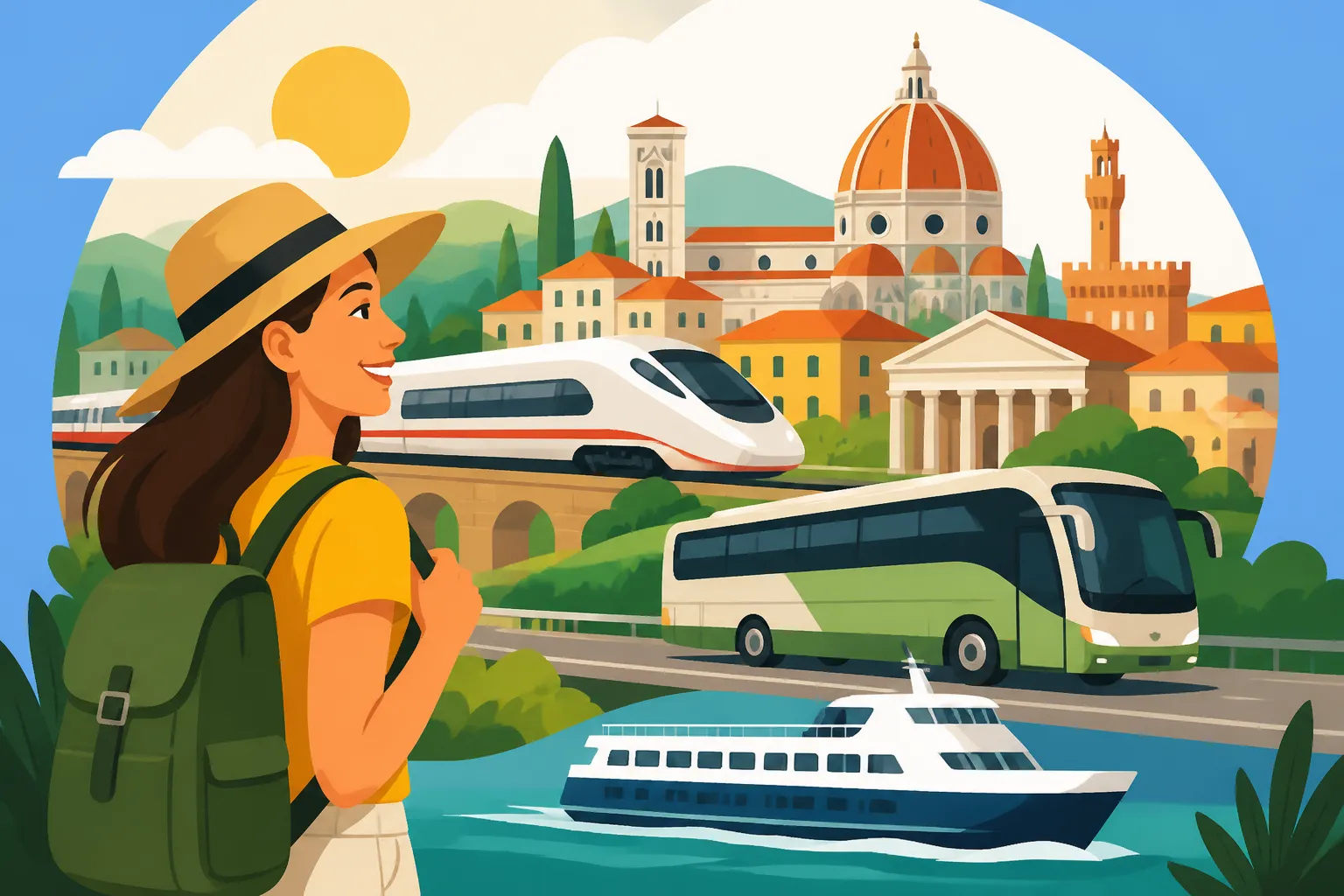
Think of Italy’s high-speed network as a backbone running down the boot. In the north, it starts around Turin and Milan. It then runs through Bologna, Florence and Rome, and continues to Naples and Salerno. A branch reaches east toward Verona and Venice. For most travellers, the classic loop of Rome, Florence, Venice and Milan sits entirely on this spine. You can spend a week moving between those cities without ever thinking about a steering wheel.
Two companies run trains on these lines. Trenitalia is the state-owned operator, and its Frecciarossa trains are the flagship service. Italo is a private competitor that runs sleek trains on the main high-speed corridors. Both are comfortable, have reserved seating, and arrive at central stations. The choice between them usually comes down to timing and fare on the day. For a detailed breakdown of routes and classes, see High-Speed Trains in Italy: Trenitalia, Italo, Routes, and Savings.
Beyond the backbone sits a dense web of regional lines. These slower trains stop at smaller towns: Pisa and Lucca from Florence, the Cinque Terre villages from La Spezia, and Lake Como towns such as Varenna from Milan. They are less glamorous, but they are often the only rail link to the towns that make an Italian trip memorable.
Where Buses and Ferries Fill the Gaps
Rail coverage thins out as you move south and inland. Hilltop towns in Tuscany and Umbria, much of Basilicata, and stretches of Puglia’s coast can be awkward or impossible by train alone. Long-distance coaches step in here. FlixBus, Itabus and MarinoBus run routes the train map doesn’t cover well. Local regional bus companies handle the final climb up to many hill villages.
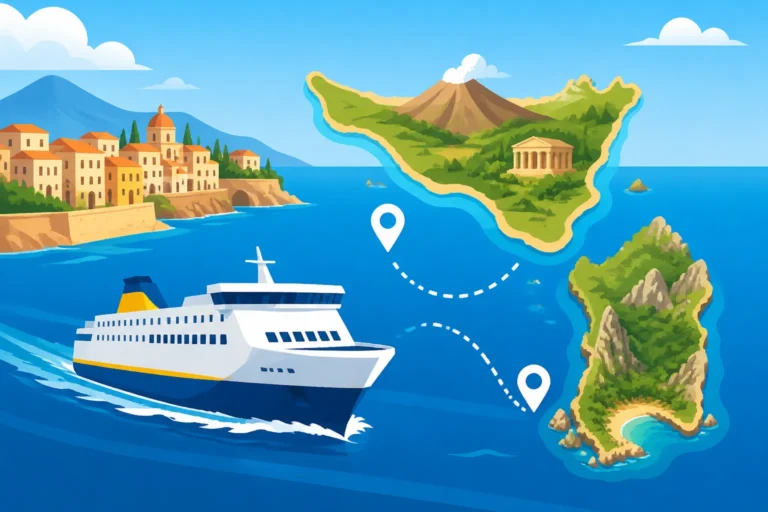
Then there is the sea. Capri, Ischia, Procida, the Aeolian Islands, Sardinia and the coastal towns of the Amalfi Coast are often reached most easily by ferry or hydrofoil. In summer, a boat from Salerno or Sorrento can beat the crawling coastal road by a wide margin.
Here is how the main options compare for car-free travellers:
| Mode | Best For | Booking Needed | Main Strengths | Main Drawbacks |
|---|---|---|---|---|
| High-speed train | Rome, Florence, Venice, Milan, Naples, Bologna | Yes, reserved seats | Fast, central stations, comfortable | Fares rise closer to departure |
| Regional train | Small towns, coastal villages, short hops | No seat reservation | Flexible, frequent on many lines | Slower, crowded in summer, paper tickets need validating |
| Long-distance coach | Routes poorly served by rail, budget trips | Yes, recommended | Reaches places rail misses, often cheap | Terminals can be outside the centre, traffic delays |
| Local regional bus | Hill towns, rural areas | Usually buy before boarding | Final connection to villages | Sparse schedules, few services on Sundays |
| Ferry or hydrofoil | Islands, Amalfi Coast, lakes | Advisable in peak season | Scenic, avoids coastal traffic | Weather cancellations, seasonal timetables |
| Domestic flight | Sicily, Sardinia, deep south from the north | Yes | Saves a full day on long routes | Airport transfers and baggage fees add time and cost |
How to Book and Ride Italian Trains Like a Local
Trains will probably carry you on most of your journeys, so it’s worth knowing how they actually work. Most mistakes I see from visitors fall into two groups. Some people buy the wrong type of ticket. Others buy the right ticket and then forget a small step that costs them a fine.
High-Speed Trains Between Big Cities
High-speed tickets work like airline tickets. Each one comes with a specific train, date, time, carriage and seat. Prices change with demand. The cheapest promotional fares appear well in advance and sell out on popular routes such as Rome to Florence or Milan to Venice. Flexible fares cost more but let you change your plans without losing the ticket value.
You can buy directly through the Trenitalia or Italo websites and apps. You can also use an aggregator. Omio is useful at the planning stage because it shows trains and coaches side by side for the same route. That makes it easier to see whether a FlixBus departure undercuts the train, or whether Italo has a better slot than Trenitalia that day. Many travellers compare options there and then decide where to buy.
On the day itself, check the departures board, the Partenze screen, for your train number and platform, the binario. Platforms are often confirmed only shortly before departure, so don’t panic if yours hasn’t appeared yet. At big stations such as Roma Termini, Milano Centrale and Firenze Santa Maria Novella, ticket gates sit in front of the high-speed platforms. Have your QR code ready on your phone, and allow time to walk. At Termini, the furthest platforms take a good stroll from the main concourse.
One detail catches many people out in Venice. Venezia Mestre is on the mainland. Venezia Santa Lucia is the station on the island, right on the Grand Canal. If you are staying in the historic centre, book through to Santa Lucia.
Regional Trains and Ticket Validation
Regional trains work differently, and this is where good-natured visitors most often get fined. A paper regional ticket is usually not tied to a specific train. It is valid for a route, so you must activate it before boarding. You do this by stamping it in the small validation machines on station platforms or at the head of each track. Get on with an unstamped paper ticket and the conductor can fine you, even if you paid for the journey.
Digital regional tickets from the official apps have their own rules. Some come with a set travel time, and others ask you to check in through the app before boarding. Read the instructions on the ticket screen carefully. For the specifics, see How to Validate a Regional Train Ticket in Italy.
Regional trains don’t have reserved seats. On summer weekends, routes such as Florence to Pisa or the Cinque Terre line can be standing room only. Plan ahead and board early, especially if you have luggage. For tips on getting the most from these slower lines, see Regional Trains in Italy: How to Use Them and Save.
A Step-by-Step Booking Routine
This is the routine I give friends who visit:
- Sketch your route and identify which legs are high-speed and which are regional or coach.
- Book the high-speed legs as early as your plans allow, because those fares rise as departure approaches.
- Leave short regional legs flexible unless you are travelling on a peak weekend or holiday.
- Download the Trenitalia and Italo apps, and keep tickets saved offline in case your data drops in a tunnel.
- Arrive at the station early enough to find your platform and pass through ticket gates.
- Validate any paper regional ticket before boarding, every single time.
- Keep your ticket handy until you leave the destination station, as inspections can happen on board or at the exit.
If you want help building the whole trip around rail, see How to Plan an Italy Itinerary by Train.
Buses, Ferries, and Flights for the Tricky Routes
Trains are wonderful until the line simply stops. Matera is a classic example. It sits on a small private railway rather than the national network, and many visitors end up taking a coach or a connection via Bari. For more on that region, see Reaching Matera and Basilicata: Where the Rail Network Runs Out.
Long-Distance Coaches
Coaches have improved enormously over the years. FlixBus, Itabus and MarinoBus offer comfortable seats, power sockets and Wi-Fi on many routes. They often reach towns that have no direct rail link to where you are starting. On some routes into the south, a direct coach can also be simpler than a train journey with several changes.
The catch is the terminal. Long-distance coaches in big cities often leave from hubs away from the historic centre. In Rome, many depart from the Tiburtina bus terminal next to Roma Tiburtina station. In Milan, Lampugnano, on the metro’s red line, is a major hub. In Florence, some services use Villa Costanza, which connects to the city by tram. Always check the exact stop name on your ticket and plan the last stretch. For an operator-by-operator overview, see Intercity Buses in Italy: FlixBus and Regional Networks.
Local regional buses are a separate world. Reaching a Tuscan hill town such as San Gimignano or Montepulciano usually means a train to a nearby hub followed by a local bus. These buses tend to run frequently on weekday mornings and much less often on Sundays and holidays. Buy tickets in advance where required, often at a tabaccheria or the station, and photograph the timetable posted at the stop.
Island and Coastal Crossings
Ferries and hydrofoils are part of everyday life on the coast. From Naples, boats leave for Capri, Ischia and Procida. From Sorrento and Salerno, they serve Positano and Amalfi in season. On the lakes, public boats link the towns of Como, Garda and Maggiore, and they are often the most pleasant way to move between villages.
Two warnings from experience. First, timetables shrink dramatically outside summer, and some coastal routes stop entirely in winter. Second, rough seas can cancel sailings at short notice. Don’t book a ferry that leaves an hour before your flight home. Keep a buffer.
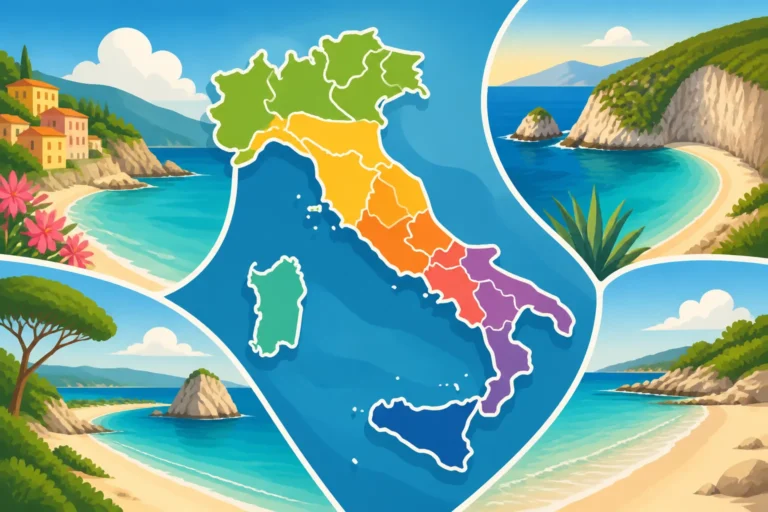
Sicily is a special case. You can fly, take an overnight ferry from Naples, or ride a train that boards a ship to cross the Strait of Messina. The trade-offs are explained in Getting to Sicily: Ferry vs Flight vs the Train That Boards a Ship.
Domestic Flights for the Far South
Sometimes the train isn’t the hero. Milan to Palermo by train, or Venice to Cagliari by train and ferry, takes the better part of a day or more. A short domestic flight can save that day, although airport transfers, security queues and baggage rules eat into the time saved. If you fly into Rome, think about how you’ll reach the city before you book onward trains. See Rome Fiumicino Transfers: Leonardo Express, Regionale, and Bus Compared.
For places where public transport is genuinely thin, such as the wineries of the Val d’Orcia or a full day along the Amalfi Coast without juggling bus timetables, a guided day tour is a practical alternative to renting a car. GetYourGuide lists many of these trips, with pickups in major cities. That lets you see the countryside while someone else handles the narrow roads.
Practical Survival Tips for Car-Free Travel
The big decisions are trains versus buses, and which cities to visit. The small habits are what make car-free travel feel easy.
Luggage, Stations, and Last-Mile Transport
Pack lighter than you think you need. Italian stations have stairs. Regional trains have high steps. Cobbled streets in Florence or Bologna will test your suitcase wheels. On high-speed trains there are racks above the seats and at the ends of carriages. On crowded regional services, space vanishes quickly. Size and handling rules are covered in Luggage Rules on Italian Trains and Buses: Limits and Fees.
Staying close to the station saves energy on travel days. When I book accommodation, I filter by distance to the main station, especially in cities I’m only passing through. On Booking.com, the map view makes it easy to check whether a hotel is a short walk from Firenze Santa Maria Novella or Napoli Centrale before you commit.
In Venice, the last stretch is a vaporetto, a water bus, rather than a taxi. In Rome, Milan and Naples, the metro connects the main stations to most neighbourhoods. Learn the local ticket system on arrival, because city transport tickets are separate from your train ticket.
Strikes, Delays, and Building a Buffer
Every resident of Italy has a strike story. Transport strikes, called scioperi, are announced in advance. Guaranteed services usually run during set time bands, but disruption on the day can be significant. Check the news before travel days, and keep your plans flexible when a strike is announced. For rebooking strategies, see Strikes in Italy: How Sciopero Days Work and How to Rebook.
Delays happen too, particularly on regional lines and on long north-south journeys. If a connection is tight, choose a later onward train. If you have a non-refundable ferry or flight after your train, leave a generous margin. The few minutes you save on paper aren’t worth the stress of sprinting down a platform at Bologna Centrale.
Choosing Bases and Day Trips
The most effective car-free strategy is often to choose a few well-connected bases and day-trip from them, rather than changing hotels every night. Florence works well for Pisa, Lucca, Siena and Bologna. Naples works for Pompeii, the islands and the Sorrento peninsula. Milan works for Lake Como, Bergamo and Verona. Rome works for Orvieto, Tivoli and the Castelli Romani.
This approach cuts down on packing and unpacking, and you travel light on day trips. Arrange your bases so that each move between them is a single direct high-speed train where possible. For help sequencing hotels around the rail network, see Booking Multiple Italian Cities: Sequencing Around Rail Routes.
Travelling between Italian cities without a car isn’t a compromise. Most days it is the more relaxing way to see the country. You arrive in the centre, you skip the parking hunt, and you watch Tuscan hills or the Ligurian coast slide past the window, maybe with a coffee from the station bar in hand.
Disclaimer
This article is for general informational purposes only and does not constitute professional advice. Laws, prices and regulations vary by location and change over time. Consult a qualified professional for guidance on your specific situation.