How to Plan a Road Trip Through Tuscany and Umbria
One of the most common frustrations I hear from fellow expats and travelers is the sheer logistical overwhelm of trying to bridge the gap between the postcard-perfect hills of Tuscany and the wild, mystical forests of Umbria. Most people end up trapped in the "Florence bubble," missing the deep, soul-stirring landscapes of the Tiber Valley simply because they are intimidated by the local driving regulations and the labyrinthine backroads. This guide solves that problem by providing a meticulous, boots-on-the-ground strategy for planning a road trip that seamlessly blends these two iconic regions without the typical stress of ZTL fines or getting lost in the Apennines.
Disclosure: This post may contain affiliate links. We may earn a commission at no extra cost to you if you make a purchase through these links. Read full disclosure.
Navigating the Logistics of Central Italy's Backroads
When you first decide to tackle a road trip through Tuscany and Umbria, the first hurdle isn't the route itself, but how you get there. Many travelers make the mistake of thinking they can rely on the legendary Italian rail system for everything. While I love the trains for city-hopping, if you want to see the cypress-lined avenues of the Val d'Orcia or the hidden hermitages of Umbria, you absolutely need your own wheels. Consider using Omio to compare the initial leg of your journey—perhaps a high-speed train from Rome or Milan to your starting point—before picking up a rental car. It saves you from the exhaustion of a long-haul drive on the Autostrada, allowing you to save your energy for the scenic "White Roads" (strade bianche) that define the region.
Selecting your vehicle is more than just a matter of budget; it is a matter of survival in narrow medieval villages. While it might be tempting to rent a luxury SUV for those rolling hills, you will regret it the moment you try to navigate the stone archways of Pienza or the steep inclines of Todi. A compact car with a decent engine is your best friend. Make sure you are well-versed in the specifics of Renting a Car in Italy: ZTLs, Insurance, and Driving Tips before you sign any paperwork. Many drivers return home to a mailbox full of fines because they didn’t understand that the "ZTL" sign (Zona a Traffico Limitato) means "do not enter" unless you want to pay a hundred euros for the privilege.
Booking your home base is the next critical step. In this part of Italy, the "Agriturismo" is king. These are working farms that offer high-end accommodation, often with sprawling vineyards and infinity pools. I usually scour Booking.com for properties located just outside the major towns—places like Montepulciano or Gubbio. Staying 10 minutes outside the city walls not only gives you a better view but also solves the perennial nightmare of Italian parking. You want a place where you can park your car for free and perhaps even walk through an olive grove to get your morning espresso.
Mapping Your Route: From the Val d'Orcia to the Tiber Valley
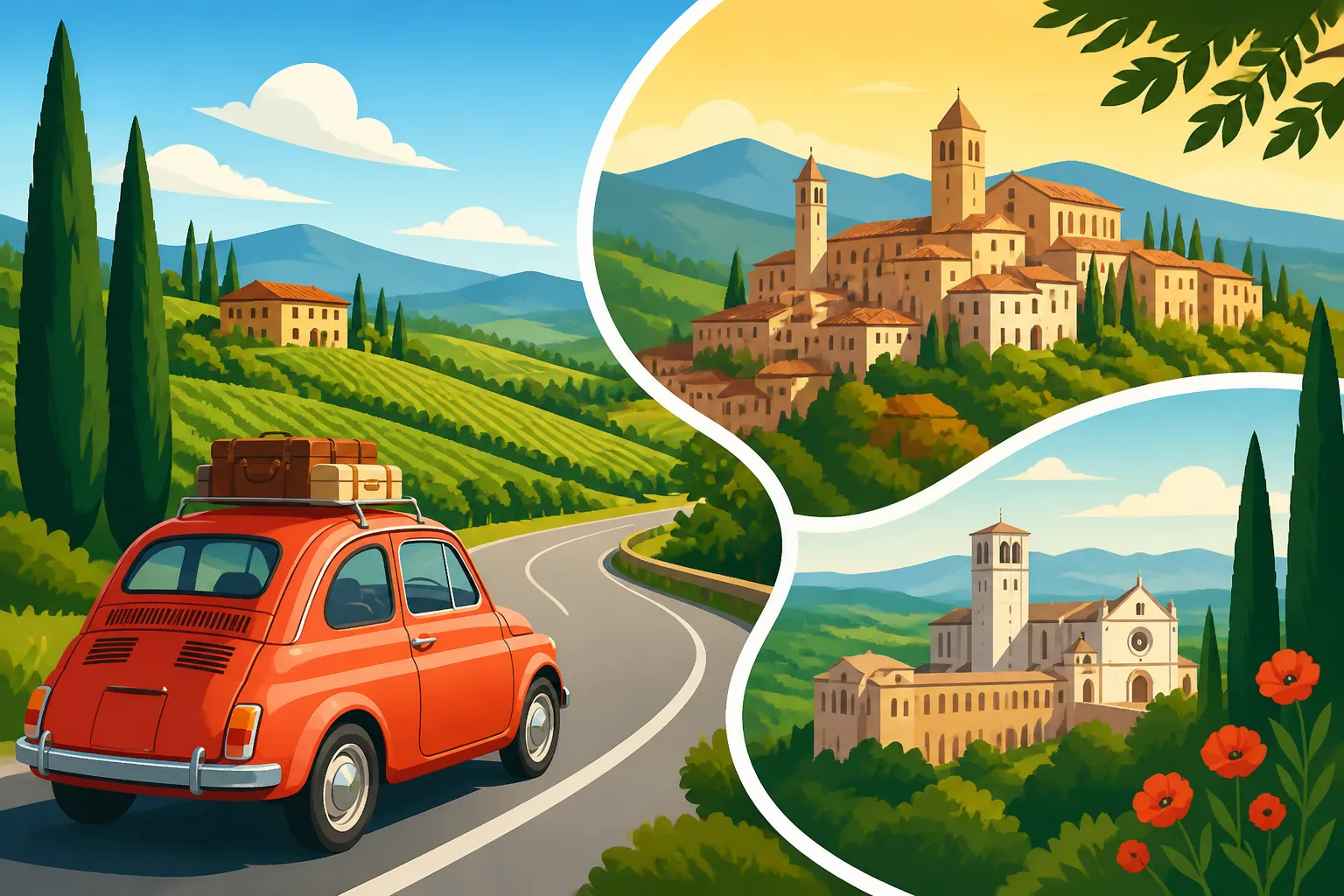
The secret to a successful Tuscany-Umbria loop is not to rush. If you try to see both Florence and Perugia in the same three days, you will see nothing but the inside of your car. I suggest starting in the south of Tuscany, specifically the Val d'Orcia. This is the Tuscany of the movies—the golden light, the rolling wheat fields, and the lonely chapels on the hilltops. Spend your first few days based near San Quirico d'Orcia. From here, you can make easy morning drives to the cheese shops of Pienza or the wine cellars of Montalcino. If you are feeling overwhelmed by the history, you can always check out Tuscany for Travelers: Cities, Hills, and Coast to narrow down which hilltop towns fit your specific vibe.
As you cross the invisible border into Umbria, the landscape shifts dramatically. The manicured vineyards of Tuscany give way to dense, ancient forests and rugged limestone cliffs. This is Italy’s "Green Heart." Your first major stop should be Orvieto, a city perched atop a volcanic tufa plug. The cathedral there is, in my humble opinion, the most beautiful in Italy. After Orvieto, head toward the capital, Perugia. While Perugia is a bustling university city, it serves as the perfect springboard for the more spiritual side of Umbria. You cannot miss Assisi and Italy's Sacred Towns, where the Basilica of St. Francis dominates the hillside. It is a place that demands silence and reflection, a stark contrast to the lively wine bars of Tuscany.
To truly get the most out of these stops, don't just wander aimlessly. Use GetYourGuide to find local truffle hunting expeditions in the woods near Norcia or private vineyard tours in Sagrantino country. Umbrian wine is often overlooked in favor of Chianti, but a bold Sagrantino di Montefalco will change your mind about what Italian red wine can be. The transition between these regions is best experienced through the taste of the land—moving from the pici pasta of Tuscany to the wild boar ragù and black truffles of Umbria.
Essential Practicalities: ZTLs, Parking, and the Art of the Slow Drive
Let's talk about the reality of driving in Central Italy, because it isn't all "La Dolce Vita" when you're stuck in a roundabout with a Vespa on either side. Italian drivers are assertive, but they are also incredibly predictable once you understand the rhythm. The most important thing is to maintain your "Bella Figura"—staying calm and looking like you know exactly where you are going, even if you are utterly lost. When you enter a village, look for the blue "P" signs for public parking. Never, under any circumstances, try to drive into the "Centro Storico" (historic center) unless your hotel has explicitly confirmed they have registered your license plate with the local police.
| Feature | Tuscany (Val d'Orcia/Siena) | Umbria (Tiber Valley/Assisi) |
|---|---|---|
| Landscape Style | Manicured rolling hills, cypress-lined drives | Wild forests, steep mountains, river valleys |
| Driving Difficulty | Moderate; well-paved but busy in summer | Challenging; winding roads, steep inclines |
| Typical Accommodation | Luxury Agriturismi, vineyard estates | Stone farmhouses, monastic retreats |
| Iconic Food | Pici pasta, Chianina beef, Pecorino | Black truffles, Norcia lentils, Wild boar |
| Crowd Levels | High in peak season (May-Sept) | Lower; more authentic and quiet |
| Main Attraction | Renaissance art and wine culture | Medieval spirituality and rugged nature |
One thing that surprises many of my guests is the "riposo"—the Italian version of a siesta. Between 12:30 PM and 4:00 PM, many gas stations (the ones without automated pumps) and smaller shops will close. This is the perfect time to be on the road moving between towns, but a terrible time to realize you’re running on fumes. Always keep your tank at least half full. Also, keep in mind that many of the most charming towns, like San Gimignano, have become so popular that they require a strategy to visit. If you find the crowds too much, you might even consider How to Visit San Gimignano Without a Car as a research tool to see how the day-trippers arrive, so you can plan to arrive exactly when they leave.
Parking in Umbria can be even trickier than in Tuscany because the towns are often built on much steeper terrain. In Gubbio or Spoleto, you might find yourself parking in a lot at the bottom of the hill and taking a series of public elevators or escalators to reach the town center. It’s an adventure in itself! Always carry a few Euro coins for the parking meters (parcometri), although many now accept cards or apps like EasyPark. Understanding these small hurdles is what separates a frustrating trip from a legendary one.
Packing, Timing, and Cultural Etiquette
Timing your road trip is the difference between a dream and a sweltering nightmare. July and August in Tuscany and Umbria can be punishingly hot, with temperatures often soaring above 35°C (95°F). I always advocate for the "shoulder seasons"—May, June, September, and October. In the spring, the fields are a vibrant, neon green; in the autumn, you have the harvest festivals (sagre) where you can eat world-class food for pennies on a paper plate. If you find yourself in Florence before picking up your car, check out Best Day Trips From Florence Without a Car to see some nearby sights while you wait for the cooler weather to kick in.
Culture on the road is just as important as the GPS. When you pull over at a "Bar" for a break, remember that Coffee Culture in Italy: How to Order Like a Local is a specific ritual. You stand at the counter, drink your espresso quickly, and move on. Ordering a cappuccino after 11:00 AM is a classic "tourist" move that might earn you a playful smirk from the barista. And when you finally reach your destination for the evening, immerse yourself in the Aperitivo in Italy: The Pre-Dinner Ritual Explained. A Spritz or a glass of local Grechetto accompanied by some olives and focaccia is the only way to transition from the stress of the road to the relaxation of the evening.
Finally, don't forget the importance of Italian Social Customs: Greetings, Gestures, and Personal Space. In the small villages of Umbria, a simple "Buongiorno" or "Buonasera" when you enter a shop goes a long way. People are incredibly proud of their local heritage, and showing a bit of interest in their specific olive oil or their town’s patron saint can open doors—sometimes literally, to a private wine cellar or a hidden chapel. As you travel, you'll likely want to stop for a treat; knowing Gelato in Italy: How to Spot the Real Thing will ensure you aren't wasting your calories on the bright-blue, industrially produced fluff sold near the main monuments.
Bringing the Trip to a Close: Logistics of Departure
As your road trip winds down, you'll likely be dropping your car off in a different city than where you started. Most major agencies allow for a "one-way" rental, though they charge a fee for the privilege. If you are heading back to a major hub like Rome or Florence to catch a flight, you might find it easier to drop the car at a suburban rental office and take a train for the final leg. If you do this, make sure you know How to Validate a Regional Train Ticket in Italy before you board. There’s nothing that ruins the "vacation glow" quite like a 60-euro fine from a train conductor on your last day because you forgot to stamp your ticket in the little green or yellow machine.
Reflecting on your journey through the Val d'Orcia and the Umbrian hills, you'll realize that the "road trip" wasn't just about the driving. it was about the moments in between—the spontaneous stop at a roadside fruit stand, the wrong turn that led to a 12th-century abbey, and the sunset over Lake Trasimeno. Central Italy rewards the brave and the curious. By planning ahead, respecting the local regulations, and embracing the "slow drive," you’ve experienced a side of Italy that most travelers only see on a postcard.
Disclaimer
The information provided in this guide is based on personal experience and current travel regulations in Italy. While we strive to provide the most accurate and up-to-date advice regarding ZTLs, car rentals, and regional highlights, local laws and conditions can change rapidly. Always verify specific driving restrictions and opening times locally during your trip. This guide is for informational purposes only and does not constitute legal or professional travel insurance advice.