How to Eat Gluten-Free in Italy (Senza Glutine Tips)
You sit down at a trattoria in Rome, the waiter rattles off the specials, and you realize you have no idea how to explain coeliac disease, or whether that innocent-looking risotto was finished with flour-dusted butter. This guide covers how to eat gluten-free in Italy: the vocabulary, the certification symbols, safe restaurant strategies, supermarket and pharmacy shopping, and the dishes worth trusting.
Disclosure: This post may contain affiliate links. We may earn a commission at no extra cost to you if you make a purchase through these links. Read full disclosure.
Why Italy Is Easier for Gluten-Free Eating Than You Think
When I first moved here, I assumed the land of pasta, pizza and focaccia would be a minefield. I packed rice cakes in my suitcase like I was heading into the wilderness. Within a month I had stopped carrying emergency snacks. Italy turned out to be one of the most coeliac-aware countries I have ever lived in, and the reasons are worth understanding before you travel.
Coeliac Disease Is Taken Seriously Here
In Italy, coeliac disease is called celiachia, and someone who has it is celiaco for a man or celiaca for a woman. It is recognized as a medical condition, not a lifestyle preference. Children are often screened, and many Italians know someone in the family who is coeliac. When you say “Sono celiaca” in a restaurant, it usually lands very differently from saying “I’d prefer no gluten” back home. Waiters tend to straighten up, go to the kitchen, and come back with real answers.
There is a national association, the Associazione Italiana Celiachia, usually shortened to AIC. It runs a program called Alimentazione Fuori Casa, which translates as “eating away from home.” Restaurants, pizzerias, gelaterie, hotels and bakeries in this network have received training on cross-contamination and follow specific kitchen procedures. The AIC also maintains an app and an online directory where you can search for participating venues by town. Before every trip I take, even a weekend in a small hilltop borgo, I check that directory first.
The Words You Will See Everywhere
The phrase senza glutine means simply “without gluten.” You will see it on menus, shop windows, bakery signs, and supermarket shelf tags. A few related terms come up often:
- Glutine: gluten.
- Contiene glutine: contains gluten.
- Può contenere tracce di glutine: may contain traces of gluten. Treat this as a warning, not a green light.
- Contaminazione crociata: cross-contamination.
- Farina: flour, and the word to listen for when asking about sauces and frying.
- Grano or frumento: wheat.
- Orzo: barley. This catches visitors out, because in Italy orzo also refers to a popular coffee substitute made from barley.
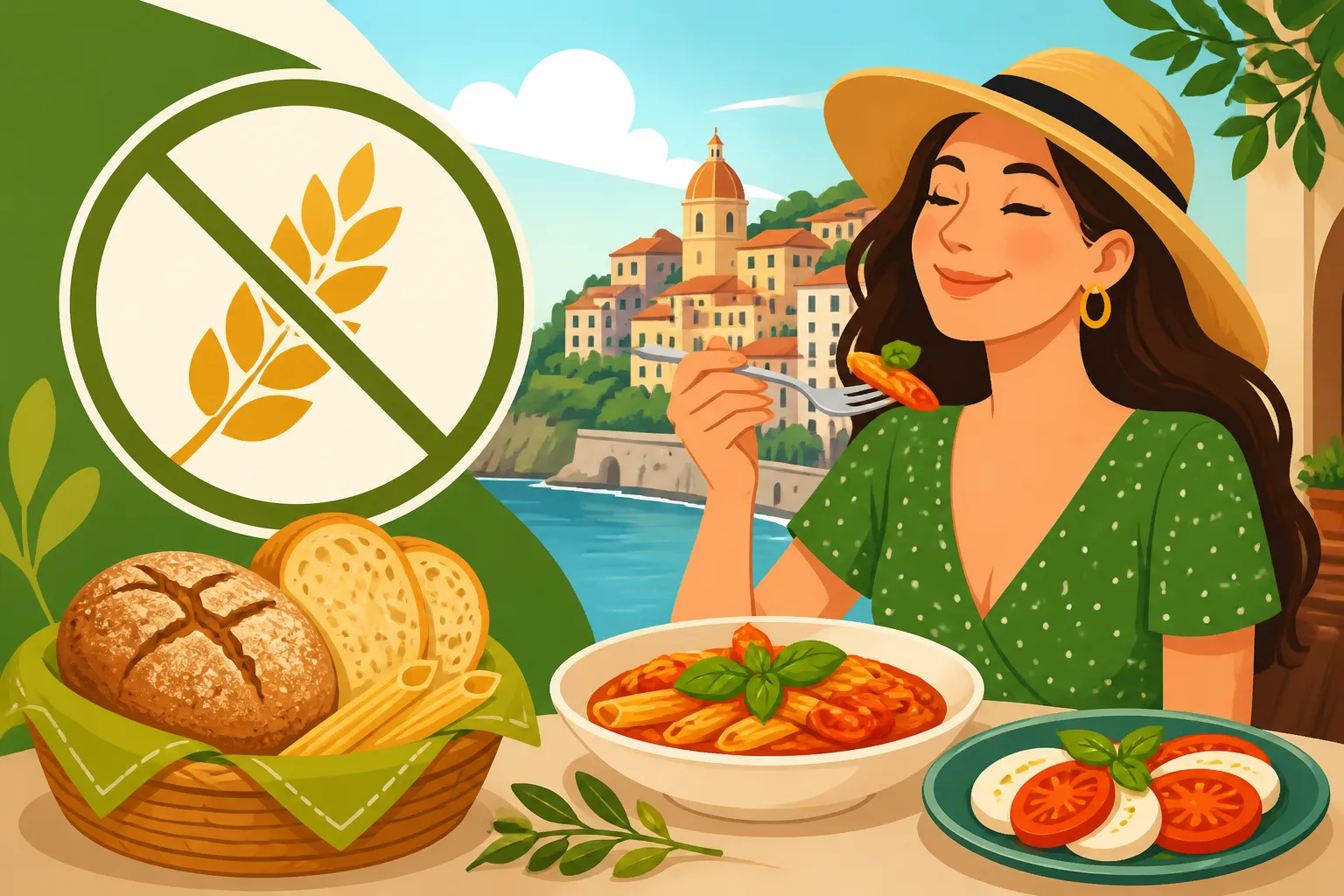
The crossed grain symbol, known in Italian as the Spiga Barrata or “crossed-out ear of wheat,” is the certification mark licensed through AIC. When you see it on packaged food, the product has been certified as suitable for people with coeliac disease. Some products are labeled senza glutine without the symbol, which can still be fine, but the symbol is the extra reassurance I look for when I’m tired and don’t want to read every ingredient line.
Where Italian Awareness Still Falls Short
None of this means you can relax completely. Awareness is high in larger cities and tourist areas, but it is uneven. A nonna running a tiny osteria in the countryside might be lovely and well-meaning while dusting her cutting board with flour between dishes. Bars that sell tramezzini and cornetti rarely have separate preparation areas. And the confidence of a busy waiter is not the same as a trained kitchen. The skill you need is not avoiding Italian food; it is knowing which questions to ask and which places have already done the work for you. For the broader food landscape, including meal timing and how courses work, Italian Food Culture: Eating Well as a Visitor is a helpful companion read.
Eating Out Safely: Restaurants, Pizzerias, and Gelato
This is where most of the anxiety lives, and where a little preparation pays off enormously. Eating out in Italy gluten-free is genuinely joyful once you have a system.
How to Talk to a Waiter About Gluten
Italians appreciate directness, and in restaurants clarity is respected far more than politeness padded with apologies. My standard script goes like this:
- Greet them and say “Sono celiaco” or “Sono celiaca.” Lead with the medical term, not “I avoid gluten.”
- Ask “Avete piatti senza glutine?” which means “Do you have gluten-free dishes?”
- For anything that looks naturally safe, ask “Questo piatto contiene glutine?” meaning “Does this dish contain gluten?”
- Then ask the crucial follow-up: “C’è rischio di contaminazione in cucina?” which means “Is there a risk of contamination in the kitchen?”
- For pasta, ask “La pasta senza glutine è cotta in acqua separata?” meaning “Is the gluten-free pasta cooked in separate water?”
- For anything fried, ask “La friggitrice è separata?” meaning “Is the fryer separate?”
The answers to steps four through six tell you more than the menu ever will. If the waiter hesitates, shrugs, or says “un po'” which means “a little,” take that as your cue to order something simpler or move on. Many coeliac travelers also carry a printed restaurant card in Italian explaining the condition, which is useful in loud places or when your Italian freezes up under pressure. If you rely on your phone, download Italian for offline use before you travel; I explain how in How to Use a Translation App Offline in Italy.
Under EU rules, restaurants must be able to tell you which allergens are in their dishes, and gluten-containing cereals are on that list. Many places keep an allergen binder or a printed allergen sheet. Ask for “la lista degli allergeni” and they should produce it. For the rest of the ordering etiquette, including why you shouldn’t expect the bill until you ask, see Restaurant Etiquette in Italy: Coperto, Courses, and the Bill.
Which Dishes Are Usually Safe and Which Are Traps
Italian cooking has a huge range of naturally gluten-free dishes, but some hide wheat in unexpected places. This table is the mental cheat sheet I wish someone had given me on day one.
| Dish or Item | Usual Gluten Status | What to Check |
|---|---|---|
| Risotto | Often naturally gluten-free | Stock cubes and whether flour is used to thicken |
| Polenta | Naturally gluten-free | Whether it is grilled on a shared surface |
| Grilled meat or fish | Usually safe | Flour dusting before cooking, shared grill |
| Fritto misto and fried calamari | Contains gluten unless specified | Batter and a dedicated fryer |
| Cotoletta alla milanese | Contains gluten | Breadcrumbs; only order a certified version |
| Gnocchi | Often contains wheat flour | Ask for a gluten-free version |
| Arancini | Contains gluten | Breadcrumb coating |
| Cured meats and salumi | Often safe | Additives in cheaper products |
| Fresh cheeses like mozzarella | Usually safe | Contact with bread on a shared board |
| Soups like minestrone | Varies | Pasta or bread added, thickening |
| Gelato in a cup | Often safe | Biscuit pieces in flavors, shared scoops |
| Tiramisu | Contains gluten | Savoiardi biscuits; look for a certified version |
| Panna cotta | Often naturally gluten-free | Toppings and biscuit crumbs |
Regional cooking matters too. In Emilia-Romagna you will face endless fresh egg pasta, while in Venice and the Veneto you’ll find more polenta and seafood. In Sicily, arancini and cannoli are everywhere, but so are certified gluten-free bakeries in Palermo and Catania that make versions of both.
Pizza Without the Panic
Gluten-free pizza in Italy is excellent when done right, and genuinely risky when done wrong. Flour floats in the air of a traditional pizzeria, coats the counters, and dusts the wooden peel. A wood-fired oven is shared space.
Trustworthy gluten-free pizzerias usually have one or more of these features: a separate preparation room or counter, a separate oven, and gluten-free bases made or sealed off-site. Many AIC-network pizzerias bake gluten-free pizzas in an electric oven reserved for that purpose. Some cities also have fully gluten-free pizzerias where every item on the menu is safe, which is pure bliss if you have been tense for days.
My rule is simple. If a pizzeria offers gluten-free bases but cannot tell me how they avoid contamination, I order a salad. If you want to understand the difference between Neapolitan softness and Roman crispness so you know what you are aiming for, read Pizza in Italy: Neapolitan, Roman, and Beyond.
Gelato, Aperitivo, and the Little Moments
Gelato is often the first thing a gluten-free traveler wants to enjoy guilt-free, and it often is safe. Ask for a coppetta, a cup, rather than a cono, a cone, unless the shop offers a cono senza glutine, a gluten-free cone. Many AIC-trained gelaterie keep gluten-free cones sealed in packaging. Watch out for flavors with biscuit or cookie pieces, like stracciatella variants with wafers, and ask staff to use a clean scoop from a fresh tub if you are highly sensitive. How to Tell Real Gelato From Fake in Italy will also help you avoid the bright, artificial tourist stuff.
Aperitivo is trickier. The free nibbles that come with a spritz tend to be crackers, taralli, focaccia squares and little sandwiches. Olives, potato chips, cubes of cheese and slices of cured meat are your friends. Taralli, the ring-shaped snack common in Puglia, almost always contain wheat. For the ritual itself, see What Is an Aperitivo and How Do You Order One?.
Shopping Gluten-Free: Supermarkets, Pharmacies, and Bakeries
Even if you mostly eat out, knowing how to stock up locally saves you on travel days, early mornings and those long Sunday afternoons when half the town seems to close.
Supermarket Aisles You Can Rely On
Major Italian supermarket chains, including Esselunga, Coop, Conad, Carrefour and Pam, generally have a dedicated gluten-free section, often signposted senza glutine or alimenti per celiaci. You will find pasta made from corn, rice, or blends, along with bread, crackers, breadsticks, biscuits, flour mixes, and frozen pizzas. Schär, the South Tyrol-based brand, is the one you’ll see most often, alongside supermarket own-brand lines.
Smaller neighborhood shops and discount supermarkets may have only a single shelf. In rural areas, you may find very little. If you’re heading into the countryside for a few days, buy what you need in the nearest large town first. I’ve written more about chain-by-chain availability in Finding Gluten-Free Products in Italian Stores, and Grocery Shopping in Italy: Supermarkets vs Markets explains how the weekly market and the supermarket fit together.
A word of warning about outdoor markets: fresh produce, cheese and cured meats are wonderful, but stalls selling bread, focaccia and fried snacks create a lot of airborne flour. Shop the produce, enjoy the atmosphere, and skip the open food counters.
Why Italian Pharmacies Sell Gluten-Free Food
This surprises almost every visitor. Italian pharmacies, the farmacie marked by a green cross, often stock gluten-free bread, pasta, biscuits and snacks. This is because residents diagnosed with coeliac disease receive support for gluten-free food through the national health system, and pharmacies are one of the main distribution points.
As a visitor you won’t access that support, but you can simply buy the products. Pharmacy selections are sometimes smaller than supermarket ones, yet they can be a lifesaver in towns without a big supermarket. Ask the pharmacist “Avete prodotti senza glutine?” meaning “Do you have gluten-free products?” For more on how pharmacies work here, see Italian Pharmacies: Prescription, Over-the-Counter, and Supplies. If you are planning a longer stay or relocating, Availability of Gluten-Free and Special Diet Foods in Italy covers the resident side in more depth.
Dedicated Gluten-Free Bakeries
Italian cities increasingly have fully dedicated gluten-free bakeries and pastry shops. These places make cornetti, the Italian breakfast pastry, along with focaccia, cannoli, crostata tarts and even panettone at Christmas, all without gluten. Walking into one after weeks of watching everyone else eat cornetti at the bar is emotional, and I’m not exaggerating.
The best way to find them is through the AIC directory or by searching “pasticceria senza glutine” plus the city name in a maps app. Read recent reviews carefully. Look for phrases like “100% senza glutine,” “laboratorio dedicato,” which means “dedicated kitchen,” or “certificato AIC.”
Planning Your Trip Around Gluten-Free Food
The happiest gluten-free trips I’ve taken weren’t the ones where I found the most restaurants on the fly. They were the ones where I planned a few anchors in advance and left room to explore.
Choosing Where to Stay
A kitchen changes everything. Even if you plan to eat out most nights, being able to make your own breakfast removes the morning scramble, because Italian breakfast is almost entirely bread and pastry. When I search for apartments or aparthotels on Booking.com, I filter for a kitchen or kitchenette and then message the host directly to ask whether there is a supermarket within walking distance.
Hotels and B&Bs vary. Some in the AIC network offer certified gluten-free breakfasts, while others will buy a pack of gluten-free toast and put it on the same buffet as the croissants. Email ahead and ask specifically: “Offrite una colazione senza glutine preparata separatamente?” meaning “Do you offer a gluten-free breakfast prepared separately?” Agriturismi, the farm stays, can be wonderful because meals are often cooked to order, but the same contamination questions apply. The differences between property types are laid out in Accommodation in Italy: Hotels, B&Bs, and Agriturismi.
Travel Days, Trains, and Long Journeys
Train stations and motorway service stations are where gluten-free travelers go hungry. Station bars rarely have more than a packaged snack, and the food trolley on high-speed trains is mostly sandwiches and biscuits. I always pack a small bag the night before: gluten-free crackers, fruit, a hunk of Parmigiano, and something sweet.
If you’re hopping between Rome, Florence, Bologna and Venice, booking tickets in advance through Omio or directly with the rail operators lets you plan arrival times around meals. Arriving in a new city at three in the afternoon is a classic trap, because many restaurants close between lunch and dinner service. Plan to land close to a meal time, or know exactly where your snack stop is.
Food Tours and Cooking Classes
Food tours are a highlight of travel in Italy, but a standard tasting walk through a market is usually built around bread, pasta, pastries and fried snacks. Before booking anything, contact the operator and ask whether they can genuinely accommodate coeliac disease, not just “gluten intolerance.” On platforms like GetYourGuide, some cooking classes and tours specifically advertise gluten-free options, and reading reviews from other coeliac travelers is the most honest signal you’ll get.
A gluten-free cooking class is one of my favorite experiences to recommend. Learning to make fresh pasta from gluten-free flour, or a proper risotto, gives you something to take home. If a class can’t confirm a separate workspace, choose one built around naturally gluten-free cooking, such as risotto, polenta or seafood.
A Quick Pre-Trip Checklist
Here is the routine I follow before every Italian trip:
- Download the AIC app and check the venues in each town on your route.
- Save several certified restaurants, pizzerias and bakeries in your maps app for each city.
- Print or save a coeliac restaurant card in Italian.
- Learn the key phrases, especially “Sono celiaco” or “Sono celiaca” and the contamination question.
- Book at least a few nights with a kitchen if you’re staying longer than a weekend.
- Pack travel-day snacks and know which supermarkets are near your accommodation.
- Check opening hours, since many places close one day a week and some close for holidays in August.
If you also have other dietary needs, How to Find Vegetarian and Vegan Food in Italy uses similar strategies, and How to Find Authentic Restaurants in Italy (Not Tourist Traps) will help you spot the places that cook from scratch, which, for coeliacs, usually means staff who actually know what’s in the food.
The first time a Roman waiter brought me a plate of gluten-free carbonara, cooked in fresh water, with a small flag stuck in it to mark it as safe, I nearly cried into my wine. Italy can be that place for you too. Ask clearly, trust certified venues, and don’t let fear keep you out of the trattoria.
Disclaimer
This article is for general informational purposes only and does not constitute professional advice. Laws, prices and regulations vary by location and change over time. Consult a qualified professional for guidance on your specific situation.