How to Greet People in Italy: Handshake or Kiss?
Walking into a social gathering in Italy can feel like a high-stakes performance where you have forgotten your lines and the choreography. The anxiety of whether to extend a hand, lean in for a kiss, or simply wave from a distance is a common hurdle for every newcomer. This guide meticulously deconstructs the nuances of Italian greetings to ensure you navigate every social encounter with confidence and grace.
Disclosure: This post may contain affiliate links. We may earn a commission at no extra cost to you if you make a purchase through these links. Read full disclosure.
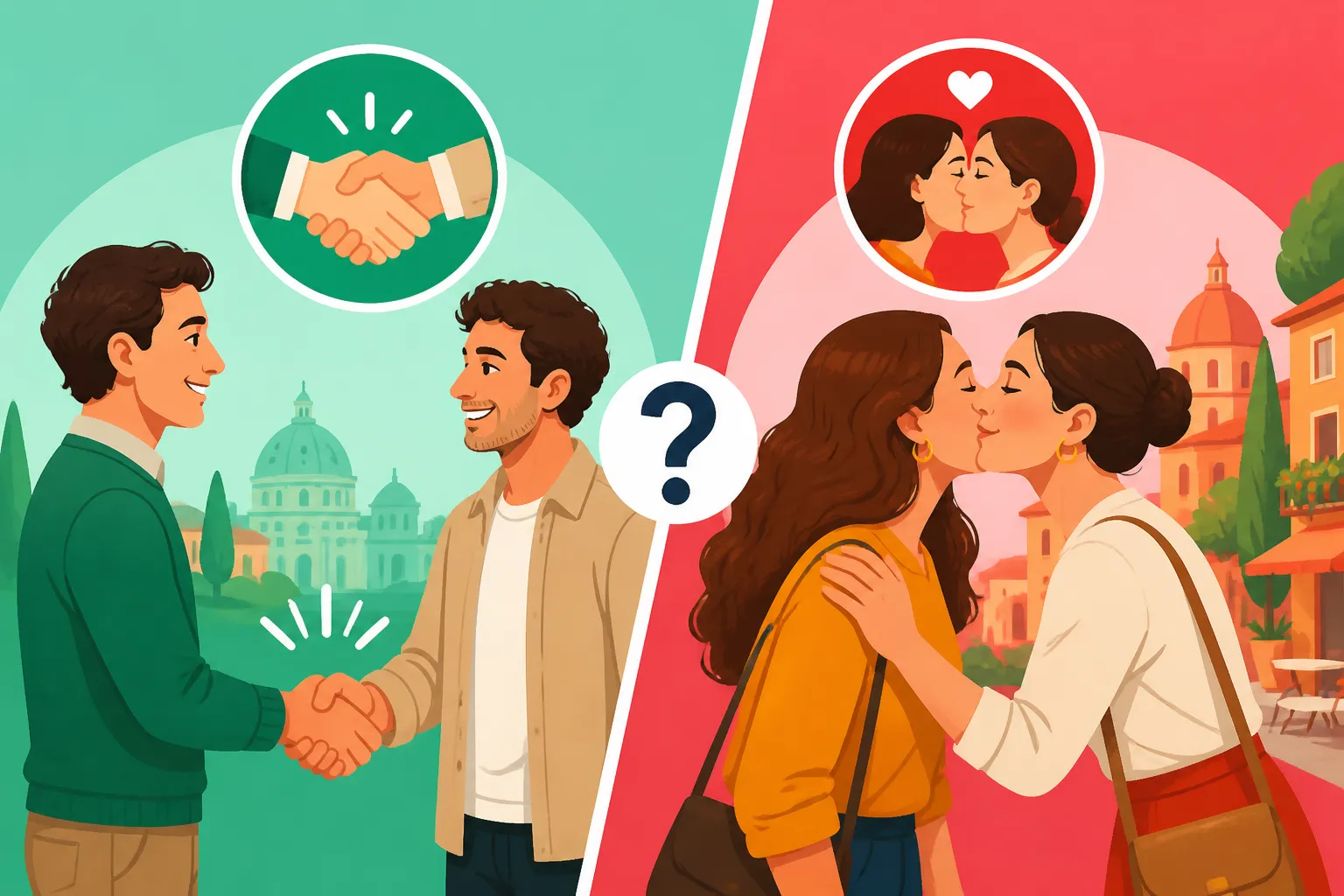
The Core Dilemma: Handshake, Hug, or Kiss?
The initial moment of contact in Italy is where most cultural misunderstandings happen. Unlike the relatively predictable "wave or handshake" culture of North America or Northern Europe, Italy relies on a sliding scale of physical intimacy that depends entirely on your relationship with the other person. If you are arriving in a new city after booking your stay through Booking.com, your first interaction will likely be with a host or a receptionist. In this professional or semi-professional setting, the handshake is the undisputed king.
A proper Italian handshake is firm but not aggressive. It should be accompanied by direct eye contact and a slight smile. If you are wearing gloves—perhaps during a chilly winter morning in Milan—it is considered polite to remove the right glove before shaking hands. This small gesture shows respect and a willingness to make a genuine connection. Failing to make eye contact during a handshake can be interpreted as a lack of interest or, worse, a sign that you are untrustworthy.
As you transition from a stranger to an acquaintance, the physical boundaries begin to soften. However, the most common mistake expats make is rushing into the "double kiss" too early. The kiss is reserved for friends, family, and people you have met at least a few times. If you are on a guided walking tour found through GetYourGuide, you should stick to a friendly verbal greeting and perhaps a handshake at the conclusion of the tour. Pouncing on a tour guide with a double kiss on the first meeting would be seen as an overwhelming breach of personal space.
Decoding the Two-Kiss Rule
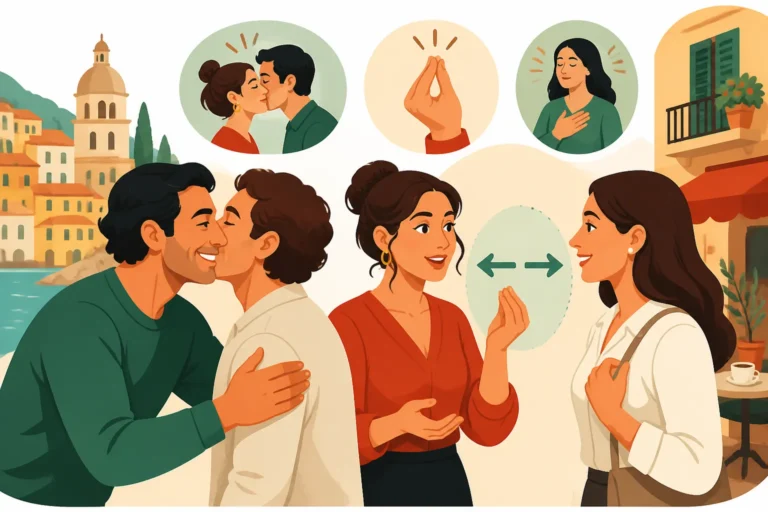
When you finally reach the "kissing stage" of a relationship, the mechanics are vital. In Italy, the standard is two kisses—one on each cheek. The most important rule to remember is that you start by leaning to your right, meaning you touch your right cheek to their right cheek first. This prevents the awkward and potentially painful "nose-clash" that haunts many first-time visitors.
It is also important to note that these are usually "air kisses." Your lips do not actually need to make contact with the person’s skin; instead, you touch cheeks and make a light kissing sound in the air. For men, the rules are slightly different. While men kissing men is perfectly common among family members or very close friends, it is less frequent between male acquaintances, who often opt for a firm handshake combined with a pat on the shoulder or upper arm.
When the Handshake is Your Best Friend
There are specific scenarios where the handshake should never be bypassed. In business meetings, formal introductions, or when meeting someone significantly older than you, the handshake remains the safest and most respectful option. If you are unsure, wait for the Italian person to initiate. They are usually very adept at reading social cues and will signal their preference through their body language.
If you see someone leaning in with their shoulders squared and a hand extended, stay the course with the handshake. If they approach with open arms and a tilted head, prepare for the double kiss. If you have just arrived in a new region via a train booked on Omio, and you are meeting a local business partner for the first time, keep it formal. Transitioning too quickly to informal greetings can undermine your professional standing.
Navigating Formality: The Social Hierarchy of Greetings
The Italian language itself is built around greeting hierarchy. Understanding Italian Customs, Etiquette, and Social Life involves recognizing the difference between the informal "Tu" and the formal "Lei." This linguistic divide dictates how you should physically greet someone. If you are addressing someone as "Lei," you are almost certainly in a handshake-only zone.
Using "Ciao" is often the first instinct for foreigners, but it is a deeply informal word. In a formal setting, such as a doctor's office, a government building, or a high-end boutique, you should lead with "Buongiorno" (Good morning) or "Buonasera" (Good evening). These verbal cues set the stage for the physical greeting. If you start with a formal "Buongiorno," the other person knows to expect a professional distance.
Formal Situations and Professional Etiquette
In a professional environment, greetings are not just about the physical act but about acknowledging rank and seniority. When entering a room, it is customary to greet the eldest person or the person in the highest position first. This shows an understanding of Work Culture in Italy: What Expats Should Expect and earns you immediate respect.
If you are introduced to a group, try to make individual eye contact with each person as you shake hands. A generic "hello" to the room can feel dismissive. Italians value the individual connection, even in a brief greeting. This is also why CV and Interview Tips for Working in Italy often emphasize the importance of the "first impression" during the initial seconds of an interview.
Meeting the In-Laws and Family Circles
The most stressful greeting scenario for many expats is meeting an Italian partner's family. Here, the rules of Italian Social Customs: Greetings, Gestures, and Personal Space are amplified. You may find yourself being hugged and kissed by aunts, uncles, and cousins you’ve never met. In this context, it is best to be a "social chameleon."
Follow your partner’s lead. If the family is traditional, start with a polite handshake for the elders and wait for them to pull you into a kiss. For the younger generation, a double kiss is almost always the standard. Remember that food is often a secondary form of greeting. When you sit down for a meal, your behavior at the table is an extension of your greeting. Understanding How to Eat Like a Local in Italy: Meal Structure and Timing will help you navigate the long, social lunches that often follow these initial introductions.
Regional Nuances: North vs South
While the double kiss is a national phenomenon, the intensity and frequency of greetings can vary as you travel between the North and the South. If you use Omio to travel from the fog-wrapped streets of Milan to the sun-drenched alleys of Naples, you will notice a palpable shift in social energy.
In the North, specifically in business-centric cities like Milan or Turin, greetings tend to be more efficient. The handshake is often quicker, and the "air kisses" might be more distant. There is a greater emphasis on Dress Codes and Bella Figura in Italy, where the greeting is part of a polished, professional image.
Milanese Efficiency vs Neapolitan Warmth
In Naples, Sicily, or Puglia, the greeting is an event in itself. Physical touch is much more common. You might find an acquaintance holding your hand for a few seconds longer than expected or placing a hand on your heart during a conversation. This is not an invasion of privacy; it is an expression of warmth and "calore umano" (human warmth).
When you are Living in Florence and Bologna: A Practical Comparison, you might find a middle ground. These central regions often blend the professional reserve of the North with the friendliness of the South. Regardless of the region, the most important thing is to remain present. An Italian greeting is never a "drive-by" event; it requires your full attention for those few seconds.
The Impact of Rural vs Urban Settings
In small hilltop villages, the rules change again. When walking through the "borgo," it is customary to greet everyone you pass, even if you don't know them. A simple "Buongiorno" or a tip of the head is enough. This is a sign of being a "buona persona" (a good person) who acknowledges the community.
In contrast, in the bustling centers of Rome or Milan, you wouldn't dream of greeting every stranger on the street. However, the moment you enter a small shop or a "bar" for your morning espresso, the greeting becomes mandatory. Silence upon entry is seen as incredibly rude. Even a quick "Salve" (a neutral, slightly formal "hello") to the barista is essential.
Practical Tips for the Greeting Process
To master the Italian greeting, you need to look beyond the hands and the cheeks. Your voice and your timing are equally important. If you have used Booking.com to find a charming villa in the countryside, your interactions with the local staff will set the tone for your entire stay.
One of the most useful tips is to learn the time-of-day transitions. "Buongiorno" is used from morning until roughly 1:00 PM or 2:00 PM. After lunch, most Italians switch to "Buonasera." While "Buon pomeriggio" (Good afternoon) exists, it is rarely used in casual conversation and can sound a bit like a television presenter. Using "Buonasera" starting in the early afternoon is a local pro-tip that makes you sound much more like a seasoned resident.
Mastering the Verbal "Buongiorno" and "Ciao"
Many expats over-rely on "Ciao" because it is famous globally. However, "Ciao" is both "hello" and "goodbye," and it should only be used with people you are on a first-name basis with. If you are speaking to someone in a position of authority, an older person, or a stranger, stick to the formal options.
Another useful word is "Piacere" (Pleasure). When being introduced to someone for the first time, saying "Piacere" or "Piacere di conoscerti" (Pleasure to meet you) while shaking hands is the gold standard of Italian Language and Everyday Communication for Visitors. It is simple, elegant, and universally accepted.
Dealing with the "Air Kiss" Awkwardness
If you find yourself in the middle of an "air kiss" and you realize the other person is only going for one kiss (which happens occasionally in certain Northern circles or with specific families), don't panic. Simply follow their lead and pull back gracefully. The "half-kiss" is much less awkward than forcing a second kiss on someone who has already moved on.
Similarly, if you have a cold or are feeling unwell, it is perfectly acceptable—and appreciated—to skip the kisses. You can simply say, "Scusa, sono un po' raffreddato/a" (Sorry, I have a bit of a cold) and offer a wave or a polite nod instead. This shows that you care about their well-being, which is the highest form of respect in Italian culture.
| Greeting Type | Social Context | Physical Action | Verbal Accompanying |
|---|---|---|---|
| Formal | Business, Elders, Strangers | Firm Handshake | Buongiorno / Buonasera |
| Neutral | Shops, Waiters, Staff | Polite Nod / Slight Wave | Salve |
| Informal | Friends, Peers, Family | Two Air Kisses (Right first) | Ciao |
| First Meeting | Social Introduction | Handshake + Eye Contact | Piacere |
| Very Close | Family, Best Friends | Hug + Two Kisses | Ciao Bella/Caro |
Summary of Best Practices for Expats
Navigating Italian greetings is ultimately about observation and empathy. If you are traveling through the country using Omio and exploring different cities, take a moment to sit in a piazza and watch how locals interact. You will see that the "rules" are flexible and heavily influenced by the specific "vibe" of the group.
Always err on the side of formality if you are unsure. It is much easier to be told "Dammi del tu" (Give me the 'tu' / Speak to me informally) than it is to recover from being accidentally disrespectful. Italians are generally very forgiving of foreigners, especially if they see you are making a genuine effort to follow their customs.
By focusing on eye contact, choosing the right verbal greeting for the time of day, and mastering the "right-cheek-first" rule, you will quickly move from being a confused "turista" to a respected member of the local social fabric. Whether you are Finding and Using Pharmacies in Italy or attending a high-society event in Venice, your greeting is your calling card. Make it count.
Disclaimer
The information provided in this guide is for educational and informational purposes only. Cultural norms and social etiquette in Italy can vary significantly based on specific regional traditions, individual preferences, and evolving social standards. While every effort has been made to ensure the accuracy of this advice, readers should always prioritize local context and personal safety in their social interactions. This guide does not constitute legal or professional advice.