Where to Get Organ Donor Cards as an Expat
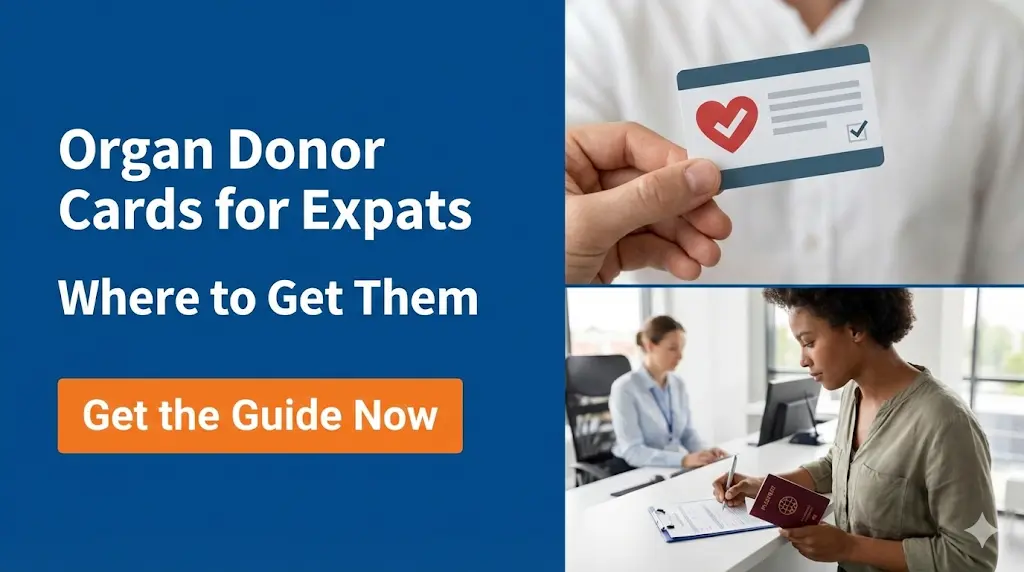
Picture this: you finally get your Italian residency, and a clerk at the Comune asks whether you want to donate your organs. You freeze. You signed a donor card back home, but does that count here? Where do you even sign up in Italy? This guide explains every route expats can use to register their organ donation decision in Italy, and which one fits your situation.
Disclosure: This post may contain affiliate links. We may earn a commission at no extra cost to you if you make a purchase through these links. Read full disclosure.
How Organ Donation Consent Works in Italy for Foreign Residents
When I first moved to Italy, I assumed my old donor card from home would be valid everywhere, like a passport for good intentions. It isn’t. The Italian system runs on its own register and its own paperwork. Once you understand how it fits together, the choices become much simpler.
The National Register and Why It Matters
Italy records each person’s decision about organ and tissue donation in a national database called the Sistema Informativo Trapianti, usually shortened to SIT. The Centro Nazionale Trapianti, the national transplant authority, manages it. When a patient dies in circumstances where donation is possible, the hospital coordination team checks this register to find out what that person wanted.
This is the most important point for expats. A decision recorded in the SIT is the clearest signal you can leave. A doctor in Bologna or Palermo can see it quickly, whatever language you speak and whether or not your family is reachable that night. A decision that lives only on a piece of paper in your wallet depends on someone finding the paper. Your relatives may also have to explain it to medical staff in Italian.
If you never record any decision, Italian practice is to ask your closest family members whether they object to donation. For many expats, those family members are thousands of kilometres away, grieving, and facing a phone call in a language they may not understand. The emotional reason to register is to spare them that position.
Your recorded choice can be a yes or a no. Registering is not only for people who want to donate. If donation goes against your beliefs, recording a refusal protects that wish just as clearly.
Your Home-Country Donor Card Does Not Carry Over
This is where many of us get caught out. Your registration with a donor register in the UK, the US, Canada, Australia or anywhere else is not shared with the Italian SIT. Those systems do not talk to each other. Italian transplant coordinators work from Italian records.
A card from home is not worthless. It is still written evidence of what you wanted, and it can help your family express your wishes. But it is not a substitute for an Italian registration. I kept my old card for years thinking I was covered. Then a nurse friend in Turin pointed out that nobody in an Italian intensive care unit would ever look up a foreign database.
Keep your home registration active if you still spend time there, because it applies if something happens on a visit home. For your life in Italy, treat the Italian registration as a separate task on your settling-in list. It sits alongside the residency and health card steps covered in Registering Residency in Italy (Residenza and Anagrafe).
Four Places to Register Your Donor Decision in Italy
There is no single “organ donor card office” in Italy, which confuses many newcomers. Instead there are several official doors into the same register, plus one informal option that stays outside it.
At the Comune When You Get Your Electronic Identity Card
For most residents, this is the easiest route by far. When you request or renew your Carta d’Identità Elettronica, the electronic identity card, at your Comune’s registry office, the clerk asks whether you want to state your decision on organ and tissue donation. You can say yes, say no, or decline to answer. If you answer, the Comune sends your declaration to the national register. You sign it on the spot as part of the card process.
There is one catch for foreigners. The Comune issues the electronic identity card to people registered as residents in its Anagrafe. If you have not completed residency registration, you cannot use this route yet. If you are a non-EU citizen, the card you receive is an identity document for use in Italy, not a travel document. It still works perfectly well for the donation declaration.
A practical tip from experience: the question comes at the end of a long appointment, often with a queue behind you. The clerk may say it quickly in Italian, something like “Vuole esprimere la sua volontà sulla donazione di organi e tessuti?” Know your answer before you walk in, so you don’t panic and wave it away. If your Comune’s procedures feel overwhelming in general, Navigating Italian Bureaucracy: Comune and Prefettura is a good primer on how these offices operate.
At Your ASL With the Declaration of Will Form
Your Azienda Sanitaria Locale, the local health authority, can also record your decision. You go to the ASL office that handles your area and ask to fill in the official declaration of will form for organ and tissue donation. In Italian it is usually called the “modulo per la dichiarazione di volontà alla donazione di organi e tessuti.” Some ASL offices shorten it to “modulo dichiarazione di volontà.” Saying the full name at the counter saves a lot of confused back-and-forth.
That declaration form asks for your personal details, your codice fiscale and your signature, and you mark whether you consent or refuse. The ASL staff then enter your declaration into the national register. Bring a valid identity document and your tessera sanitaria if you have one. Which office handles these declarations varies from one ASL to another. It might be a general front desk, a public relations office or a dedicated health services counter. Call ahead or ask at reception which desk deals with organ donation declarations.
The ASL route suits you if your Comune appointment is months away, or if you already have your identity card and don’t want to wait for a renewal. It is also convenient when you are at the ASL anyway, for example when you are enrolling with the health service, choosing your family doctor or collecting your health card. If those steps are still ahead of you, see Registering With Your Local ASL in Italy: A Practical Guide and Obtaining the Italian Health Card (Tessera Sanitaria).
Through AIDO, the National Donor Association
AIDO, the Associazione Italiana per la Donazione di Organi, Tessuti e Cellule, is Italy’s best-known donor association. You can join it and sign a declaration of consent. AIDO then transmits your declaration to the national register, so it carries the same weight as a Comune or ASL registration.
AIDO has local sections across the country. They are often run by volunteers who staff stands at town festivals, markets and hospital events. That makes this route feel much more human than a bureaucratic counter. You can ask questions, and the volunteers are usually happy to explain things slowly. AIDO has also offered online registration that uses digital identity tools such as SPID. If you already have SPID, check the association’s own website for its current process. If you don’t, SPID and Digital Identity for Italian Tax and Services walks you through what it is and why it is useful far beyond this one task.
Keep in mind that joining AIDO is a statement of consent. It is a route for people who want to donate. If you want to record a refusal, use the Comune or the ASL instead.
The Signed Card or Written Declaration You Carry With You
Finally, there is the classic donor card. Italy’s health authorities have long made a donor card, often called the “tesserino,” available for people to fill in, sign and carry. You can also write your own declaration on a sheet of paper, stating your will, with your full name, date of birth, date and signature.
This is a legitimate expression of your wishes, and hospital staff will take it into account if they find it. But it is not entered into the national register. It only works if someone finds it and reads it. Think of it as a backup, or as a bridge for the period before you can register formally, not as your main method.
If you carry a written declaration, write it in Italian or keep an Italian version alongside the English one. A short, clear sentence in Italian is far more useful in an emergency department than a long English paragraph. You don’t need a formal sworn translation for a personal wallet card. For official documents in other contexts, though, How to Get a Sworn (Giurata) Translation for Italy explains when certified translations are needed.
Comparing Your Registration Options
| Route | Goes Into the National Register | Who Can Use It | What to Bring | Best For |
|---|---|---|---|---|
| Comune, during electronic identity card issue or renewal | Yes | Residents registered at the Anagrafe | Documents required for the identity card | Residents with an upcoming card appointment |
| ASL, using the declaration of will form | Yes | People with access to their local ASL, typically SSN-enrolled residents | Identity document, codice fiscale, health card if available | Residents who don’t want to wait for a card renewal |
| AIDO membership and declaration | Yes, consent only | Adults wishing to donate, generally with a codice fiscale | Identity document and codice fiscale, or digital identity for online sign-up | People who want a supportive, volunteer-led process |
| Signed donor card or written declaration | No | Anyone, including visitors and non-residents | Pen, paper or the printed card | Short stays, or a temporary bridge before formal registration |
Step-by-Step Registration for Different Expat Situations
Everyone’s paperwork journey in Italy is different, so here is how I would approach it depending on where you are.
If You Are a Newly Registered Resident
You have your residency and your codice fiscale, and you are slowly ticking off the list. Here is the order that tends to work best:
- Decide your answer at home, ideally after talking it through with your partner or family. Write it down if that helps you feel settled.
- Check when you are due to request your electronic identity card at the Comune. If the appointment is coming up soon, plan to state your decision there.
- If the identity card appointment is far away, or you already have one, go to your ASL instead. Ask specifically for the “modulo per la dichiarazione di volontà alla donazione di organi e tessuti.”
- Fill in the declaration form, sign it in front of the staff member, and ask whether they will give you a copy or receipt for your records.
- Fill in a wallet card as well and put it with your identity documents. It can help your family and medical staff while your registration is still being processed.
- Tell your next of kin what you decided and that it is now recorded in Italy.
If you still need your tax code, that has to come first, because almost every official form here asks for it. How to Get a Codice Fiscale in Italy (and Why You Need One) covers the process.
If You Are a Non-Resident, Student or Long-Stay Visitor
This is the trickiest group. Without residency, you cannot get the electronic identity card, so the Comune route is closed. ASL access depends on whether you are enrolled with the health service. Many students and visitors in their first months rely on private insurance rather than the SSN. The rules for which visa holders can or must enrol vary, and Health Insurance for Italian Visa Types: A Comparison lays out the differences.
In this situation, a practical sequence looks like this:
- Fill in a written declaration in Italian right away and carry it with your passport or residence permit.
- If you have a codice fiscale, ask your local AIDO section, or check the association’s website, about whether you can register with them.
- If you are enrolled with the SSN, even as a student or temporary resident, ask your ASL whether it will accept your declaration of will form.
- Once you complete residency registration, use the Comune route at your first identity card appointment, so your decision is firmly recorded in the national register.
A note for those of us who arrived on private cover: many newcomers hold an international policy such as SafetyWing or Cigna Global during their first months. Insurers have no role in registering donor decisions in Italy. Your policy can be excellent and still leave this question completely untouched. The registration always happens through Italian public institutions or AIDO, never through your insurer.
If You Want to Change or Update Your Decision
People change their minds, and the Italian system allows for that. You can update your declaration at any time through any of the registering routes. The most recent declaration you make is the one that counts.
Here is a real-life style example. Sarah, a British teacher in Florence, refused donation at her first identity card appointment because she felt rushed. A year later she changed her mind after a colleague’s family went through a transplant. She went to her ASL, filled in a new declaration of will form stating consent, and the newer declaration replaced the old one. She did not need to “cancel” anything first.
If you change your mind, also update or throw away any old wallet card that says the opposite. Two contradictory pieces of paper are the last thing you want your family to find. If you want to confirm what is recorded about you, ask at your ASL. Some regions are also expanding what citizens can see in their online health records. The Electronic Health Record in Italy (Fascicolo Sanitario Elettronico) explains how to access yours and what your region currently shows.
Practical Tips Before You Sign Anything
Paperwork is only half the story. The other half is human, and in my experience it is the half people neglect.
Talk to Your Family, Whatever Language They Speak
Even with your decision in the national register, the hospital team will speak with your family. A family that already knows your wishes can support them calmly instead of being surprised at the worst possible moment. Have the conversation with relatives back home too, not just with whoever lives with you in Italy.
Write a short note for them in English, or their own language, that explains three things. First, you have registered your decision in Italy. Second, Italian doctors can see it in the national register. Third, you want them to respect it. Store that note with your will or your important documents.
If you have an Italian partner, ask them to help you rehearse the vocabulary: “donatore,” “donazione di organi e tessuti,” “consenso,” “opposizione.” It takes ten minutes and makes the Comune moment much less stressful.
Insurance, Repatriation and Living Donation
One question expats ask me surprisingly often: “If I’m a donor and I die in Italy, will that mess up my repatriation?” Donation and repatriation of remains can both happen. Hospitals routinely coordinate donation with the family’s later funeral arrangements. What varies is how your particular insurance policy handles repatriation of remains, and what documents your insurer will want. If you rely on an international plan such as Cigna Global, read the repatriation section of your policy wording. Ask the insurer directly if anything is unclear, and check their own pages for the current terms.
Living donation is a different scenario. You might one day consider donating a kidney or part of a liver to a relative. That involves medical assessment, surgery and recovery time. Whether a private or international policy covers any of a living donor’s costs depends entirely on the policy. Ask your insurer in writing before you make plans, and check how the SSN would be involved if you are enrolled. Don’t assume either way.
If you are still in the gap before SSN enrolment, nomad-style cover such as SafetyWing may be what you have. Treat its policy documents as the only reliable source for what it does and does not include.
Related Donor Registers: Blood, Bone Marrow and Body Donation
Registering as an organ and tissue donor does not sign you up for anything else. Italy runs separate systems for other kinds of donation:
- Blood donation runs through hospital transfusion services and associations such as AVIS and FIDAS. You donate while alive, after a health screening. How to Donate Blood in Italy as a Foreign Resident covers eligibility and how to book.
- Bone marrow and stem cell donation involves joining the Italian bone marrow donor registry. This is usually done through ADMO or a hospital recruitment centre, and it requires a sample for tissue typing.
- Donating your body to medical science after death is a separate arrangement made directly with university anatomy departments, each with its own procedure.
Many expats feel a strong pull to contribute to the community that welcomed them, and these registers are a lovely way to do it. For the wider picture of how transplant programmes operate, including how organs are allocated and the role of regional transplant centres, see Participating in Organ Donation Programs in Italy.
A Quick Checklist to Finish
- Confirm you have a codice fiscale, since nearly every official route asks for it.
- Choose your route: the Comune if you are a resident with an identity card appointment coming up, the ASL with the declaration of will form if you want it done sooner, or AIDO if you want to give consent with volunteer support.
- Carry an Italian-language written declaration in the meantime.
- Tell your family, both in Italy and abroad.
- Update everything, including old cards, if you ever change your mind.
It took me far too long to sort this out after moving here, mostly because nobody told me where to start. Now you know.
Disclaimer
This article is for general informational purposes only and does not constitute professional advice. Laws, prices and regulations vary by location and change over time. Consult a qualified professional for guidance on your specific situation.