How to Plan a Multi-City Trip Across Italy
Planning a trip across Italy often feels like a beautiful dream that quickly turns into a logistical puzzle. Many travelers struggle with over-ambitious itineraries, confusing train schedules, and the sheer volume of choices between historical landmarks and coastal escapes. This guide provides a realistic, expert-led roadmap to help you navigate Italy’s complex transport systems and create a seamless multi-city journey.
Disclosure: This post may contain affiliate links. We may earn a commission at no extra cost to you if you make a purchase through these links. Read full disclosure.
The Logistics of Movement: Master the Italian Rail System
When I first moved to Italy, I thought I could just show up at the station and hop on any train, much like a subway system. I quickly learned that the Italian rail network is a sophisticated beast with its own set of unwritten rules. For a multi-city trip, the train is almost always your best friend, but you need to know which one to pick. The High-Speed Trains in Italy: Trenitalia, Italo, Routes, and Savings are the backbone of travel between major hubs like Milan, Florence, Rome, and Naples. These "Le Frecce" (Arrows) or Italo trains can reach speeds of 300 km/h, turning a four-hour drive into a relaxing 90-minute dash through the countryside.
However, the mistake many first-timers make is failing to book these in advance. Unlike regional trains, high-speed rail prices fluctuate significantly based on demand. To keep your budget intact, you should learn How to Buy Trenitalia and Italo Tickets and Save Money as early as possible. I often recommend using Omio to compare both the national carrier, Trenitalia, and the private competitor, Italo, side-by-side. Italo often runs aggressive promotions, but Trenitalia has a wider network. Using Omio helps you visualize the price and time differences without having to navigate two separate, sometimes clunky, Italian websites.
For the smaller, more charming towns, you will likely switch to the "Regionale." These are the slower, more affordable workhorses of the country. If you are heading into the hills of the Val d'Orcia or the smaller coastal towns of Liguria, you’ll be relying on Regional Trains in Italy: How to Use Them and Save. A vital tip from a veteran: always, always validate your paper regional ticket in the little green or yellow machines on the platform before boarding. If you don’t, you risk a hefty fine from a conductor who has heard the "I'm a tourist, I didn't know" excuse a thousand times.
To Drive or Not to Drive: The Reality of the Italian Road
There is a romanticized version of an Italian multi-city trip that involves a vintage convertible and a winding road through Tuscany. While beautiful, the reality of driving in Italy involves a steep learning curve regarding the "Zona a Traffico Limitato" or ZTL. These are restricted zones in almost every city center where only residents with permits can drive. If you accidentally cross that invisible line—and you will, because the signs are small and in Italian—a camera will snap your plate, and a massive fine will show up at your home months after your vacation. Knowing What Is a ZTL in Italy and How to Avoid Fines is essential if you insist on renting a car.
My advice is usually to split your trip. Use the trains for the city-to-city legs, and only rent a car for a specific three-day window when you want to explore the countryside of Tuscany for Travelers: Cities, Hills, and Coast. In the cities, a car is a liability; parking is expensive, the streets are narrow, and Italian drivers are… let's call them "passionate." If you are moving between Rome and Florence, the train wins every time. If you want to stop at three different vineyards and a remote goat cheese farm between those cities, that is the only time the car becomes the hero of your story.
When planning your car rental, check platforms like Omio if they have integrated bus or car options for those specific stretches. Generally, keep the car for the rural "middle" of your trip and drop it off at a suburban station before entering your next major city. This saves you the stress of navigating a one-way street in a foreign language while a Vespa zips past your side mirror.
Comparing Transportation Options in Italy
| Feature | High-Speed Train (Frecciarossa/Italo) | Regional Train (Regionale) | Rental Car |
|---|---|---|---|
| Best For | Major city connections | Small towns and short distances | Countryside exploration |
| Booking | Highly recommended in advance | Not necessary; fixed price | Recommended 1-2 months prior |
| Flexibility | Low (Ticket usually for specific time) | High (Validate and go) | Highest (Go anywhere) |
| Speed | Very Fast (up to 300 km/h) | Slow (Stops at every village) | Varies (Beware of traffic) |
| Stress Level | Low | Low | High (ZTLs and parking) |
Strategic Itinerary Mapping: The North, the South, and the Classic Triangle
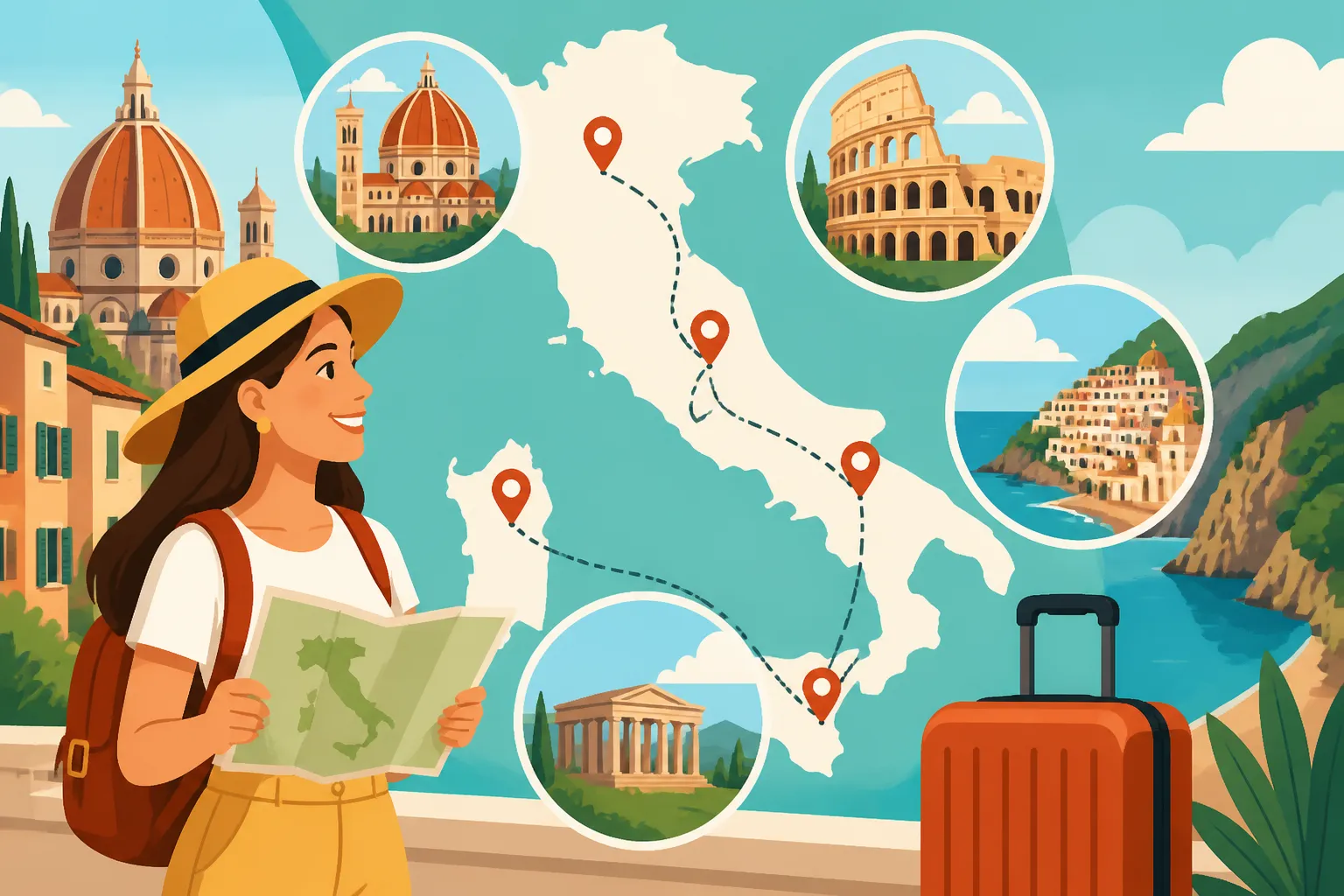
The biggest mistake I see expats and tourists make is trying to "do it all." Italy looks small on a map, but it is densely packed with culture. If you try to see Venice, Rome, the Amalfi Coast, and Sicily in ten days, you will spend half your trip in transit. For a multi-city itinerary, I suggest focusing on a theme. The most popular is Rome, Florence, and Venice: Italy's Great Cities Explorer's Guide. This "Classic Triangle" is perfectly served by high-speed rail and offers a massive dose of history without the need for complex transfers.
If you have already seen the big three, consider a Northern route. Start in Milan, head to the lakes, and then move toward the Dolomites. For this type of trip, you can find excellent Accommodation in Italy: Hotels, B&Bs, and Agriturismi using Booking.com. I prefer Booking.com because their "map view" is incredibly accurate for Italian cities where being two blocks away can mean the difference between a quiet night and staying above a noisy late-night bar. You can filter for properties near the central stations, which is a life-saver when you are hauling luggage between three different cities.
For a Southern itinerary, you might start in Naples, explore the ruins of Pompeii, and then head into Puglia. This requires more patience as the trains are slightly slower once you get past Salerno. This is where your planning needs to be tighter. Use Omio to see if a long-distance bus might actually be faster for certain Southern legs, such as getting from Naples over to Bari. The South moves at a different pace, and your multi-city plan needs to account for the "riposo"—the afternoon shut-down where shops and even some transport services take a breather between 1:30 PM and 4:30 PM.
Organizing Tours and Experiences Without the Headache
Once you have your cities and hotels locked in on Booking.com, you have to tackle the "experience" layer. Italy is a victim of its own success; the lines for the Vatican Museums or the Uffizi Gallery can be hours long. I have stood in those lines in 35-degree heat, and I can tell you it is the fastest way to ruin a vacation. For any multi-city trip, you must pre-book your "Hero" attractions.
I am a big advocate for using GetYourGuide to handle these bookings. The reason is simple: their mobile app keeps all your tickets in one place. When you are visiting four cities in twelve days, the last thing you want to do is dig through your email for a PDF ticket for a specific 10:00 AM slot in Venice. GetYourGuide often offers skip-the-line options and small-group tours that provide context you simply won't get from a guidebook. For example, a food tour in Trastevere is much more rewarding than just picking a random restaurant and hoping for the best.
Speaking of food, don't let your multi-city transit days be "wasted" food days. Many people eat terrible sandwiches at the train station because they are in a rush. If you plan your arrivals and departures around lunch, you can drop your bags at your Booking.com hotel and head straight for a meal. Part of your planning should be learning How to Find Authentic Restaurants in Italy (Not Tourist Traps) so you don't end up paying 20 Euros for a frozen lasagna next to the Pantheon. Real Italian food is regional; what you eat in Milan (Risotto) should be vastly different from what you eat in Rome (Carbonara).
Practical Survival Tips for the Multi-City Traveler
Moving between cities requires a certain level of physical and mental preparation. First, the cobblestones. Italy’s historic centers are paved with "sampietrini" or uneven stones. If you are planning to visit multiple cities, pack light. Dragging a 30kg suitcase across Florence’s pedestrian zones is a rite of passage I wouldn't wish on anyone. If you must have heavy bags, look for hotels on Booking.com that offer shuttle services or are within a short, flat walk of the station.
Safety is another factor often overlooked in the excitement of planning. While Italy is generally very safe, train stations in major cities are hotspots for opportunistic pickpockets who target distracted travelers looking at schedule boards. I always tell my visiting friends to keep their wits about them in Rome Termini or Milano Centrale. Reading up on Staying Safe in Italy: Common-Sense Tips for Travelers will give you the confidence to navigate these hubs without feeling like a target.
Finally, consider the "middle man" of travel: luggage storage. If you are taking a morning train from Florence to Rome but can't check into your hotel until 3:00 PM, don't waste your day sitting on your bags. Almost every major Italian station has a "Deposito Bagagli," or you can use apps to find local shops that will hold your luggage for a few Euros. This allows you to grab a gelato, see one last piazza, and truly maximize every hour of your multi-city adventure.
Why Planning the Transitions is More Important than the Destinations
When we dream of Italy, we dream of the destination—the Colosseum, the canals, the rolling hills. But the success of a multi-city trip lies in the "in-between." It is the 45 minutes you spend figuring out which platform your train is on, or the decision to book a private transfer through GetYourGuide because the local bus in Amalfi is too crowded.
I have found that the most relaxed travelers are the ones who have a "digital hub" for their trip. They have their transport compared and booked via Omio, their stays confirmed on Booking.com, and their afternoon tours organized through GetYourGuide. By centralizing your logistics, you free up your brain to actually enjoy the scenery out of the train window. You aren't worrying about how to get to your next stop; you are wondering whether you should have the pistachio or the stracciatella gelato.
Remember that Italy is best enjoyed with a bit of "flessibilità." Trains might be delayed, a museum might be closed for a strike, or you might find a piazza so charming you want to stay for three hours instead of one. Build "buffer time" into your multi-city plan. Don't book a tour at 2:00 PM if your train arrives at 1:30 PM. Give yourself the gift of time, and Italy will reward you with the kind of memories that last a lifetime.
Disclaimer
The information provided in this guide is for informational purposes only. Travel regulations, train schedules, and ZTL rules in Italy can change frequently. While we strive to provide the most accurate and up-to-date advice based on veteran expat experience and current data, always verify specific travel requirements and local laws before your departure. We are not responsible for any fines, delays, or issues encountered during your travels.