What’s the Quietest Region in Italy for a Relaxed Trip?
You booked two weeks in Italy to slow down. Then you spent them in shoulder-to-shoulder queues in Florence, fighting for a sunbed on the Amalfi Coast, and waiting for a table in Cinque Terre. This guide is for travellers who want a calm trip instead. It compares Italy’s quietest regions, explains who each one suits, and covers how to plan a stay that actually feels unhurried.
Disclosure: This post may contain affiliate links. We may earn a commission at no extra cost to you if you make a purchase through these links. Read full disclosure.
Why Italy Feels So Crowded and Where the Calm Actually Is
Most first-time visitors trace the same path: Rome, Florence, Venice, maybe a coastal add-on in Campania or Liguria. That loop is beautiful, but it pulls an enormous share of international visitors into a few historic centres. My first summer in Italy, I left Florence feeling as if I had spent a week inside a crowded museum gift shop. A friend from Pescara laughed and asked why I hadn’t simply gone east.
That question changed how I travel here. The country’s quiet is not hidden. It sits in plain sight in regions that most foreign itineraries skip because they lack a single headline monument. If you want the bigger picture before choosing, see Italy’s Regions: A Traveler’s Overview, which places every region in context.
What Quiet Really Means in Italy
Be honest with yourself about the kind of quiet you want, because there are several:
- Low tourist density: you can walk into a trattoria at 8 pm without booking, and locals outnumber visitors in the piazza.
- Physical stillness: mountain villages, empty hiking trails and nights with no traffic noise.
- Slow pace: fewer “must-sees,” so no pressure to tick off a list.
- Seasonal quiet: a region that is calm most of the year but fills up with domestic holidaymakers in August.
The last point catches many people out. A region can be almost empty of foreign tourists in June and still be busy in mid-August, when Italian families head to the coast and the mountains. That is why timing matters as much as geography.
The Honest Trade-Off
The quiet regions are quieter partly because they are harder to reach. Train lines thin out, buses run on school timetables, and some restaurants close on Mondays or for the whole winter. Fewer people speak English. None of this ruins a trip, but it changes how you plan. Going from a hotel concierge who books everything to a village where the bar owner is your best source of information takes some adjusting. Most travellers who make the switch end up preferring it.
The Quietest Regions in Italy Compared
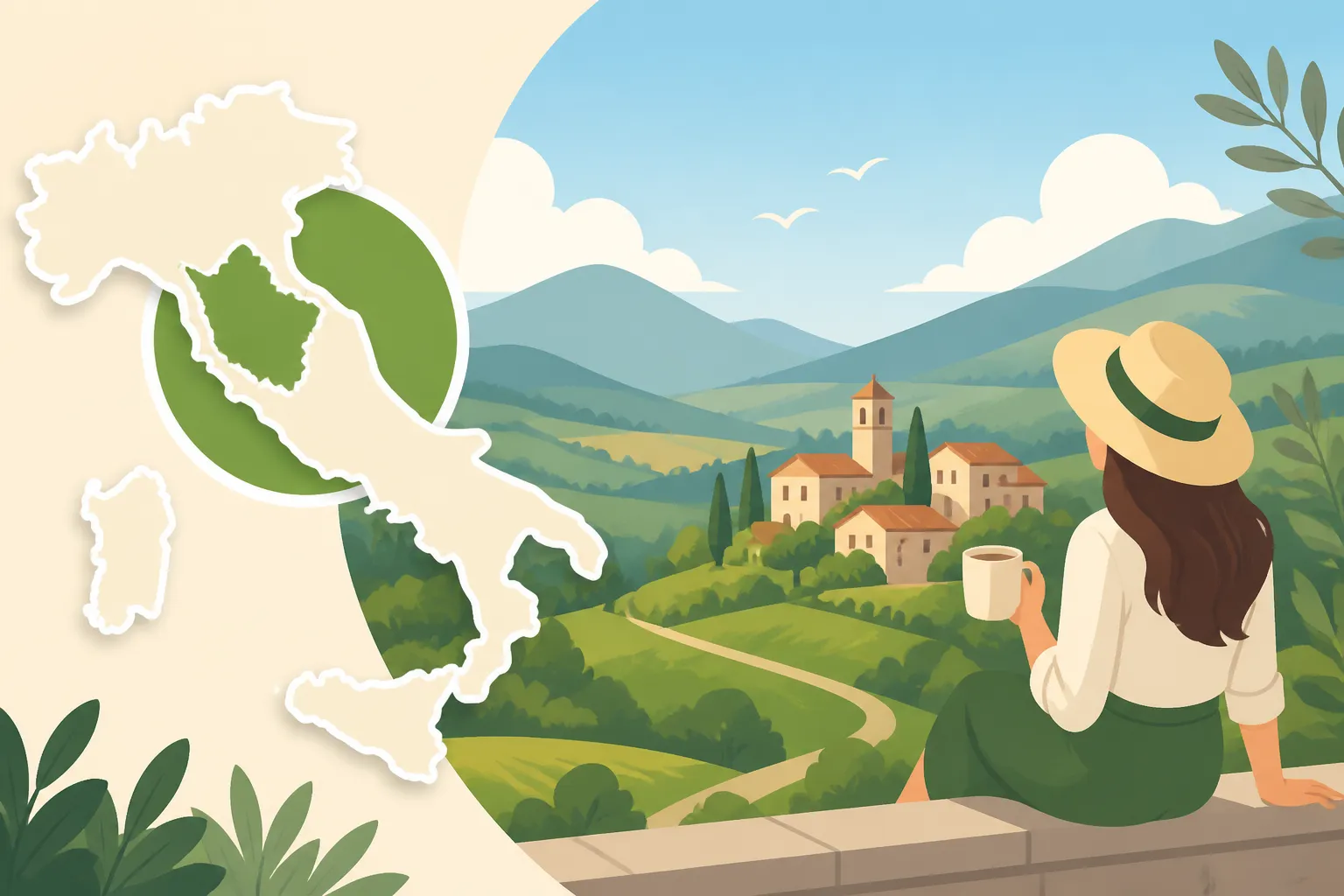
If someone forced me to pick one answer, I would say Molise. It is the region Italians joke “doesn’t exist,” and it is the place where I have felt most completely off the tourist grid. It is not the only good choice, though, and it may not be the right one for you. Here is how the main contenders compare.
| Region | Overall Vibe | Best For | Getting There | Crowd Pressure | Quietest Seasons |
|---|---|---|---|---|---|
| Molise | Rural, unpolished, deeply local | Travellers who want true anonymity | Car strongly recommended; limited rail | Very low year-round | Spring, autumn, winter |
| Basilicata | Dramatic landscapes, cave towns, mountains | Hikers and photographers | Car or bus; rail is patchy | Low, except Matera at weekends | Late spring, early autumn |
| Abruzzo | Wild national parks plus an easy coastline | Nature lovers and families | Car from Rome; trains on the coast | Low inland, moderate on beaches in August | May, June, September, October |
| Le Marche | Tuscany-like hills without the coach tours | Food, wine and hill towns | Adriatic rail line plus car | Low to moderate | Spring and autumn |
| Friuli Venezia Giulia | Central European feel, vineyards, Alps to sea | Wine, culture and refined calm | Good rail to Trieste and Udine | Low to moderate | Most of the year outside August |
| Umbria, away from Assisi | Green valleys and medieval towns | First-timers who want an easy alternative to Tuscany | Rail to Perugia plus car | Moderate in hotspots, low elsewhere | Shoulder seasons |
Molise: The Region That Barely Shows Up on Itineraries
Molise is small, mountainous and very little visited. Campobasso, the capital, is a working city, not a postcard. The rewards are in the details. Agnone has a historic bell foundry that has cast church bells for centuries. Saepinum, near Sepino, is a Roman town with ruins that are often almost empty. Pietrabbondante has a Samnite theatre set against green hills. Termoli, on the coast, has a compact old town above the sea and makes a gentle beach base outside peak summer.
A realistic scenario: you arrive on a Tuesday in May, drive into a hill village, and the only sound is a tractor in the distance. Lunch is whatever the cook made that morning. That is Molise at its best. The downside is that it rewards self-sufficiency. Without a car, you will spend a lot of time waiting for buses.
Basilicata: Big Landscapes, Small Crowds
Basilicata is known mainly for Matera, whose cave dwellings are now a major draw and can feel busy on weekends. The rest of the region is a different world. Castelmezzano and Pietrapertosa cling to jagged Dolomiti Lucane peaks. Pollino National Park, shared with Calabria, offers long and silent trails. Maratea gives you the region’s short Tyrrhenian coastline without the Amalfi density. Craco, an abandoned hilltop town, is eerie and memorable.
My tip: see Matera on a weekday, then spend most of your nights inland. If you want context on the Sassi, a small-group walking tour booked through GetYourGuide can help in a town where the layers of history are hard to read alone. For logistics, Reaching Matera and Basilicata: Where the Rail Network Runs Out explains the transport gaps in detail.
Abruzzo, Le Marche and Friuli: Quiet Without Roughing It
These three suit travellers who want calm but still expect good infrastructure.
Abruzzo is often called Italy’s green region because so much of it is protected parkland. Gran Sasso and the Majella massif feel almost Alpine, and Abruzzo, Lazio and Molise National Park around Pescasseroli is one of the best places to experience the Apennines. Santo Stefano di Sessanio is a fortified stone village that rewards a slow overnight stay. Sulmona, home of sugared-almond confetti, is a lovely low-key town. On the coast, the Costa dei Trabocchi has old wooden fishing platforms and quiet coves.
Le Marche is the region I recommend to people who love the idea of Tuscany but hate the reality of summer crowds. Urbino’s Renaissance palace, Ascoli Piceno’s travertine piazza, Recanati’s literary history, the Conero Riviera’s cliffs, and the Monti Sibillini all offer variety without the queues.
Friuli Venezia Giulia feels part Italian, part Austrian, part Slavic. Trieste has grand cafés and a slow, literary rhythm. Cividale del Friuli and Aquileia carry deep history, and the Collio hills produce serious white wines. For bases, see Where to Stay in Trieste and Friuli: The Eastern Corner and Where to Stay in Le Marche and Abruzzo: Overlooked Central Italy.
How to Plan a Genuinely Relaxed Trip
Choosing a quiet region is only half the job. You can still turn a peaceful place into a stressful trip by overscheduling it. These are the habits that have worked for me and for friends I have sent off the beaten track.
Step-by-Step Planning for a Slow Itinerary
- Pick one region, maybe two. Resist the urge to “also squeeze in” Rome. Every extra transfer day eats into your rest.
- Choose two bases at most for a week or more. One inland and one near the coast works well in Abruzzo, Basilicata and Le Marche.
- Decide early whether you will drive. In Molise and inland Basilicata, a car is close to essential. In Friuli and coastal Le Marche, trains cover more of the map.
- Check opening patterns before booking. In small towns, museums, restaurants and even petrol stations may close at lunchtime, on a weekly rest day, or for the off-season.
- Book accommodation with flexible cancellation when you can, because rural plans change with the weather.
- Leave whole days unplanned. The best moments in quiet regions are often unplanned, like a village festa or a long lunch that turns into an afternoon.
- Download offline maps and a translation app before you head into the mountains, where signal can disappear.
The philosophy behind this list is covered in depth in Slow Travel in Italy: Staying Longer in One Place.
Getting There and Getting Around
Transport is the main source of frustration in quiet regions, so plan it carefully. Regional trains run along the Adriatic coast through Le Marche, Abruzzo and Molise, and Friuli has good rail links. Inland connections, though, often depend on regional buses timed for commuters and students. When I tried to reach a Molise village by public transport, I worked out a route that combined a train, a regional bus and a very patient taxi. It worked, but only because I had checked everything twice.
A comparison platform such as Omio is useful at the planning stage for seeing train and coach options side by side. Always confirm the final leg with the local bus operator, because small rural lines may not appear on aggregators. For routes where rail simply stops, read When Buses Beat Trains in Italy: Routes Where Rail Doesn’t Reach. If you hire a car, learn the ZTL limited-traffic zones in historic centres before you drive into one by mistake. See Renting a Car in Italy: ZTLs, Insurance, and Driving Tips.
Choosing Where to Sleep
Where you stay can make or break the calm. In these regions, my strong preference is an agriturismo, a working farm that offers rooms and often home-cooked dinners. You wake to birdsong, eat food grown metres away, and usually share the evening with a handful of guests rather than a busload. Expectations vary a lot, so Agriturismi in Italy: What’s Included and How the Booking Works is worth reading before you commit.
On booking platforms such as Booking.com, filter for properties outside town centres, check for a guest kitchen or half-board option, and read recent reviews for comments on road access. A beautiful farmhouse at the end of a steep dirt track is a joy in a sturdy car and a nightmare in a tiny rental. In Basilicata and Calabria, Where to Stay in Calabria and Basilicata: Coastal and Inland Options breaks down the trade-offs between coastal and inland bases.
Timing Your Visit for Maximum Peace
Even the quietest region has busy weeks. Timing is the easiest lever you control.
The Best Months for Quiet
For most of these regions, late April to June and September to October are the sweet spot. The weather is pleasant for walking, the landscapes are green or golden, and most restaurants and lodgings are open. Winter brings real solitude, especially in Molise and inland Abruzzo, but also snow on mountain roads and many seasonal closures. For a region-by-region view of the calmest and cheapest windows, see Off-Season Italy: The Cheapest Weeks to Book by Region.
The August Problem
Around Ferragosto in mid-August, Italians take their holidays en masse. Even “undiscovered” Adriatic beaches in Abruzzo and Molise fill with domestic visitors, prices rise, and some city businesses close while coastal ones get very busy. If August is your only option, go inland and uphill. Mountain villages in the Majella or the Sibillini stay far more peaceful than the coast. Ferragosto Bookings: Why Italy Shuts and What Stays Open explains what to expect.
Weekday Versus Weekend
This is the simplest trick, and the most underrated one. Matera, Urbino, Trieste and the Trabocchi coast can feel noticeably livelier on Saturdays and Sundays when Italians take day trips. Plan your must-see towns for midweek and keep weekends for countryside walks or a long lunch at your agriturismo. For more strategies that work anywhere in the country, see How to Avoid the Crowds in Italy’s Peak Season.
Which Quiet Region Should You Choose
Here is the summary I give friends over coffee:
- You want to disappear completely: Molise.
- You want dramatic scenery and adventure: Basilicata, with only a short stop in Matera.
- You want nature with easy beach access: Abruzzo.
- You want rolling hills, food and art without crowds: Le Marche.
- You want elegant calm, wine and a cosmopolitan edge: Friuli Venezia Giulia.
- You want an easy first step away from the main circuit: Umbria, staying away from Assisi’s peak hours.
Whichever you choose, expect a slower rhythm, some closed shutters at lunchtime, and a few logistical puzzles. In return, you get the Italy that many visitors hope for and rarely find: a café owner who remembers your order on day two, a piazza that belongs to the people who live there, and evenings that end with nothing louder than church bells.
Disclaimer
This article is for general informational purposes only and does not constitute professional advice. Laws, prices and regulations vary by location and change over time. Consult a qualified professional for guidance on your specific situation.