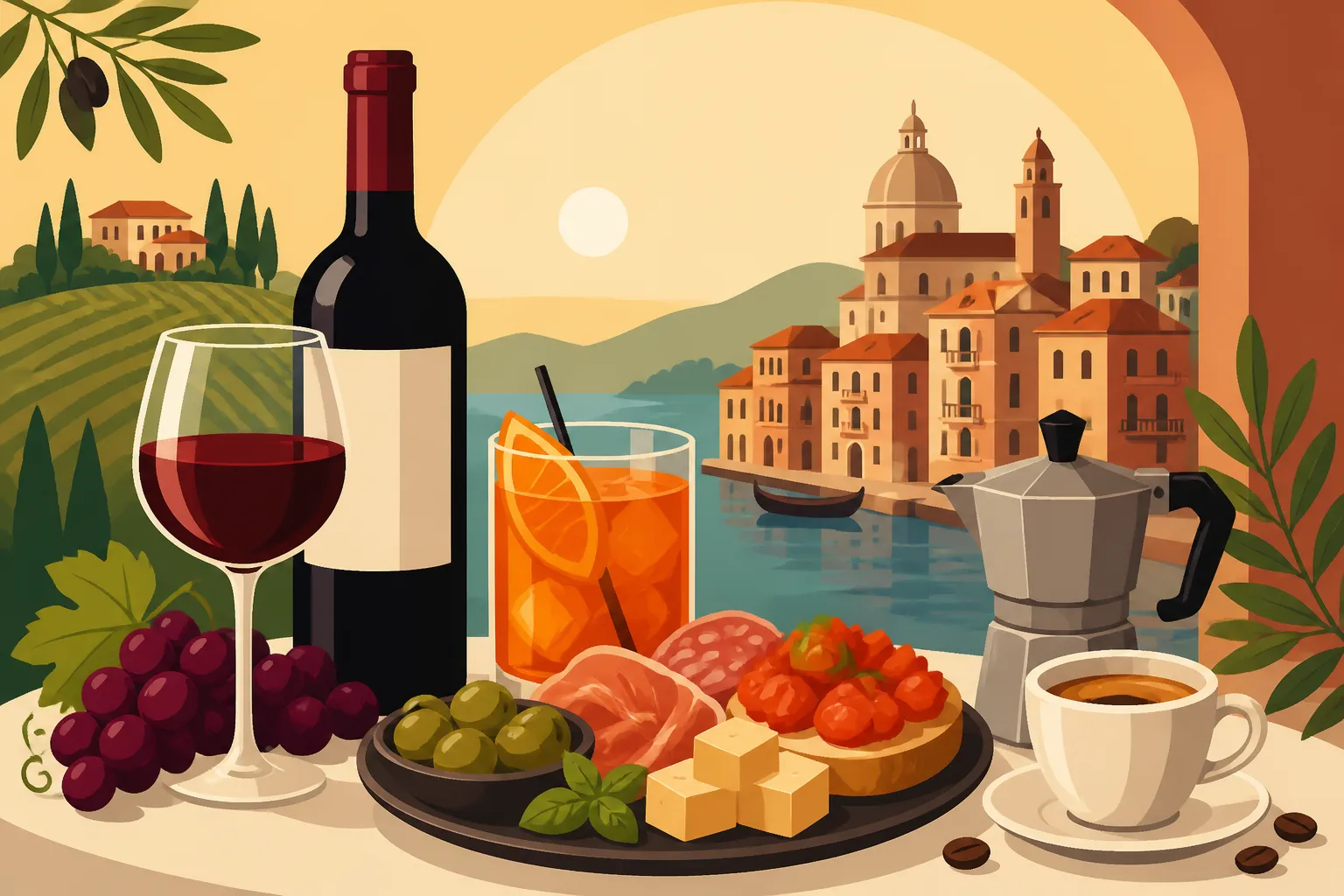
Italian Wine, Coffee, and Aperitivo Culture
You order a cappuccino after dinner and the barista gives you a look. You sit at a café table and the bill is far higher than you expected. You walk into a buzzing bar at seven in the evening and have no idea what to order or whether the snacks are free. This guide explains how Italy’s wine, coffee, and aperitivo rituals work, so you can join in with confidence.
Disclosure: This post may contain affiliate links. We may earn a commission at no extra cost to you if you make a purchase through these links. Read full disclosure.
I have lived here long enough to have made every one of these mistakes myself, some of them several times. I have stood in the wrong queue, ordered the wrong drink at the wrong hour, and paid table prices for a coffee I could have had standing up for a fraction of the cost. None of it is a disaster. Once you understand the logic behind the rituals, Italian drinking culture becomes one of the best parts of daily life here.
How the Italian Day Is Built Around Drinks
Before getting into specific drinks, it helps to see the bigger picture. In Italy, coffee, aperitivo, wine, and the after-dinner digestivo are not random indulgences. Each one has its own time slot, purpose, and social meaning, and together they shape the rhythm of the day.
The Rhythm From Morning Espresso to Evening Amaro
A typical Italian day might start with a cappuccino and a cornetto at the neighbourhood bar on the way to work, standing at the counter for barely five minutes. Mid-morning brings another espresso, often with colleagues. After lunch comes a quick espresso to close the meal, and sometimes another mid-afternoon to fight the post-lunch slump. Then, as offices empty in the early evening, people drift towards aperitivo: a light drink with snacks to open the appetite before dinner.
Dinner itself usually comes with wine, often whatever the house pours. The meal ends with an espresso and, for many, a small glass of amaro, grappa, or limoncello to aid digestion. Every drink has a job, so certain combinations feel wrong to Italians. A frothy milk coffee after a heavy dinner works against the whole idea of digestion.
When I first arrived, I found this rigid and a bit fussy. I drank cappuccino whenever I liked and ordered wine at odd hours. Nobody was rude, but I could tell I stood out. After a year, I noticed I had absorbed the rhythm without trying. Now a cappuccino at nine in the evening seems strange to me too.
The rhythm also makes social life easier. If a friend says “prendiamo un caffè,” that means a short, casual catch-up. “Ci vediamo per un aperitivo” means an hour or two of relaxed drinking and chatting before dinner. Knowing these codes helps you read invitations and plan your day.
Why Drinking in Italy Is About Food and Company
The biggest cultural shift for many newcomers, especially from the UK, Ireland, Northern Europe, Australia, and parts of North America, is that Italians rarely drink just to drink. Alcohol almost always comes with food, and drinking is about conversation, not getting drunk. Public drunkenness is frowned upon and seen as a lapse in bella figura, the idea of presenting yourself well.
That is why even a basic glass of wine at a bar usually arrives with something to nibble: a small bowl of olives, a few crisps, some peanuts, perhaps a slice of focaccia. It is also why aperitivo developed as it did, with food built into the experience. If you are used to rounds of pints with nothing to eat, slowing down to one or two drinks over a long evening can feel odd at first. Your body and your wallet will thank you.
Here is a scenario I see often. A group of young visitors arrives in Florence, finds a lively piazza, and orders drink after drink with no food, getting louder as the evening goes on. Locals at nearby tables nurse a single Negroni each for two hours, eating small plates and talking. Nobody says anything to the visitors, but the difference is obvious. You will enjoy Italy more if you adopt the local pace.
This does not mean Italians are puritanical. Wine is present at most family meals, and children grow up seeing it as a normal part of the table, like bread or olive oil. The relationship is relaxed precisely because it is moderate and tied to food.
Italian Coffee Culture: The Bar Is Your Second Living Room
In Italy, the place where you drink coffee is called a bar, not a café. That confuses many visitors who expect a bar to be about alcohol. An Italian bar is a hybrid: coffee, pastries, sandwiches, juices, and alcohol, all served from the same counter from early morning to evening. Every neighbourhood has several, and most Italians have a favourite.
Paying at the Cassa and Drinking at the Banco
The first hurdle is the ordering system, which varies from bar to bar and causes plenty of anxiety. In busy city-centre bars, especially in Rome, Milan, Naples, and train stations, you usually pay first at the cash desk, the cassa. You tell the cashier what you want, pay, and receive a receipt called a scontrino. You then take the scontrino to the counter, the banco, place it in front of the barista, and repeat your order. They tear or mark the receipt and make your drink.
In smaller neighbourhood bars, especially in towns and villages, you often order at the counter first, drink, and pay on your way out. The easiest way to tell is to watch the person ahead of you for thirty seconds. If everyone heads to the till first, do the same. If people order directly and pay at the end, follow them. If you are still unsure, ask the barista “Pago prima?” (“Do I pay first?”) and nobody will mind.
The second hurdle catches nearly everyone: where you drink it changes the price. Coffee drunk standing at the banco is the cheapest way to have it, and in many places the counter price is kept low by custom and competition. Sit at a table, especially on a terrace in a famous piazza, and you may pay several times more for the same espresso because you are paying for table service and the seat. The menu often lists separate prices for “banco” and “tavolo.” For the reasoning behind these price differences and how to spot an overpriced bar, see How Much Should Coffee Cost at an Italian Bar?
Neither choice is wrong. Sometimes paying for a table is completely worthwhile. An hour with a book in a beautiful square, watching the city go by, is a fair trade. Just do not order at the counter, carry your cup to a table, and expect counter prices. That causes awkward conversations at the till.
Decoding the Coffee Menu
When you ask for “un caffè” in Italy, you get an espresso. That is the default, and there is no need to say “espresso.” From there, a whole vocabulary of variations opens up. Do not order a “latte,” because that just means milk, and you will get a glass of it. Ask for a “caffè latte” if you want a large milky coffee.
| What You Say | What You Get | When Italians Drink It |
|---|---|---|
| Un caffè | A single espresso | Any time of day |
| Caffè ristretto | A shorter, more concentrated espresso | Any time, for purists |
| Caffè lungo | An espresso pulled with more water | Any time |
| Caffè macchiato | Espresso with a small dash of foamed milk | Any time, a common afternoon choice |
| Latte macchiato | A glass of hot milk with espresso poured in | Morning |
| Cappuccino | Espresso with steamed milk and foam | Morning, usually with a pastry |
| Caffè americano | Espresso topped up with hot water | Any time, mainly ordered by visitors |
| Caffè corretto | Espresso with a shot of grappa, sambuca, or other spirit | After meals or on cold mornings |
| Caffè d’orzo | A barley-based coffee substitute, caffeine-free | Any time, popular with older Italians |
| Caffè decaffeinato or “deca” | Decaffeinated espresso | Any time |
| Caffè shakerato | Espresso shaken with ice and sugar, served chilled | Summer afternoons |
| Marocchino | Espresso with cocoa and milk foam, often in a small glass | Morning or afternoon, especially in the north |
You will also hear people ask for their coffee “in vetro” (in a glass rather than a cup), “freddo” (cold), or “con panna” (with whipped cream). Sugar is usually on the counter, and many Italians add some even to a strong espresso. Nobody judges you either way.
For the full routine of walking in, ordering, and leaving like a regular, see Coffee Culture in Italy: How to Order Like a Local, which covers the phrasing and the little courtesies that make baristas warm to you.
The Unwritten Timing Rules
Now for the most famous rule. Milky coffees such as cappuccino, latte macchiato, and caffè latte are considered morning drinks. Italians generally stop ordering them by late morning, and almost never after lunch or dinner. The reasoning is partly about digestion, since Italians believe a big dose of milk on a full stomach is heavy, and partly about habit. A cappuccino is breakfast.
Will anyone refuse to serve you a cappuccino at four in the afternoon? No. Baristas in tourist areas make them all day long. You may get an amused glance, and in a traditional bar you will clearly mark yourself as a foreigner. If that does not bother you, order what you enjoy. If you want to blend in, switch to a macchiato after lunch. You still get a touch of milk without breaking the morning rule. I explain the full reasoning, with a bit of tongue-in-cheek history, in Why You Shouldn’t Order a Cappuccino After Lunch in Italy.
Other timing habits are worth knowing. Coffee is usually drunk quickly and standing, a two-minute pause rather than a long sit-down. Takeaway cups exist in larger cities, but walking down the street sipping coffee is still uncommon outside big train stations and busy business districts. Italians also do not drink coffee with a meal. The espresso comes after the food is finished, never alongside the main course.
One more thing that confused me early on: many bars are busiest at breakfast and just after lunch, and quiet in the late afternoon. If you want to chat with the barista or practise your Italian, aim for those quiet moments. Showing up at the same bar every morning for a week makes you a regular faster than you might expect.
Regional Coffee Traditions Worth Seeking Out
Coffee in Italy is not identical from north to south. Every region has its own twist, and some of the best drinks never appear on a tourist menu. Seeking them out is one of the joys of travelling around the country.
Naples, Turin, and the North
Naples takes coffee more seriously than almost anywhere else. The espresso tends to be strong and dense, and some bars serve it pre-sweetened unless you ask otherwise. Historic places like Gran Caffè Gambrinus near Piazza del Plebiscito are institutions, and the city is home to the caffè sospeso, or “suspended coffee.” A customer pays for two coffees, drinks one, and leaves the second paid for someone who cannot afford it. You may also find caffè alla nocciola, a hazelnut cream coffee that has become a Neapolitan favourite.
Turin has a café culture of its own, shaped by its history as a royal capital. Its signature drink is the bicerin, a layered mix of espresso, hot chocolate, and cream served in a small glass, associated with the historic Caffè Al Bicerin near the Consolata sanctuary. On a cold Piedmontese winter morning it is pure comfort. The marocchino, a coffee with cocoa and milk foam, comes from nearby Alessandria and is common across the north.
In Rome, coffee lovers make pilgrimages to Sant’Eustachio Il Caffè and Tazza d’Oro, both close to the Pantheon. Expect queues and locals and visitors packed shoulder to shoulder at the counter. In Venice, historic cafés such as Caffè Florian in Piazza San Marco offer a different experience: elegant rooms, a sense of history, and table prices that reflect it, sometimes with an extra charge on the bill when the live music is playing. Go knowing that and enjoy it as a special occasion, not a daily habit.
To find the cafés that locals actually love rather than the ones with the most signage, see How to Find the Best Coffee Bars in Italy. It covers the clues that separate a great neighbourhood bar from a tourist trap.
Sicily and Puglia in Summer
The south has developed clever ways to enjoy coffee in brutal summer heat. In Puglia, especially around Lecce and the Salento, look for caffè leccese: espresso poured over ice with almond milk syrup. It is sweet, cold, nutty, and perfect on a scorching afternoon. Once you try it, ordinary iced coffee feels dull.
In Sicily, summer breakfast often means granita with brioche. Granita is a semi-frozen dessert made with sugar, water, and flavouring. Coffee granita, often topped with whipped cream, is a classic, alongside almond, lemon, pistachio, and mulberry. You tear off pieces of soft brioche and dip them in. It sounds strange as breakfast until you try it in Catania or Palermo in July, when it becomes the only sensible choice.
Across much of the south in summer, you will also see caffè freddo, chilled sweetened coffee kept in a jug in the fridge, and caffè shakerato on bar menus. If you are in Italy during the hot months, try these regional specialities instead of reaching for an iced latte. They are part of the local culture and not just novelties for tourists.
Aperitivo: The Ritual That Saves Your Evening
If coffee anchors the Italian morning, aperitivo shapes the early evening. Many expats say it is the custom they miss most when they leave Italy. It is relaxed, sociable, affordable, and it fills the gap between finishing work and Italy’s late dinner hour.
What Aperitivo Actually Is
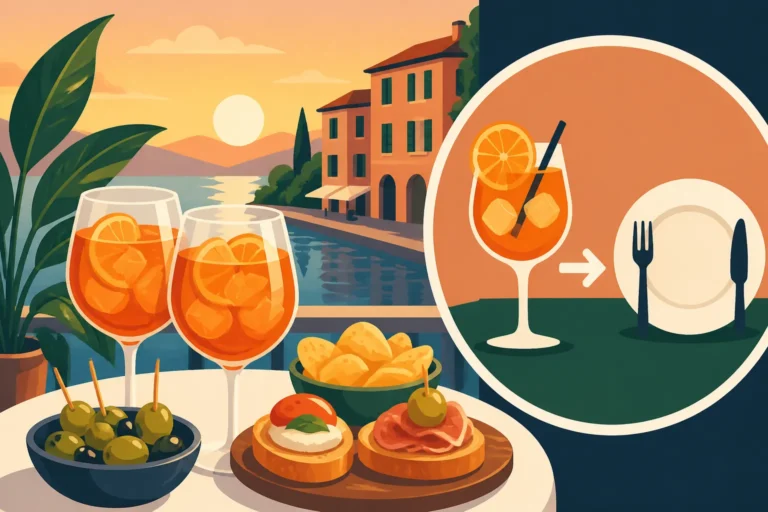
Aperitivo is a pre-dinner drink, traditionally something bitter or lightly alcoholic, meant to stimulate the appetite. It usually happens from the early evening until about the time Italians start thinking about dinner, which in most of the country is later than many visitors are used to. You order a drink, and in most bars it arrives with snacks. Those might be a modest bowl of crisps and olives, or a spread of small sandwiches, bruschetta, cheese, cured meats, and mini pizzas.
The key point is that the snacks are usually included with the drink, not ordered separately. That is why aperitivo is such good value. Your drink price is often a little higher than at other times of day, but it covers the food. Some bars bring snacks to your table, while others set out a buffet you can visit. In buffet bars, keep it modest and take a reasonable plate, not a pile that would feed a family. Locals notice.
For newcomers, aperitivo is also the easiest way into Italian social life. Colleagues invite each other for aperitivo, friends gather for one before going their separate ways, and couples meet for one before dinner. If someone invites you, say yes. For more detail on the ritual’s history and etiquette, see Aperitivo in Italy: The Pre-Dinner Ritual Explained.
Spritz, Negroni, Americano, and Friends
The drinks you order at aperitivo are a world of their own. Most revolve around Italian bitters and fortified wines like vermouth, plus sparkling wine and soda. Here are the ones you will see most often.
| Drink | What Is In It | Character | Where It Shines |
|---|---|---|---|
| Spritz | Prosecco, a bitter liqueur such as Aperol, Campari, or Select, and soda water | Light, bittersweet, fizzy | Venice and the Veneto, now everywhere |
| Negroni | Gin, Campari, sweet vermouth | Strong, bitter, complex | Florence claims it, popular nationwide |
| Negroni Sbagliato | Campari, sweet vermouth, and sparkling wine instead of gin | Lighter, fizzier Negroni | Milan, especially Bar Basso |
| Americano | Campari, sweet vermouth, soda water | Bitter, refreshing, lower in alcohol | Milan and Turin |
| Hugo | Prosecco, elderflower syrup, mint, soda | Floral, sweet, summery | Alto Adige and the north |
| Bellini | Prosecco and white peach purée | Fruity, delicate | Venice, especially Harry’s Bar |
| Vermouth on the rocks | Sweet or dry vermouth over ice, with citrus peel | Herbal, aromatic | Turin, the home of vermouth |
| Glass of prosecco or local wine | Whatever the bar pours by the glass | Simple, food-friendly | Anywhere |
| Crodino or Sanbittèr | Non-alcoholic bitter aperitifs | Bitter, fizzy, alcohol-free | Anywhere, popular with drivers |
The Spritz has spread so far that some Italians now roll their eyes at it, but in the Veneto it is still a real local drink and a source of regional pride. When you order there, you may be asked which bitter you want. Select is the classic Venetian choice. Aperol is sweeter and orange, and Campari is more bitter and deep red.
The Negroni story is part of Florentine folklore. The tale goes that a Count Camillo Negroni asked a bartender to strengthen his Americano by replacing the soda with gin. Whether every detail is true matters less than the fact that the drink has become one of the world’s great cocktails. If you want a fuller drinks primer, including what to order when you do not want something sweet, see How to Drink Like a Local in Italy: Spritz, Negroni, and More.
Do not feel pressured to drink alcohol. Ordering a Crodino, a fresh juice, or sparkling water is completely normal, and you will still get the snacks. Many Italians who are driving, pregnant, or simply not in the mood do exactly that.
Aperitivo vs Apericena
In bigger cities, especially Milan, a supersized version called apericena has developed. The name blends aperitivo and cena (dinner). The buffet is substantial enough to replace dinner: pasta salads, rice dishes, vegetables, cured meats, cheeses, sometimes hot dishes. You pay a fixed price for a drink plus access to the food, and many students and young professionals treat it as an affordable night out.
Traditionalists sometimes look down on apericena as a diluted, quantity-over-quality version of the ritual. Some apericena buffets are fantastic, while others are trays of reheated pasta that have been sitting under lights for hours. Look at what the locals are eating and how fresh the food seems. A busy bar with a constantly refilled buffet is usually a good sign.
If you are on a tight budget, especially as a student or during a long stay, apericena can be a lifesaver. A friend of mine survived her first months in Milan largely on apericena in the Navigli and Isola districts, and she ate surprisingly well. For a rundown of how it works and where it is most common, see What Is Apericena and Where to Find It.
Aperitivo City by City
Every Italian city does aperitivo slightly differently. Knowing the local style helps you choose where to go and what to order.
Venice and the Veneto: Bacari, Cicchetti, and the Ombra
Venice has its own version of the ritual built around bacari, small, often cramped wine bars where locals stand at the counter or spill out onto the street. You order an “ombra,” the Venetian word for a small glass of wine, and pick a few cicchetti from the counter display. Cicchetti are small bites: crostini topped with baccalà mantecato (whipped salt cod), sarde in saor (sweet-and-sour sardines), meatballs, slices of mortadella, or little sandwiches.
The best way to experience it is a bacaro crawl, called a giro di ombre: one glass and one or two cicchetti per bar, then on to the next. The area around the Rialto market is the classic starting point. Historic places like Cantina Do Mori and All’Arco are well known, and the streets of Cannaregio and Castello have many quieter spots used mostly by residents. Go in the late afternoon or early evening, before the dinner crowd and while the counters are still well stocked.
Elsewhere in the Veneto, Padua and Treviso have lively Spritz cultures in their central squares. In Padua, people gather in Piazza delle Erbe and Piazza dei Frutti. Treviso, close to the Prosecco hills, takes its sparkling wine seriously. If you like the idea of a guided bacaro crawl with someone explaining each dish, food tour operators listed on GetYourGuide run small-group cicchetti walks in Venice. They can be a helpful introduction before you head out on your own.
Milan and Turin: The Northern Heartland
Milan is the aperitivo capital in many people’s minds. Campari made its name here, and the historic Camparino in Galleria, at the entrance to the Galleria Vittorio Emanuele II beside the Duomo, is a classic place for a Campari Seltz or a Negroni. Bar Basso, further from the centre, is linked to the Negroni Sbagliato and still serves drinks in enormous glasses. The canals of the Navigli district are packed every evening with people enjoying apericena, and neighbourhoods like Brera, Isola, and Porta Venezia have plenty of choices with a more local feel.
Turin has a strong claim as the birthplace of aperitivo itself, because vermouth was developed here. Producers like Carpano, Martini, and Cinzano all have Piedmontese roots. Ordering a vermouth in one of Turin’s grand historic cafés feels like stepping back in time. The city’s aperitivo culture is elegant and generous, and the snacks are often excellent. Try the areas around Piazza Vittorio Veneto, the Quadrilatero Romano, and San Salvario.
Both cities treat aperitivo as an after-work ritual. On weekdays you will see professionals in suits arriving straight from the office, loosening their ties over a Negroni. If you are new and working in either city, aperitivo with colleagues is one of the fastest ways to build relationships. Do not skip it in favour of going straight home.
Rome, Florence, Bologna, and the South
In Rome, aperitivo is a little less formalised than in the north, but it is everywhere. The areas around Campo de’ Fiori, Trastevere, Monti, and Testaccio fill up in the evenings. Wine bars like the ones around Roscioli near Campo de’ Fiori focus on serious wine and excellent cured meats and cheeses rather than buffets. Romans often pair aperitivo with a wander, perhaps a drink with a view near Piazza Navona or on a terrace overlooking the rooftops.
Florence has an enviable wine bar scene, with enoteche and vinai scattered across the city. Look out for the buchette del vino, small wine windows set into the walls of old palazzi. Historically they were used to sell wine directly to passers-by, and a handful have been revived. The Oltrarno and Santo Spirito areas are lively in the evening and feel more local than the streets right around the Duomo.
Bologna, a university city, has a casual and affordable aperitivo culture centred on the old market streets of the Quadrilatero, where you can order a glass of Lambrusco or Pignoletto with a board of mortadella, prosciutto, and Parmigiano. Osteria del Sole, one of the city’s oldest drinking places, is famous for serving only wine. You can bring your own food, which says a lot about the city’s relaxed attitude.
In the south, aperitivo blends into the late evening passeggiata. In Naples, the Chiaia district is the place to be. In Palermo, the old market area of the Vucciria comes alive at night with street food and drinks. In Puglia, people gather in the piazzas of Lecce, Bari, and the whitewashed towns of the Valle d’Itria. The southern style is generally more spontaneous: fewer formal buffets, more sitting in a square with friends until well after dark.
Understanding Italian Wine Without a Sommelier Certificate
Italy has an enormous number of grape varieties and wine regions, and the labels can be bewildering. The good news is that you do not need to be an expert to drink well here. A few basics will take you a long way.
Reading a Label: DOCG, DOC, and IGT
Italian wines are classified by a quality and origin system. The letters on the label tell you how strictly the wine is regulated.
DOCG (Denominazione di Origine Controllata e Garantita) is the top tier. These wines come from specific areas and follow strict rules on grape varieties, yields, ageing, and production. They are often marked with a numbered band around the neck of the bottle. Famous examples include Barolo, Barbaresco, Brunello di Montalcino, Chianti Classico, and Amarone della Valpolicella.
DOC (Denominazione di Origine Controllata) is the next level, also tied to a specific area and production rules, but slightly less strict. Many excellent everyday wines are DOC. IGT (Indicazione Geografica Tipica) is a broader category with more freedom for winemakers. Do not assume IGT means lower quality. Some of Italy’s most celebrated and expensive wines, including many of the “Super Tuscans” from the Bolgheri coast, were made outside the traditional DOC rules and labelled IGT for that reason.
Below these categories is plain table wine, simply labelled as wine without a specific geographical claim. Restaurant house wine often falls into this category, and it can range from forgettable to surprisingly good, especially in rural areas where it comes from a local producer.
The Big Regions Explained
Italy makes wine in every one of its regions. Here are the main areas a visitor or new resident is likely to come across, with the styles each is best known for.
| Region | Signature Wines | Main Grapes | Style in a Nutshell |
|---|---|---|---|
| Piedmont | Barolo, Barbaresco, Barbera d’Asti, Moscato d’Asti | Nebbiolo, Barbera, Dolcetto, Moscato | Structured, age-worthy reds and sweet fizzy whites |
| Tuscany | Chianti Classico, Brunello di Montalcino, Vino Nobile di Montepulciano, Bolgheri | Sangiovese, Cabernet, Merlot | Savoury, food-friendly reds |
| Veneto | Amarone, Valpolicella, Soave, Prosecco | Corvina, Garganega, Glera | Rich dried-grape reds, crisp whites, sparkling |
| Lombardy | Franciacorta, Valtellina | Chardonnay, Pinot Nero, Nebbiolo | Fine sparkling wine and mountain reds |
| Trentino-Alto Adige | Trentodoc sparkling, Lagrein, Gewürztraminer | Chardonnay, Lagrein, aromatic whites | Fresh, alpine, precise |
| Friuli Venezia Giulia | Friulano, Ribolla Gialla | Friulano, Ribolla, Pinot Grigio | Aromatic whites and skin-contact orange wines |
| Emilia-Romagna | Lambrusco, Sangiovese di Romagna | Lambrusco, Sangiovese | Sparkling reds made for cured meats |
| Lazio | Frascati, Cesanese | Malvasia, Trebbiano, Cesanese | Easygoing whites from the hills near Rome |
| Campania | Taurasi, Fiano di Avellino, Greco di Tufo | Aglianico, Fiano, Greco | Powerful reds and mineral whites |
| Puglia | Primitivo di Manduria, Salice Salentino | Primitivo, Negroamaro | Ripe, generous, sun-soaked reds |
| Sicily | Etna Rosso, Nero d’Avola, Marsala | Nerello Mascalese, Nero d’Avola, Grillo | Volcanic reds, bold reds, fortified wines |
| Sardinia | Cannonau, Vermentino di Gallura | Cannonau, Vermentino | Warm reds and coastal whites |
The rule of thumb that never fails is to drink local. If you are in Bologna, order Lambrusco with your salumi. In Rome, try Frascati or a Cesanese. On Etna, drink Etna Rosso. Italian wines evolved alongside the local food, and the pairings that grew up in the same place almost always work. If you want a structured introduction to each area before you travel, see Italian Wine Regions: A Beginner’s Guide.
A personal tip: some of my most memorable bottles in Italy have come from grapes I had never heard of before moving here, such as Pecorino from Abruzzo and Le Marche, Pallagrello from inland Campania, and Ruchè from a tiny corner of Piedmont. Ask the waiter or wine shop owner for something “del territorio” (from the local area) and let them surprise you.
House Wine, Sfuso, and Ordering in Restaurants
In many trattorie and osterie, especially outside the big tourist centres, the house wine (vino della casa) is the default choice for locals. It usually comes in a carafe, and you order by volume: a quarter litre (un quarto), a half litre (mezzo litro), or a litre. Ask for “rosso” or “bianco.” It is often made by a local producer and can be very good value. In big tourist hubs, quality varies more, so let a glance at what locals are drinking guide you.
If you want something more specific, most restaurants have a wine list, and staff in good places are happy to recommend a bottle to suit your food and budget. Do not be shy about naming a price range. Pointing at a line on the list and saying “qualcosa così” (“something like this”) is perfectly polite and saves everyone embarrassment. For practical phrases and strategies when your Italian is limited, see How to Try Italian Wine Without Knowing the Language.
Once you live here, you will discover vino sfuso, wine sold loose from the tap. Many towns have a shop or cantina sociale (cooperative winery) where locals bring their own bottles or containers and fill them from large steel tanks. It is everyday wine, not fine wine, but it is a very Italian experience and a sensible choice for weekday dinners. Some older Italians still buy wine in large glass demijohns (damigiane) and bottle it at home.
Corkage and bringing your own bottle to a restaurant are not common customs in Italy, and many places will not allow it. It is best not to try unless you know the owner well.
Visiting Wineries, Enoteche, and Wine Country
Tasting wine where it is made is one of the great experiences Italy offers. It also involves some planning, because Italian wineries work differently from the walk-in tasting rooms common in places like California or South Africa.
Booking a Cantina Visit
Many Italian wineries are small family operations. The person pouring your wine may well be the person who pruned the vines, drove the tractor, and did the books. Walk-in visits are often not possible, so plan ahead.
- Choose a region and a few wineries that interest you, ideally clustered close together so you do not spend the day driving.
- Check each winery’s own website for visit information, tasting options, and opening days, since many close on Sundays and some close during harvest.
- Email or call to book, giving your preferred date, time, group size, and the language you would like the visit in.
- Confirm a day or two before, especially in smaller wineries where plans can change.
- Arrive on time. Small producers often schedule visits around vineyard and cellar work.
- During the tasting, feel free to use the spittoon if you are driving or visiting several wineries. Nobody will be offended.
- Buy at least a bottle or two if you enjoyed the wines and the visit was free or very inexpensive. It is a courtesy many small producers appreciate.
- Ask about shipping if you want to buy more than you can carry, as some wineries can arrange it.
Timing matters too. The harvest, or vendemmia, usually runs in late summer and autumn depending on the region and grape. It is a beautiful time to visit, but wineries are very busy and may limit tours. Spring and early summer are often calmer. Some regions also hold open-cellar days when many wineries welcome visitors at once, which can be a festive way to experience wine country.
For a step-by-step look at what a tasting involves, what to wear, and what to ask, see How to Visit a Winery (Cantina) in Italy.
Getting There Without Driving
This is where many people’s plans come unstuck. Wine country is, by nature, rural, and Italy takes drink-driving seriously. The legal limits are strict, they are tougher for newly licensed drivers and professional drivers, and police checks do happen on country roads. Driving yourself from winery to winery while tasting is not a smart plan unless one person in your group commits to not drinking.
Several options make life easier. You can travel by train to a hub town, such as Alba for the Langhe, Montalcino or Montepulciano via Siena and Chiusi in Tuscany, Conegliano for Prosecco, or Verona for Valpolicella, and then use local taxis, a hired driver, or an organised tour. Booking train and bus legs in advance on a comparison platform like Omio can help you combine operators and see connections in one place, which is useful when rural bus timetables are confusing. Local tourist offices in wine towns often keep lists of drivers and small tour operators.
Organised wine tours solve the driving problem completely and often get you into wineries that are hard to book independently. GetYourGuide lists day tours from Florence into Chianti, from Verona into Valpolicella, and from Alba into the Barolo hills. Compare group sizes, the number of wineries included, and whether lunch is part of the day before choosing. Smaller groups generally make for a more personal experience.
My favourite option, though, is simply to stay in wine country. An agriturismo, a working farm that offers rooms and often meals, lets you taste wine at the source, walk among the vines, and sleep where you drank. Searching Booking.com with filters for agriturismo stays near towns like La Morra, Greve in Chianti, or Valdobbiadene is a practical way to find one. Then you can taste at the farm and walk or take a short taxi to nearby producers. Many Italian wine lovers holiday exactly this way. For a regional deep-dive in Piedmont, see How to Explore the Langhe Wine Region in Piedmont.
Enoteche and Wine Bars in the City
You do not need to leave the city to explore Italian wine. An enoteca can be a wine shop, a wine bar, or both, often with a few tables and a short menu of cheese, cured meats, and simple dishes. It is one of the best places to learn, because staff are usually enthusiastic and happy to pour a few different glasses for comparison.
In a good enoteca, try asking for a “degustazione,” a tasting flight of several wines, or tell the staff what you usually like at home and ask them to suggest an Italian equivalent. If you like Pinot Noir, for example, they might suggest a Nebbiolo from Valtellina or a Pinot Nero from Alto Adige. If you like crisp Sauvignon Blanc, they might point you to a Vermentino or a Friulian white.
Prices for bottles in enoteche shops are often reasonable, and buying a bottle to drink at home or at a picnic is entirely normal. Many enoteche also host tasting evenings, sometimes with producers present, which are great for meeting people with shared interests. If you are new to a city and want to build a social circle, a regular tasting night at a local enoteca beats any app.
Digestivi, Etiquette, and Mistakes Newcomers Make
The final part of the daily drinking cycle comes after dinner, and alongside it there are a handful of etiquette points worth knowing. None of them are strict laws, but following them will make you feel far more at home.
Amaro, Grappa, and Limoncello
After a substantial meal, many Italians finish with a digestivo, a small glass of something strong meant to help digestion. The most common is amaro, a bitter herbal liqueur. Every region seems to have its own: Averna from Sicily, Montenegro from Bologna, Braulio from the Valtellina, Cynar made with artichoke, and the intensely bitter Fernet-Branca from Milan, among countless smaller local brands. They range from sweet and gentle to medicinal and fierce, so try a few.
Grappa is a clear spirit distilled from grape pomace, the skins, seeds, and stems left after winemaking. Traditionally strong and rustic, it has become far more refined over time, and some producers make aged and single-grape grappe that rival fine brandies. It is particularly loved in the north, in Veneto, Trentino, Friuli, and Piedmont. Sip it slowly from a small glass.
Limoncello, the bright yellow lemon liqueur, is associated with the Amalfi Coast, Sorrento, and Capri, and it is usually served ice-cold. Many restaurants in the south offer it at the end of the meal, sometimes on the house. In other parts of Italy you might be offered mirto (myrtle liqueur) in Sardinia, nocino (walnut liqueur) in Emilia-Romagna, or genepì in the Alps. Saying yes to the house digestivo is part of the experience. If it is offered free, accept it graciously.
Etiquette Rules That Actually Matter
After years here, these are the habits I think make the biggest difference.
First, pace yourself. Drink slowly, eat while you drink, and do not get visibly drunk. This matters more than any rule about which coffee to order.
Second, respect the bar’s system. Pay where locals pay, take your scontrino to the counter, and do not carry your counter drink to a table. If you sit, accept that you pay for the seat.
Third, do not overload your plate at aperitivo buffets. Take a reasonable amount, and if you go back for more, buy another drink.
Fourth, toast properly. Italians say “cin cin” or “salute” and make eye contact while clinking glasses. Some people consider it bad luck to toast with water, and crossing arms with others while clinking is also avoided.
Fifth, understand the bill. In restaurants you may see a coperto (cover charge) or servizio (service charge) listed. Tipping is not obligatory in Italy the way it is in some countries, though rounding up or leaving a few coins for good service is appreciated. For how the bill works and what each line means, see Restaurant Etiquette in Italy: Coperto, Courses, and the Bill.
Finally, do not ask for odd modifications to classic drinks or wines in traditional places. Ice in red wine, a cappuccino with your lasagne, or a “skinny” anything will be served in some places but may get puzzled looks. In tourist hubs, nobody blinks. In a village bar, you will become the story of the week.
Living Here Long-Term: Becoming a Regular
If you are moving here rather than visiting, the best thing you can do is pick a local bar and keep going back. Order your coffee at roughly the same time each morning, say “buongiorno” when you walk in and “arrivederci” when you leave, and learn the barista’s name. Within weeks, your coffee may start appearing before you have finished ordering. That small moment of recognition is one of the warmest feelings of expat life in Italy.
The same applies to aperitivo and wine. Find a wine bar you like, try something new each time you visit, and ask questions. Italians love to talk about food and wine, and showing genuine curiosity opens doors faster than perfect grammar ever will. Some of my closest Italian friendships started over a shared bottle at a tiny enoteca where the owner insisted I try “just one more” wine from his cousin’s vineyard.
Be patient with yourself during the adjustment. In the first months you will make mistakes: ordering at the wrong place, getting a glass of milk instead of a caffè latte, paying table prices without realising. Every expat has a story like that. Laugh about it, learn the local rhythm, and you will soon be the one explaining the rules to visiting friends, steering them towards the counter and quietly suggesting a macchiato instead of an evening cappuccino.
Italy’s wine, coffee, and aperitivo culture is not about rules for their own sake. It is about slowing down, sharing time with others, and enjoying good things in their proper moment. Once you embrace that, you will understand why so many of us came for a short stay and never quite managed to leave.
Disclaimer
This article is for general informational purposes only and does not constitute professional advice. Laws, prices and regulations vary by location and change over time. Consult a qualified professional for guidance on your specific situation.