How to Plan a Road Trip Through Puglia
Many travelers arrive in Puglia thinking they can hop between white-washed villages and crystal-clear coves using the local train system, only to find themselves stranded at a dusty station in the midday heat with no bus in sight. This guide solves the logistical nightmare of navigating Italy's deep south by providing a comprehensive, realistic roadmap for a Puglia road trip, ensuring you spend your time sipping Primitivo rather than deciphering unreliable transit schedules.
Disclosure: This post may contain affiliate links. We may earn a commission at no extra cost to you if you make a purchase through these links. Read full disclosure.
Preparing for the Drive Logistics and Essential Tips
Planning a road trip through the heel of Italy’s boot requires a bit more than just a GPS and a sense of adventure. Unlike the rolling, well-marked hills of Tuscany, Puglia is a sprawling region where the most magical spots—the hidden beaches of the Salento or the remote masserie of the Itria Valley—are completely inaccessible without your own set of wheels. Your journey likely begins in one of the two major gateways: Bari or Brindisi. If you are coming from Rome or Florence, using a platform like Omio to book your initial high-speed train or flight to Bari is a smart way to start, as it allows you to pick up your rental car directly from the airport or city center and hit the coastal roads immediately.
Before you even turn the key in the ignition, you need to be aware of the administrative hurdles. Italian traffic police are notoriously strict with foreigners, and the fines for simple mistakes can be astronomical. Most importantly, check if your home country's license is sufficient or if you need an International Driving Permit. Navigating the paperwork beforehand saves you from a stressful encounter on a sun-drenched coastal highway. To understand the full scope of what you need, I highly recommend reading up on whether Do You Need an International Driving Permit to Drive in Italy? before you leave home.
Renting the right vehicle is equally critical. While you might be tempted to rent a luxury SUV for the extra space, you will quickly regret that choice the moment you try to navigate the medieval limestone alleys of Ostuni or Polignano a Mare. Narrow streets and tight corners are the norm here. A compact car is your best friend in Puglia. Additionally, make sure your rental agreement includes comprehensive insurance. The local driving style is "expressive," to put it mildly, and minor bumper scrapes are common in crowded parking lots. For a deep dive into the specifics of navigating the rental market and local road rules, check out our guide on Renting a Car in Italy: ZTLs, Insurance, and Driving Tips.
Choosing Your Route and Starting Point
Most road trippers choose Bari as their starting point because of its large airport and central location. However, Brindisi further south is an excellent alternative if you want to focus primarily on the Salento peninsula. If you start in Bari, spend your first afternoon wandering the "Bari Vecchia" (the old town). It is a sensory overload of laundry hanging between balconies and nonnas hand-rolling orecchiette pasta on wooden tables right in the street. From here, the coast beckons. Driving south along the SS16 highway gives you stunning views of the Adriatic, but don't be afraid to take the smaller, slower coastal roads to find the smaller fishing villages.
The beauty of a Puglia road trip is the ability to split your time between two very different worlds: the rugged, olive-grove-filled interior of the Itria Valley and the Caribbean-like coastline of the Salento. A standard one-week itinerary usually involves three days in the valley and four days near the coast. If you have more time, you can venture further north to the Gargano Peninsula, which is heavily forested and mountainous—a stark contrast to the flat plains of the south. Regardless of your choice, the freedom of a car allows you to pivot your plans when you stumble upon a local "sagra" (food festival) advertised on a hand-painted sign by the side of the road.
Navigating Italian Traffic Rules and ZTL Zones
One of the biggest frustrations for expats and tourists alike is the dreaded ZTL, or Zona a Traffico Limitato. These are restricted areas in almost every historic city center where only residents with permits can drive. In Puglia, where the historic centers are the main draw, it is incredibly easy to accidentally drive past a camera-monitored sign and receive a 100-euro fine in the mail six months later. When you arrive at a new town, always look for the large blue "P" signs for public parking lots outside the ancient walls. Walking an extra ten minutes is far better than dealing with the administrative headache of a ZTL violation. You can learn more about how to spot these traps in our article on What Is a ZTL in Italy and How to Avoid Fines.
Beyond the ZTLs, you must adapt to the rhythm of the road. In Puglia, the "riposo"—the afternoon siesta—is sacred. Between 1:30 PM and 4:30 PM, many gas stations (especially the non-automated ones) and shops will close. If you are low on fuel, don't wait until you get to a tiny village in the middle of the afternoon. Use the automated "Fai da Te" (Self Service) pumps, which usually only accept cash or Italian cards. Having some local currency on hand is vital for these situations. If you're unsure about the local cash culture, take a look at How Much Cash Should You Carry When Traveling in Italy? to prepare your wallet for the trip.
The Ultimate Puglia Itinerary From the Itria Valley to Salento
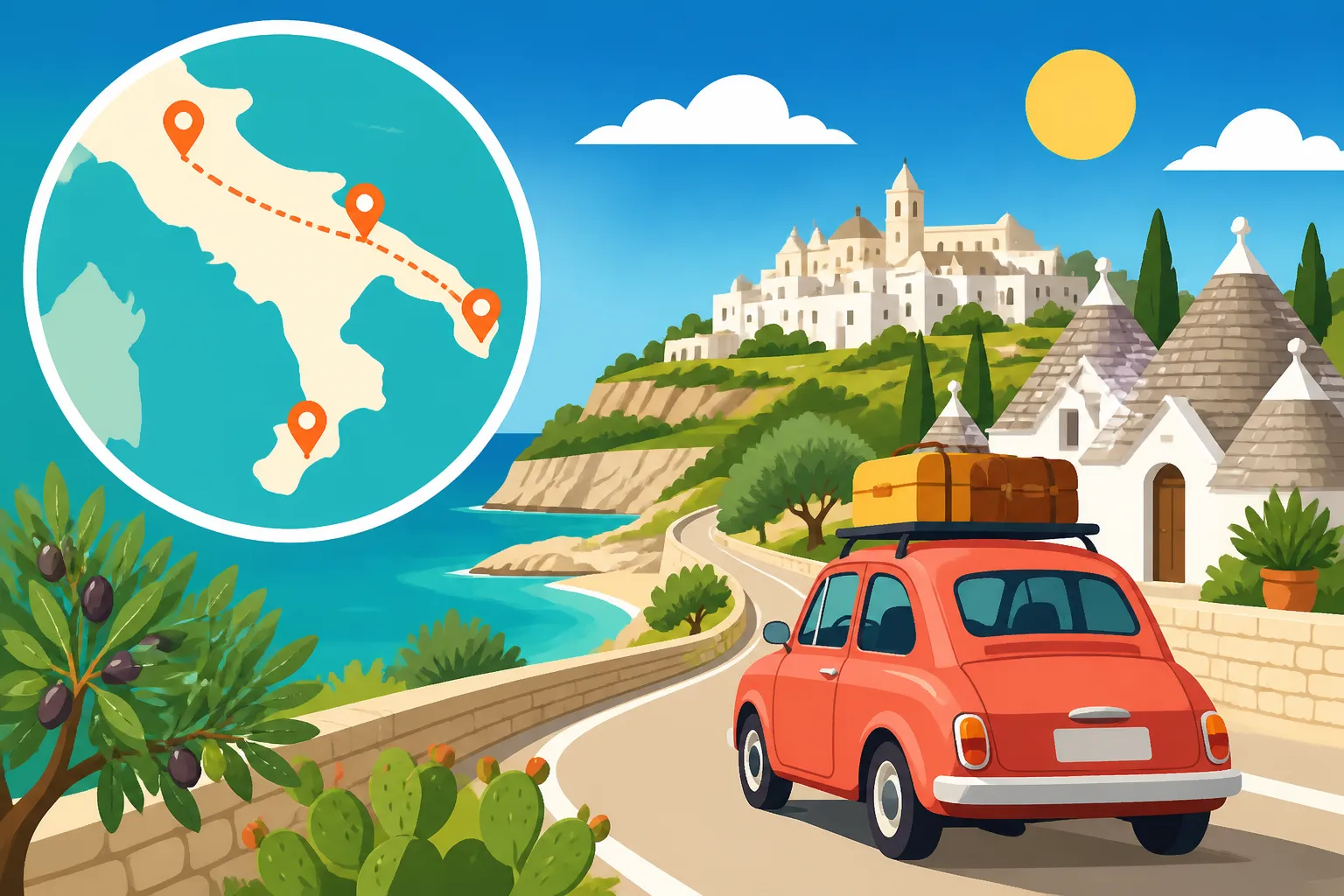
Once you’ve mastered the logistics, the real magic begins. Puglia isn't just one destination; it's a collection of distinct micro-regions. The Itria Valley is the heart of the "Trulli" country. These dry-stone huts with conical roofs look like something out of a fairy tale. Driving through this area is a slow-motion experience; the roads are lined with ancient stone walls and olive trees that have stood for over a thousand years. This is the place to slow down, pull over at a roadside stand to buy a bag of sun-dried tomatoes, and breathe in the scent of wild oregano.
For those looking to deep-dive into the history and architecture of these unique structures, our guide on Puglia: Trulli, Beaches, and Whitewashed Towns provides excellent context for what you'll see in places like Alberobello and Martina Franca. While Alberobello is the most famous, it can feel like a tourist theme park during the day. Having a car allows you to visit early in the morning or late at night when the crowds have vanished and the limestone glows under the moonlight. To enhance your experience, checking GetYourGuide for a local-led walking tour of the Trulli can provide insights into the history that you simply won't find on a plaque.
Exploring the Magic of the Itria Valley
Your base in the Itria Valley should ideally be a "Masseria"—a fortified farmhouse that has been converted into a luxury hotel or a rustic bed-and-breakfast. Using a site like Booking.com is the most reliable way to find these gems, as you can filter for properties that offer free parking, which is a non-negotiable for this trip. From your masseria, you can take day trips to the "White City" of Ostuni, which perches on a hill overlooking the sea, or Locorotondo, which is consistently voted one of the most beautiful villages in Italy.
In these towns, the focus is entirely on the slow life. Lunch is the main event. You will find that the food here is "Cucina Povera"—the cuisine of the poor—transformed into something extraordinary. Think fava bean purée with wild chicory, or massive burrata cheeses that are made fresh every morning. Because these towns are small, the best restaurants are often hidden down narrow side streets. To avoid the mediocre tourist menus in the main squares, consult our tips on How to Find Authentic Restaurants in Italy (Not Tourist Traps) to ensure every meal is a highlight of your trip.
Journeying Deep Into the Salento Peninsula
After a few days in the hills, it’s time to head south to the Salento. This is where the Adriatic and Ionian seas meet. The landscape flattens out, the air gets saltier, and the vibe becomes decidedly more Mediterranean. Lecce, often called the "Florence of the South," is your cultural anchor here. It is a city of exuberant Baroque architecture, carved out of soft local limestone. Driving into Lecce can be intimidating, so aim for the large parking areas near the Porta Napoli or the Carlo V Castle.
From Lecce, the coastline offers two distinct experiences. The eastern side, around Otranto, is rugged and dramatic, with cliffs dropping into deep blue water. The western side, near Gallipoli, features long stretches of white sand and shallow turquoise water that rivals the Maldives. Having a car means you can spend the morning at a rocky cove near the Grotta della Poesia and the sunset at a "Lido" (beach club) on the Ionian side. Puglia’s coastal culture is vibrant and social; to blend in, make sure you understand the nuances of Italian Wine, Coffee, and Aperitivo Culture before you order your first sunset Spritz.
| Region | Primary Vibe | Must-See Landmark | Driving Difficulty |
|---|---|---|---|
| Bari Coast | Urban & Traditional | Basilica di San Nicola | Moderate (Traffic) |
| Itria Valley | Fairy-tale & Rural | Alberobello Trulli | Easy (Narrow Roads) |
| Salento Coast | Caribbean & Beachy | Otranto Cathedral | Easy (Flat Plains) |
| Lecce & Interior | Baroque & Artistic | Piazza del Duomo | High (ZTL Zones) |
Practical Advice for Life on the Road in Puglia
The reality of a road trip in Puglia is that things will not always go according to plan. You might find a road closed for a village procession, or you might find yourself stuck behind a tractor carrying a mountain of grapes for three miles. The key is to embrace the "Piano, Piano" (slowly, slowly) philosophy. Don't overschedule your days. Two towns per day is the absolute maximum if you want to actually enjoy them. Remember that parking in popular spots like Polignano a Mare is a competitive sport in the summer. Arriving before 10:00 AM or after 7:00 PM will save you a lot of circling.
Safety is another consideration. While Puglia is generally very safe for tourists, car break-ins can happen in busy beach parking lots. Never leave your luggage visible in the car. If you are moving between hotels, try to check into your new accommodation and drop off your bags before heading to a beach or a crowded city center. For a broader look at staying secure during your travels, see Staying Safe in Italy: Common-Sense Tips for Travelers.
Eating and Sleeping Like a Local
One of the greatest joys of a Puglia road trip is the unplanned culinary discoveries. While dinner usually starts late—rarely before 8:00 PM—the ritual of the "Aperitivo" starts around 6:30 PM. This is the perfect time to find a bar in a village square and enjoy some local Taralli (crunchy bread rings) and olives. If you're traveling with kids or just want to stay healthy on the road, knowing the meal times is essential. Check out How to Eat Like a Local in Italy: Meal Structure and Timing to sync your appetite with the local clock.
When it comes to sleeping, consider staying slightly outside the main towns. Not only is parking easier, but the experience of waking up in an olive grove is far more authentic than staying in a modern apartment block. Many masserie offer dinner for their guests using ingredients grown on-site. This is often the best meal of the trip, paired with a heavy Negroamaro or Primitivo wine. For those interested in the viticulture of the region, we have a guide on Italian Wine Regions: A Beginner's Guide that highlights why Puglia's reds are gaining worldwide fame.
Dealing with the Summer Heat and Seasonality
If you plan your road trip for July or August, prepare for the heat. Temperatures often soar above 35°C (95°F), and the sun in the Salento is relentless. Ensure your rental car has functioning air conditioning—verify this before leaving the rental lot. This is also when most of Italy goes on holiday, meaning beaches will be packed and prices will double.
The "shoulder seasons" of May, June, September, and October are the absolute best times for a road trip. The weather is warm enough for swimming, but the towns are quiet enough that you can actually find a parking spot and a table at the best osteria without a reservation. During these months, the colors of the landscape—the red earth against the silver-green olive leaves and the white stones—are at their most vivid, making every mile of your drive a postcard-perfect moment.
Important Disclaimer About Travel in Italy
This guide provides travel information based on personal experiences and general regional knowledge. While we strive for accuracy, local regulations regarding traffic, ZTL zones, and car rental requirements in Italy change frequently. Always verify specific road rules, parking regulations, and entry requirements with official government sources or your rental agency before commencing your journey. The author is not responsible for any fines, accidents, or logistical issues encountered during your trip.