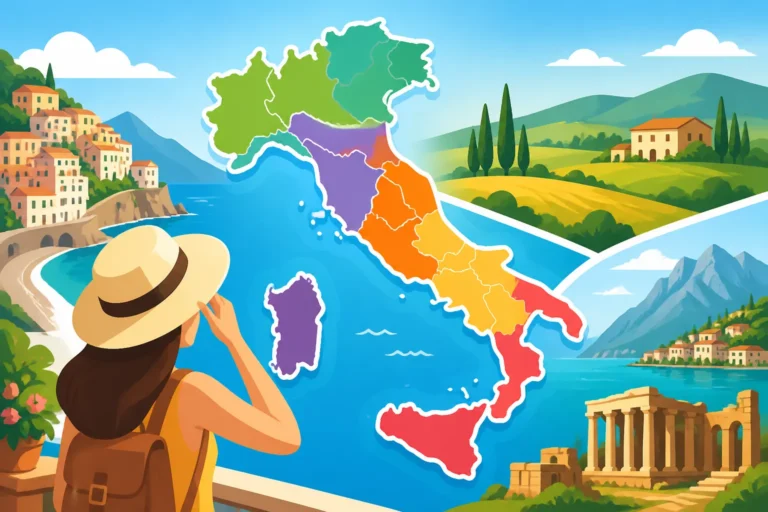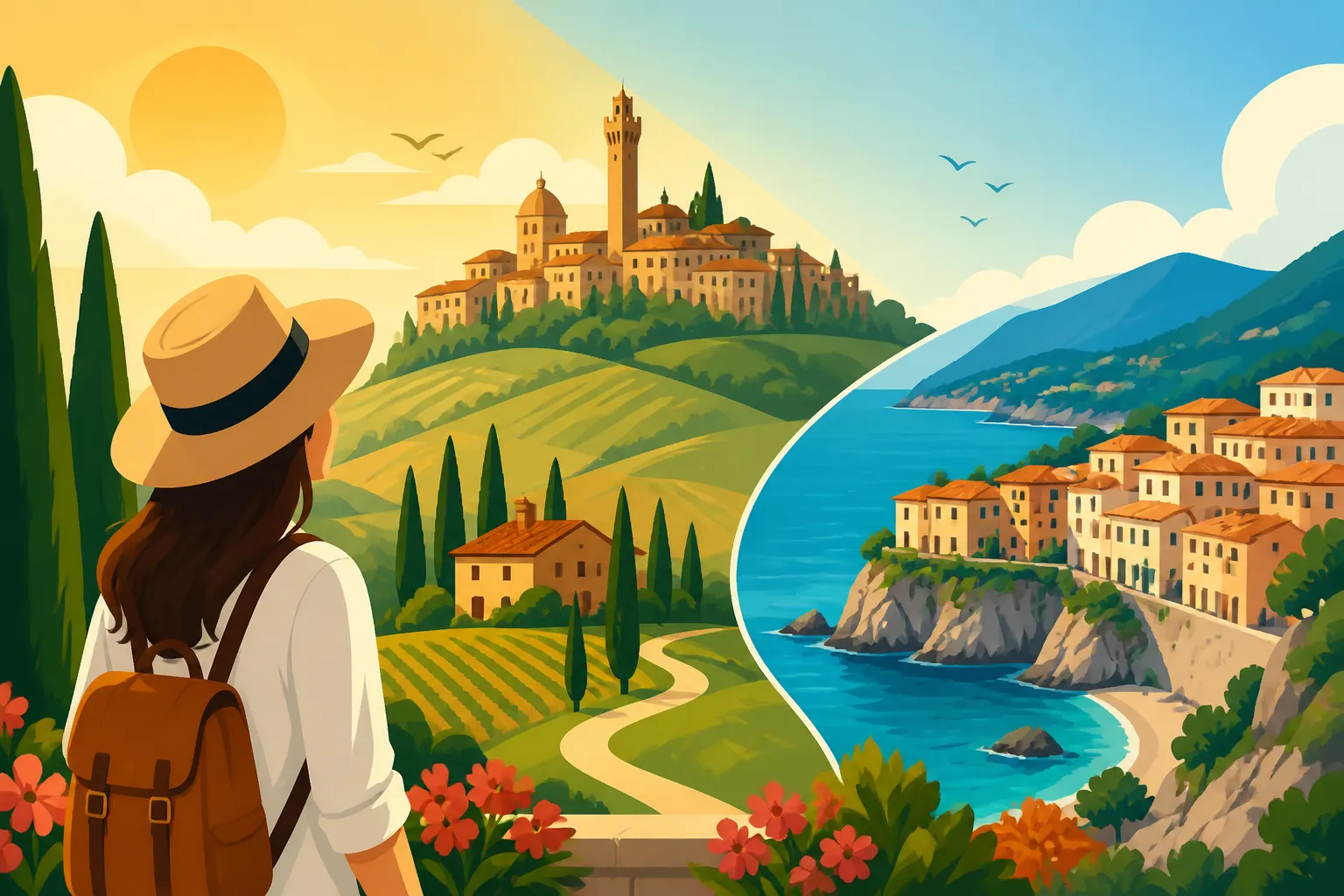
Tuscany for Travelers: Cities, Hills, and Coast
You’ve got a week or two in Tuscany and every search turns up postcard photos. None of them explain why the Siena bus beats the train, where a rental car becomes a liability, or how to choose between a hilltop farmhouse and a beach town. This guide covers the cities, the hill country, and the coast, and how to put them together.
Disclosure: This post may contain affiliate links. We may earn a commission at no extra cost to you if you make a purchase through these links. Read full disclosure.
Getting Your Bearings in Tuscany Before You Book Anything
Tuscany looks small on a map of Italy, and that is the first trap. On paper, Florence to the Maremma coast looks like a gentle drive. In reality you are on winding two-lane roads behind a tractor, then circling a hill town for twenty minutes looking for legal parking. I have lived in Italy long enough to have made every planning mistake in this region at least once. The most common one is trying to see “all of Tuscany” from a single base in four days. You can’t, and trying leaves you exhausted and resentful of a place that should feel unhurried.
How Tuscany Is Actually Laid Out
The region makes sense once you split it into three zones. The first is the city corridor. It runs roughly west to east along the Arno valley, from Pisa and Lucca through Florence and on toward Arezzo, with Siena sitting further south. These cities are linked by trains and buses, and you can visit them without ever touching a steering wheel.
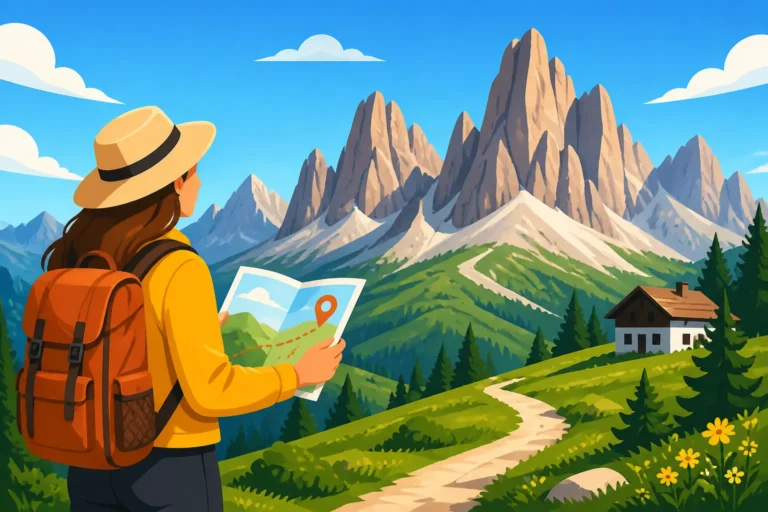
The second zone is the hill country. This is the Tuscany of the imagination: Chianti between Florence and Siena, the Val d’Orcia south of Siena, and the hilltop towns of San Gimignano, Volterra, Montepulciano, Pienza, and Montalcino. This is where public transport thins out badly. A bus might run twice a day, or only on school days, or not at all on Sundays.
The third zone is the coast and islands. That means the beach resorts of Versilia in the north and the working port of Livorno. Further south is the wilder Maremma with its nature park, lagoons, and the Monte Argentario promontory. Offshore sit Elba, Giglio, and the rest of the Tuscan Archipelago.
There are quieter pockets too. The Garfagnana and Lunigiana valleys in the northwest are chestnut forests and stone villages. The Casentino is east of Florence, and the tufa towns of Pitigliano, Sorano, and Sovana lie in the deep south. Most first-time visitors never reach them, and that is exactly why returning visitors love them.
Choosing When to Go
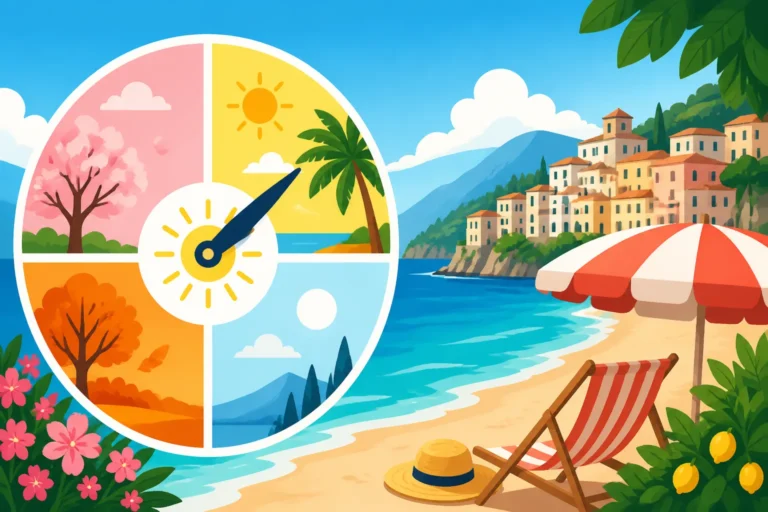
Tuscany shifts so much through the year that timing should shape your whole plan. Spring brings green hills, wildflowers, and comfortable walking weather, which suits hill-town hopping. Early summer is lovely but busy. July and August are hot in the cities and inland valleys. Florence in particular can feel like walking around inside a stone oven by mid-afternoon. In those months the coast comes alive, and Italians themselves head for the beach.
Autumn is my personal favourite. The grape harvest, the olive pressing, mushroom and chestnut festivals, and softer light make the hill country glow. Winter is quiet and grey, with some agriturismi and coastal hotels shut. On the plus side, the Uffizi and the Duomo area feel almost human, and a plate of ribollita tastes better when it’s cold outside. For a month-by-month breakdown, see What’s the Best Month to Visit Tuscany?
A quick hypothetical shows why timing matters. Imagine a couple who book Val d’Orcia for the first week of August because they picture golden wheat fields. They arrive to find the wheat harvested, the hills a bare brown, and the afternoon heat too fierce for walking. The same couple in late May would have seen green fields, poppies, and cool evenings. Neither season is “wrong”, but expectations matter enormously here.
How Long to Stay
As a rough rule, give Florence at least two full days, and three if you want museums and the Oltrarno neighbourhood. Add a day each for Siena and the Pisa-Lucca pairing. Then give the hill country at least two or three nights from a single rural base. The coast needs its own block of time, because it doesn’t combine well with Chianti on a short trip.
So a one-week trip realistically covers either Florence plus the hills, or Florence plus the cities, or one of those plus a beach finish. Two weeks lets you do all three zones without feeling rushed. For more detailed scenarios, see How Many Days Do You Need in Tuscany?
Tuscany’s Cities: Florence, Siena, Pisa, and Lucca
Every Tuscan city has its own personality, and old rivalries between them still flavour local conversation. A Sienese friend of mine still refers to the Florentines with a raised eyebrow, centuries after the wars ended. Treating these cities as interchangeable is the fastest way to miss what makes each one special.
Florence: Beyond the Postcard Queue
Florence is where most trips start, usually through Santa Maria Novella station, a short walk from the historic centre. The core sights are packed close together. There is the Duomo with Brunelleschi’s dome, Giotto’s bell tower, and the Baptistery. The Uffizi Gallery holds Botticelli’s Birth of Venus. The Accademia holds Michelangelo’s David, and the Ponte Vecchio is lined with jewellers.
The honest truth is that the area between the Duomo and the Ponte Vecchio can feel like an obstacle course of tour groups for much of the year. The fix is to timebox it. See the headline sights early in the morning or with pre-booked timed entry, then get out of the bottleneck.
Booking matters most for the Uffizi and the Accademia. Turning up and hoping can cost you hours in a queue in high season. Reserving a timed slot directly through the official channels, or taking a guided entry, saves enormous frustration. For the full rundown, see How to Get Into the Uffizi Without Long Queues. If you’d rather have context than just walk past paintings, the guided small-group visits sold on GetYourGuide are a reasonable shortcut. Compare what’s included and the group size before you pay, because “skip-the-line” doesn’t always mean a guide.
Once the essentials are done, cross the river into the Oltrarno. This is the Florence that people who live here actually love. It has artisan workshops around Santo Spirito, the Pitti Palace and Boboli Gardens, and evening drinks on the piazza. Climb up to Piazzale Michelangelo for the classic view. Then keep climbing a few minutes more to San Miniato al Monte, which is quieter, older, and often has the monks singing at vespers.
For food, skip the restaurants with laminated picture menus near the Duomo. Head instead to the Mercato Centrale area, or try a lampredotto (tripe) sandwich from a street kiosk if you’re brave. Save the bistecca alla fiorentina for a proper trattoria, and remember it is priced by weight and served rare.
Siena: The Shell-Shaped Piazza and the Palio
Siena feels medieval in a way Florence, which is fundamentally Renaissance, does not. The city is built across three ridges. Everything flows down into Piazza del Campo, a sloping, fan-shaped square where people sit directly on the warm brick to eat gelato and people-watch. The Torre del Mangia rises above the Palazzo Pubblico, and climbing it is worth the effort for the view over terracotta rooftops. The Duomo is astonishing, with its striped marble and inlaid floor, and its partially finished extension shows just how ambitious the Sienese once were.
The Palio is the horse race run around the Campo on 2 July and 16 August. It is not a show put on for tourists. It is a fierce, ancient competition between the city’s neighbourhoods, called contrade, and locals take it extremely seriously. If you’re in town around those dates you’ll see contrada flags, processions, and nightly dinners in the streets. You’ll also find that accommodation books out and the centre is packed. For how to watch it, see How to See the Palio di Siena Horse Race
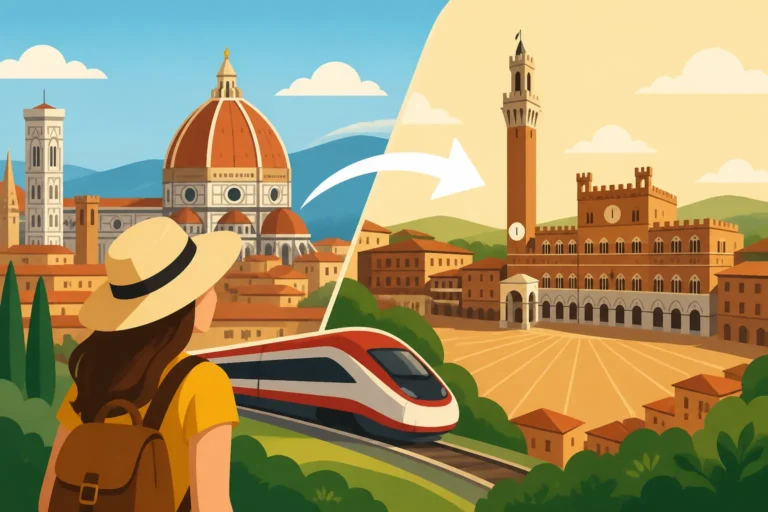
A practical point that catches people out: Siena’s train station sits in the valley below the old town. You either ride a series of escalators up through a shopping area or take a local bus. Long-distance buses from Florence often drop you closer to the historic centre. That’s one reason many people choose the bus over the train for this route. For the logistics, see How to Take a Day Trip to Siena From Florence
Pisa, Lucca, and the Eastern Cities
Pisa gets unfairly dismissed as “the tower and nothing else”. Yes, most visitors go straight to the Piazza dei Miracoli, take the obligatory photo propping up the Leaning Tower, and leave. The cathedral and baptistery on the same lawn are magnificent in their own right, though. Climbing the tower itself requires a timed ticket, so book ahead if that’s important to you. Walk back toward the Arno through the university quarter and you’ll find a lively, ordinary Italian city with students, bookshops, and cheap places to eat.
Lucca, a short train ride from Pisa, is the city many visitors end up wishing they’d given more time. Its Renaissance walls are fully intact and topped with a broad tree-lined path. Renting a bike and riding the whole circuit is one of the simplest pleasures in Tuscany. Inside the walls you’ll find the oval Piazza dell’Anfiteatro, built on the footprint of a Roman amphitheatre. There is also the Guinigi Tower with oak trees growing out of its top, and the birthplace of Puccini, whose music turns up in concerts around town. Lucca is flat, walkable, and calmer than Florence, which makes it a superb base for families. For the train connections between these two, see Florence to Pisa and Lucca: Regional Ticketing Explained
To the east, Arezzo is a handsome, prosperous city. It is best known for Piero della Francesca’s fresco cycle in the Basilica of San Francesco and for its large monthly antiques fair. It sees far fewer tourists than Siena. Further south, the hill town of Cortona looks out over the Val di Chiana. It has steep streets, Etruscan roots, and enough literary fame from expat memoirs to fill its cafés in summer. Pistoia and Prato, close to Florence, are worth a look for travellers who want an authentic, working Tuscan city with very few crowds.
| City | Best For | Ideal Time on the Ground | Car Needed? | Crowd Level in Peak Season |
|---|---|---|---|---|
| Florence | Renaissance art, architecture, food markets | Two to three days | No, a car is a burden | Very high in the centre |
| Siena | Medieval atmosphere, the Campo, the Palio | One day, ideally with an overnight | No | High midday, calmer in the evening |
| Pisa | Piazza dei Miracoli, student life | Half a day | No | High at the tower, low elsewhere |
| Lucca | Walls, cycling, relaxed old-town strolling | One full day or a base for several | No | Moderate |
| Arezzo | Frescoes, antiques fair, uncrowded streets | One day | No | Low to moderate |
| Cortona | Views, hill-town charm | Half a day to one day | Helpful | Moderate in summer |
The Hills: Chianti, Val d’Orcia, and the Hilltop Towns
This is the part of Tuscany people dream about, and the part where planning gets tricky. The hill country rewards slow travel and punishes a tight schedule. My advice, learned the hard way, is to pick one area, stay in it for several nights, and resist the urge to drive across half the region every day.
Chianti: Vineyards Between Florence and Siena
Chianti is the rolling stretch of vineyards, olive groves, and oak woods between Florence and Siena. The classic route is the SR222, known as the Chiantigiana. It winds south through Greve in Chianti, with its triangular arcaded piazza, and the butcher-famous village of Panzano. Beyond them lie Castellina in Chianti, Radda in Chianti, and Gaiole in Chianti. The black rooster symbol on a bottle marks Chianti Classico, the historic heart of the wine zone.
What surprises visitors is how spread out it all is. The villages are small, and the real draw is the wineries, called cantine, scattered down gravel roads in between. Many require a booking for tastings, and drop-in visits aren’t always possible. The obvious problem is that tasting wine and driving don’t mix. You have a few options. Hire a driver, or join an organised wine tour from Florence or Siena. Or base yourself at a winery estate that does tastings on site, or nominate a designated driver who sips and spits.
Picture a group of four friends who rent a car in Florence, plan five winery visits in one day, and realise by the second tasting that nobody can safely drive. Half-day small-group tours exist for precisely this reason. Several are listed on GetYourGuide, so compare the itineraries carefully: the number of wineries, whether lunch is included, and pickup location. For a broader introduction to visiting wineries anywhere in Italy, see Wine Tasting in Italy: Cantine and Enoteche
Val d’Orcia: Montalcino, Pienza, and Montepulciano
South of Siena, the Val d’Orcia is a UNESCO-listed landscape and the source of countless calendar photos. Think lone farmhouses on bare ridges and avenues of cypress trees. It has a cluster of towns, each with its own speciality:
- Montalcino: a fortress-topped town, home of Brunello di Montalcino, one of Italy’s most prestigious red wines.
- Pienza: a “perfect” Renaissance town redesigned by a pope, famous for pecorino sheep’s cheese and its panoramic walkway.
- Montepulciano: a long, steep hill town known for Vino Nobile di Montepulciano and atmospheric cellars carved into the rock.
- San Quirico d’Orcia: a quieter town with formal gardens and a good central location.
- Bagno Vignoni: a tiny village whose main square is a steaming thermal pool, with spa facilities nearby.
The Val d’Orcia is gloriously beautiful and deeply impractical without a car. Buses connect some towns, but schedules are built around commuters and schoolchildren, not visitors who want to watch the sunset from Pienza and then get home. If you can’t or won’t drive, consider a guided day trip from Siena or Florence. Or base yourself in one well-connected town and accept that you’ll see one or two places in depth rather than all of them.
Many people pair this area with neighbouring Umbria, since Montepulciano sits close to the regional border. For a drive-focused plan, see How to Plan a Road Trip Through Tuscany and Umbria
San Gimignano, Volterra, and Monteriggioni
West of the Chianti hills, San Gimignano is the “medieval Manhattan”. It is a walled town bristling with stone towers that wealthy families built to outdo one another. By day in high season it is overwhelmed by coach groups. By evening, once they leave, it becomes magical, which is a strong argument for staying overnight. Taste the local white wine, Vernaccia di San Gimignano, and do as everyone else does and queue for gelato in Piazza della Cisterna.
Getting there without a car is doable but involves a connection. The usual route is a bus or train to Poggibonsi, then a local bus up the hill. See How to Visit San Gimignano Without a Car for the step-by-step version.
Volterra, further west, is dramatic and a little stern, perched high above eroded clay hills. It has Etruscan foundations, a Roman theatre, and a long tradition of alabaster carving. Workshops still sell hand-carved pieces, and it’s worth buying from an artisan rather than a souvenir rack. It’s less polished than San Gimignano and, for many travellers, more memorable.
Monteriggioni is a tiny ring of walls and towers just north of Siena. It takes about an hour to see, but it makes a lovely stop between Florence and Siena if you are driving. You can also walk a section of the Via Francigena pilgrim route that passes right by it.
| Hill Area | Signature Experience | Public Transport Reality | Best Base |
|---|---|---|---|
| Chianti | Winery visits and village lunches | Limited buses along the main road | Greve, Radda, or a wine estate |
| Val d’Orcia | Iconic landscapes, Brunello and Vino Nobile | Sparse and commuter-oriented | Pienza, San Quirico, or Montepulciano |
| San Gimignano | Towers and evening atmosphere | Bus via Poggibonsi, workable | San Gimignano itself or nearby farm stays |
| Volterra | Etruscan history, alabaster | Limited, with connections | Volterra town |
| Monteriggioni | Walled hamlet, Via Francigena walks | Possible via Siena-area buses | Siena |
The Coast: Versilia, Maremma, and the Islands
International visitors often forget that Tuscany has a long, varied coastline. That is a gift, because summer in the hill towns can be stiflingly hot, and the sea is where Tuscans themselves go. The coast divides into very different experiences, and choosing the wrong one for your travel style is a common source of disappointment.
Versilia, Viareggio, and the Marble Mountains
The northern stretch of coast, Versilia, is the classic Italian beach holiday. It runs as a long ribbon of sand backed by the jagged Apuan Alps. Most of the beach is divided into stabilimenti balneari, private beach clubs with neat rows of umbrellas and sunloungers that you rent by the day. There are free public stretches as well, though they tend to be smaller.
Viareggio is the biggest town. It has Art Nouveau seafront buildings and one of Italy’s most famous Carnival celebrations, with enormous papier-mâché floats. Forte dei Marmi is the upscale end of the coast: boutiques, villas, and a well-heeled crowd. Pietrasanta, a little inland, is an artists’ town full of sculpture studios. That is no accident, because the marble quarries of Carrara are close by. A visit to the quarries, carved into mountains that look snow-capped from a distance, is unforgettable.
Versilia works best for travellers who want beach days with good restaurants, an evening passeggiata on the promenade, and easy train connections to Pisa and Lucca. It is not the place for wild, empty coves.
Maremma, Monte Argentario, and the Southern Coast
The southern Tuscan coast is the Maremma, a once-marshy area that was famously hard to farm. Today it is the region’s wild, open, and less polished corner. The Parco Regionale della Maremma, reached from Alberese, protects pine forests, unspoilt beaches, and hills. Walking trails lead down to beaches like Cala di Forno. You may also see the butteri, the Maremma’s horseback cattle herders, and the long-horned local cattle.
Further south, the Orbetello lagoon and the Monte Argentario promontory have clear water and small coves. Porto Santo Stefano and Porto Ercole are attractive harbour towns. Inland sits the hilltop village of Capalbio, and beyond it the remarkable tufa towns of Pitigliano, Sorano, and Sovana. Pitigliano seems to grow straight out of its volcanic cliff and has a long Jewish heritage, sometimes earning it the nickname “Little Jerusalem”. Nearby are the thermal waters of Saturnia, where the free cascades at the old mill are famous. They get crowded, so go very early or late.
Between Livorno and the Maremma lies the Etruscan Coast. Highlights here are Bolgheri, with its famous cypress-lined avenue and world-renowned wines, and the hill village of Castagneto Carducci. Livorno itself is a gritty, genuine port city with a rough-edged charm. It is home to cacciucco, a rich, tomato-based fish stew that locals will argue about endlessly.
The Maremma suits travellers who want nature, space, and a slower pace. The trade-off is that you almost certainly need a car, and distances between attractions are larger than they look.
Elba, Giglio, and the Tuscan Archipelago
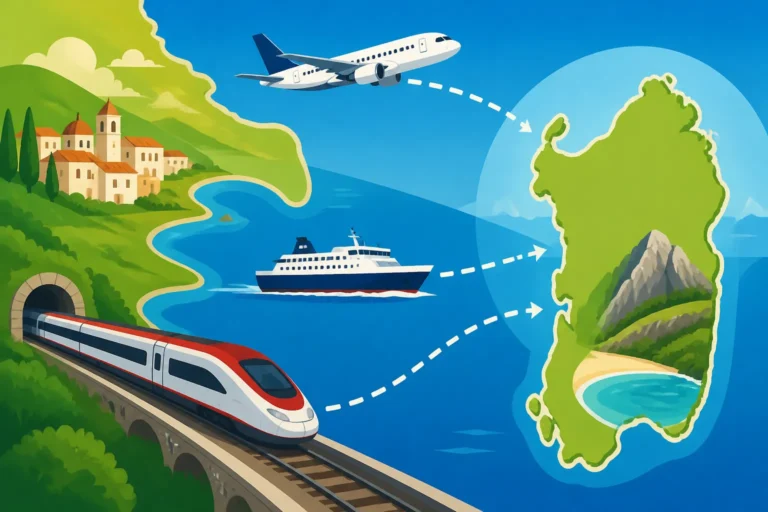
Off the coast lies the Tuscan Archipelago, much of it protected as a national park. Elba is the largest island, reached by ferry from Piombino to Portoferraio. Napoleon spent his first exile here, and you can visit his residences. Most people come for the beaches, the hiking, and the small fishing villages, though. The island is bigger than first-timers expect, with mountainous terrain, so having a car or scooter helps a great deal.
Giglio is reached from Porto Santo Stefano on Monte Argentario. It is smaller, rockier, and quieter, with clear water and steep terraced vineyards. Some of the other islands, such as Montecristo, Pianosa and Gorgona, are restricted, with access limited to certain visits.
Ferry schedules change by season, and summer weekends book up, especially if you are bringing a car. For crossings, see Reaching Elba and the Tuscan Archipelago: Piombino Crossings
| Coastal Area | Atmosphere | Beach Style | Car Needed? | Good For |
|---|---|---|---|---|
| Versilia | Lively, classic Italian resort | Long sandy beaches, organised beach clubs | No, trains run along the coast | Families, beach-and-dinner holidays |
| Livorno and Etruscan Coast | Working port, wine country inland | Mixed rocky and sandy stretches | Helpful | Food lovers, Bolgheri wine visits |
| Maremma | Wild, natural, spacious | Unspoilt beaches in protected areas | Yes | Nature, walking, quiet escapes |
| Monte Argentario | Harbour towns, clear water | Coves and small beaches | Yes | Swimming, boat days |
| Elba | Island holiday, varied terrain | Many beaches, sandy and rocky | Strongly recommended on the island | Week-long beach and hiking trips |
Getting Around Tuscany Without Losing Your Mind
Transport is where Tuscany trips are made or broken. The cities and the countryside need two completely different approaches. Most frustrations I hear from friends come from using the wrong tool for the wrong zone, like driving into Florence or trying to bus around the Val d’Orcia on a Sunday.
Trains and Buses Between Cities
Regional trains connect Florence with Pisa, Lucca, Arezzo, Prato, Pistoia, Viareggio, and the coast. They are frequent, simple, and you don’t need to book a specific train in advance. The key thing is that paper regional tickets must be validated before you board, using the machines on the platforms. Otherwise you risk a fine, even if you bought a ticket. Digital tickets bought through apps have their own activation rules, so read the details. See How to Validate a Regional Train Ticket in Italy for the exact process.
Buses fill the gaps where rail is inconvenient. The Florence to Siena route is the best-known example, and buses also reach Chianti villages, San Gimignano via Poggibonsi, and Volterra via connections. Rural services can be infrequent and are often reduced on Sundays and public holidays, so always check the return time before you set off. Comparing timetables across operators is tedious when you’re unfamiliar with them. A journey planner like Omio can help you see train and bus options side by side before you choose, though checking the operator’s own timetable on the day is still wise for rural routes.
Here’s how a typical car-free day trip from Florence to Siena works:
- Check bus and train times the evening before, noting the last return departure.
- Head to the departure point early, since morning buses can fill in high season.
- Buy your ticket before boarding, and validate it if it’s a paper regional ticket.
- On arrival, if you came by train, take the escalators or a local bus up to the historic centre.
- Walk to Piazza del Campo first to orient yourself, then explore outward.
- Head back with a buffer before your return departure, rather than racing the clock.
For a full menu of rail and bus excursions, see Best Day Trips From Florence Without a Car
Driving in Tuscany: ZTLs, Parking, and Rural Roads
A car is close to essential for the Val d’Orcia, the Maremma, the deeper Chianti estates, and much of Elba. It is a liability in the cities. Almost every Tuscan historic centre has a ZTL, a limited traffic zone. Driving into it without authorisation triggers a camera and a fine that may reach you by post weeks or months after you get home. Rental companies typically add their own administrative charge on top for passing your details to the authorities.
The signs are easy to miss when you’re following a satnav through unfamiliar streets. Hotels inside a ZTL can sometimes register your plate for access, but you must arrange this with them in advance. Never assume it happens automatically. For details on recognising and avoiding these zones, see What Is a ZTL in Italy and How to Avoid Fines
The smartest approach for most visitors is to combine the two modes:
- Explore Florence, Siena, Pisa, and Lucca by train and bus without a car.
- Pick up a rental car on the day you leave for the countryside, ideally from a location on the edge of the city rather than the centre.
- Use the car for your hill-country and coast stays, parking in the signed car parks outside town walls.
- Return the car before heading back into a city, or at the airport on departure.
Rural Tuscan roads have their own quirks. Many farmhouses are reached by unpaved white gravel roads called strade bianche, which are slow going. Hill-town streets are narrow, so a small car is far less stressful than a large one. Petrol stations in rural areas may close at lunchtime and on Sundays, leaving only self-service pumps. Some of those pumps can be fussy about foreign cards, so keep your tank comfortably full.
Choosing the Right Transport for Each Zone
| Travel Zone | Best Option | Second Option | Avoid |
|---|---|---|---|
| Florence, Pisa, Lucca, Arezzo | Regional trains | Buses | Driving into historic centres |
| Florence to Siena | Bus to the centre | Train plus escalator or bus | Driving into the Siena ZTL |
| Chianti | Car with a designated driver, or a guided tour | Limited bus routes | Unplanned tastings while driving |
| Val d’Orcia | Rental car | Guided day trip | Relying on Sunday buses |
| San Gimignano and Volterra | Bus with connection, or car | Guided day trip | Midday arrival in peak season if you dislike crowds |
| Versilia | Train along the coast | Car | Driving on summer weekends |
| Maremma and Argentario | Rental car | Limited buses to main towns | Trying it car-free on a short trip |
| Elba | Ferry plus car or scooter on the island | Island buses | Arriving without a ferry booking in peak season |
Where to Stay, What to Eat, and How to Plan Your Route
Once you know which zones you want to cover, accommodation becomes the backbone of the trip. In Tuscany, where you sleep shapes your days more than in almost any other Italian region. A badly placed base can turn every outing into a long drive or a complicated transfer.
City Hotels Versus Agriturismi and Farm Stays
In the cities, a central hotel, B&B, or apartment makes sense because everything is walkable. In Florence, the Oltrarno and Santa Croce areas offer more local atmosphere than the streets right beside the station. In Siena and Lucca, staying inside the walls is the whole point, so just check parking arrangements if you arrive by car.
In the countryside, the agriturismo is the classic Tuscan experience. These are working farms or estates that offer rooms or apartments, often with a pool, olive groves, and sometimes home-cooked dinners using their own produce. They range from rustic to frankly luxurious. The trade-offs are real, though. Many are reached by gravel roads, require a car, and are a drive from the nearest restaurant. Some also have minimum stays in high season. For the pros and cons, see How to Choose Between a Hotel and an Agriturismo in Italy
When I search for rural stays, I filter on Booking.com by location on the map rather than by town name. A place listed as “Montalcino” might be a long gravel drive from the town itself. Read recent reviews for mentions of the access road, air conditioning, and whether dinner is available on site. Once you’re tucked away in the hills, those three details make or break a summer stay.
For help matching a base to the kind of trip you want, see Where to Stay in Tuscany: Choosing a Base for Wine Country or the Coast
Eating and Drinking Your Way Through Tuscany
Tuscan cooking is rustic, seasonal, and built on simple ingredients done well. Bread is traditionally made without salt, a quirk that baffles many visitors until they taste it alongside salty cured meats and rich sauces. Look out for:
- Ribollita: a thick bread and vegetable soup, best in cooler months.
- Pappa al pomodoro: a tomato and bread soup, comfort food in summer.
- Pici: thick hand-rolled pasta from the Siena area, often served with garlic and tomato sauce or a meat ragù.
- Pappardelle al cinghiale: wide ribbons of pasta with wild boar sauce, a hill-country staple.
- Bistecca alla fiorentina: a huge, thick-cut steak served rare and priced by weight.
- Pecorino di Pienza: sheep’s cheese, sold fresh or aged, often with honey or local jams.
- Cacciucco: Livorno’s fish stew, served over garlic-rubbed bread.
- Cantucci and vin santo: almond biscuits dipped in sweet dessert wine to end a meal.
On wine, the essentials are Chianti Classico, Brunello di Montalcino, Vino Nobile di Montepulciano, Vernaccia di San Gimignano, and the coastal reds of Bolgheri. You don’t need to be an expert. In a local enoteca, simply ask for a recommendation to go with what you’re eating, and staff are usually happy to guide you.
Rhythms matter too. Lunch in rural areas is a proper affair, and many trattorias close between lunch and dinner. Dinner rarely starts as early as visitors from northern Europe or North America might expect. In smaller towns, if you arrive mid-afternoon hoping to eat, you may find only a bar serving panini.
Sample Routes for One and Two Weeks
Here are three realistic shapes for a Tuscany trip, each built around minimising wasted travel time:
| Trip Style | Days 1 to 3 | Days 4 to 6 | Days 7 Onward |
|---|---|---|---|
| One week, car-free | Florence, with an evening in the Oltrarno | Lucca as a base, with a half day in Pisa | Siena overnight, plus a day trip to San Gimignano |
| One week, hills focus | Florence on foot | Pick up a car, stay in Chianti for wineries | Move to the Val d’Orcia for Pienza, Montalcino, Montepulciano |
| Two weeks, all three zones | Florence, then Siena by bus | Car-based stay in Chianti or the Val d’Orcia | Coast in the Maremma or Versilia, with an optional ferry to Elba |
To build your own version, work through these steps in order:
- Decide which of the three zones you want, and be honest about whether you’ll drive.
- Fix the city portion first, since it needs no car and can be booked flexibly.
- Choose a single countryside base for at least three nights rather than moving every night.
- Check whether any festivals, such as the Palio, fall during your dates, and book early if so.
- Plan car pickup and drop-off around the cities, not inside them.
- Leave at least one unscheduled day, because Tuscany rewards wandering.
Common Tuscany Mistakes and How to Sidestep Them
After years of hosting friends and family, I’ve watched the same handful of mistakes trip people up. None of them are disasters, but each one quietly steals time and joy from a trip.
Overpacking the Itinerary
The single biggest mistake is cramming too much in. A visitor sees on a map that San Gimignano, Volterra, Siena, and Montalcino are all “nearby” and tries to fit them into one day. The result is hours in the car, parking hunts, a rushed lunch, and seeing each town only at its most crowded hour.
Tuscany is at its best in the gaps: the long lunch, the aperitivo with a view, the unplanned stop at a roadside farm shop selling olive oil. A good rule is one major town plus one smaller stop per day in the countryside, with afternoons left loose.
Ignoring Opening Hours and Seasonal Closures
Smaller museums, churches, and shops often close for a long lunch break, and many close on one fixed weekday. In the countryside, Sunday can be very quiet. Coastal hotels, beach clubs, and some agriturismi shut outside the warmer months. Island ferry timetables thin out considerably in winter.
Before committing to a plan, check the opening hours of anything you really care about. This is especially true of smaller frescoed churches, where opening times can depend on the parish. If you’re visiting in the shoulder seasons, confirm that the restaurant you’ve read about is actually open that week.
Underestimating Heat, Crowds, and Footwear
Summer heat in Florence and the inland valleys is serious. Plan sightseeing for the morning and late afternoon, carry water, and refill it at public fountains where the water is drinkable. Rest during the hottest part of the day, as locals do. Hill towns mean steep cobbled streets, so comfortable shoes with grip matter far more than fashionable sandals.
When dealing with crowds, timing beats everything. San Gimignano at sunset, the Campo after dinner, the Ponte Vecchio at seven in the morning: the same places feel entirely different outside the coach-tour hours. Staying overnight in a popular town, rather than day-tripping, is the single best crowd-beating tactic there is. Do it at least once and you’ll understand why so many visitors fall for Tuscany and keep coming back.
Disclaimer
This article is for general informational purposes only and does not constitute professional advice. Laws, prices and regulations vary by location and change over time. Consult a qualified professional for guidance on your specific situation.